Page 96 of 167

Driving while you tow
Do not drive faster than 72 km/h (45 mph) with any
weight on the trailer while towing on a hot day or in
hilly country.
Cruise control may shut off if you are towing on
long, steep grades.
When towing a trailer:
²Use 2 (Second) (if equipped) or 1 (First) when
towing up or down steep hills. This will eliminate
excessive downshifting and upshifting for
optimum fuel economy and transaxle cooling.
²Anticipate stops and brake gradually.
Servicing after towing
If you tow a trailer for long distances, your vehicle
will require more frequent service intervals. Refer to
theService Guidefor more information.
Trailer towing tips
²Practice turning, stopping and backing up in an
area before starting on a trip to get the feel of the
vehicle trailer combination. When turning, drive
slightly beyond the normal turning point so the
trailer wheels will clear curbs and other obstacles.
²Allow more room for stopping with a trailer
attached.
²The trailer tongue weight should be 10±15% of
the loaded trailer weight.
²After you have traveled 80 km (50 miles),
thoroughly check your hitch, electrical
connections and trailer wheel lug nuts.
²When stopped in traffic for long periods of time in
hot weather, place the gearshift in P (Park) and
increase idle speed. This aids engine cooling and
air conditioner efficiency.
²Vehicles with trailers should not be parked on a
grade. If you must park on a grade, place wheel
chocks under the trailer's wheels.
Driving
97
ProCarManuals.com
Page 139 of 167
²Be particularly careful if you are taking
ªAntabuseº or other forms of disulfiram for the
treatment of alcoholism. Breathing gasoline vapors
or skin contact could cause an adverse reaction.
Consult a physician immediately.
Choosing the right fuel
Use only UNLEADED FUEL. The use of leaded fuel
is prohibited by law and could damage your vehicle.
The damage may not be covered by your warranty.
Your vehicle was not designed to use fuel containing
manganese-based additives such as MMT.
Additionally, vehicles certified to California emission
standards (indicated on the underhood Vehicle
Emissions Control Information label) are designed to
operate on California reformulated gasolines. If
California reformulated gasoline is not available
when you refuel, your vehicle can be operated on
non-California fuels. However, even though your
engine will perform adequately on other gasolines,
the performance of the emission control devices and
systems may be adversely affected. Repair of
damage caused by using a fuel that your vehicle was
not designed for may not be covered by your
warranty.
Octane recommendations
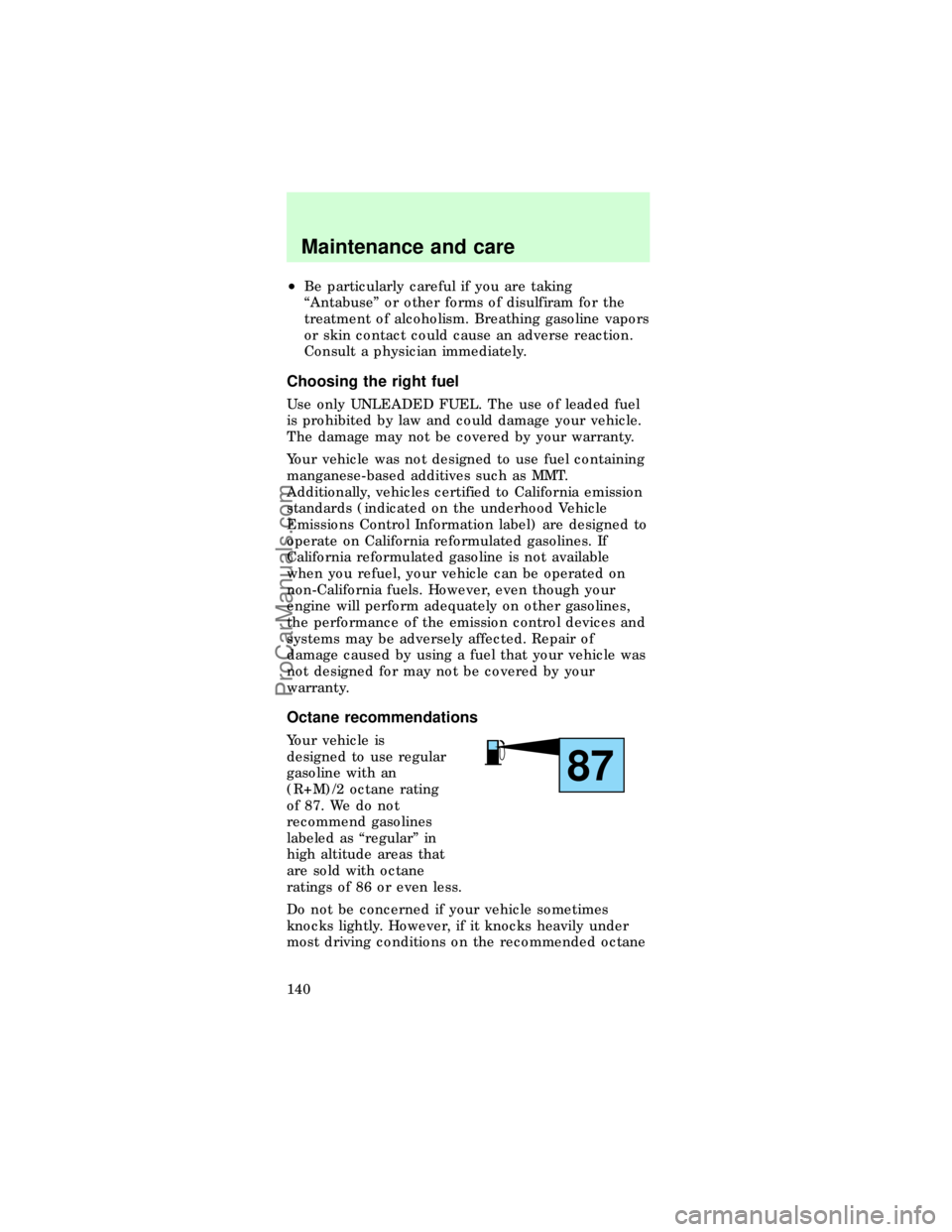
Your vehicle is
designed to use regular
gasoline with an
(R+M)/2 octane rating
of 87. We do not
recommend gasolines
labeled as ªregularº in
high altitude areas that
are sold with octane
ratings of 86 or even less.
Do not be concerned if your vehicle sometimes
knocks lightly. However, if it knocks heavily under
most driving conditions on the recommended octane
87
Maintenance and care
140
ProCarManuals.com
Page 140 of 167
fuel, see your dealer or a qualified service technician
to prevent any engine damage.
SHO engines
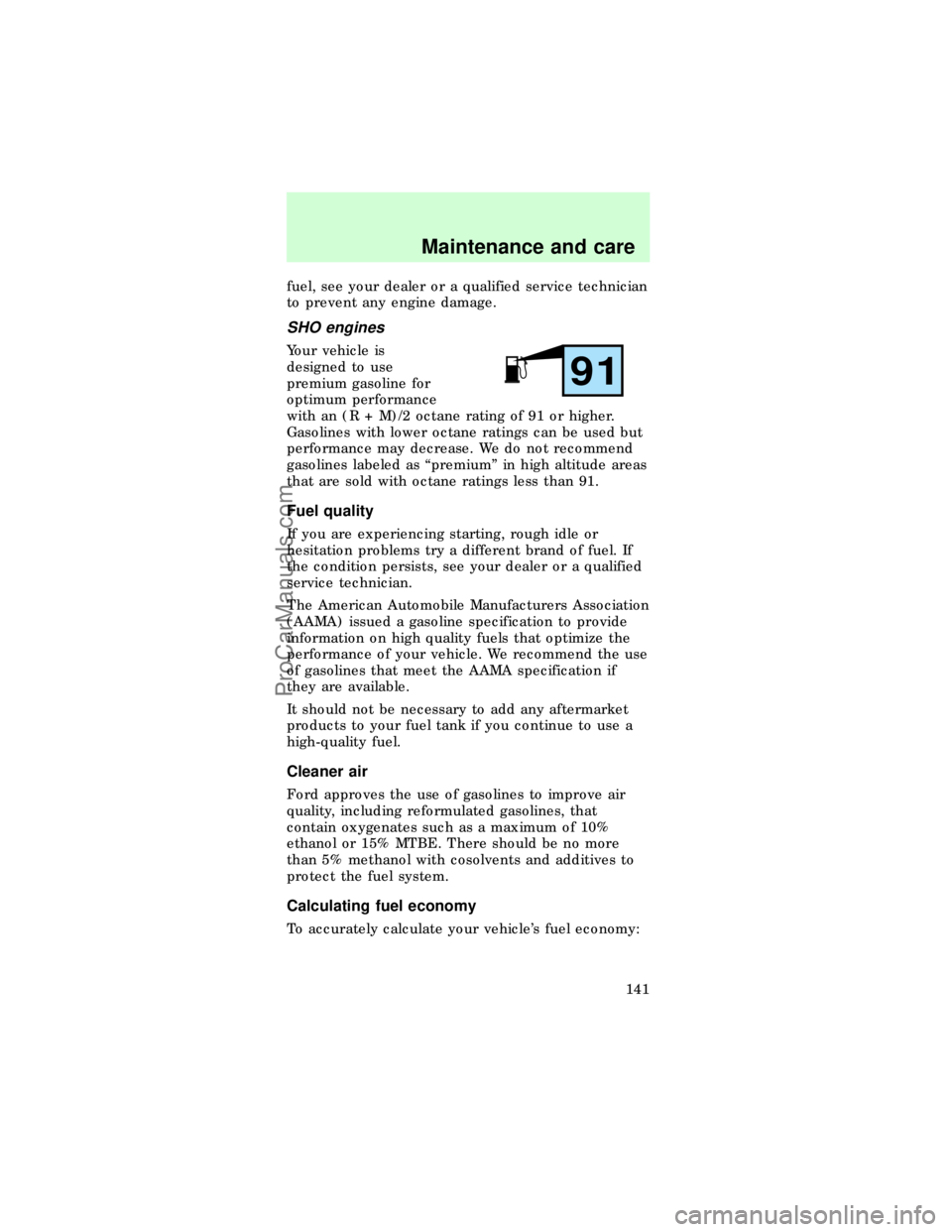
Your vehicle is
designed to use
premium gasoline for
optimum performance
with an (R + M)/2 octane rating of 91 or higher.
Gasolines with lower octane ratings can be used but
performance may decrease. We do not recommend
gasolines labeled as ªpremiumº in high altitude areas
that are sold with octane ratings less than 91.
Fuel quality
If you are experiencing starting, rough idle or
hesitation problems try a different brand of fuel. If
the condition persists, see your dealer or a qualified
service technician.
The American Automobile Manufacturers Association
(AAMA) issued a gasoline specification to provide
information on high quality fuels that optimize the
performance of your vehicle. We recommend the use
of gasolines that meet the AAMA specification if
they are available.
It should not be necessary to add any aftermarket
products to your fuel tank if you continue to use a
high-quality fuel.
Cleaner air
Ford approves the use of gasolines to improve air
quality, including reformulated gasolines, that
contain oxygenates such as a maximum of 10%
ethanol or 15% MTBE. There should be no more
than 5% methanol with cosolvents and additives to
protect the fuel system.
Calculating fuel economy
To accurately calculate your vehicle's fuel economy:
91
Maintenance and care
141
ProCarManuals.com
Page 151 of 167

exterior accessories, such as antennas, before
entering a car wash.
²After washing, apply the brakes several times to
dry them.
Waxing your vehicle
The best way to determine when the paintwork
needs waxing is by noting when water stops beading
on the surface. This could be every three or four
months, depending on operating conditions.
Use only carnauba or synthetic-based waxes.
Remove any bugs and tar before waxing vehicle. Use
cleaning fluid or alcohol with a clean cloth to
remove. Use tar remover to remove any tar spots.
Repairing paint chips
Minor scratches or paint damage from road debris
may be repaired with touch-up paint, paint repair
foil or aerosol paint spray from the Ford accessory
line. Observe the application instructions on the
products.
Remove particles such as bird droppings, tree sap,
insect remains, tar spots, road salt and industrial
fallout immediately.
Cleaning the wheels
Wash the wheels with
the same detergent you
use to clean the body
of your vehicle. Do not
use acid-based wheel cleaners, steel wool, fuel or
strong detergents. Never use abrasives that will
damage the finish of special wheel surfaces. Use a
tar remover to remove grease and tar.
Cleaning the engine
Engines are more efficient when they are clean
because grease and dirt buildup act as insulators and
keep the engine warmer than normal. Follow these
guidelines to clean your engine:
Maintenance and care
152
ProCarManuals.com