Page 88 of 219
the vehicle. Using the heater for
longer than three hours will not
harm the engine, so the heater can
be plugged in the night before
starting the vehicle.
To prevent electrical
shock, do not use your
heater with ungrounded
electrical systems or
two-pronged (cheater) adapters.
Guarding against exhaust
fumes
Although odorless and colorless,
carbon monoxide is present in
exhaust fumes. Take precautions
to avoid its dangerous effects.
If you ever smell exhaust
fumes of any kind inside
your vehicle, have your dealer
inspect and fix your vehicle
immediately. Do not drive if you
smell exhaust fumes. These
fumes are harmful and could kill
you.
Have the exhaust and body
ventilation systems checked
whenever:
²the vehicle is raised for service
²the sound of the exhaust system
changes
²the vehicle has been damaged in
a collision
com_guarding_exhaust.01
com_ventilation_info.01
Starting
89
Page 89 of 219
Important ventilating
information
If the engine is idling while the
vehicle is stopped in an open area
for long periods of time, open the
windows at least 2.5 cm (one
inch).
Adjust the heating or air
conditioning (if equipped) to bring
in fresh air.
Improve vehicle ventilation by
keeping all air inlet vents clear of
snow, leaves and other debris.
FLR
& DEF MAX
A/CFLOOR PANEL &
FLOOR
DEF OFF
PANEL
A/C
LU
AUTOLR
Starting
90
Page 92 of 219
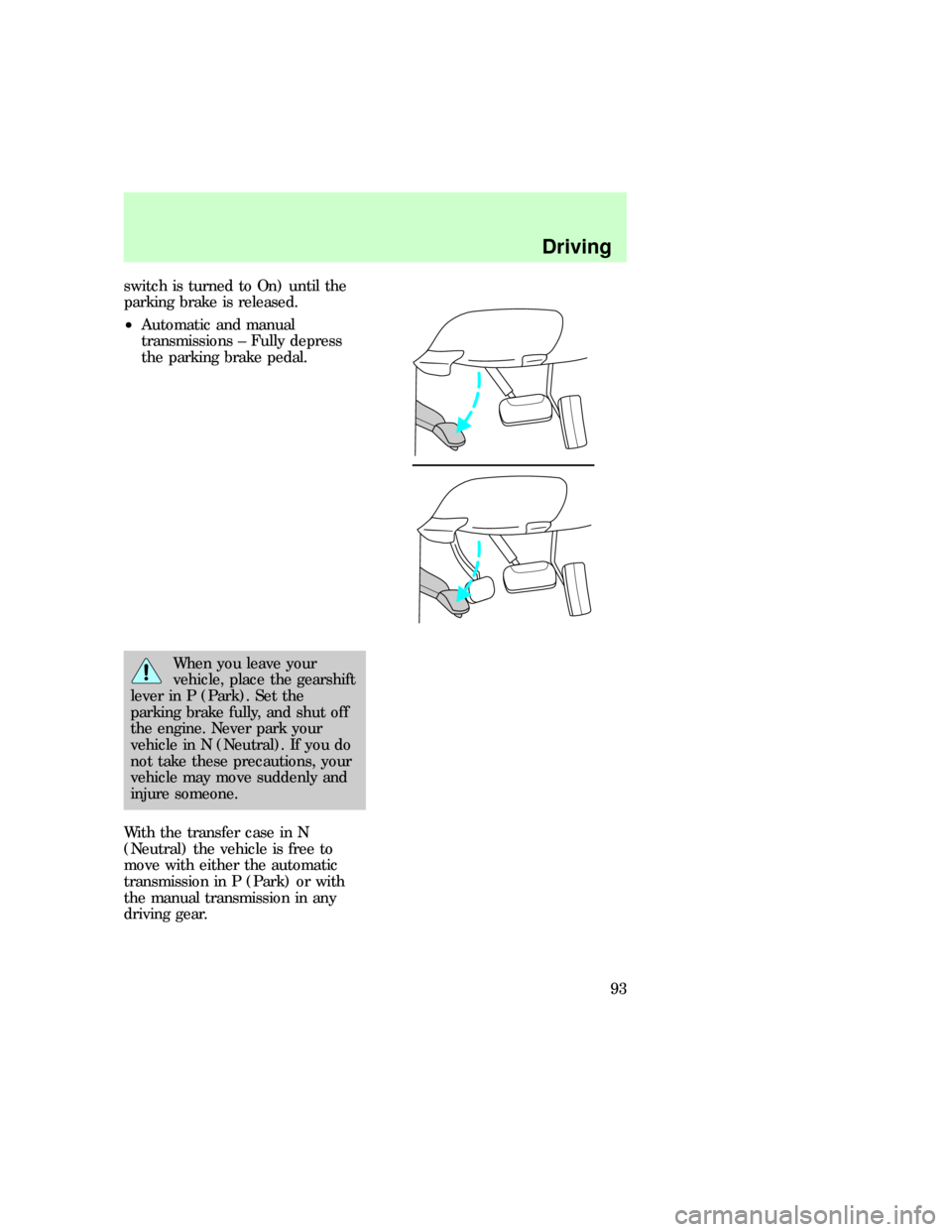
switch is turned to On) until the
parking brake is released.
²Automatic and manual
transmissions ± Fully depress
the parking brake pedal.
When you leave your
vehicle, place the gearshift
lever in P (Park). Set the
parking brake fully, and shut off
the engine. Never park your
vehicle in N (Neutral). If you do
not take these precautions, your
vehicle may move suddenly and
injure someone.
With the transfer case in N
(Neutral) the vehicle is free to
move with either the automatic
transmission in P (Park) or with
the manual transmission in any
driving gear.
Driving
93
Page 95 of 219
TRANSMISSION OPERATION
Automatic transmission
operation (if equipped)
Hold the brake pedal down
while you move the
gearshift lever from position to
position. If you do not hold the
brake pedal down, your vehicle
may move unexpectedly and
injure someone.
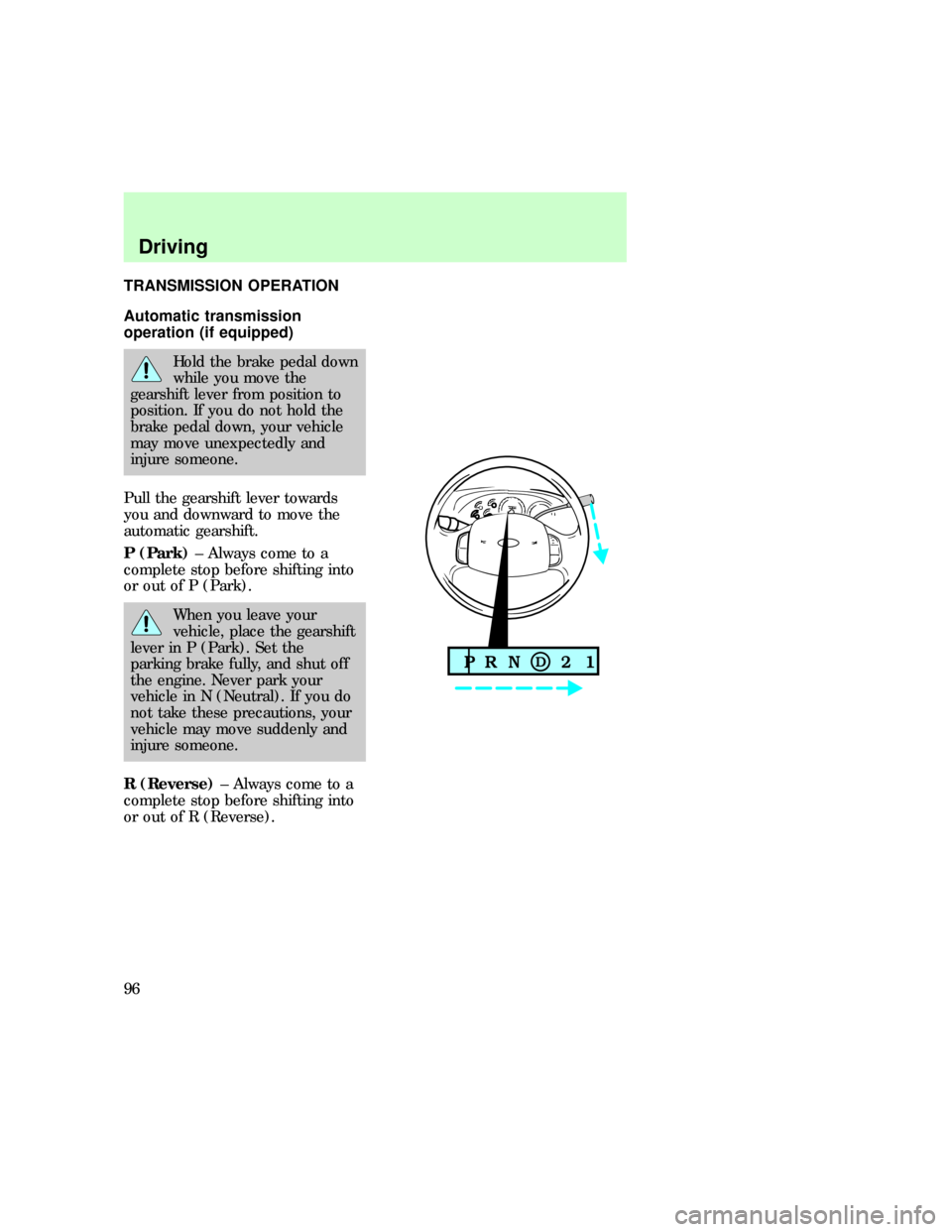
Pull the gearshift lever towards
you and downward to move the
automatic gearshift.
P (Park)± Always come to a
complete stop before shifting into
or out of P (Park).
When you leave your
vehicle, place the gearshift
lever in P (Park). Set the
parking brake fully, and shut off
the engine. Never park your
vehicle in N (Neutral). If you do
not take these precautions, your
vehicle may move suddenly and
injure someone.
R (Reverse)± Always come to a
complete stop before shifting into
or out of R (Reverse).
f12_automatic
Driving
96
Page 96 of 219

N (Neutral)± Vehicle is free to
roll.
D(Overdrive)± The normal
driving position for the best fuel
economy. Transmission operates in
gears one through four.
D(Overdrive) can be deactivated
by pressing the transmission
control switch on the end of the
gearshift lever. The transmission
control indicator light (TCIL)
(OFF) on the end of the gearshift
lever will remain off.
D (Drive)± Not shown on the
display. Activate by pressing the
transmission control switch on the
end of the gearshift lever. The
TCIL (OFF) will illuminate on the
gearshift lever. Transmission
operates in gears one through
three. D (Drive) provides more
engine braking than
D(Overdrive) and is useful
whenever driving conditions (i.e.,
city traffic, hilly terrain, etc.) cause
the transmission to excessively
shift between
D(Overdrive) and
D (Drive). Also deactivate
D(Overdrive) when:
²driving with a heavy load
²towing a trailer up or down
steep hills
²additional engine braking is
desired.
To return to
D(Overdrive)
mode, press the transmission
control switch. The TCIL (OFF)
will no longer be illuminated.
OVERDRIVE OFF
Driving
97
Page 97 of 219
Each time the vehicle is started,
the transmission will automatically
return to normal overdrive mode.
2 (Second)± Use 2 (Second) to
start-up on slippery roads or to
provide additional engine braking
on downgrades. Transmission
operates in first and second gears.
1 (Low)± Use 1 (Low) to provide
maximum engine braking on steep
downgrades. Upshifts can be made
by shifting to 2 (Second) or to
D(Overdrive). Selecting 1 (Low)
at higher speeds causes a shift to 2
(Second), and will shift to 1 (Low)
after vehicle decelerates to the
proper speed.
Brake-shift interlock
The brake-shift interlock feature
prevents you from shifting from P
(Park) unless the brake pedal is
depressed (with the ignition in the
On position). If you cannot move
the gearshift out of P (Park) with
the brake pedal depressed:
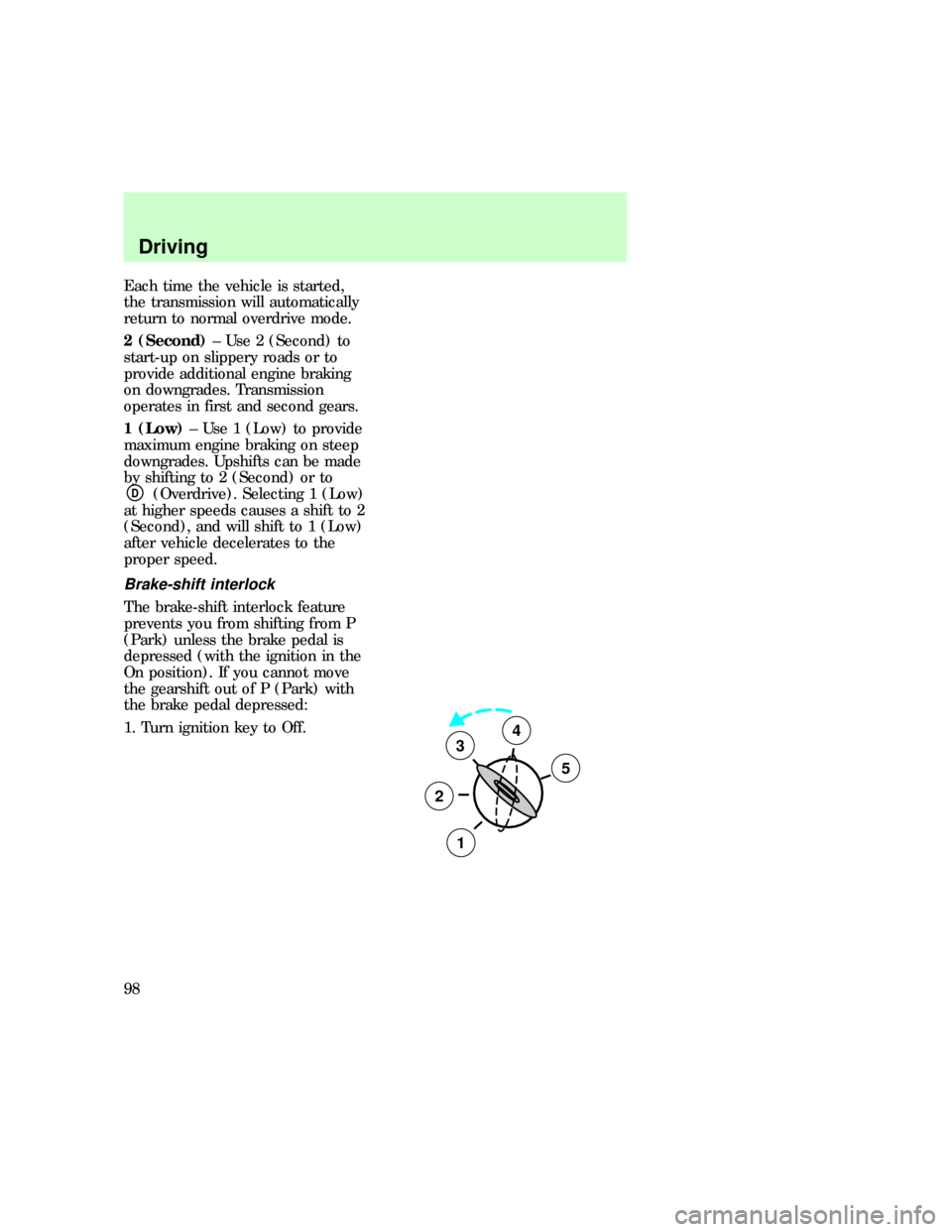
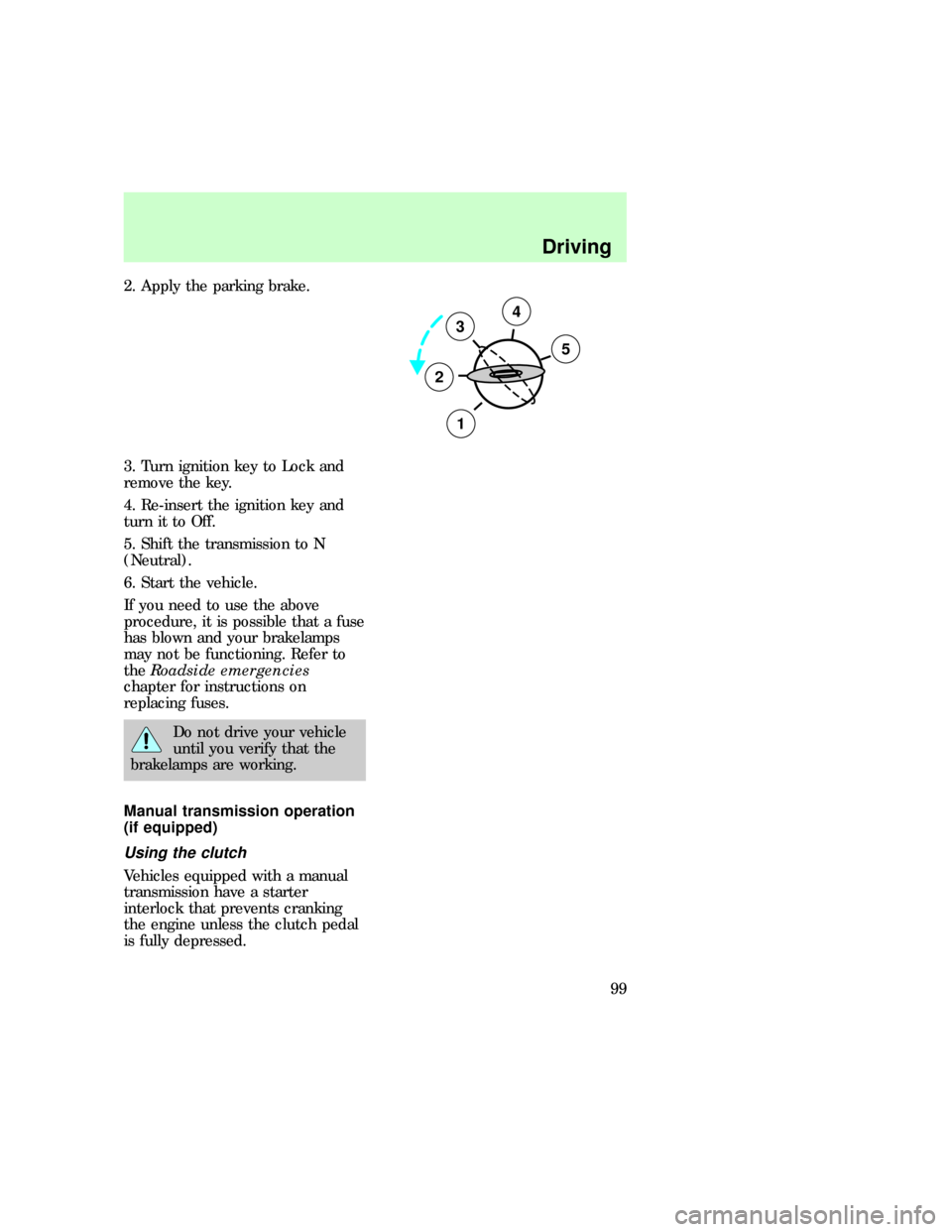
1. Turn ignition key to Off.
3
2
1
5
4
f12_brake_shift_interlock
Driving
98
Page 98 of 219
2. Apply the parking brake.
3. Turn ignition key to Lock and
remove the key.
4. Re-insert the ignition key and
turn it to Off.
5. Shift the transmission to N
(Neutral).
6. Start the vehicle.
If you need to use the above
procedure, it is possible that a fuse
has blown and your brakelamps
may not be functioning. Refer to
theRoadside emergencies
chapter for instructions on
replacing fuses.
Do not drive your vehicle
until you verify that the
brakelamps are working.
Manual transmission operation
(if equipped)
Using the clutch
Vehicles equipped with a manual
transmission have a starter
interlock that prevents cranking
the engine unless the clutch pedal
is fully depressed.
3
2
1
5
4
f12_manual
f12_using_clutch
Driving
99
Page 100 of 219
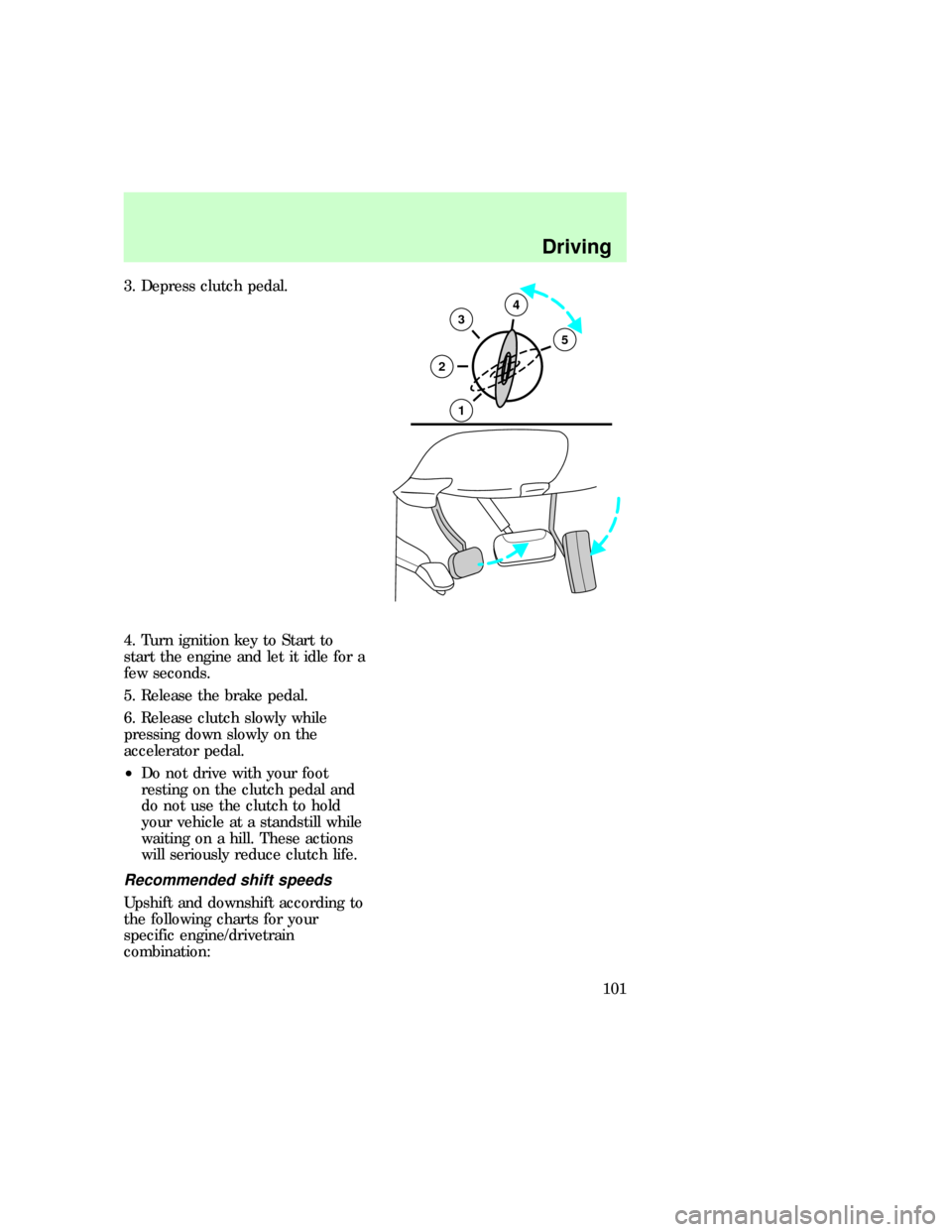
3. Depress clutch pedal.
4. Turn ignition key to Start to
start the engine and let it idle for a
few seconds.
5. Release the brake pedal.
6. Release clutch slowly while
pressing down slowly on the
accelerator pedal.
²Do not drive with your foot
resting on the clutch pedal and
do not use the clutch to hold
your vehicle at a standstill while
waiting on a hill. These actions
will seriously reduce clutch life.
Recommended shift speeds
Upshift and downshift according to
the following charts for your
specific engine/drivetrain
combination:
34
5
2
1
f12_shift_speeds
Driving
101