Page 142 of 219
Tire change procedure
1. Park on a level surface.
2. Activate the hazard flashers.
3. Set the parking brake.
4. Place the gearshift in P (Park)
(automatic transmission) or R
(Reverse) (manual transmission).
For 4WD vehicles equipped with
Lever-operated transfer case, make
sure that the lever is not in the N
(Neutral) position.
5. Block the diagonally opposite
wheel.
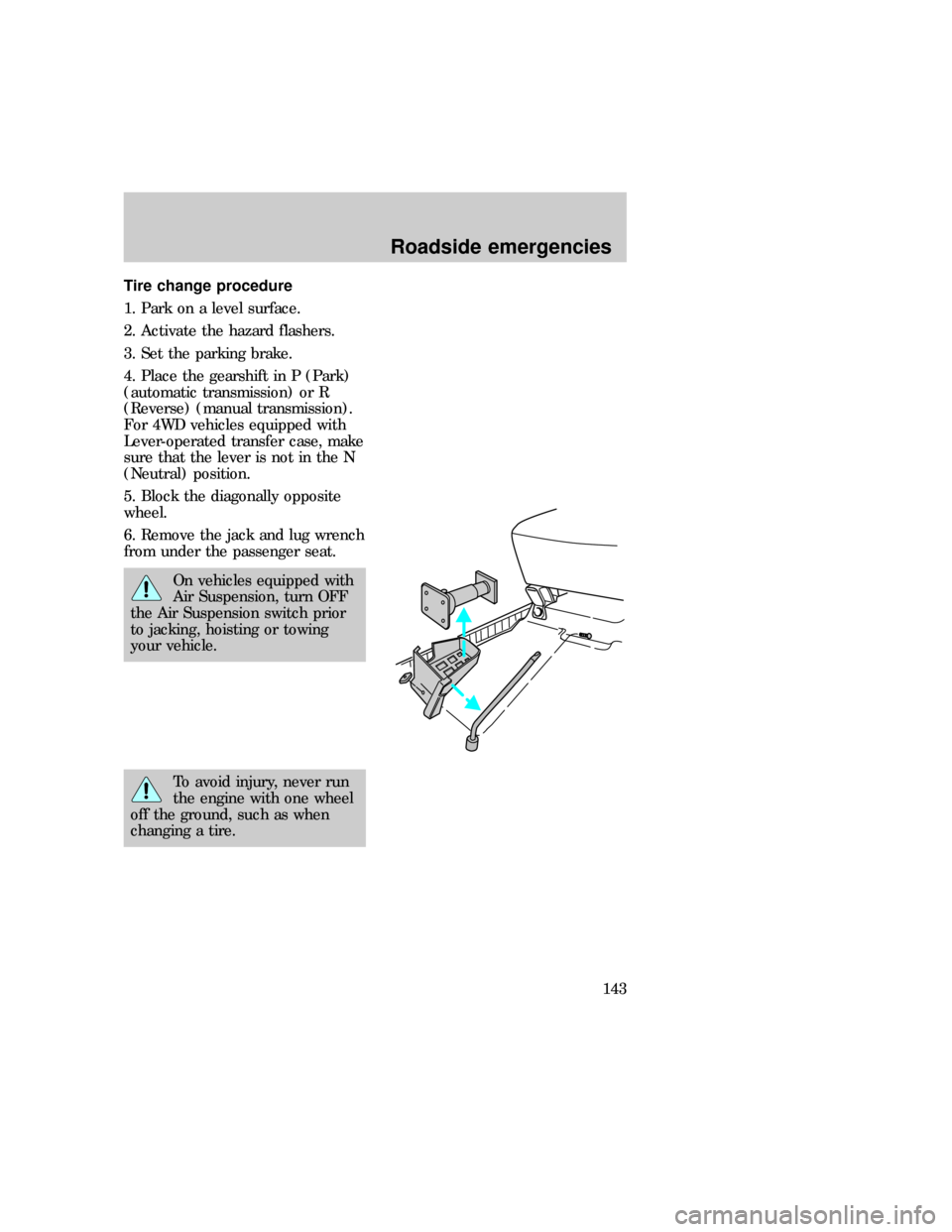
6. Remove the jack and lug wrench
from under the passenger seat.
On vehicles equipped with
Air Suspension, turn OFF
the Air Suspension switch prior
to jacking, hoisting or towing
your vehicle.
To avoid injury, never run
the engine with one wheel
off the ground, such as when
changing a tire.
f12_removing_spare
Roadside emergencies
143
Page 150 of 219
Ford recommends using one of the
above methods for towing.
Recreational towing (all wheels
on the ground)
Follow these guidelines for your
specific powertrain combination to
tow your vehicle with all four
wheels on the ground (such as
behind a recreational vehicle).
These guidelines are designed to
ensure that your transmission is
not damaged due to insufficient
lubrication.
2WD (manual and automatic
transmissions)
1. Place transmission in N
(Neutral).
f12_recreational_towing
Roadside emergencies
151
Page 151 of 219

2. Maximum speed is 56 km/h (35
mph).
3. Maximum distance is 80 km (50
miles).
If a distance of 80 km (50 miles)
or a speed of 56 km/h (35 mph)
must be exceeded, you must
disconnect the rear driveshaft.
With the rear driveshaft
disconnected, the maximum speed
is 88 km/h (55 mph) and there are
no mileage restrictions.
See your dealer for help with
disconnecting the driveshaft.
4WD ± Lever operated transfer
case (manual and automatic
transmissions)
1. Place transmission in P (Park).
2. Shift the transfer case to N
(Neutral).
3. Lockout the center disconnect
by capping off one of the front
axle vacuum motor lines. See your
Ford dealer for assistance.
4. Vehicle speed should not exceed
88 km/h (55 mph) and there are
no mileage restrictions.
4WD ± Electronic shift transfer
case
1. Place transmission in N
(Neutral).
2. Shift the transfer case to 2H
(2WD high).
3. Lockout the center disconnect
by capping off one of the front
axle vacuum motor lines. See your
dealer for assistance.
Roadside emergencies
152
Page 154 of 219

could get caught in moving
parts. Take precautions with
long hair.
²Do not work on a vehicle with
the engine running in an
enclosed space, unless you are
sure you have enough
ventilation.
²Keep all lit cigarettes, open
flames and other lit material
away from the battery and all
fuel related parts.
If you disconnect the battery, the
engine must ªrelearnº its idle
conditions before your vehicle will
drive properly, as explained in
Batteryin this chapter.
Working with the engine off
²Automatic transmission
1. Set the parking brake fully and
ensure the gearshift is securely
latched in P (Park).
2. Turn off the engine and remove
the key.
3. Block the wheels to prevent the
vehicle from moving unexpectedly.
²Manual transmission
1. Set the parking brake, depress
the clutch and place the gearshift
in 1 (First).
2. Turn off the engine and remove
the key.
3. Block the wheels to prevent the
vehicle from moving unexpectedly.
Working with the engine on
²Automatic transmission
com_working_off.02
com_working_on.02
Maintenance and care
155
Page 157 of 219
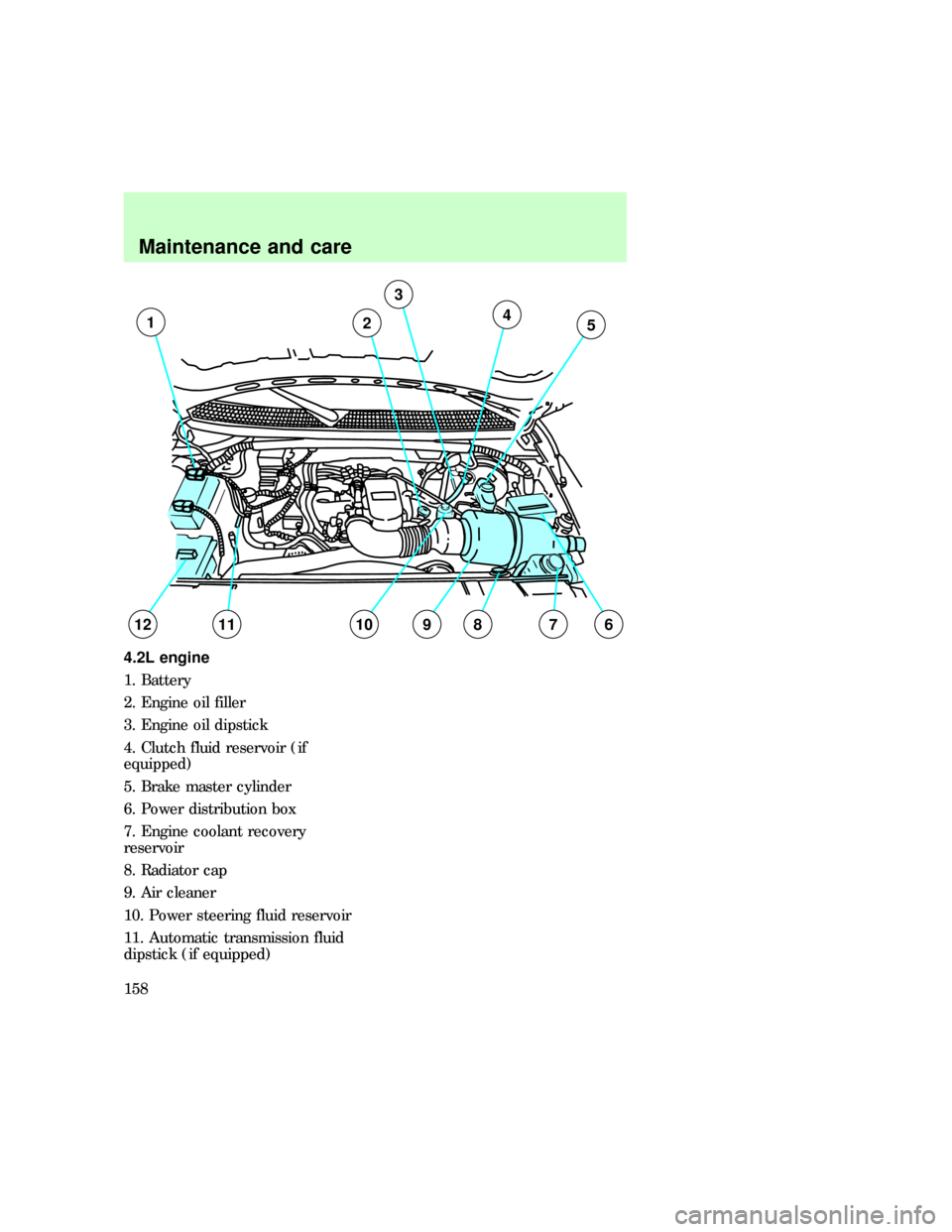
4.2L engine
1. Battery
2. Engine oil filler
3. Engine oil dipstick
4. Clutch fluid reservoir (if
equipped)
5. Brake master cylinder
6. Power distribution box
7. Engine coolant recovery
reservoir
8. Radiator cap
9. Air cleaner
10. Power steering fluid reservoir
11. Automatic transmission fluid
dipstick (if equipped)
1
1289761110
2
3
45
Maintenance and care
158
Page 158 of 219
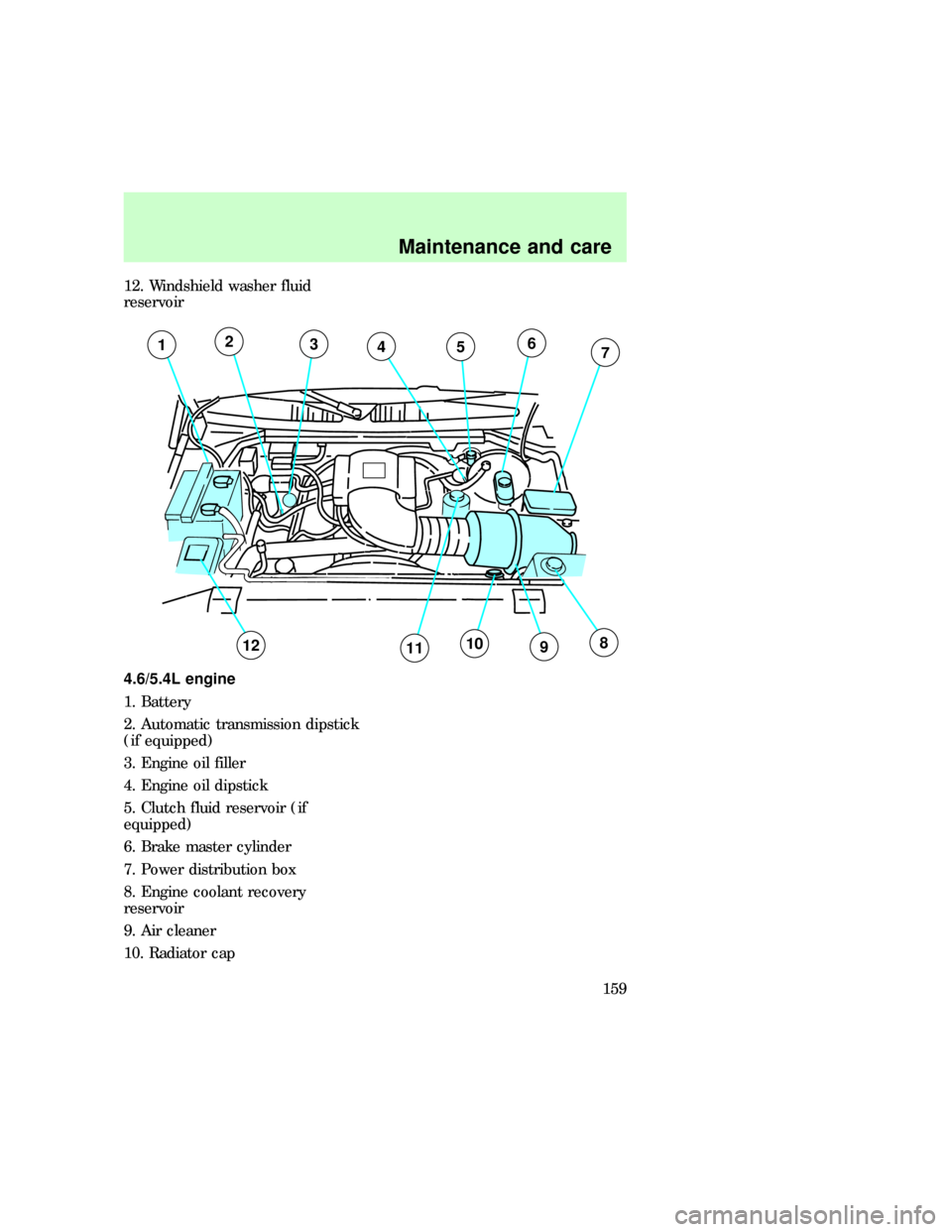
12. Windshield washer fluid
reservoir
4.6/5.4L engine
1. Battery
2. Automatic transmission dipstick
(if equipped)
3. Engine oil filler
4. Engine oil dipstick
5. Clutch fluid reservoir (if
equipped)
6. Brake master cylinder
7. Power distribution box
8. Engine coolant recovery
reservoir
9. Air cleaner
10. Radiator cap
10118129
1245673
f12_4.6L_5.4L_engine
Maintenance and care
159
Page 160 of 219

Oil filters
Ford production and aftermarket
(Motorcraft) oil filters are designed
for added engine protection and
long life. If a replacement oil filter
is used that does not meet Ford
material and design specifications,
startup engine noises or knock
may be experienced. It is
recommended that you use the
appropriate Motorcraft oil filter (or
another brand meeting Ford
specifications) for your engine
application.
Checking engine oil
Check the engine oil each time you
fuel your vehicle.
Check the engine oil level more
frequently if the vehicle is carrying
a heavy load, towing a trailer,
idling for extended periods (like
police, taxi or shuttle service
vehicles) or driven at high speeds
for extended periods of time.
To check the oil:
1. Make sure the vehicle is on level
ground. If the engine is warm, turn
the engine off and wait a few
minutes for the oil to drain into
the oil pan.
2. Set the parking brake and
ensure the gearshift is latched in P
(Park) (automatic transmission) or
1 (First) (manual transmission).
3. Open the hood. Protect yourself
from engine heat.
4. Locate and carefully remove the
f12_checking_oil
Maintenance and care
161
Page 172 of 219
2. When the engine coolant
temperature gauge reaches the
normal zone, turn the engine off.
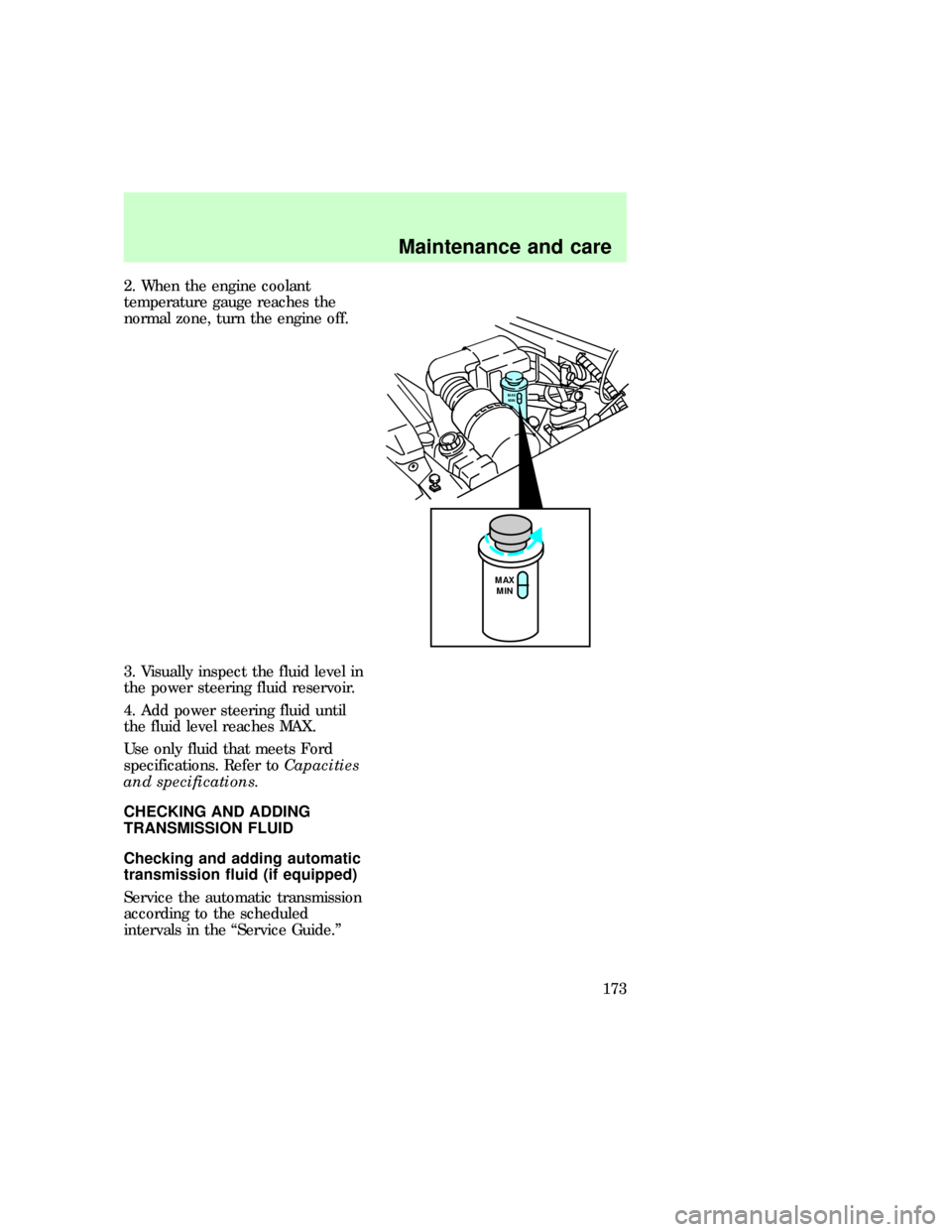
3. Visually inspect the fluid level in
the power steering fluid reservoir.
4. Add power steering fluid until
the fluid level reaches MAX.
Use only fluid that meets Ford
specifications. Refer toCapacities
and specifications.
CHECKING AND ADDING
TRANSMISSION FLUID
Checking and adding automatic
transmission fluid (if equipped)
Service the automatic transmission
according to the scheduled
intervals in the ªService Guide.º
MAX
MIN
MAX
MIN
f12_trans_fluid
f12_checking_adding_autotrans
Maintenance and care
173