Page 121 of 219
Trailer towing table (F-250 4x2 manual transmission)
4.6L 3.31 3,261 (7,200) 1,133 (2,500) 5.52 (60)
4.6L 3.73 3,533 (7,800) 1,406 (3,100) 5.52 (60)
Trailer towing table (F-250 4x4 automatic transmission)
Engine Rear axle
ratioMaximum
GCWR kg (lb)Maximum
trailer weight
kg (lb)Maximum
frontal area of
trailer m
2(ft2)
Regular Cab F-250
4.6L 3.31 4,756 (10,500) 2,449
(5,400)5.52 (60)
4.6L 3.73 5,436 (12,000) 3,129
(6,900)5.52 (60)
5.4L 3.31 5,436 (12,000) 3,084
(6,800)5.52 (60)
5.4L 3.73 6,115 (13,500) 3,764
(8,300)5.52 (60)
SuperCab F-250
4.6L 3.31 4,756 (10,500) 2,449
(5,400)5.52 (60)
4.6L 3.73 5,436 (12,000) 3,129
(6,900)5.52 (60)
5.4L 3.31 5,436 (12,000) 3,084
(6,800)5.52 (60)
5.4L 3.73 6,115 (13,500) 3,764
(8,300)5.52 (60)
Trailer towing table (F-250 4x4 manual transmission)
Engine Rear axle
ratioMaximum
GCWR kg (lb)Maximum
trailer weight
kg (lb)Maximum
frontal area of
trailer m
2(ft2)
Regular Cab F-250
4.6L 3.31 3,261 (7,200) 952 (2,100) 5.52 (60)
Driving
122
Page 122 of 219
Trailer towing table (F-250 4x4 manual transmission)
4.6L 3.73 3,533 (7,800) 1,224
(2,700)5.52 (60)
SuperCab F-250
4.6L 3.31 3,261 (7,200) 952 (2,100) 5.52 (60)
4.6L 3.73 3,533 (7,800) 1,224
(2,700)5.52 (60)
TOWING A TRAILER
Your vehicle may tow a class I, II
or III trailer provided the
maximum trailer weight is less
than or equal to the maximum
trailer weight listed for your engine
and rear axle ratio on the above
charts.
Your vehicle's load capacity is
designated by weight, not by
volume, so you cannot necessarily
use all available space when
loading a vehicle.
Towing a trailer places an
additional load on your vehicle's
engine, transmission, axle, brakes,
tires and suspension. Inspect these
components carefully after any
towing operation.
f12_trailer
Driving
123
Page 123 of 219
Do not exceed the GVWR
or the GAWR specified on
the Safety Compliance
Certification Label.
Towing trailers beyond the
maximum recommended
gross trailer weight could result
in engine damage,
transmission/axle damage,
structural damage, loss of
control, and personal injury.
Preparing to tow
Use the proper equipment for
towing a trailer, and make sure it
is properly attached to your
vehicle. See your dealer or a
reliable trailer dealer if you require
assistance.
Hitches
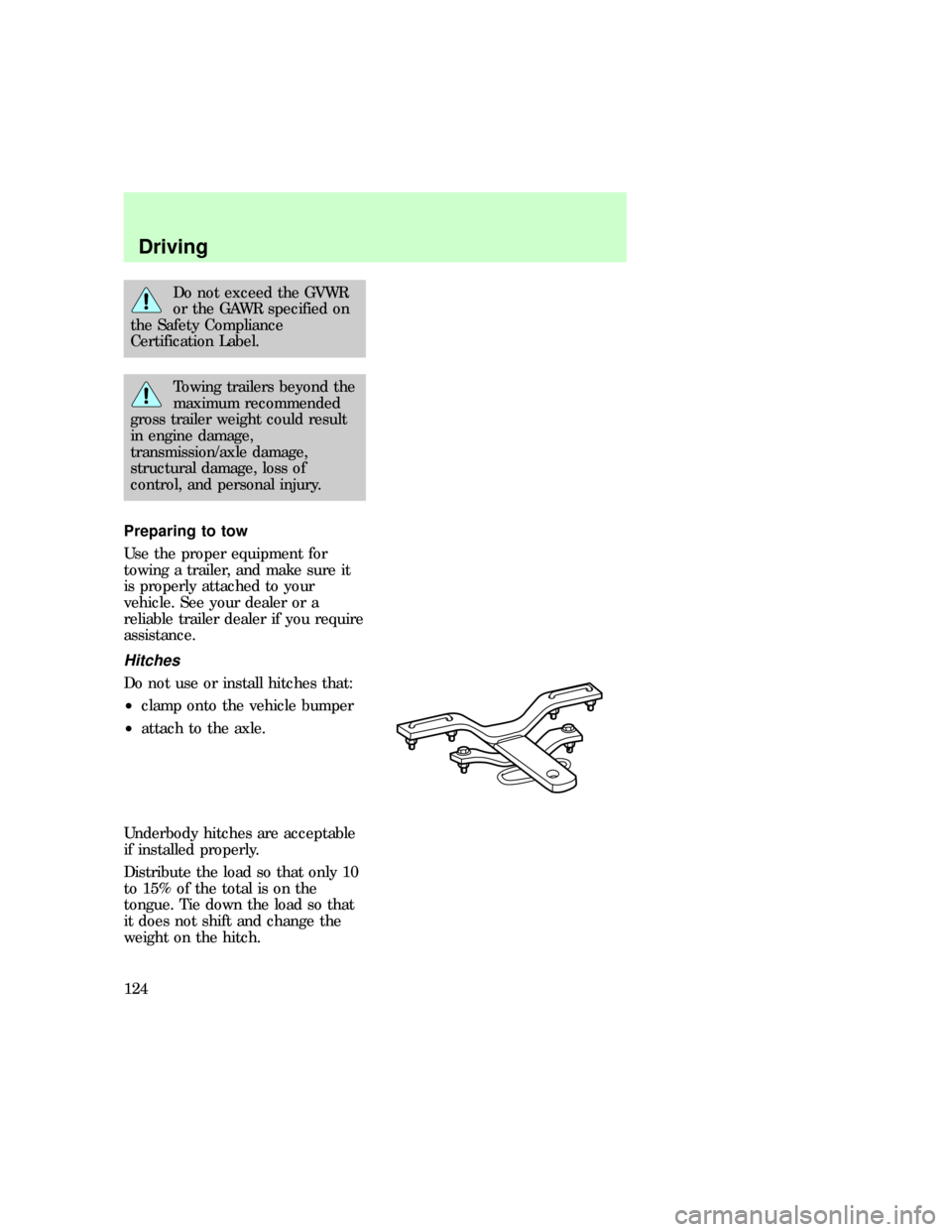
Do not use or install hitches that:
²clamp onto the vehicle bumper
²attach to the axle.
Underbody hitches are acceptable
if installed properly.
Distribute the load so that only 10
to 15% of the total is on the
tongue. Tie down the load so that
it does not shift and change the
weight on the hitch.
f12_preparing_tow
f12_hitches
Driving
124
Page 125 of 219
If it is necessary to relocate the
trailer hitch ball position, a
frame-mounted trailer hitch must
be installed.
Safety chains
Always use safety chains between
your vehicle and trailer. Cross
chains under the trailer tongue and
allow slack for turning corners.
Connect safety chains to the
vehicle frame or hook retainers.
Never attach chains to the bumper.
Trailer brakes
Trailer brakes are required on
most towed vehicles weighing over
680 kg (1,500 lbs).
Do not connect a trailer's
hydraulic brake system
directly to your vehicle's brake
system. Your vehicle may not
have enough braking power and
your chances of having a
collision greatly increase.
Trailer lamps
Trailer lamps are required on most
towed vehicles. Make sure your
trailer lamps conform to Federal
and local regulations. See your
dealer or trailer rental agency for
the proper instructions and
equipment for hooking up trailer
lamps.
Driving while you tow
Do not drive faster than 88 km/h
(55 mph) while towing a trailer. Do
not drive faster than 72 km/h (45
f12_safety_chains
f12_trailer_brakes
f12_trailer_lamps
f12_driving_towing
Driving
126
Page 126 of 219
mph) with a trailer while towing in
hilly country or on hot days.
Speed control may shut off if you
are towing on very long, steep
grades.
When towing a trailer
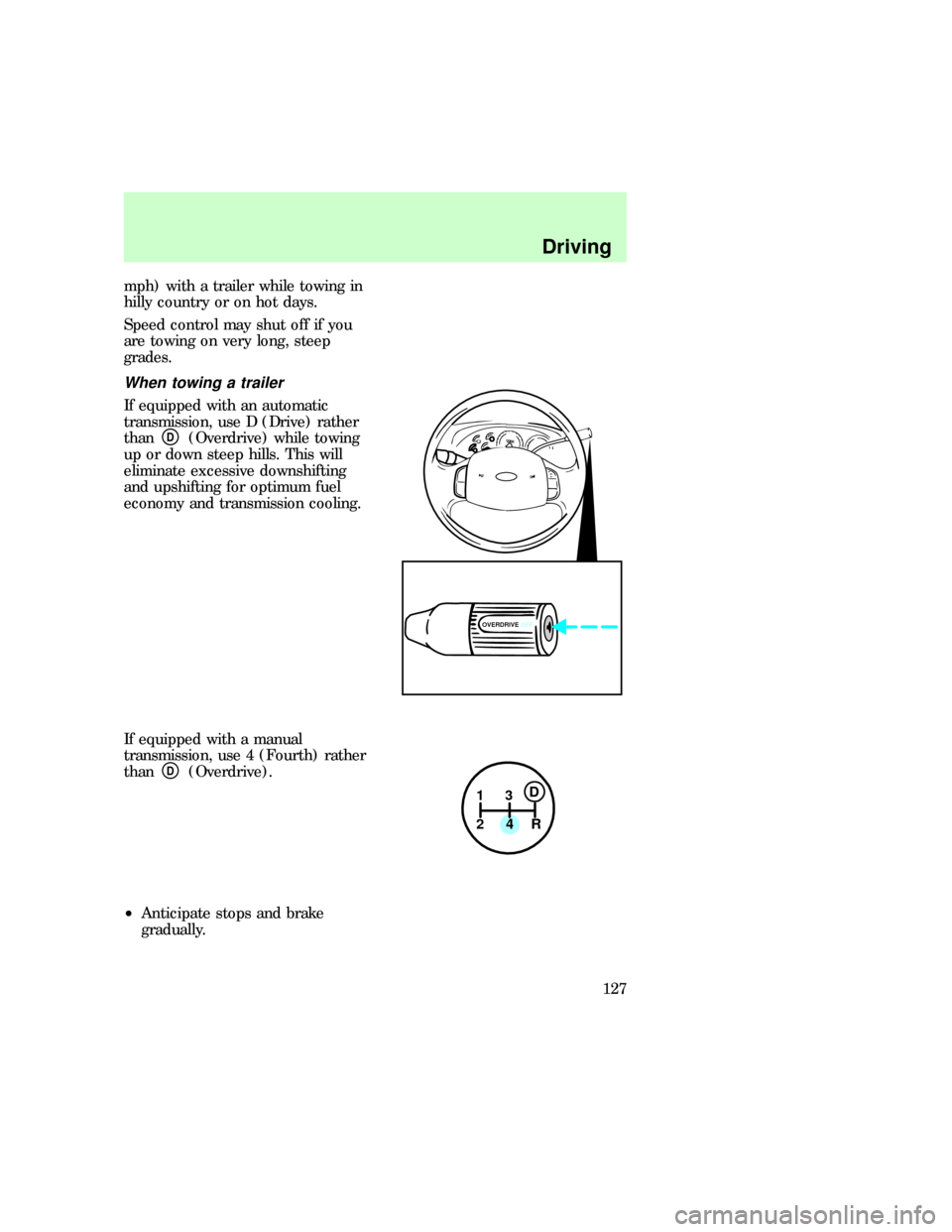
If equipped with an automatic
transmission, use D (Drive) rather
than
D(Overdrive) while towing
up or down steep hills. This will
eliminate excessive downshifting
and upshifting for optimum fuel
economy and transmission cooling.
If equipped with a manual
transmission, use 4 (Fourth) rather
than
D(Overdrive).
²Anticipate stops and brake
gradually.
OVERDRIVE OFF
1
24R3D
f12_when_you_tow
Driving
127
Page 128 of 219
Exceeding these limits may allow
water to enter critical vehicle
components, adversely affecting
driveability, emissions and
reliability.
Servicing when towing
If you tow a trailer for long
distances, your vehicle will require
more frequent service intervals.
Refer to the ªService Guideº for
more information.
SNOWPLOWING
Ford recommends the following
specifications for low speed,
personal use snow removal:
²F-150 4WD long wheelbase or
F-250 4WD Regular Cab
²4.6L or 5.4L engine
²Super engine cooling
²Heavy duty front suspension
package
²Automatic transmission with
auxiliary automatic transmission
fluid cooling
²All-terrain tires
Do not install a snowplow and
plow with your vehicle until it has
been driven at least 800 km (500
miles).
Installing snowplow
Read the following instructions
before installing a snowplow:
²Front GAWR must not exceed
63% of the GVW. Add ballast
weight to the back of the
f12_service_towing
f12_snowplowing
f12_install_plow
Driving
129
Page 142 of 219
Tire change procedure
1. Park on a level surface.
2. Activate the hazard flashers.
3. Set the parking brake.
4. Place the gearshift in P (Park)
(automatic transmission) or R
(Reverse) (manual transmission).
For 4WD vehicles equipped with
Lever-operated transfer case, make
sure that the lever is not in the N
(Neutral) position.
5. Block the diagonally opposite
wheel.
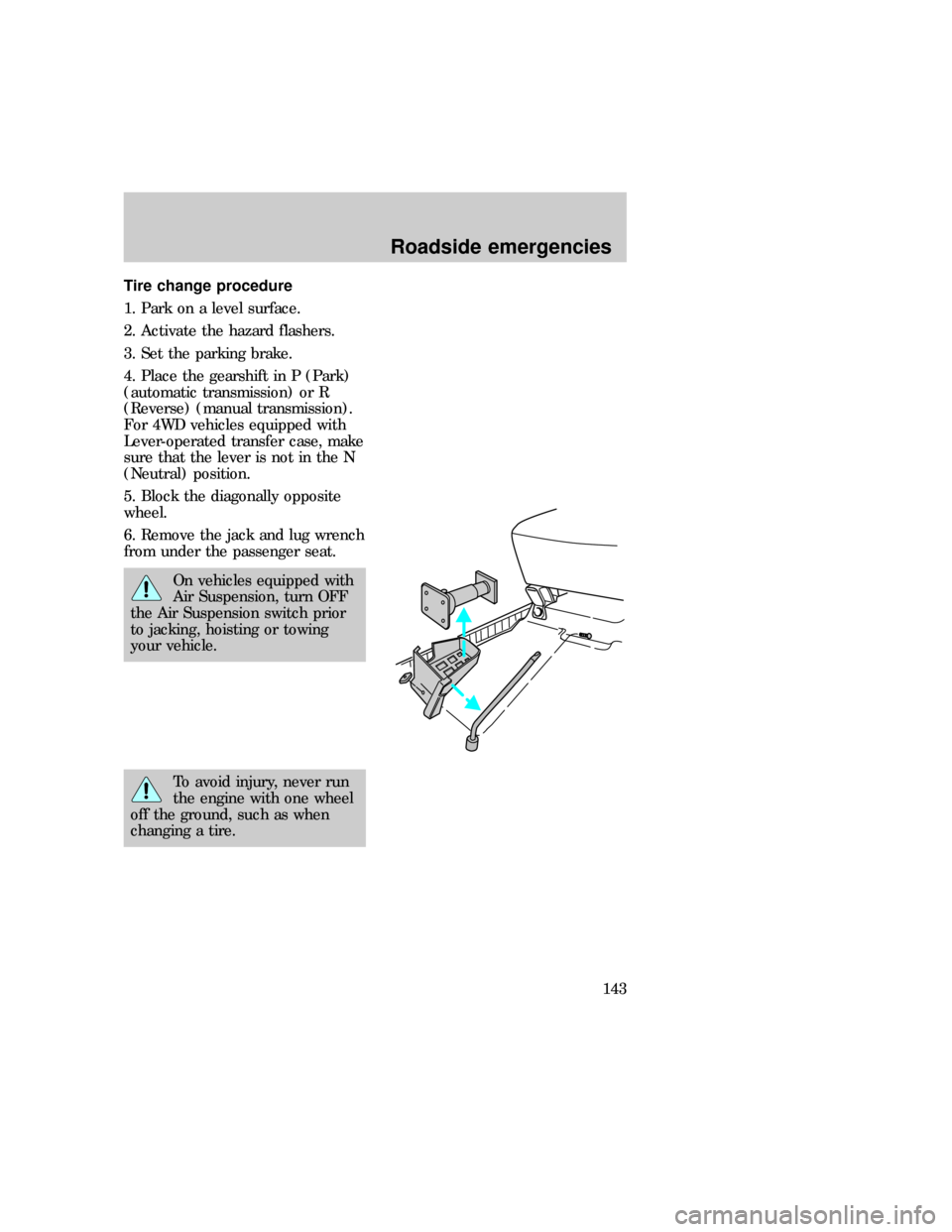
6. Remove the jack and lug wrench
from under the passenger seat.
On vehicles equipped with
Air Suspension, turn OFF
the Air Suspension switch prior
to jacking, hoisting or towing
your vehicle.
To avoid injury, never run
the engine with one wheel
off the ground, such as when
changing a tire.
f12_removing_spare
Roadside emergencies
143
Page 149 of 219
JUMP STARTING
1. Start the booster vehicle and
run the engine at moderately
increased speed.
2. Start the engine of the vehicle
with the discharged battery.
3. Once the engine has been
started, run both vehicles for a
further three minutes before
disconnecting the leads.
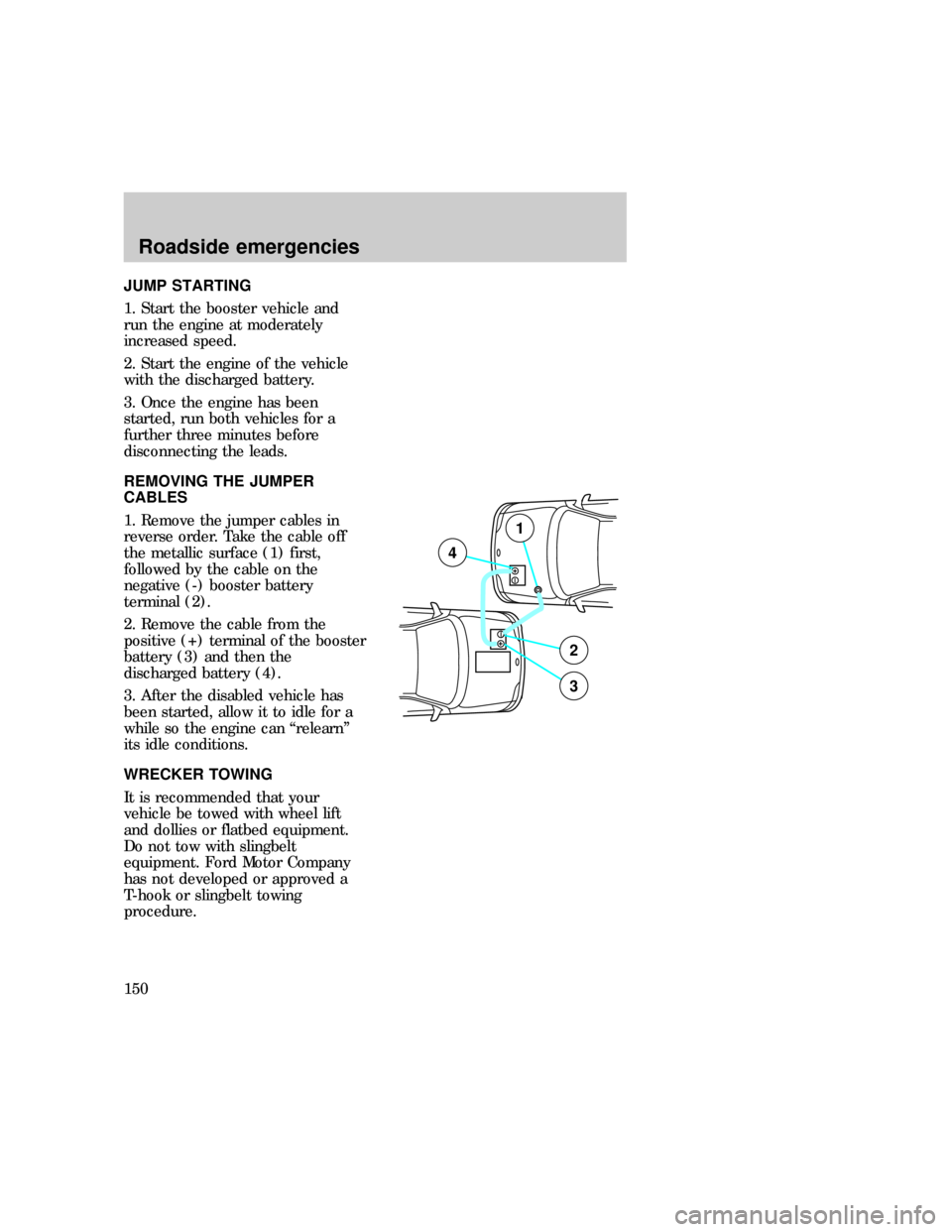
REMOVING THE JUMPER
CABLES
1. Remove the jumper cables in
reverse order. Take the cable off
the metallic surface (1) first,
followed by the cable on the
negative (-) booster battery
terminal (2).
2. Remove the cable from the
positive (+) terminal of the booster
battery (3) and then the
discharged battery (4).
3. After the disabled vehicle has
been started, allow it to idle for a
while so the engine can ªrelearnº
its idle conditions.
WRECKER TOWING
It is recommended that your
vehicle be towed with wheel lift
and dollies or flatbed equipment.
Do not tow with slingbelt
equipment. Ford Motor Company
has not developed or approved a
T-hook or slingbelt towing
procedure.
+–
+–
2
3
4
1
com_removing_cables.01
f12_wrecker
Roadside emergencies
150