Page 139 of 219
Fuses
Position Amps Description
7 15 Parking and tail lamps
8 30 Headlamps
9 15 Daytime running lamps and fog lamps
10 25 Auxiliary power point
11 - Not used
12 - Not used
13 - Not used
14 60/20 4WABS/rear anti-lock brake
15 50 Air suspension compressor
16 40 Trailer tow battery charge and stop/turn lamps
17 30 4WD transfer case shift motor and clutch
18 30 Driver power seat
19 20 Fuel pump
20 50 Instrument panel fuse panel ignition switch feed
21 50 Instrument panel fuse panel ignition switch feed
22 50 I/P fuse panel battery feed
23 40 I/P blower
24 30 PCM power
25 30 Power windows
26 - Not used
27 - Not used
28 30 Trailer tow electronic brake
29 - Not used
Diodes
Position Description
1 Rear ABS diode
2 PCM diode
Roadside emergencies
140
Page 142 of 219
Tire change procedure
1. Park on a level surface.
2. Activate the hazard flashers.
3. Set the parking brake.
4. Place the gearshift in P (Park)
(automatic transmission) or R
(Reverse) (manual transmission).
For 4WD vehicles equipped with
Lever-operated transfer case, make
sure that the lever is not in the N
(Neutral) position.
5. Block the diagonally opposite
wheel.
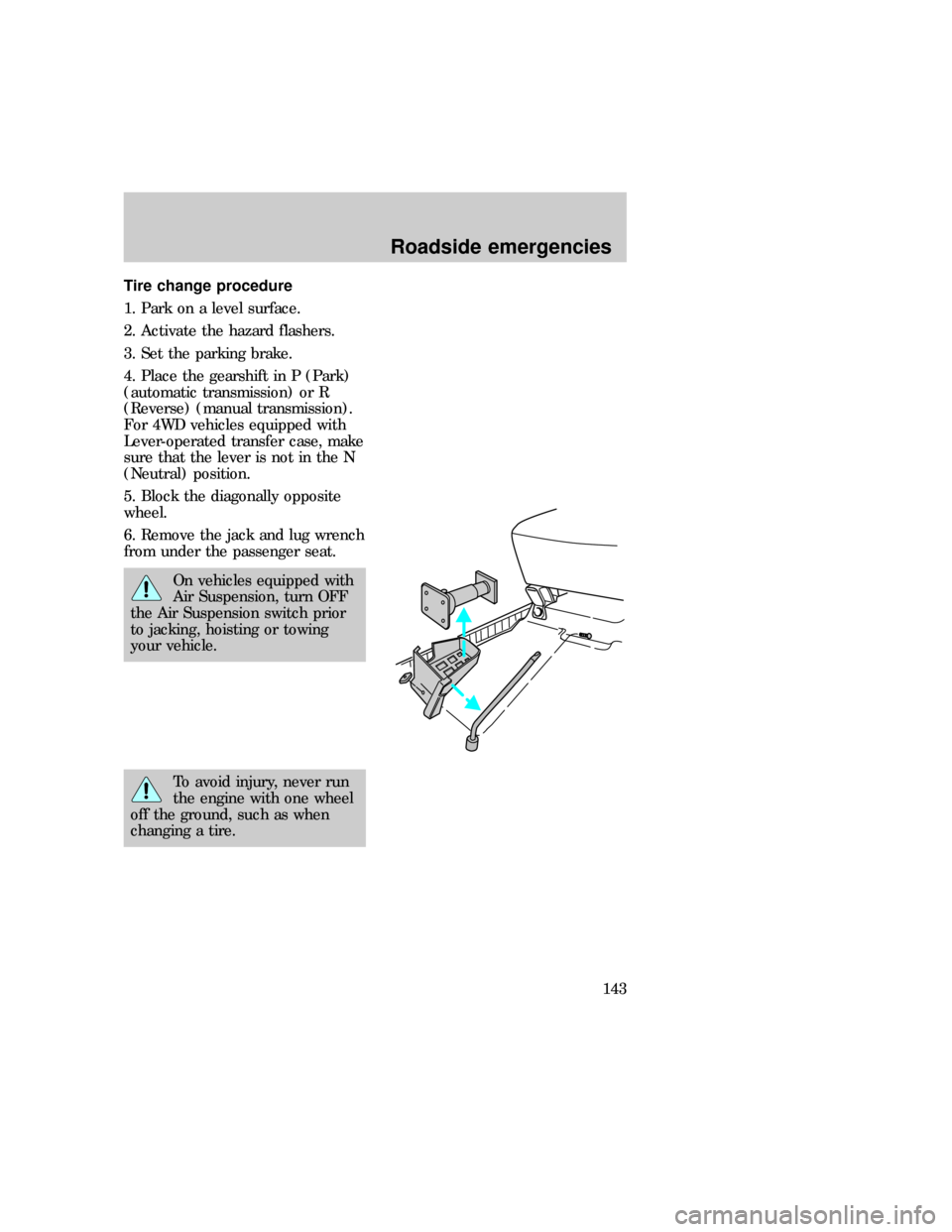
6. Remove the jack and lug wrench
from under the passenger seat.
On vehicles equipped with
Air Suspension, turn OFF
the Air Suspension switch prior
to jacking, hoisting or towing
your vehicle.
To avoid injury, never run
the engine with one wheel
off the ground, such as when
changing a tire.
f12_removing_spare
Roadside emergencies
143
Page 187 of 219
Snow tires and chains
Snow tires must be the
same size and grade as the
tires you currently have on your
vehicle.
The tires on your vehicle have all
weather treads to provide traction
in rain and snow.
However, in some climates, you
may need to use snow tires and
chains.
Follow these guidelines when using
snow tires and chains.
²Use only SAE Class ªSº chains.
²Install chains securely, verifying
that the chains do not touch any
wiring, brake lines or fuel lines.
²4x2: Install tire chains on rear
tires (of all sizes) only.
²4x4: Install tire chains on rear
tires (of all sizes), and on front
tires of size P235/70R16 only.
²Drive cautiously. If you hear the
chains rub or bang against your
vehicle, stop and retighten the
chains. If this does not work,
remove the chains to prevent
damage to your vehicle.
²If possible, avoid fully loading
your vehicle.
²Remove the tire chains when
they are no longer needed. Do
not use tire chains on dry roads.
²The suspension insulation and
bumpers will help prevent
vehicle damage. Do not remove
Maintenance and care
188