Page 86 of 219
3. Turn the key to the ON position
(without turning the key to
START).
Make sure the following lights
illuminate briefly. If a light fails to
illuminate, have the vehicle
serviced.
²If the driver's safety belt is
fastened, the
light does not
illuminate.
!MPH 1050
3070
4080
120
140
18 0
40
20
0
10090 60
8060100
20 km/h
0010
000005CH
EF
DOOR
AJARLOW
FUEL
MPH
CHECK
ENGINEABS
L H18
8
BRAKE
!
LOW
FUEL
ABS
BRAKE
3
MPH 1050
3070
4080
120
140
18 0
40
20
0
10090 60
8060100
20 km/h
0010
0000052
4
5
6 01LH
CH
EF
818RPMx1000CHECK
ENGINE
Starting
87
Page 88 of 219
the vehicle. Using the heater for
longer than three hours will not
harm the engine, so the heater can
be plugged in the night before
starting the vehicle.
To prevent electrical
shock, do not use your
heater with ungrounded
electrical systems or
two-pronged (cheater) adapters.
Guarding against exhaust
fumes
Although odorless and colorless,
carbon monoxide is present in
exhaust fumes. Take precautions
to avoid its dangerous effects.
If you ever smell exhaust
fumes of any kind inside
your vehicle, have your dealer
inspect and fix your vehicle
immediately. Do not drive if you
smell exhaust fumes. These
fumes are harmful and could kill
you.
Have the exhaust and body
ventilation systems checked
whenever:
²the vehicle is raised for service
²the sound of the exhaust system
changes
²the vehicle has been damaged in
a collision
com_guarding_exhaust.01
com_ventilation_info.01
Starting
89
Page 105 of 219
Utility and four-wheel
drive vehicles arenot
designed for cornering at speeds
as high as passenger cars any
more than low-slung sports cars
are designed to perform
satisfactorily under off-road
conditions. Avoid sharp turns or
abrupt maneuvers in these
vehicles.
4WD operation is not
recommended on dry pavement.
Doing so could result in difficult
disengagement of the transfer
case, increased tire wear and
decreased fuel economy.
4WD system indicator lights
The 4WD system indicator lights
illuminate only under the following
conditions. If these lights
illuminate during normal driving,
have your vehicle serviced.
4x4± illuminates when 4H (4WD
High) or 4L (4WD Low) is
selected.
LOW RANGE ± illuminates when
4L (4WD Low) is selected.
f12_fourwd_lights
f12_using_4wd_leverop
Driving
106
Page 128 of 219
Exceeding these limits may allow
water to enter critical vehicle
components, adversely affecting
driveability, emissions and
reliability.
Servicing when towing
If you tow a trailer for long
distances, your vehicle will require
more frequent service intervals.
Refer to the ªService Guideº for
more information.
SNOWPLOWING
Ford recommends the following
specifications for low speed,
personal use snow removal:
²F-150 4WD long wheelbase or
F-250 4WD Regular Cab
²4.6L or 5.4L engine
²Super engine cooling
²Heavy duty front suspension
package
²Automatic transmission with
auxiliary automatic transmission
fluid cooling
²All-terrain tires
Do not install a snowplow and
plow with your vehicle until it has
been driven at least 800 km (500
miles).
Installing snowplow
Read the following instructions
before installing a snowplow:
²Front GAWR must not exceed
63% of the GVW. Add ballast
weight to the back of the
f12_service_towing
f12_snowplowing
f12_install_plow
Driving
129
Page 130 of 219
These specifications are located
in the vehicle's Service Manual.
Adherence to the toe and ride
height specification is important
for proper tire wear, ride,
handling and headlight aim.
Do not exceed the GVWR
or the GAWR specified on
the Safety Compliance
Certification Label.
Removing snowplow
Read the following instructions
before removing a snowplow:
²After removing a snowplow from
the vehicle, ensure the vehicle's
front toe alignment and front
ride height are within
specification (reset if required).
These specifications are located
in the vehicle's Service Manual.
Adherence to the toe and ride
height specification is important
for proper tire wear, ride,
handling and headlight aim.
Snowplowing with your air bag
equipped vehicle
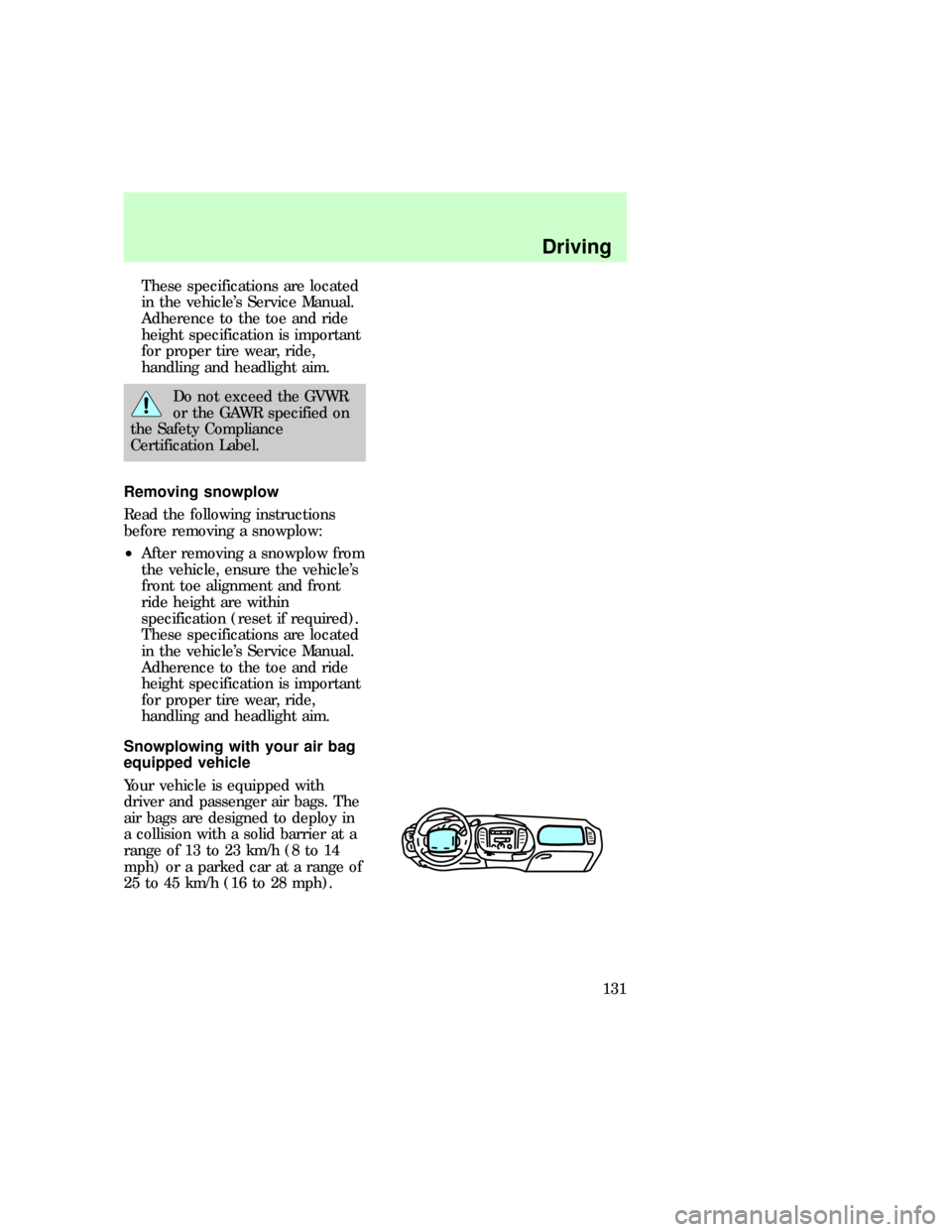
Your vehicle is equipped with
driver and passenger air bags. The
air bags are designed to deploy in
a collision with a solid barrier at a
range of 13 to 23 km/h (8 to 14
mph) or a parked car at a range of
25 to 45 km/h (16 to 28 mph).
f12_remove
f12_snowplow_srs
Driving
131
Page 131 of 219
Careless or high speed driving
while plowing snow which results
in vehicle decelerations equivalent
to or greater than the air bag
deployment impact speeds listed
above can deploy the air bag. Such
driving also increases the risk of
accidents.
All occupants of the
vehicle, including the
driver, should always wear their
safety belts.
Never remove or defeat the
ªtripping mechanismsº designed
into the snow removal equipment
by its manufacturer. Doing so may
cause damage to the vehicle and
the snow removal equipment as
well as possible air bag
deployment.
Do not attempt to service,
repair, or modify the Air
Bag Supplemental Restraint
System or its fuses. See your
Ford or Lincoln-Mercury dealer.
Engine temperature while
plowing
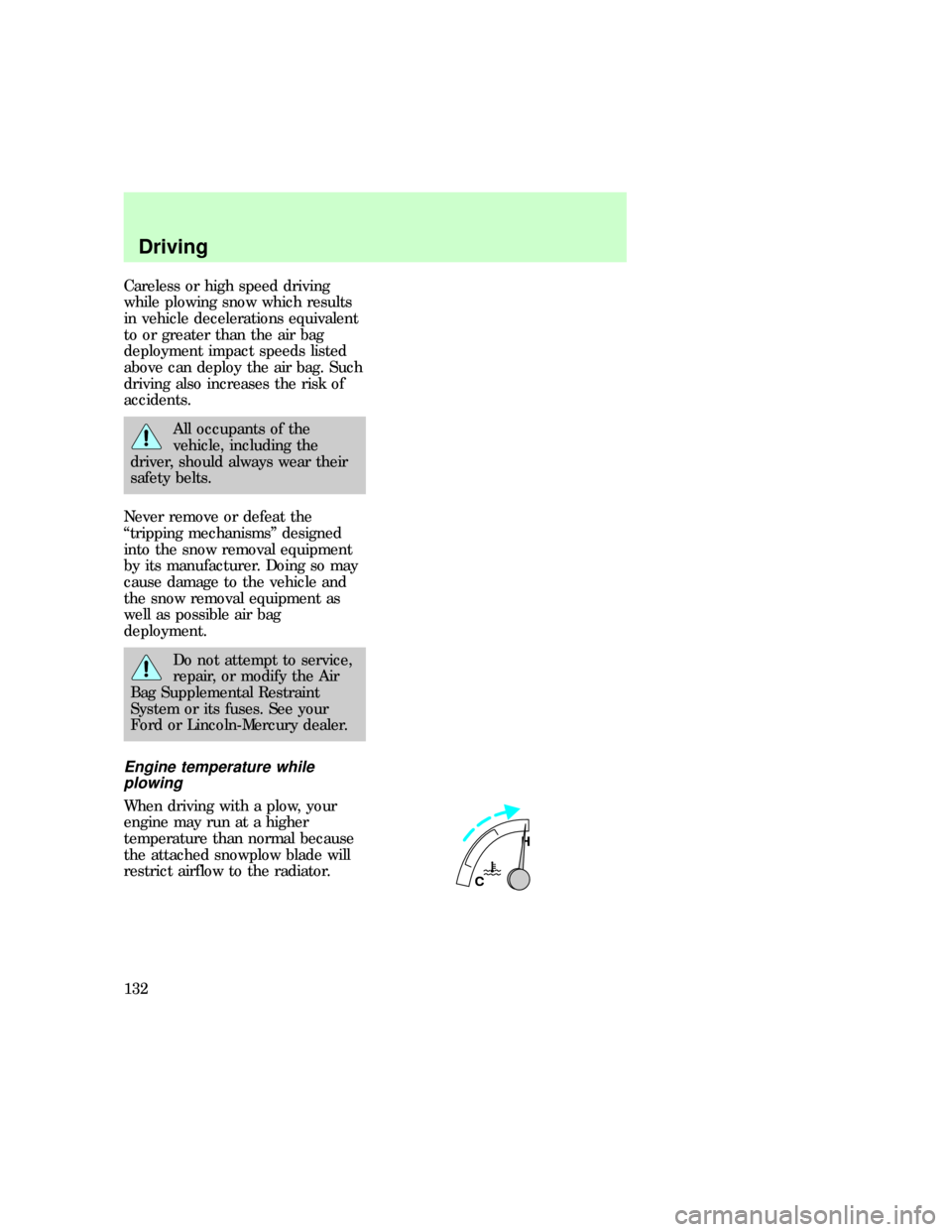
When driving with a plow, your
engine may run at a higher
temperature than normal because
the attached snowplow blade will
restrict airflow to the radiator.
CHCH
f12_driving_wplow
Driving
132
Page 140 of 219
Relays
Position Description
1 Windshield wipers HI/LO speed
2 Windshield wipers run/park relay
3 Washer pump relay
4 Fuel pump relay
5 Horn relay
6 PCM power relay
Primary battery fuses
(megafuses)
Primary battery fuses are located
under the PRIMARY BATTERY
FUSE cover next to starter relay.
Ford recommends that megafuses
only be serviced by a qualified
service technician.
Location Amperage Description
1 175 Power network box megafuse
2 175 Alternator megafuse
3 20 Alternator field minifuse
1
2
3
f12_megafuse
Roadside emergencies
141
Page 153 of 219

SERVICING YOUR VEHICLE
Service recommendations
To help you service your vehicle:
²We highlight do-it-yourself items
in the engine compartment for
easy location.
²As possible, we design parts that
can be replaced without tools.
²We provide you with a ªService
Guideº which makes tracking
routine service for your vehicle
easy.
If your vehicle requires
professional service, your
dealership can provide necessary
parts and service. Check your
ªWarranty Information Bookletº to
find out which parts and services
are covered.
Use only recommended fuels,
lubricants, fluids and service parts
conforming to specifications.
Motorcraft parts are designed and
built to provide the best
performance in your vehicle.
Precautions when servicing
your vehicle
Be especially careful when
inspecting or servicing your
vehicle. Here are some general
precautions for your safety:
²Do not work on a hot engine.
²If you must work with the
engine running, avoid wearing
loose clothing or jewelry that
com_service_recommendations.01
com_precautions_servicing.02
Maintenance and care
154