Page 101 of 219
Upshifts when accelerating (recommended for best fuel economy)
Shift from: Transfer case position1(if equipped)
2H or 4H 4L
1 - 2 14 km/h (9 mph) 5 km/h (3 mph)
2 - 3 32 km/h (20 mph) 11 km/h (7 mph)
3 - 4 50 km/h (31 mph) 19 km/h (12 mph)
4-
D(Overdrive) 71 km/h (44 mph) 27 km/h (17 mph)
Upshifts when cruising (recommended for best fuel economy)
Shift from: Transfer case position1(if equipped)
2H or 4H 4L
1 - 2 16 km/h (10 mph) 6 km/h (4 mph)
2 - 3 26 km/h (16 mph) 10 km/h (6 mph)
3 - 4 43 km/h (27 mph) 16 km/h (10 mph)
4-
D(Overdrive) 68 kn/h (42 mph) 26 km/h (16 mph)
Maximum downshift speeds2
Shift from: Transfer case position (if equipped)1
2H or 4H 4L
D(Overdrive) - 4 88 km/h (55 mph) 34 km/h (21 mph)
4 - 3 72 km/h (45 mph) 27 km/h (17 mph)
3 - 2 56 km/h (35 mph) 21 km/h (13 mph)
2 - 1 32 km/h (20 mph) 11 km/h (7 mph)
1Use 2H or 4H for 4WD equipped vehicles.2Downshift at lower speeds when driving on slippery surfaces.
Driving
102
Page 103 of 219
4. Turn ignition to Off.
Do not park your vehicle
in Neutral, it may move
unexpectedly and injure
someone. Use 1 (First) gear and
set the parking brake fully.
Reverse
Make sure that your vehicle is at a
complete stop before you shift into
R (Reverse). Failure to do so may
damage the transmission.
Put the gearshift in N (Neutral)
and wait at least three seconds
before shifting into R (Reverse).
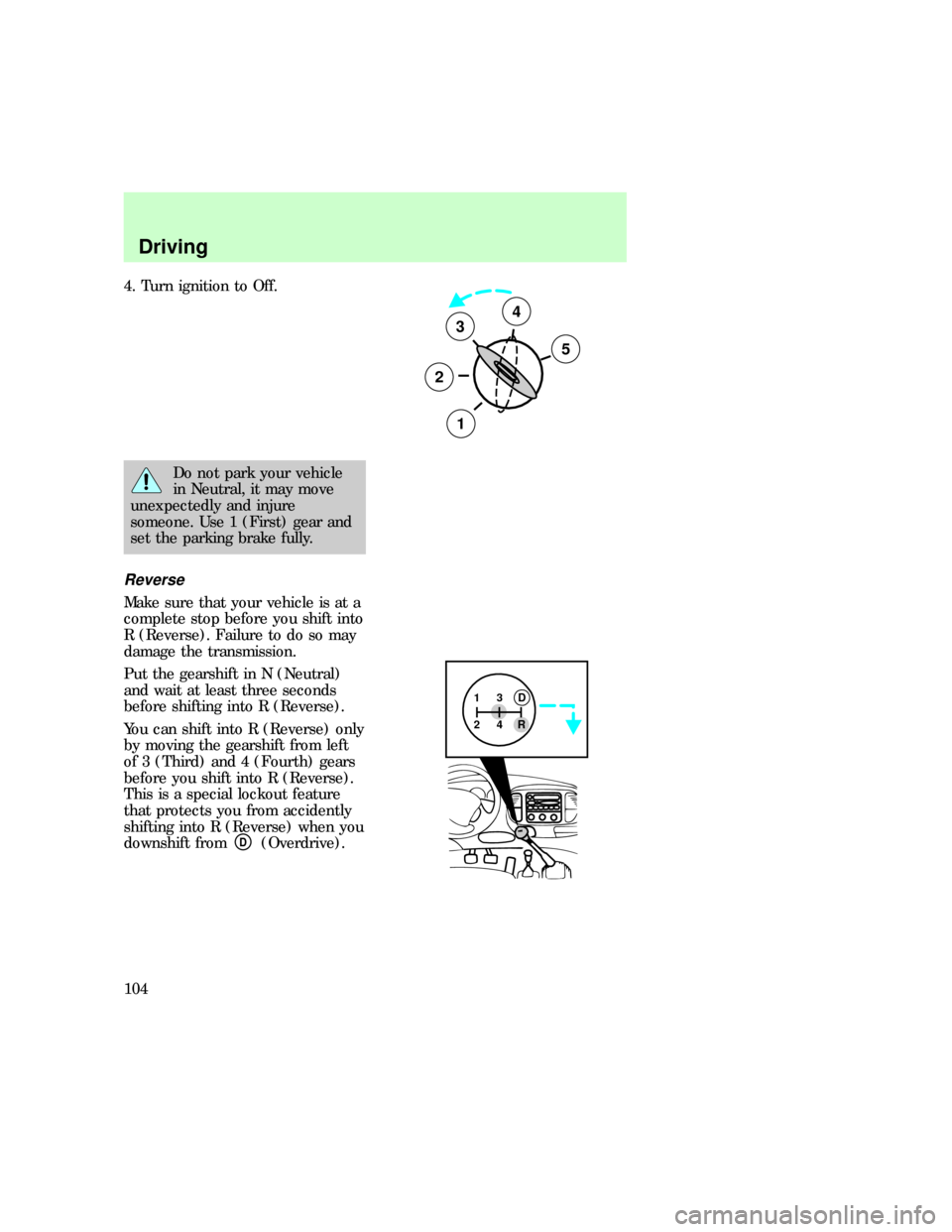
You can shift into R (Reverse) only
by moving the gearshift from left
of 3 (Third) and 4 (Fourth) gears
before you shift into R (Reverse).
This is a special lockout feature
that protects you from accidently
shifting into R (Reverse) when you
downshift from
D(Overdrive).
3
2
1
5
4
13
24RD
f12_reverse
Driving
104
Page 114 of 219

When descending a steep hill,
avoid sudden braking. Rapid
pumping of the brake pedal will
help slow the vehicle and still
maintain steering control.
When speed control is on and you
are driving uphill, your vehicle
speed may drop considerably,
especially if you are carrying a
heavy load.
If vehicle speed drops more than
15±25 km/h (8±14 mph), the speed
control will cancel automatically.
Resume speed with accelerator
pedal.
If speed control cancels after
climbing the hill, reset speed by
pressing and holding the SET
ACCEL button (to resume speeds
over 50 km/h (30 mph).
Automatic transmission may shift
frequently while driving up steep
grades. Eliminate frequent shifting
by shifting out of
D(Overdrive)
into D (Drive).
Driving on snow and ice
A 4WD vehicle has advantages
over 2WD vehicles in snow and ice
but can skid like any other vehicle.
Avoid sudden applications of
power and quick changes of
direction on snow and ice. Apply
the accelerator slowly and steadily
when starting from a full stop.
When braking, apply the brakes as
you normally would. In order to
allow the anti-lock brake system
(ABS) to operate properly, keep
f12_driving_snow_ice
Driving
115
Page 126 of 219
mph) with a trailer while towing in
hilly country or on hot days.
Speed control may shut off if you
are towing on very long, steep
grades.
When towing a trailer
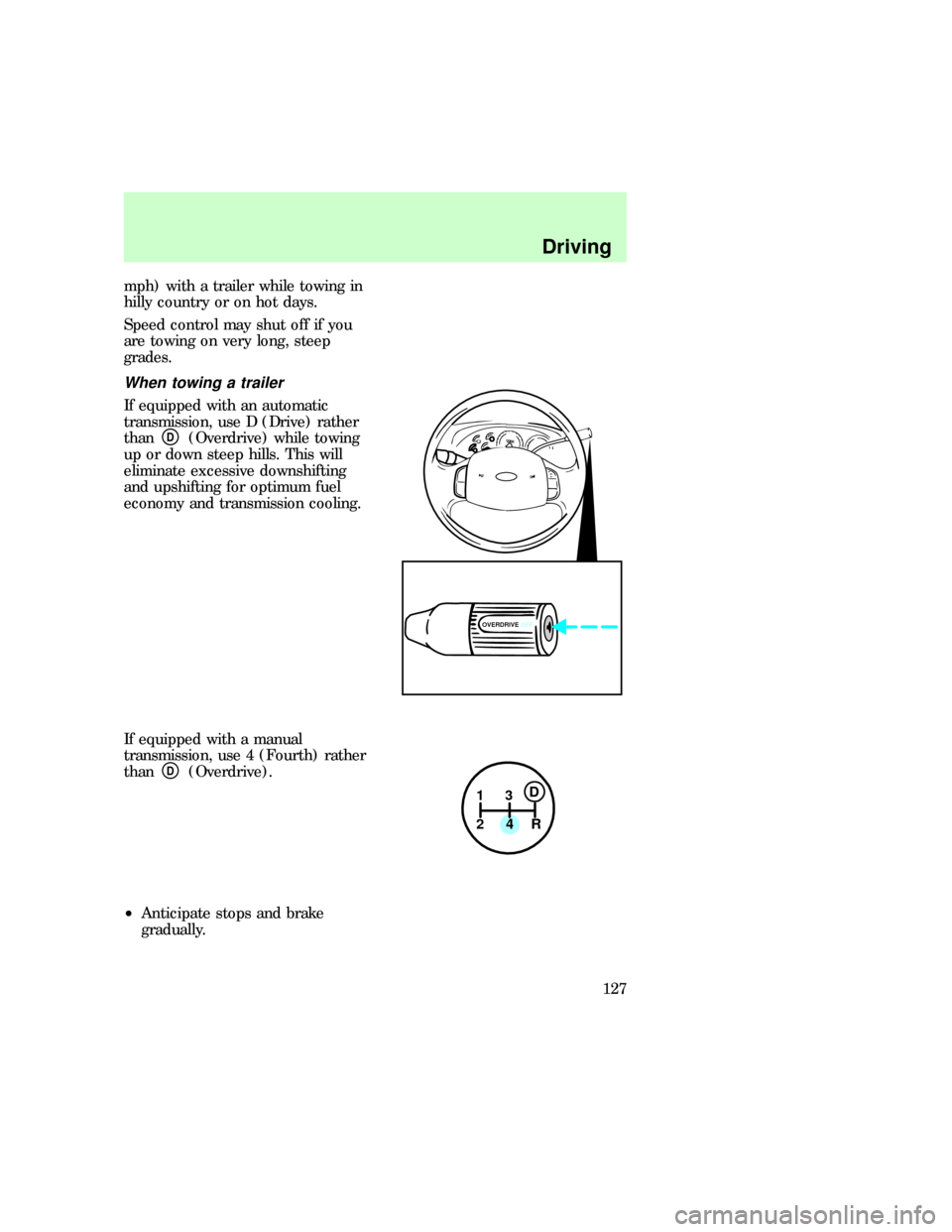
If equipped with an automatic
transmission, use D (Drive) rather
than
D(Overdrive) while towing
up or down steep hills. This will
eliminate excessive downshifting
and upshifting for optimum fuel
economy and transmission cooling.
If equipped with a manual
transmission, use 4 (Fourth) rather
than
D(Overdrive).
²Anticipate stops and brake
gradually.
OVERDRIVE OFF
1
24R3D
f12_when_you_tow
Driving
127