Page 83 of 219
If you smell exhaust fumes
inside your vehicle, have
your dealer inspect your vehicle
immediately. Do not drive if you
smell exhaust fumes.
Preparing to start the vehicle
Engine starting is controlled by the
spark ignition system. This system
meets all Canadian
Interference-Causing Equipment
standard requirements regulating
the impulse electrical field strength
of radio noise.
When starting a fuel-injected
engine, avoid pressing the
accelerator before or during
starting. Only use the accelerator
when you have difficulty starting
the engine. For more information
on starting the vehicle, refer to
Starting the vehiclein this
chapter.
Before starting the vehicle:
1. Make sure all vehicle occupants
have buckled their safety belts. For
more information on safety belts
and their proper usage, refer to
com_preparing_start.01
Starting
84
Page 86 of 219
3. Turn the key to the ON position
(without turning the key to
START).
Make sure the following lights
illuminate briefly. If a light fails to
illuminate, have the vehicle
serviced.
²If the driver's safety belt is
fastened, the
light does not
illuminate.
!MPH 1050
3070
4080
120
140
18 0
40
20
0
10090 60
8060100
20 km/h
0010
000005CH
EF
DOOR
AJARLOW
FUEL
MPH
CHECK
ENGINEABS
L H18
8
BRAKE
!
LOW
FUEL
ABS
BRAKE
3
MPH 1050
3070
4080
120
140
18 0
40
20
0
10090 60
8060100
20 km/h
0010
0000052
4
5
6 01LH
CH
EF
818RPMx1000CHECK
ENGINE
Starting
87
Page 96 of 219

N (Neutral)± Vehicle is free to
roll.
D(Overdrive)± The normal
driving position for the best fuel
economy. Transmission operates in
gears one through four.
D(Overdrive) can be deactivated
by pressing the transmission
control switch on the end of the
gearshift lever. The transmission
control indicator light (TCIL)
(OFF) on the end of the gearshift
lever will remain off.
D (Drive)± Not shown on the
display. Activate by pressing the
transmission control switch on the
end of the gearshift lever. The
TCIL (OFF) will illuminate on the
gearshift lever. Transmission
operates in gears one through
three. D (Drive) provides more
engine braking than
D(Overdrive) and is useful
whenever driving conditions (i.e.,
city traffic, hilly terrain, etc.) cause
the transmission to excessively
shift between
D(Overdrive) and
D (Drive). Also deactivate
D(Overdrive) when:
²driving with a heavy load
²towing a trailer up or down
steep hills
²additional engine braking is
desired.
To return to
D(Overdrive)
mode, press the transmission
control switch. The TCIL (OFF)
will no longer be illuminated.
OVERDRIVE OFF
Driving
97
Page 101 of 219
Upshifts when accelerating (recommended for best fuel economy)
Shift from: Transfer case position1(if equipped)
2H or 4H 4L
1 - 2 14 km/h (9 mph) 5 km/h (3 mph)
2 - 3 32 km/h (20 mph) 11 km/h (7 mph)
3 - 4 50 km/h (31 mph) 19 km/h (12 mph)
4-
D(Overdrive) 71 km/h (44 mph) 27 km/h (17 mph)
Upshifts when cruising (recommended for best fuel economy)
Shift from: Transfer case position1(if equipped)
2H or 4H 4L
1 - 2 16 km/h (10 mph) 6 km/h (4 mph)
2 - 3 26 km/h (16 mph) 10 km/h (6 mph)
3 - 4 43 km/h (27 mph) 16 km/h (10 mph)
4-
D(Overdrive) 68 kn/h (42 mph) 26 km/h (16 mph)
Maximum downshift speeds2
Shift from: Transfer case position (if equipped)1
2H or 4H 4L
D(Overdrive) - 4 88 km/h (55 mph) 34 km/h (21 mph)
4 - 3 72 km/h (45 mph) 27 km/h (17 mph)
3 - 2 56 km/h (35 mph) 21 km/h (13 mph)
2 - 1 32 km/h (20 mph) 11 km/h (7 mph)
1Use 2H or 4H for 4WD equipped vehicles.2Downshift at lower speeds when driving on slippery surfaces.
Driving
102
Page 105 of 219
Utility and four-wheel
drive vehicles arenot
designed for cornering at speeds
as high as passenger cars any
more than low-slung sports cars
are designed to perform
satisfactorily under off-road
conditions. Avoid sharp turns or
abrupt maneuvers in these
vehicles.
4WD operation is not
recommended on dry pavement.
Doing so could result in difficult
disengagement of the transfer
case, increased tire wear and
decreased fuel economy.
4WD system indicator lights
The 4WD system indicator lights
illuminate only under the following
conditions. If these lights
illuminate during normal driving,
have your vehicle serviced.
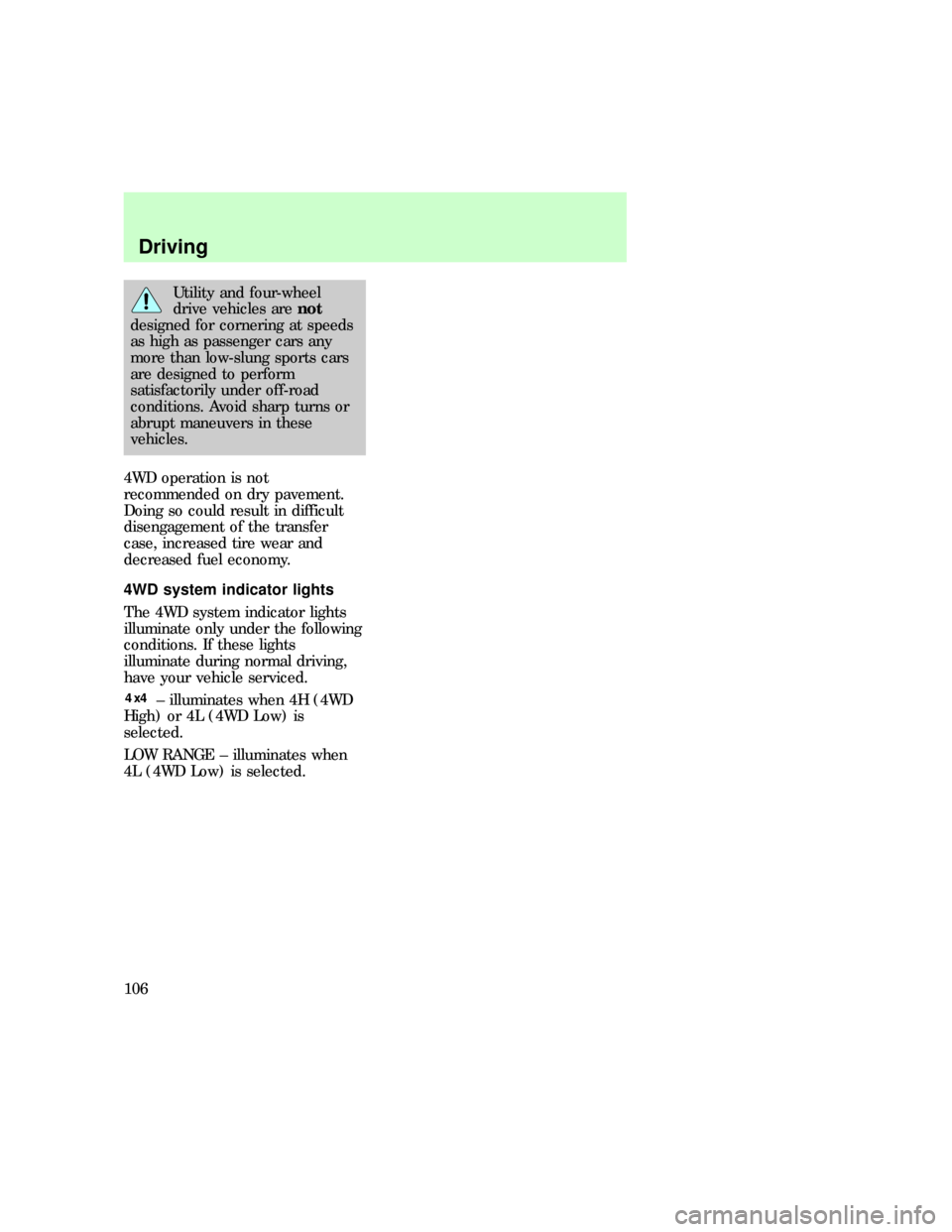
4x4± illuminates when 4H (4WD
High) or 4L (4WD Low) is
selected.
LOW RANGE ± illuminates when
4L (4WD Low) is selected.
f12_fourwd_lights
f12_using_4wd_leverop
Driving
106
Page 126 of 219
mph) with a trailer while towing in
hilly country or on hot days.
Speed control may shut off if you
are towing on very long, steep
grades.
When towing a trailer
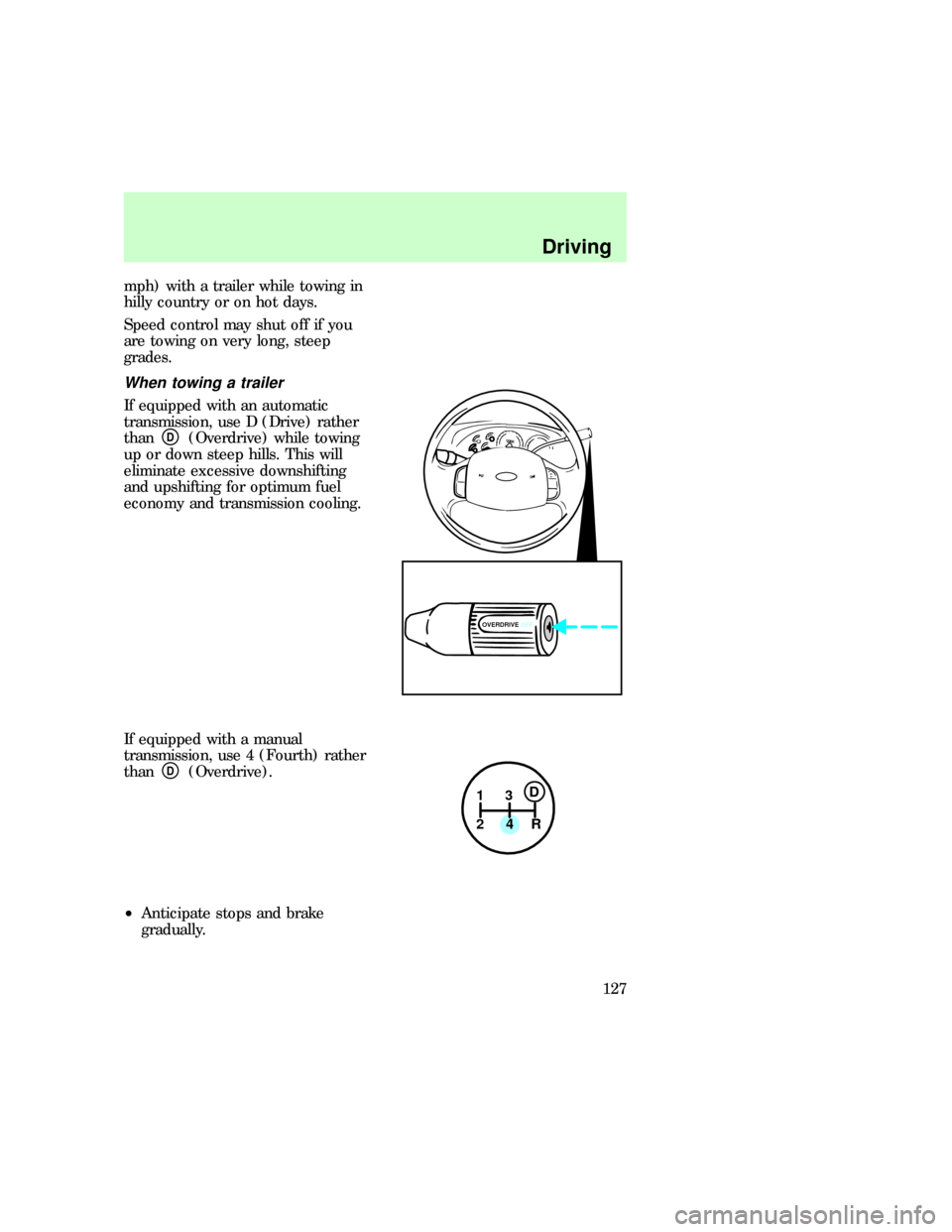
If equipped with an automatic
transmission, use D (Drive) rather
than
D(Overdrive) while towing
up or down steep hills. This will
eliminate excessive downshifting
and upshifting for optimum fuel
economy and transmission cooling.
If equipped with a manual
transmission, use 4 (Fourth) rather
than
D(Overdrive).
²Anticipate stops and brake
gradually.
OVERDRIVE OFF
1
24R3D
f12_when_you_tow
Driving
127
Page 133 of 219
Do not spin the wheels at
over 35 mph (55 km/h).
The tires may fail and injure a
passenger or bystander.
FUEL CONSUMPTION
Fuel economy can be improved by
avoiding:
²lack of regular, scheduled
maintenance
²excessive speed
²rapid acceleration.
f12_fuel_consumption
Driving
134
Page 134 of 219
HAZARD LIGHTS CONTROL
Use only in an emergency to warn
traffic of vehicle breakdown,
approaching danger, etc. Depress
to activate all indicators
simultaneously. Depress again to
switch off. The warning lights can
be operated when the ignition is
off.
FUEL PUMP SHUT-OFF SWITCH
If the engine cranks but does not
start after a collision, the fuel
pump shut±off switch may have
been activated. The shut±off
switch is a device intended to stop
the electric fuel pump when your
vehicle has been involved in a
substantial jolt.
1. Turn the ignition switch to the
OFF position.
2. Check fuel system for leaks.
3. If no fuel leak is apparent, reset
the fuel pump shut-off switch by
pushing in the button on the
switch.
4. Turn the ignition switch to the
ON position. Pause for a few
seconds and return the key to the
OFF position.
5. Make a further check for leaks
in the fuel system.com_hazard_switch.01
com_fuel_shut-off.01
f12_fuses
Roadside emergencies
135