Page 91 of 219
braking technique. However,
avoid taking any unnecessary
risks.
Parking brake
The parking brake should be used
whenever you park your vehicle. It
is not designed to stop a moving
vehicle. However, if the normal
brakes fail, the parking brake can
be used to stop your vehicle in an
emergency. Since the parking
brake applies only the rear brakes,
the vehicle's stopping distance will
increase greatly and the handling
of your vehicle will be adversely
affected.
Setting the parking brake
The!BRAKElight in the instrument
cluster will illuminate and remain
illuminated (when the ignition
f12_parking_brake
f12_setting_pbrake
Driving
92
Page 93 of 219
Do not leave the vehicle
unattended with the
transfer case in the N (Neutral)
position. Always set the parking
brake fully and turn off the
ignition when leaving the vehicle.
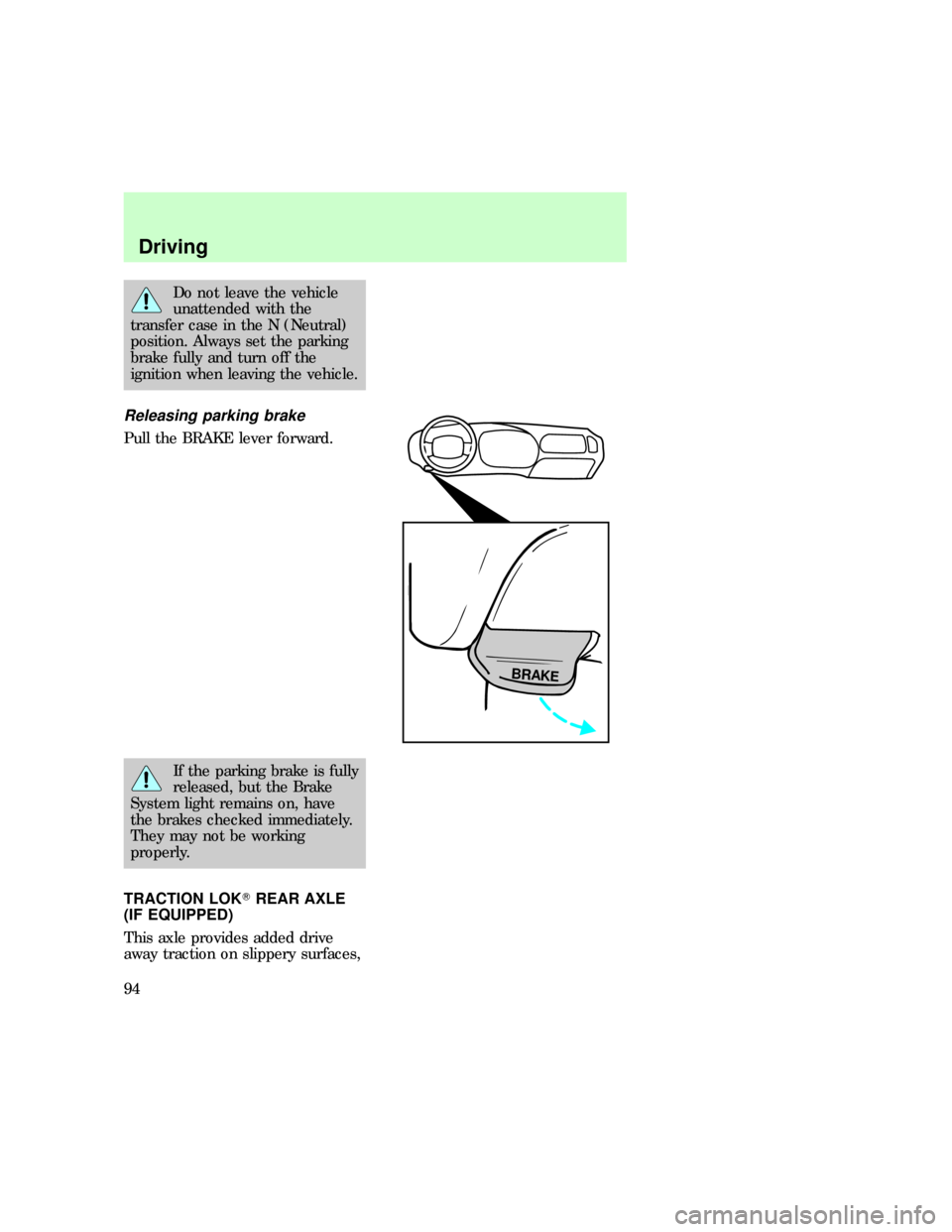
Releasing parking brake
Pull the BRAKE lever forward.
If the parking brake is fully
released, but the Brake
System light remains on, have
the brakes checked immediately.
They may not be working
properly.
TRACTION LOKTREAR AXLE
(IF EQUIPPED)
This axle provides added drive
away traction on slippery surfaces,
BRAKE
f12_releasing_pbrake
f12_traction_lok
Driving
94
Page 112 of 219
solid area of the trail. Do not
reduce the tire pressures but shift
to a lower gear and drive steadily
through the terrain. Apply the
accelerator slowly and avoid
spinning the wheels.
Mud and water
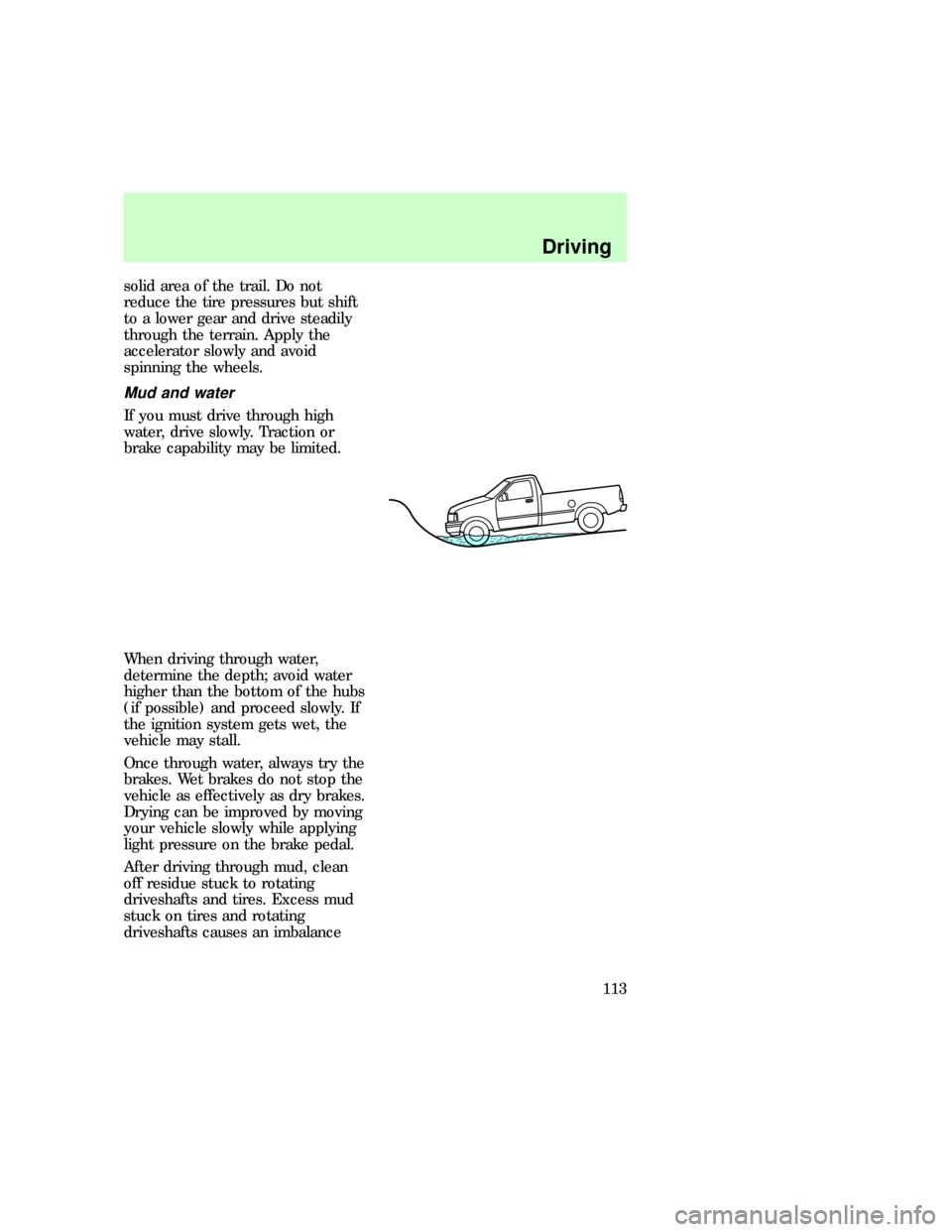
If you must drive through high
water, drive slowly. Traction or
brake capability may be limited.
When driving through water,
determine the depth; avoid water
higher than the bottom of the hubs
(if possible) and proceed slowly. If
the ignition system gets wet, the
vehicle may stall.
Once through water, always try the
brakes. Wet brakes do not stop the
vehicle as effectively as dry brakes.
Drying can be improved by moving
your vehicle slowly while applying
light pressure on the brake pedal.
After driving through mud, clean
off residue stuck to rotating
driveshafts and tires. Excess mud
stuck on tires and rotating
driveshafts causes an imbalance
f12_driving_mud_water
Driving
113
Page 136 of 219
Instrument panel fuses
Always replace a fuse with
one that has the specified
amperage rating. Using a fuse
with a higher amperage rating
can cause severe wire damage
and could start a fire.
Position Amps Description
1 15 Stop/turn lamps and turn indicators
2 5 Instrument cluster
3 25 Cigarette lighter
4 5 Power mirrors, autolamp, remote
anti-theft/keyless entry, headlamp relay and
parking lamp relay
5 15 Speed control, daytime running lamps, climate
control blend door, backup lamps, A/C clutch
coil
6 5 Brake-shift interlock, generic electronic module
(GEM)/central timer module (CTM) and air
suspension module
7 - Not used
8 5 Radio, remote anti-theft/keyless entry, GEM
module/CTM module
1
1
2
3
4
512 22
21323
31424
4
16 15
25
526
61727
71828
81929
11 21 31930
10 20
f12_pass_comp_fuses
Roadside emergencies
137
Page 206 of 219
Washing your vehicle
Wash your vehicle regularly with
cold or lukewarm water. Never use
strong detergents or soap. If your
vehicle is particularly dirty, use a
quality car wash detergent. Always
use a clean sponge, washing glove
or similar device and plenty of
water for best results. To avoid
spots, avoid washing when the
hood is still warm, immediately
after or during exposure to strong
sunlight.
During winter months, it is
especially important to wash the
vehicle on a regular basis. Large
quantities of dirt and road salt are
difficult to remove, and they also
cause damage to the vehicle.
Remove any exterior accessories,
such as antennas, before entering
a car wash.
²After washing, apply the brakes
several times to dry them.
Waxing your vehicle
The best way to determine when
the paintwork needs waxing is by
noting when water stops beading
on the surface. This could be every
three or four months, depending
on operating conditions.
Use only carnauba or
synthetic-based waxes. Remove
any bugs and tar before waxing
vehicle. Use cleaning fluid or
alcohol with a clean cloth to
remove. Use tar remover to
remove any tar spots.
com_waxing_vehicle.01
com_repairing_chips
Maintenance and care
207