Page 147 of 219
9. To stow the flat tire, lay the tire
on the ground with the inboard
side facing up. Install the retainer
through the wheel center and slide
the wheel under the vehicle. Turn
the spare handle clockwise until
the tire is raised to its original
position underneath the vehicle.
The spare handle ratchets when
the tire is raised to the stowed
position. It will not allow you to
overtighten.
10. Unblock the wheel.
11. Stow the jacking equipment
under the passenger seat and stow
the jack handle in the engine
compartment.
12. As soon as possible, tighten the
wheel nuts with a torque wrench
to 115±165 Nm (85±115 lb-ft).
JUMP STARTING YOUR
VEHICLE
The gases around the
battery can explode if
exposed to flames, sparks, or lit
cigarettes. An explosion could
result in injury or vehicle
damage.
Do not push-start your
vehicle. You could damage
the catalytic converter. For
further information, seeJumper
Cablesin the Index.
com_jump-starting.01
Roadside emergencies
148
Page 148 of 219
Batteries contain sulfuric
acid which burns skin,
eyes, and clothing.
CONNECTING THE JUMPER
CABLES
1. Position the vehicles so that
they do not touch one another.
2. Switch off the engine. Switch off
any unnecessary electrical
equipment.
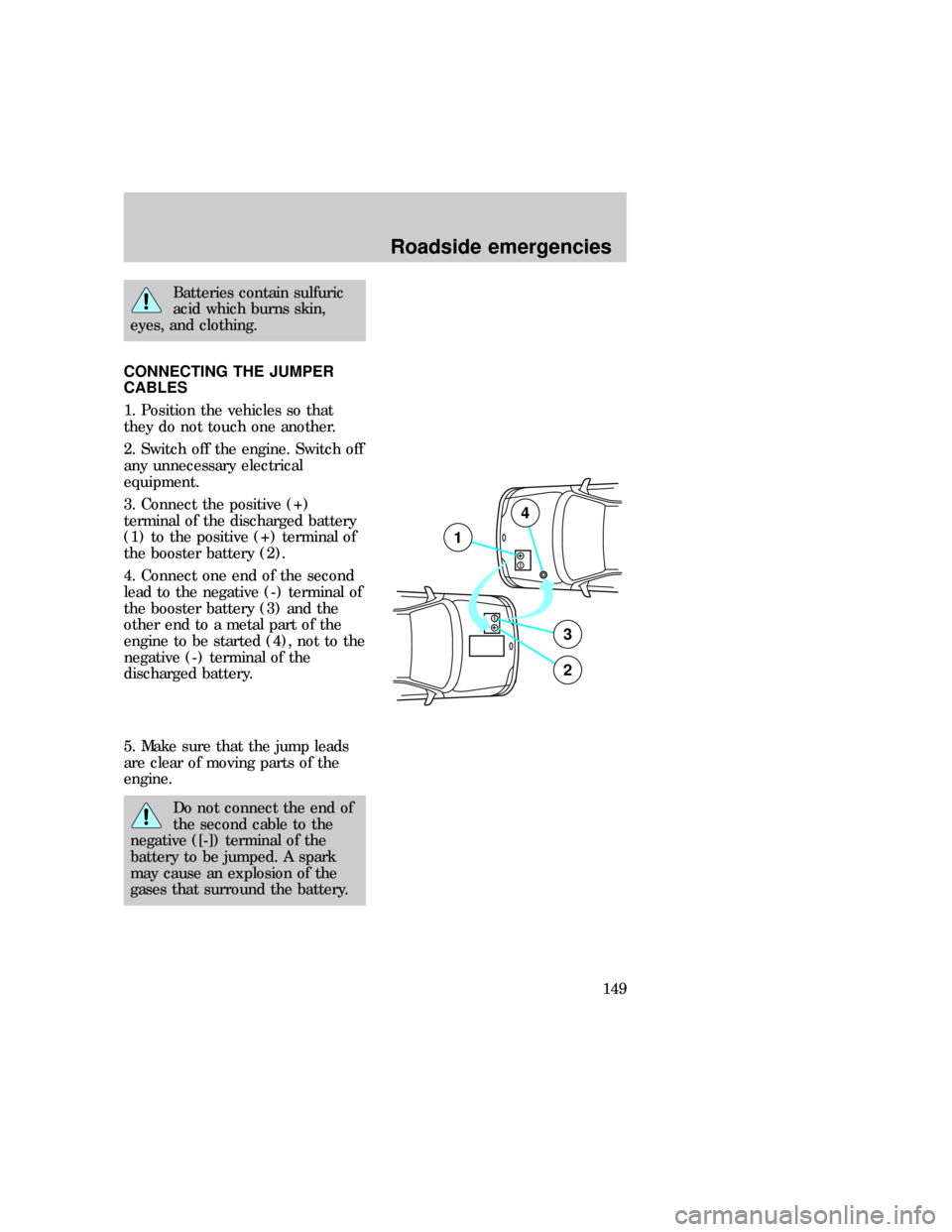
3. Connect the positive (+)
terminal of the discharged battery
(1) to the positive (+) terminal of
the booster battery (2).
4. Connect one end of the second
lead to the negative (-) terminal of
the booster battery (3) and the
other end to a metal part of the
engine to be started (4), not to the
negative (-) terminal of the
discharged battery.
5. Make sure that the jump leads
are clear of moving parts of the
engine.
Do not connect the end of
the second cable to the
negative ([-]) terminal of the
battery to be jumped. A spark
may cause an explosion of the
gases that surround the battery.
+–
+–
3
2
1
4
com_connecting_cables.01
com_jump_starting.01
Roadside emergencies
149
Page 149 of 219
JUMP STARTING
1. Start the booster vehicle and
run the engine at moderately
increased speed.
2. Start the engine of the vehicle
with the discharged battery.
3. Once the engine has been
started, run both vehicles for a
further three minutes before
disconnecting the leads.
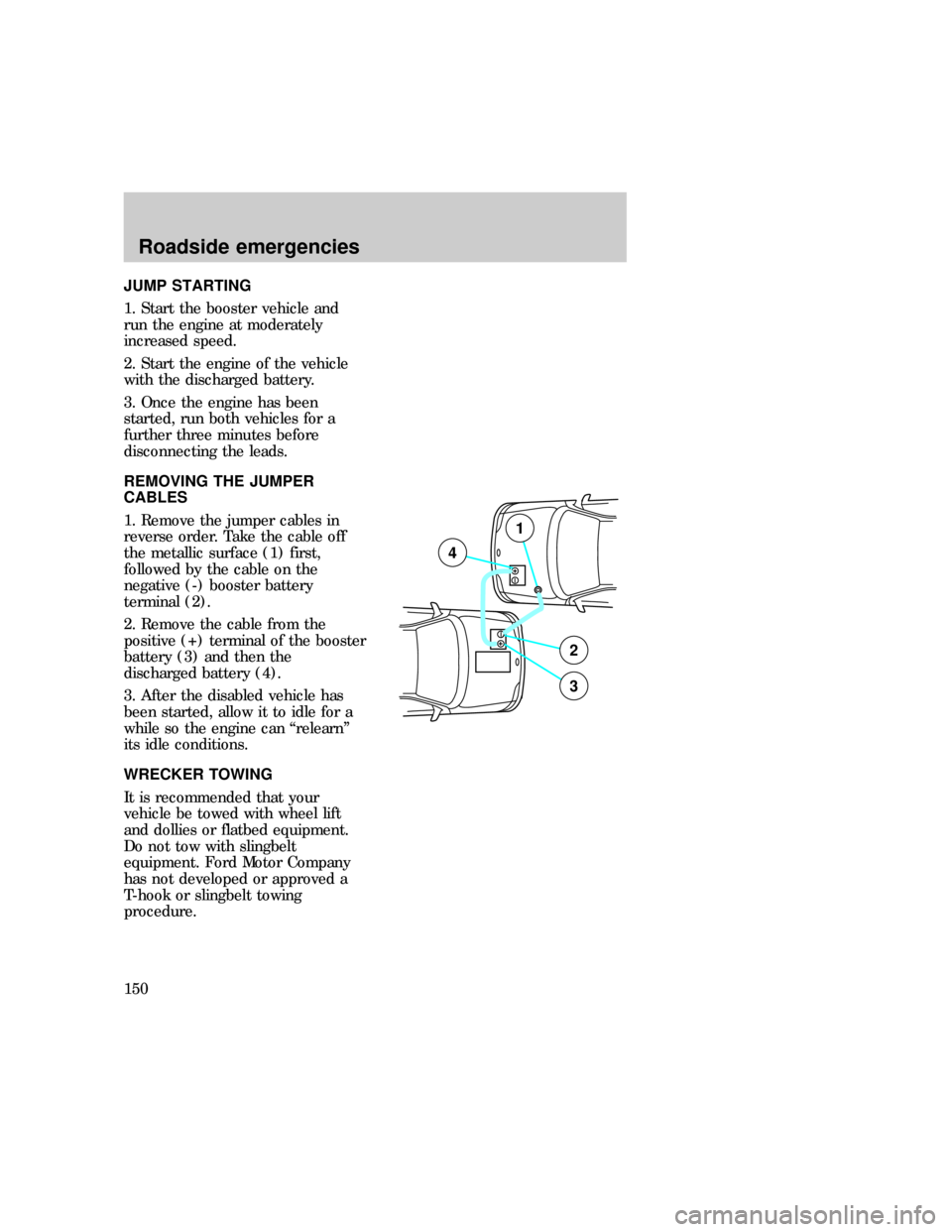
REMOVING THE JUMPER
CABLES
1. Remove the jumper cables in
reverse order. Take the cable off
the metallic surface (1) first,
followed by the cable on the
negative (-) booster battery
terminal (2).
2. Remove the cable from the
positive (+) terminal of the booster
battery (3) and then the
discharged battery (4).
3. After the disabled vehicle has
been started, allow it to idle for a
while so the engine can ªrelearnº
its idle conditions.
WRECKER TOWING
It is recommended that your
vehicle be towed with wheel lift
and dollies or flatbed equipment.
Do not tow with slingbelt
equipment. Ford Motor Company
has not developed or approved a
T-hook or slingbelt towing
procedure.
+–
+–
2
3
4
1
com_removing_cables.01
f12_wrecker
Roadside emergencies
150
Page 154 of 219
could get caught in moving
parts. Take precautions with
long hair.
²Do not work on a vehicle with
the engine running in an
enclosed space, unless you are
sure you have enough
ventilation.
²Keep all lit cigarettes, open
flames and other lit material
away from the battery and all
fuel related parts.
If you disconnect the battery, the
engine must ªrelearnº its idle
conditions before your vehicle will
drive properly, as explained in
Batteryin this chapter.
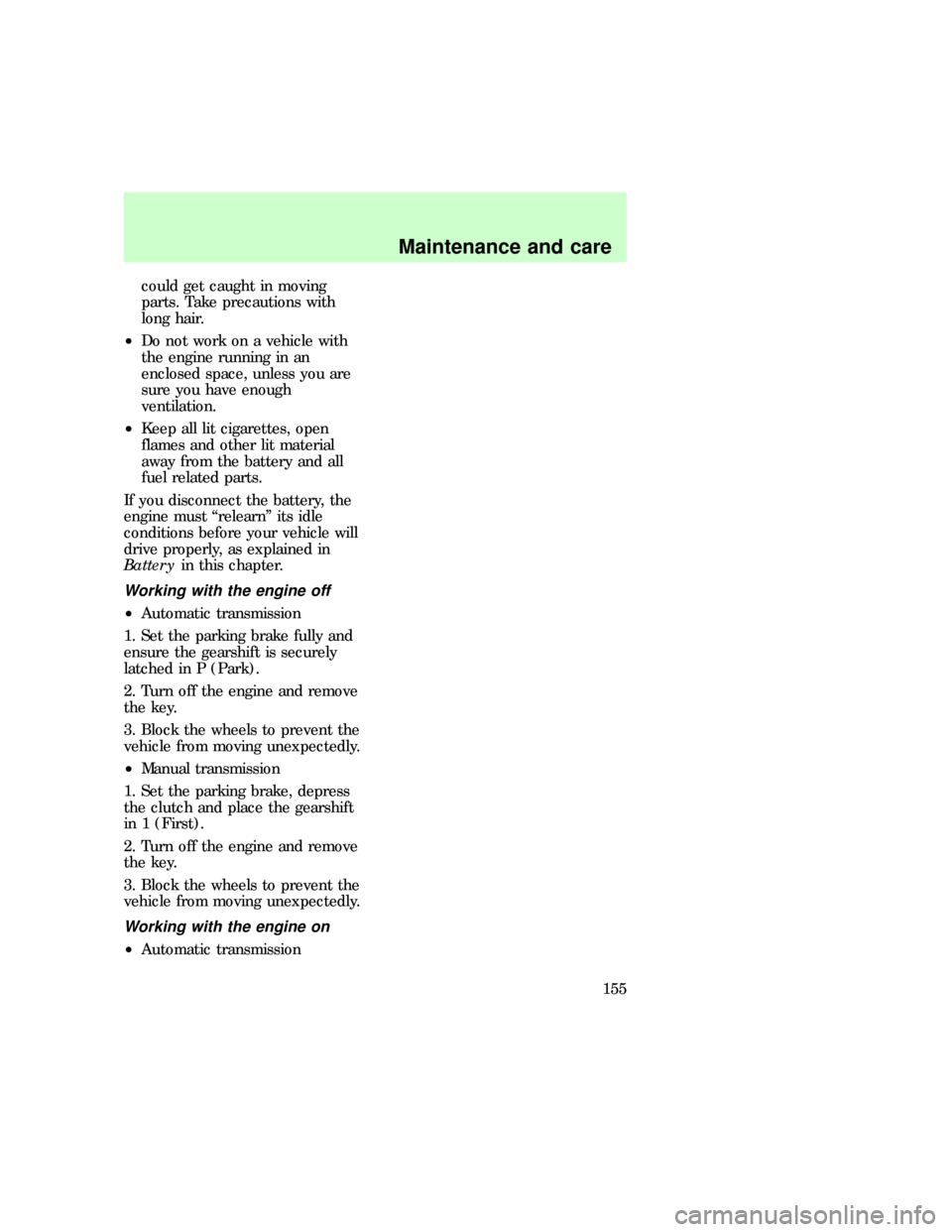
Working with the engine off
²Automatic transmission
1. Set the parking brake fully and
ensure the gearshift is securely
latched in P (Park).
2. Turn off the engine and remove
the key.
3. Block the wheels to prevent the
vehicle from moving unexpectedly.
²Manual transmission
1. Set the parking brake, depress
the clutch and place the gearshift
in 1 (First).
2. Turn off the engine and remove
the key.
3. Block the wheels to prevent the
vehicle from moving unexpectedly.
Working with the engine on
²Automatic transmission
com_working_off.02
com_working_on.02
Maintenance and care
155
Page 157 of 219
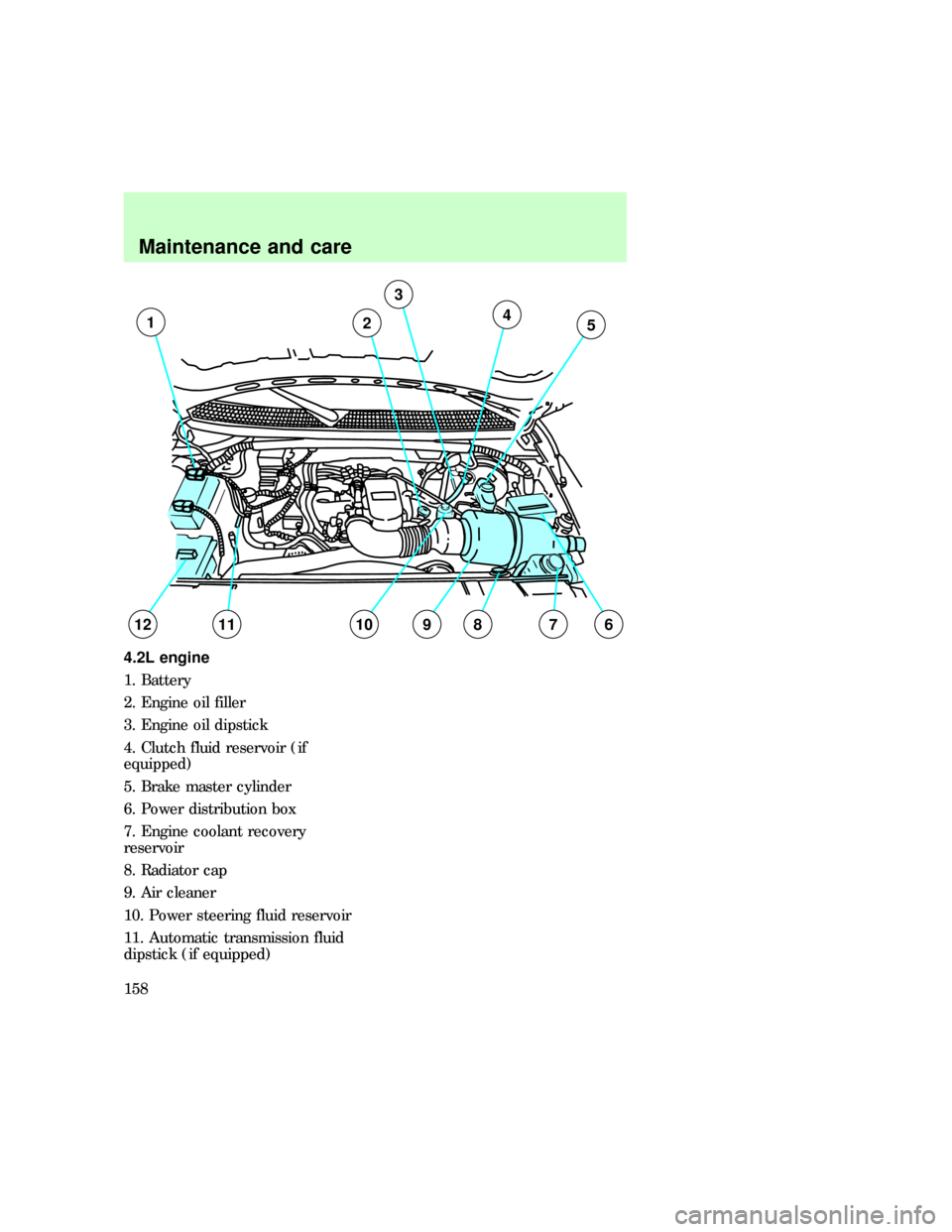
4.2L engine
1. Battery
2. Engine oil filler
3. Engine oil dipstick
4. Clutch fluid reservoir (if
equipped)
5. Brake master cylinder
6. Power distribution box
7. Engine coolant recovery
reservoir
8. Radiator cap
9. Air cleaner
10. Power steering fluid reservoir
11. Automatic transmission fluid
dipstick (if equipped)
1
1289761110
2
3
45
Maintenance and care
158
Page 158 of 219
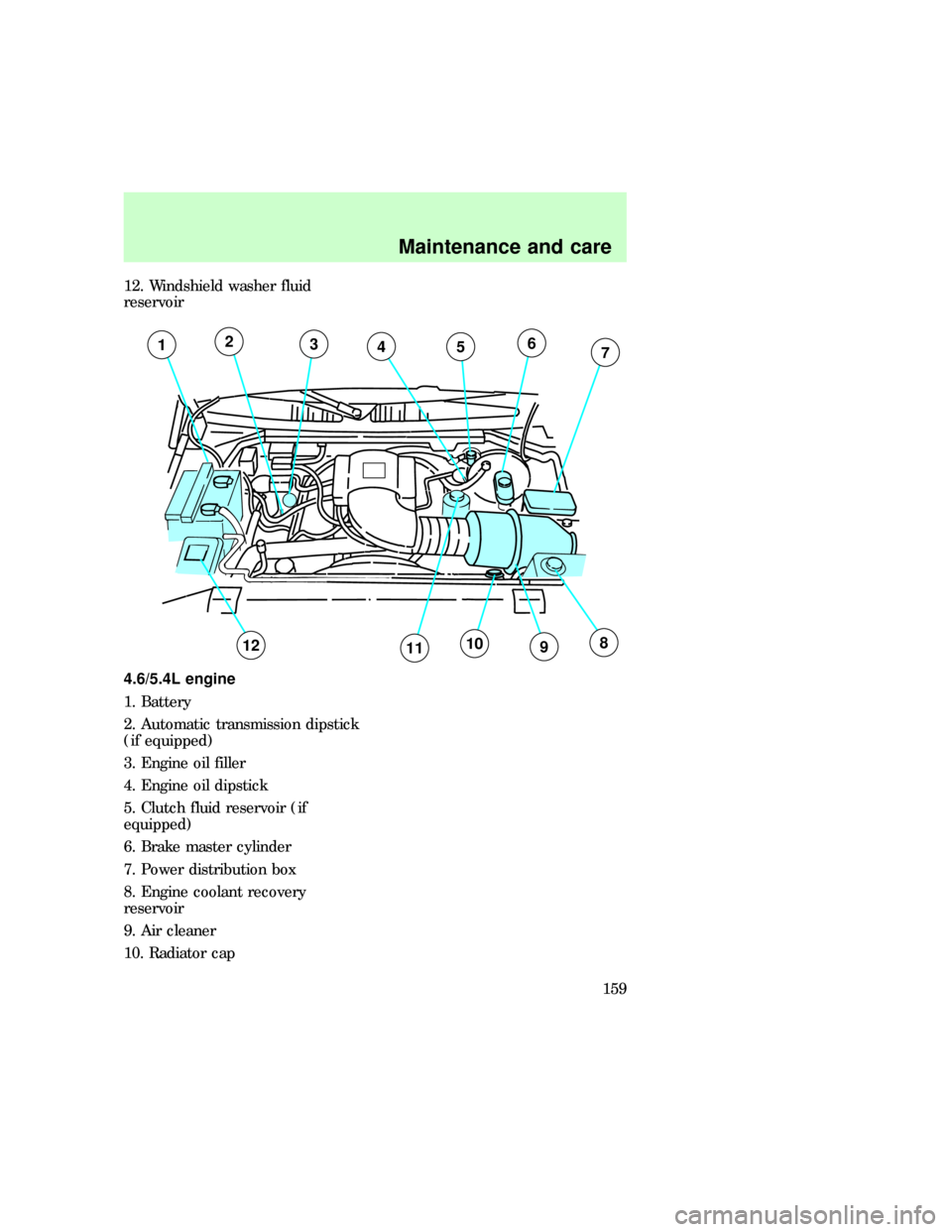
12. Windshield washer fluid
reservoir
4.6/5.4L engine
1. Battery
2. Automatic transmission dipstick
(if equipped)
3. Engine oil filler
4. Engine oil dipstick
5. Clutch fluid reservoir (if
equipped)
6. Brake master cylinder
7. Power distribution box
8. Engine coolant recovery
reservoir
9. Air cleaner
10. Radiator cap
10118129
1245673
f12_4.6L_5.4L_engine
Maintenance and care
159
Page 177 of 219
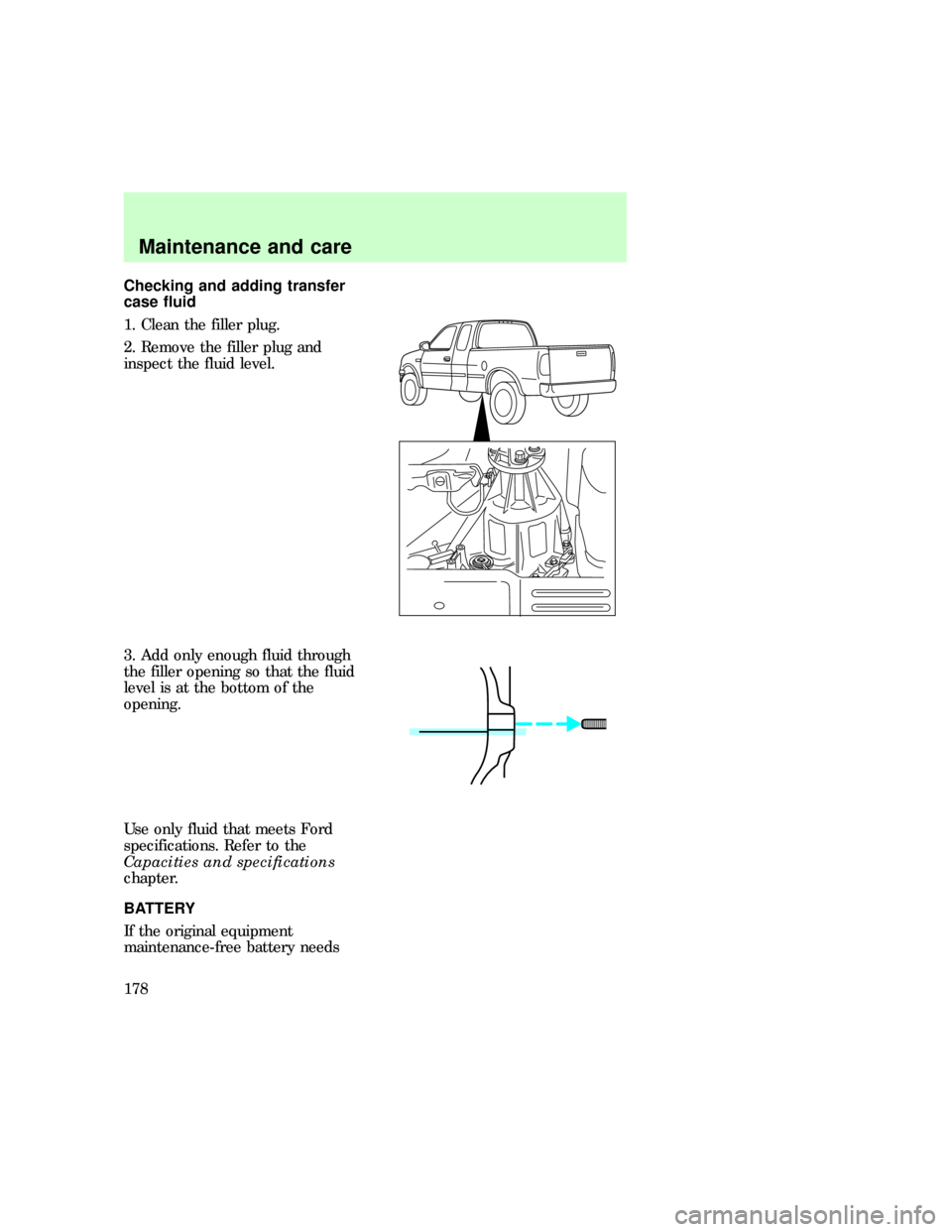
Checking and adding transfer
case fluid
1. Clean the filler plug.
2. Remove the filler plug and
inspect the fluid level.
3. Add only enough fluid through
the filler opening so that the fluid
level is at the bottom of the
opening.
Use only fluid that meets Ford
specifications. Refer to the
Capacities and specifications
chapter.
BATTERY
If the original equipment
maintenance-free battery needs
f12_battery
Maintenance and care
178
Page 178 of 219
replacing, it may be replaced with
a low-maintenance battery. For
information on replacement
batteries, refer toMotorcraft part
numbersin theCapacities and
specificationschapter.
The gases around the
battery can explode if
exposed to flames, sparks, or lit
cigarettes. An explosion could
result in injury or vehicle
damage.
Batteries contain sulfuric
acid which burns skin,
eyes, and clothing.
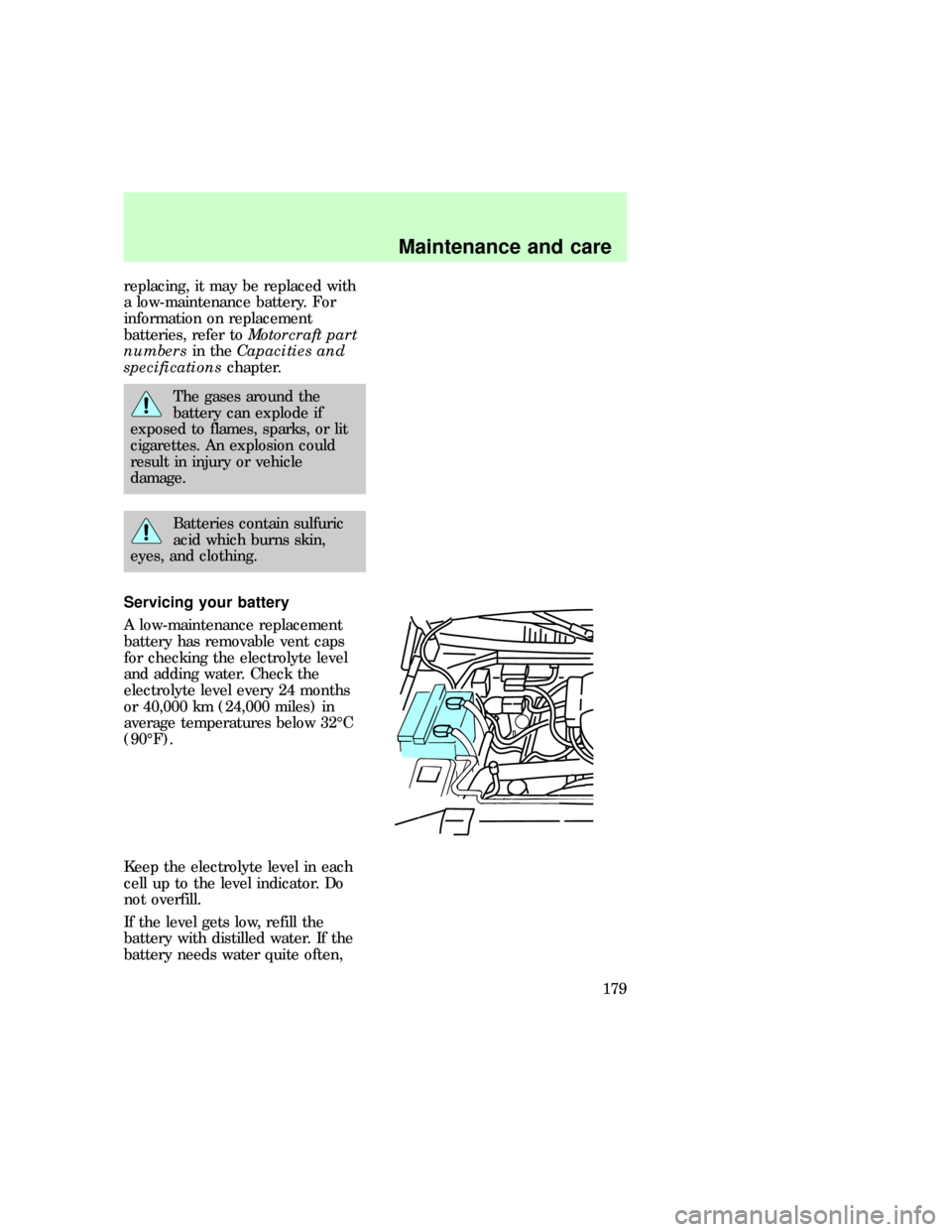
Servicing your battery
A low-maintenance replacement
battery has removable vent caps
for checking the electrolyte level
and adding water. Check the
electrolyte level every 24 months
or 40,000 km (24,000 miles) in
average temperatures below 32ÉC
(90ÉF).
Keep the electrolyte level in each
cell up to the level indicator. Do
not overfill.
If the level gets low, refill the
battery with distilled water. If the
battery needs water quite often,
f12_servicing_battery
Maintenance and care
179