Page 203 of 236
forms of disulfiram for the
treatment of alcoholism.
Breathing gasoline vapors or
skin contact could cause an
adverse reaction. Consult a
physician immediately.
Cleaner air
Ford approves the use of gasolines
to improve air quality, including
reformulated gasolines, that
contain oxygenates such as a
maximum of 10% ethanol or 15%
MTBE. There should be no more
than 5% methanol with cosolvents
and additives to protect the fuel
system.
Octane recommendations
Your vehicle is designed to use
regular gasoline with an (R+M)/2
octane rating of 87. We do not
recommend gasolines labeled as
ªregularº in high altitude areas that
are sold with octane ratings of 86
or even less.
Do not be concerned if your
vehicle sometimes knocks lightly.
However, if it knocks heavily under
most driving conditions on the
recommended octane fuel, see
your dealer or a qualified service
technician to prevent any engine
damage.
87
com_cleaner_air.01
com_octane_recommendations.01
com_fuel_quality.01
Maintenance and care
204
Page 204 of 236

Fuel quality
If you are experiencing starting,
rough idle or hesitation problems
try a different brand of fuel. If the
condition persists, see your dealer
or a qualified service technician.
The American Automobile
Manufacturers Association (AAMA)
issued a gasoline specification to
provide information on high quality
fuels that optimize the
performance of your vehicle. We
recommend the use of gasolines
that meet the AAMA specification
if they are available.
It should not be necessary to add
any aftermarket products to your
fuel tank if you continue to use a
high-quality fuel.
Choosing the right fuel
Use only UNLEADED FUEL. The
use of leaded fuel is prohibited by
law and could damage your
vehicle. The damage may not be
covered by your warranty.
Your vehicle was not designed to
use fuel containing
manganese-based additives such as
MMT. Additionally, vehicles
certified to California emission
standards (indicated on the
underhood Vehicle Emissions
Control Information label) are
designed to operate on California
reformulated gasolines. If
California reformulated gasoline is
not available when you refuel, your
vehicle can be operated on
non-California fuels. However, even
com_choosing_fuel.01
Maintenance and care
205
Page 205 of 236

though your engine will perform
adequately on other gasolines, the
performance of the emission
control devices and systems may
be adversely affected. Repair of
damage caused by using a fuel that
your vehicle was not designed for
may not be covered by your
warranty.
Calculating fuel economy
To accurately calculate your
vehicle's fuel economy:
1. Fill the tank completely and
record the initial odometer
reading.
2. Each time you fill the tank,
record the amount of fuel added
(in liters or gallons).
3. After at least three to five fuel
tank fill-ups, fill the fuel tank and
record the current mileage
reading.
4. Use one of the following
equations to calculate fuel
economy.
Liters used x 1004Total
kilometers traveled
Total miles traveled4Total
gallons used
Keep a record for at least one
month. This will provide an
accurate estimate of the vehicle's
fuel economy.
EMISSION CONTROL SYSTEM
Your vehicle is equipped with
various emission control
com_calculating_economy.01
com_emission.ses
Maintenance and care
206
Page 206 of 236
components and a catalytic
converter which will enable your
vehicle to comply with applicable
exhaust emission standards. To
make sure that the catalytic
converter and other emission
control components continue to
work properly:
²Use only unleaded fuel.
²Avoid running out of fuel.
²Do not turn off the ignition
while your vehicle is moving,
especially at high speeds.
²Have the services listed in your
ªService Guideº performed
according to the specified
schedule.
The Scheduled Maintenance
Services listed in the ªService
Guideº are required because they
are considered essential to the life
and performance of your vehicle
and to its emissions system.
If other than Ford, Motorcraft or
Ford authorized parts are used for
maintenance replacements or for
service of components affecting
emission control such non-Ford
parts should be equivalent to
genuine Ford Motor Company
parts in performance and
durability.
Do not park, idle, or drive
your vehicle in dry grass
or other dry ground cover. The
emission system heats up the
engine compartment and exhaust
system, which can start a fire.
Maintenance and care
207
Page 215 of 236

any bugs and tar before waxing
vehicle. Use cleaning fluid or
alcohol with a clean cloth to
remove. Use tar remover to
remove any tar spots.
Repairing paint chips
Minor scratches or paint damage
from road debris may be repaired
with touch-up paint, paint repair
foil or aerosol paint spray from the
Ford accessory line. Observe the
application instructions on the
products.
Remove particles such as bird
droppings, tree sap, insect
remains, tar spots, road salt and
industrial fallout immediately.
Cleaning the wheels
Wash the wheels with the same
detergent you use to clean the
body of your vehicle. Do not use
acid-based wheel cleaners, steel
wool, fuel or strong detergents.
Never use abrasives that will
damage the finish of special wheel
surfaces. Use a tar remover to
remove grease and tar.
Cleaning the engine
Engines are more efficient when
they are clean because grease and
dirt buildup act as insulators and
keep the engine warmer than
normal. Follow these guidelines to
clean your engine:
²Take care when using a power
washer to clean the engine. The
com_repairing_chips
uno_wheels_cleaning
com_engine_cleaning.01
Maintenance and care
216
Page 218 of 236
windshield wiper solution or a mild
detergent. Rinse thoroughly with
clean water. To avoid damaging the
blades, do not use fuel, kerosene,
paint thinner or other solvents.
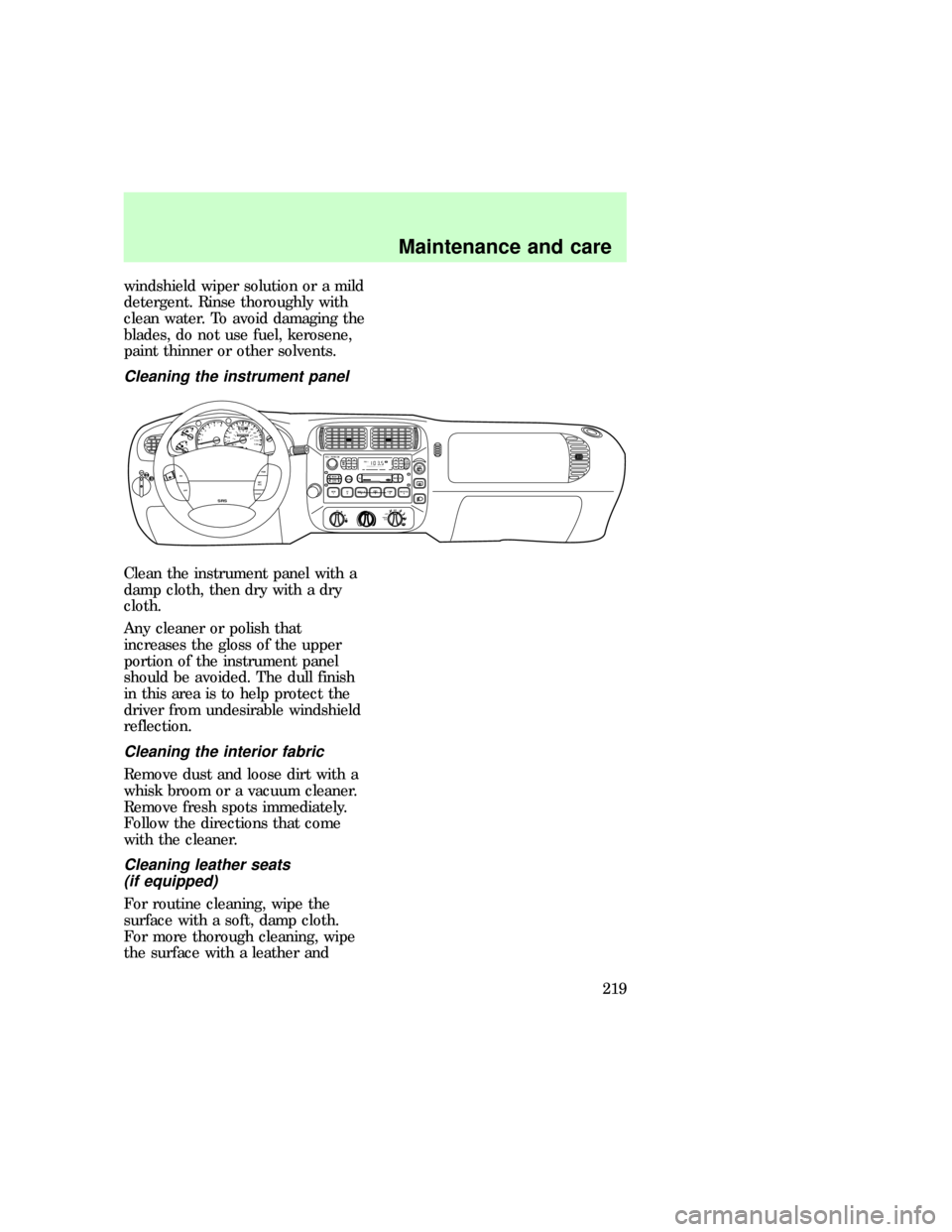
Cleaning the instrument panel
Clean the instrument panel with a
damp cloth, then dry with a dry
cloth.
Any cleaner or polish that
increases the gloss of the upper
portion of the instrument panel
should be avoided. The dull finish
in this area is to help protect the
driver from undesirable windshield
reflection.
Cleaning the interior fabric
Remove dust and loose dirt with a
whisk broom or a vacuum cleaner.
Remove fresh spots immediately.
Follow the directions that come
with the cleaner.
Cleaning leather seats
(if equipped)
For routine cleaning, wipe the
surface with a soft, damp cloth.
For more thorough cleaning, wipe
the surface with a leather and
0P RND21RPM x 100012345
6H
C
EF
RSM
SET
ACC
COAST OFF ONOFF
SRS
HI LOOFF*A/C*MAX
A/C
REW
1FF
2SIDE 1-2
3
FM 1STVOL – PUSH ON
AM
FMBASS TREBBAL FADE
AUTO
SET CLK
SEEKTUNE
DISCSSCAN4DOLBY SYSTEMEJTAPE CDCOMP5SHUFFLE
6
PUSH
020
1030405060
70
80
90
110
120000000oooo
km/h10020406080100
120
140
160
180
uno_instru-panel_cleaning
com_int_fabric_cleaning.01
com_leather_seats_cleaning.01
Maintenance and care
219
Page 221 of 236
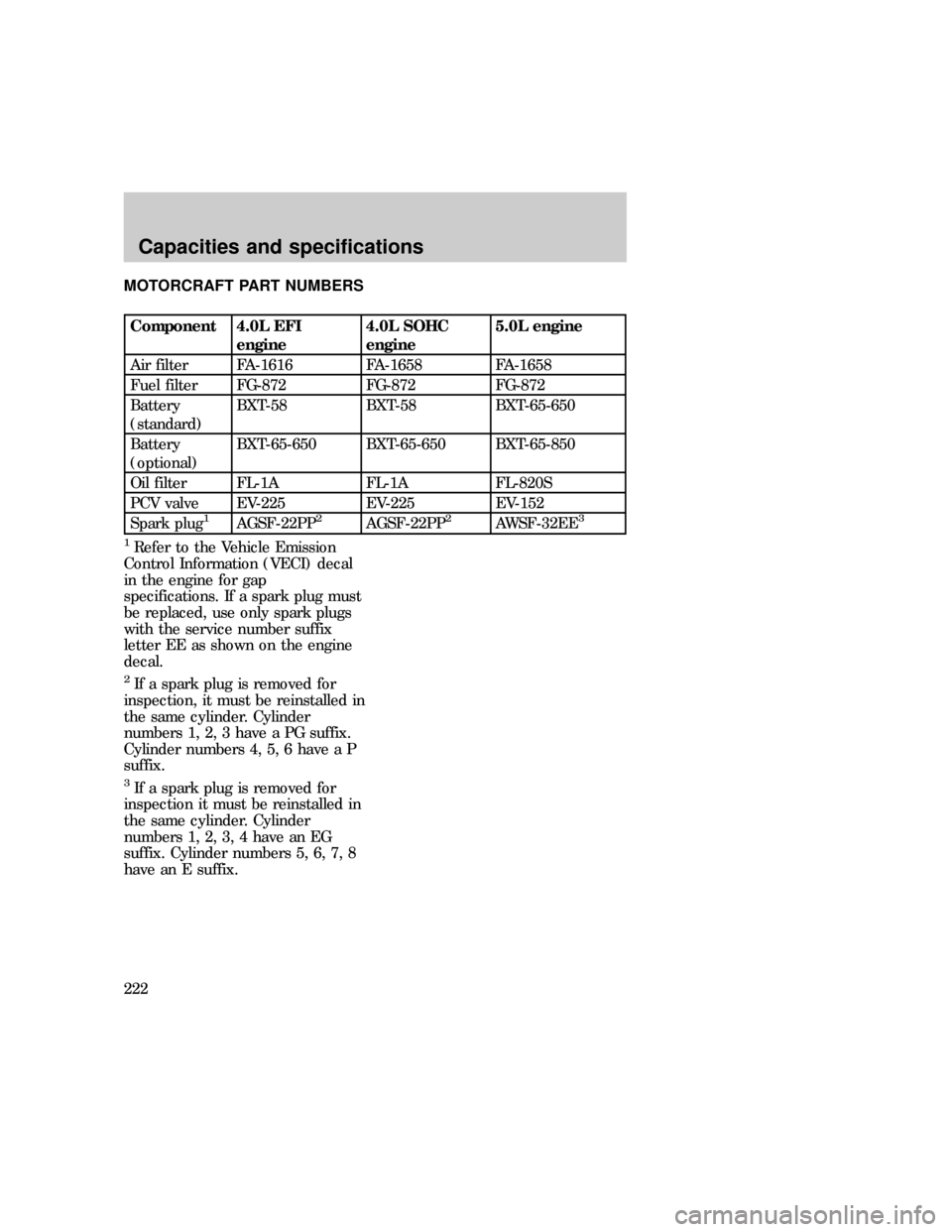
MOTORCRAFT PART NUMBERS
Component 4.0L EFI
engine4.0L SOHC
engine5.0L engine
Air filter FA-1616 FA-1658 FA-1658
Fuel filter FG-872 FG-872 FG-872
Battery
(standard)BXT-58 BXT-58 BXT-65-650
Battery
(optional)BXT-65-650 BXT-65-650 BXT-65-850
Oil filter FL-1A FL-1A FL-820S
PCV valve EV-225 EV-225 EV-152
Spark plug
1AGSF-22PP2AGSF-22PP2AWSF-32EE3
1
Refer to the Vehicle Emission
Control Information (VECI) decal
in the engine for gap
specifications. If a spark plug must
be replaced, use only spark plugs
with the service number suffix
letter EE as shown on the engine
decal.
2If a spark plug is removed for
inspection, it must be reinstalled in
the same cylinder. Cylinder
numbers 1, 2, 3 have a PG suffix.
Cylinder numbers 4, 5, 6 have a P
suffix.
3If a spark plug is removed for
inspection it must be reinstalled in
the same cylinder. Cylinder
numbers 1, 2, 3, 4 have an EG
suffix. Cylinder numbers 5, 6, 7, 8
have an E suffix.
com_explorer-part-numbers
Capacities and specifications
222
Page 224 of 236
in water. For Traction-Lok rear
axles, add 4 ounces of additive
friction modifier C8AZ-19B546-A,
Ford specification EST-M2C118±A,
whenever the lubricant is changed.
4Refer to your ªService Guideº for
axle fluid change intervals.
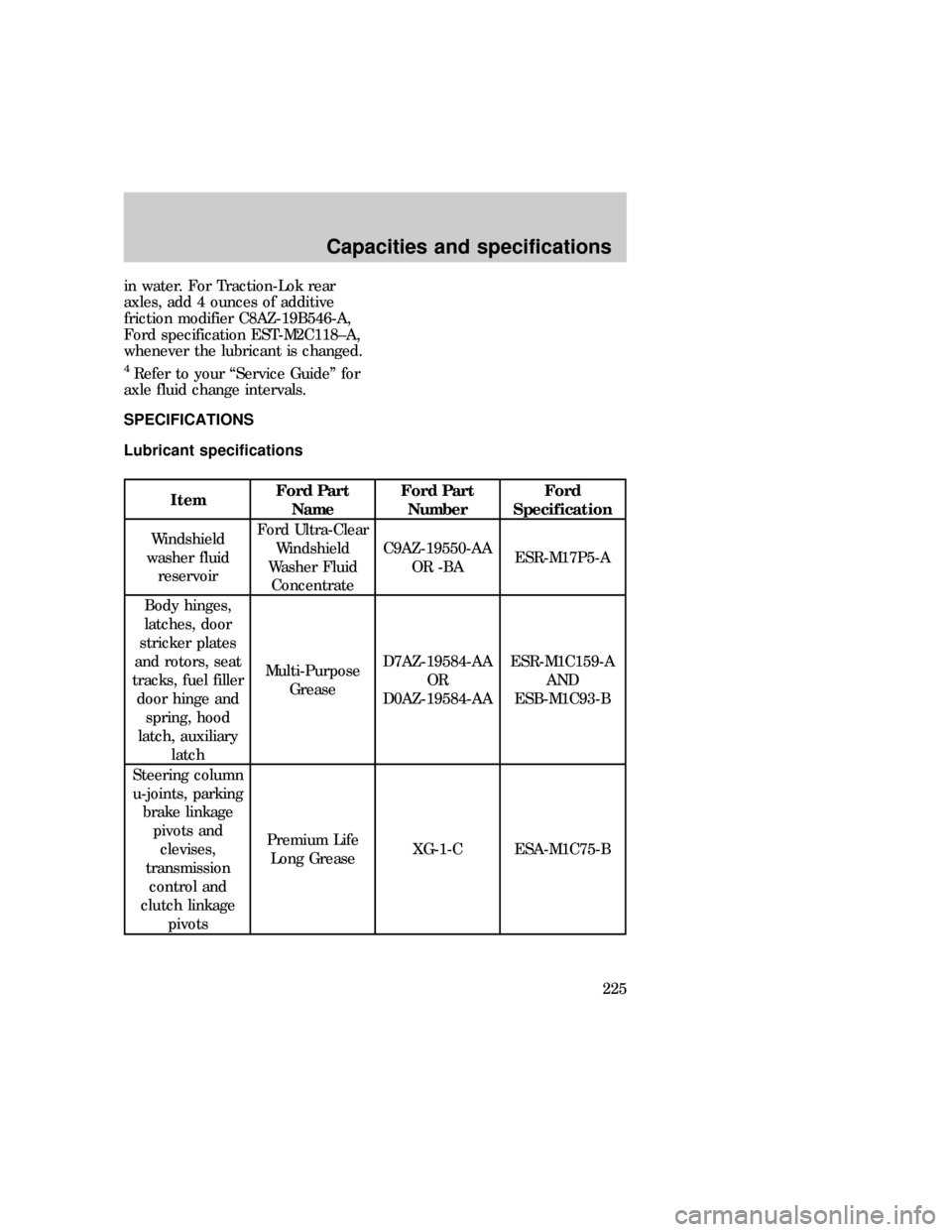
SPECIFICATIONS
Lubricant specifications
ItemFord Part
NameFord Part
NumberFord
Specification
Windshield
washer fluid
reservoirFord Ultra-Clear
Windshield
Washer Fluid
ConcentrateC9AZ-19550-AA
OR -BAESR-M17P5-A
Body hinges,
latches, door
stricker plates
and rotors, seat
tracks, fuel filler
door hinge and
spring, hood
latch, auxiliary
latchMulti-Purpose
GreaseD7AZ-19584-AA
OR
D0AZ-19584-AAESR-M1C159-A
AND
ESB-M1C93-B
Steering column
u-joints, parking
brake linkage
pivots and
clevises,
transmission
control and
clutch linkage
pivotsPremium Life
Long GreaseXG-1-C ESA-M1C75-B
uno_special_lube_specs
uno_lubricants
Capacities and specifications
225