Page 140 of 236
TRAILER TOWING TABLE 4X2 AUTOMATIC TRANSMISSION
GCWR (Gross Combined Weight Rating)/Trailer Weights
Engine
(EFI)Rear Axle
RatioMaximum
GCWR
Kg(Lb)Trailer Weight
Range Kg(Lb)
0-MaximumMaximum
Frontal Area of
Trailer Ft
2
2-DOOR
4.0 L3.27 3,175
(7,000)0-1,360
(0-3,000)50
4.0 L3.55 3,628
(8,000)0-1,814
(0-4,000)50
4.0 L3.73 4,082
(9,000)0-2,267
(0-5,000)50
4-DOOR
4.0 L 3.554,082
(9,000)0-2,177
(0-4800)50
4.0 L 3.734,535
(10,000)0-2,630
(0-5,800)50
4.0 L 4.104,535
(10,000)0-2,630
(0-5,800)50
5.0 L 3.734,990
(11,080)0-3,039
(0-6,700)50
TRAILER TOWING TABLE 4X4 AUTOMATIC TRANSMISSION
GCWR (Gross Combined Weight Rating)/Trailer Weights
2-DOOR
4.0 L3.27 3,175
(7,000)0-1,270
(0-2,800)50
4.0 L3.55 3,628
(8,000)0-1,723
(0-3,800)50
4.0 L3.73 4,082
(9,000)0-2,177
(0-4,800)50
4-DOOR
4.0 L 3.554,082
(9,000)0-2,086
(0-4,600)50
Driving
141
Page 141 of 236

TRAILER TOWING TABLE 4X4 AUTOMATIC TRANSMISSION
4.0 L 3.734,535
(10,000)0-2,540
(0-5,600)50
4.0 L 4.104,535
(10,000)0-2,540
(0-5,600)50
TRAILER TOWING TABLE AWD AUTOMATIC TRANSMISSION
GCWR (Gross Combined Weight Rating)/Trailer Weights
4-DOOR
5.0 L 3.734,990
(11,000)0-2,902
(0-6,400)50
NOTES:
- For high altitude operation, reduce GCW by 2% per 300 meters
(1,000 ft) elevation.
- For definition of terms and instructions on calculating your vehicle's
load, refer toLoading your vehiclein this chapter.
- Maximum trailer weights shown. The combined weight of the
completed towing vehicle and the loaded trailer must not exceed the
GCWR.
Calculating trailer loads
To determine the amount of weight
that your vehicle can carry:
²Obtain ratings from the Safety
Compliance Certification label
and the trailer towing
specifications in this chapter.
²Weigh your vehicle as you
customarily operate the vehicle
without cargo.
²Subtract the total weight of
passengers, driver and optional
equipment to determine the
total weight that your vehicle
can carry.
uno_calculating_towing
Driving
142
Page 143 of 236

working properly, the warning
lights in the instrument cluster
may not work properly.
Using a hitch
Do not use hitches that:
²clamp onto the vehicle bumper
²attach to the axle.
Distribute the load so that only 10
to 15% of the total weight of the
trailer is on the tongue. tie down
the load so that it does not shift
and change the weight on the
hitch. Follow the towing
instructions of a reputable rental
agency.
Driving while towing a trailer
Do not drive faster than 70 km/h
(45 mph) while towing a 454 kg
(1000 lb) trailer. Do not drive
faster than 72 km/h (45 mph) with
any weight trailer while towing in
hilly terrain or on hot days.
Speed control (if equipped) may
not work properly while towing on
long, steep grades.
If driving with an automatic
transmission:
²use D or L rather than while
towing up or down steep hills
²anticipate stops and brake
gradually.
Towing behind another vehicle
Do not tow your vehicle behind
another vehicle, such as an RV,
unless front wheel dollies are used.
uno_hitch
uno_driving_towing
uno_towing_behind
Driving
144
Page 144 of 236

Your vehicle can not be flat towed
with all wheels on the ground.
Servicing while towing
If you tow a trailer for long
distances, your vehicle requires
more frequent service than a
vehicle not used for towing. Refer
to the ªService Guideº for more
information on maintenance
intervals.
Using a step bumper
The rear bumper is equipped with
an integral hitch and requires only
a ball with a ô inch shank
diameter. The bumper has a Class
II capability (1590 kg / 3500 lb
trailer weight and 159 kg / 350 lb
tongue weight).
Use a frame mounted weight
distributing hitch for trailers over
1590 kg (3500 lb).
Launching or retrieving a boat
When backing down a ramp during
boat launching or retrieval,
²Do not allow the static water
level to rise above the bottom
edge of the rear bumper and
²Do not allow waves to break
higher than 15 cm (six inches)
above the bottom edge of the
rear bumper.
Exceeding these limits may allow
water to enter critical vehicle
components, adversely affecting
driveability, emissions and
reliability.uno_servicing_while_towing
uno_step_bumper_towing
com_launch-retrieving_boat.01
uno_roof-rack_title
Driving
145
Page 158 of 236
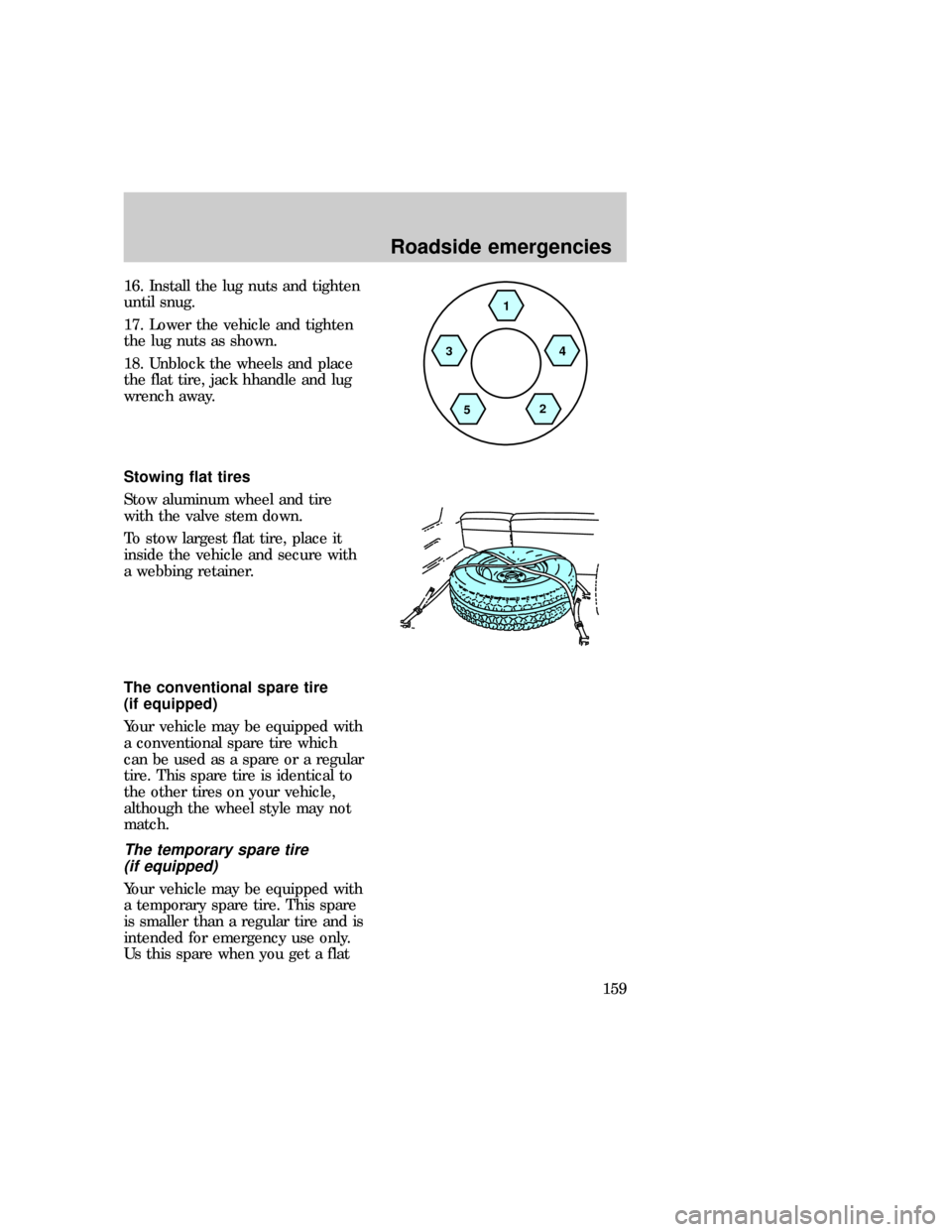
16. Install the lug nuts and tighten
until snug.
17. Lower the vehicle and tighten
the lug nuts as shown.
18. Unblock the wheels and place
the flat tire, jack hhandle and lug
wrench away.
Stowing flat tires
Stow aluminum wheel and tire
with the valve stem down.
To stow largest flat tire, place it
inside the vehicle and secure with
a webbing retainer.
The conventional spare tire
(if equipped)
Your vehicle may be equipped with
a conventional spare tire which
can be used as a spare or a regular
tire. This spare tire is identical to
the other tires on your vehicle,
although the wheel style may not
match.
The temporary spare tire
(if equipped)
Your vehicle may be equipped with
a temporary spare tire. This spare
is smaller than a regular tire and is
intended for emergency use only.
Us this spare when you get a flat
1
4
2
5 3
uno_stowing_flat_tires
uno_conventional_spare
uno_temporary_spare
Roadside emergencies
159
Page 161 of 236
![FORD EXPLORER 1997 2.G Owners Manual Do not connect the end of
the second cable to the
negative ([-]) terminal of the
battery to be jumped. A spark
may cause an explosion of the
gases that surround the battery.
Jump starting
1. Start the](/manual-img/11/4954/w960_4954-160.png "FORD EXPLORER 1997 2.G Owners Manual Do not connect the end of
the second cable to the
negative ([-]) terminal of the
battery to be jumped. A spark
may cause an explosion of the
gases that surround the battery.
Jump starting
1. Start the")
Do not connect the end of
the second cable to the
negative ([-]) terminal of the
battery to be jumped. A spark
may cause an explosion of the
gases that surround the battery.
Jump starting
1. Start the booster vehicle and
run the engine at moderately
increased speed.
2. Start the engine of the vehicle
with the discharged battery.
3. Once the engine has been
started, run both vehicles for a
further three minutes before
disconnecting the cable leads.
Removing the jumper cables
1. Remove the jumper cables in
reverse order. Take the cable off
the metallic surface (1) first,
followed by the cable on the
negative (-) booster battery
terminal (2).
2. Remove the cable from the
positive (+) terminal of the booster
battery (3) and then the
discharged battery (4).
3. After the disabled vehicle has
been started, allow it to idle for a
while so the engine can ªrelearnº
its idle conditions.
+–
+–
2
3
4
1
uno_jump_starting
com_removing_cables.01
uno_wrecker_towing
Roadside emergencies
162
Page 162 of 236
WRECKER TOWING
Ford recommends that your
vehicle be towed with wheel lift
and dollies or flatbed equipment.
Do not tow with slingbelt
equipment. Ford Motor Company
has not developed or approved a
T-hook or slingbelt towing
procedure.
For vehicles equipped with control
trac, the ignition must be in the
OFF position when towing.
When calling for a tow truck, tell
the operator what kind of vehicle
you have. A towing manual is
available for Ford Motor Company
Roadside emergencies
163
Page 163 of 236
for all authorized tow truck
operators. Have your tow truck
driver refer to this manual for
proper hook-up and towing
procedures.
Neutral tow kit accessory
Neutral tow feature is an option
which can be activated at any
dealership that has a Service Bay
Diagnostic System (SBDS). When
activated the feature may be
enabled by following the
instruction located on the visor or
the headliner.
The feature is available on vehicles
with Control Trac and automatic
transmission only. It is not
available on vehicles with
All-Wheel Drive.
There are no wrecker or
recreational vehicle towing
restrictions on method or distance
if the above feature is activated
and enabled.
See your dealer for more
information.
uno_tow-kit
Roadside emergencies
164