Page 145 of 224
4. Remove the end of the cable
from the wheel and slide the spare
out from under the vehicle.
To re-install the spare tire or tools,
reverse the removal procedure.
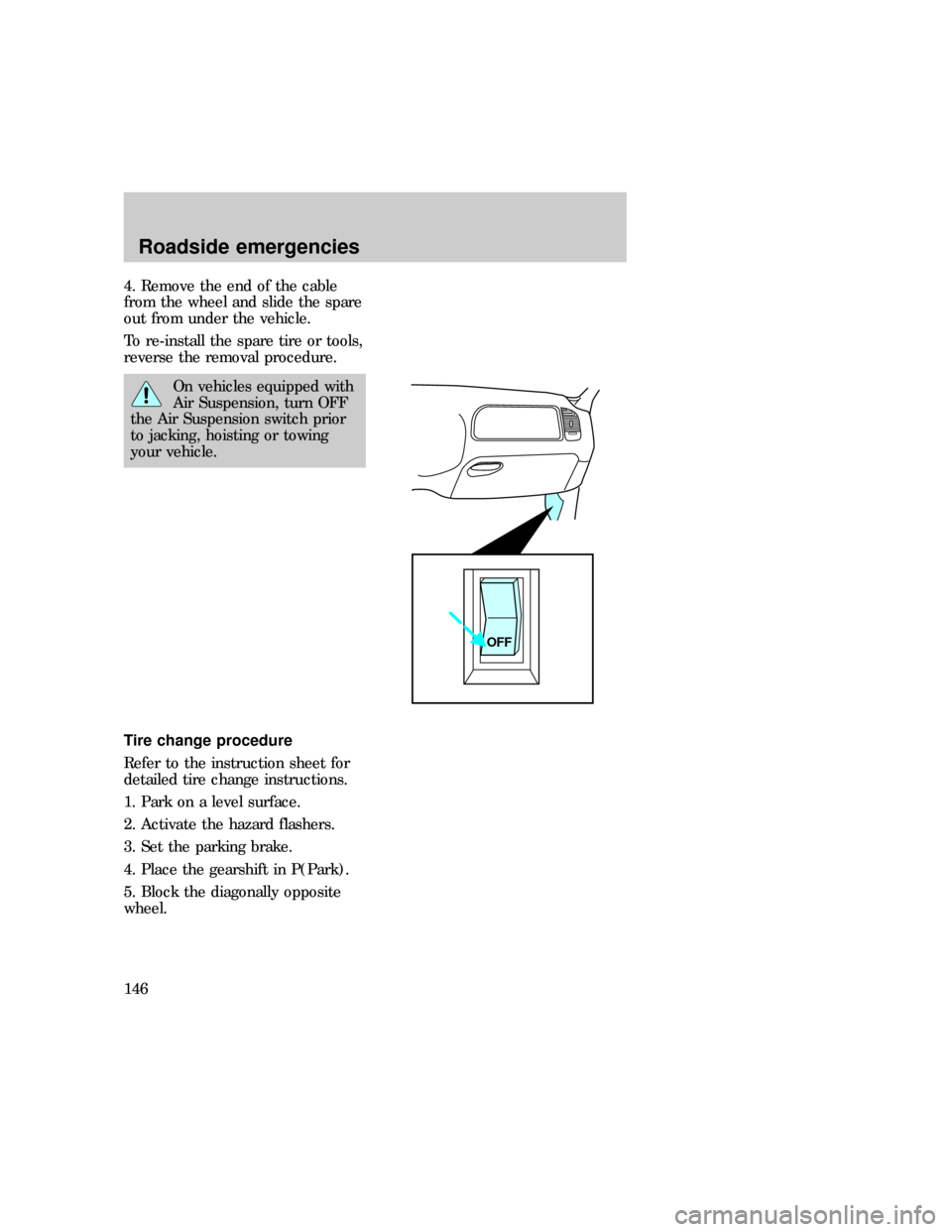
On vehicles equipped with
Air Suspension, turn OFF
the Air Suspension switch prior
to jacking, hoisting or towing
your vehicle.
Tire change procedure
Refer to the instruction sheet for
detailed tire change instructions.
1. Park on a level surface.
2. Activate the hazard flashers.
3. Set the parking brake.
4. Place the gearshift in P(Park).
5. Block the diagonally opposite
wheel.
OFF
exd_change_proc
exd_removing_flat
Roadside emergencies
146
Page 148 of 224
Rear
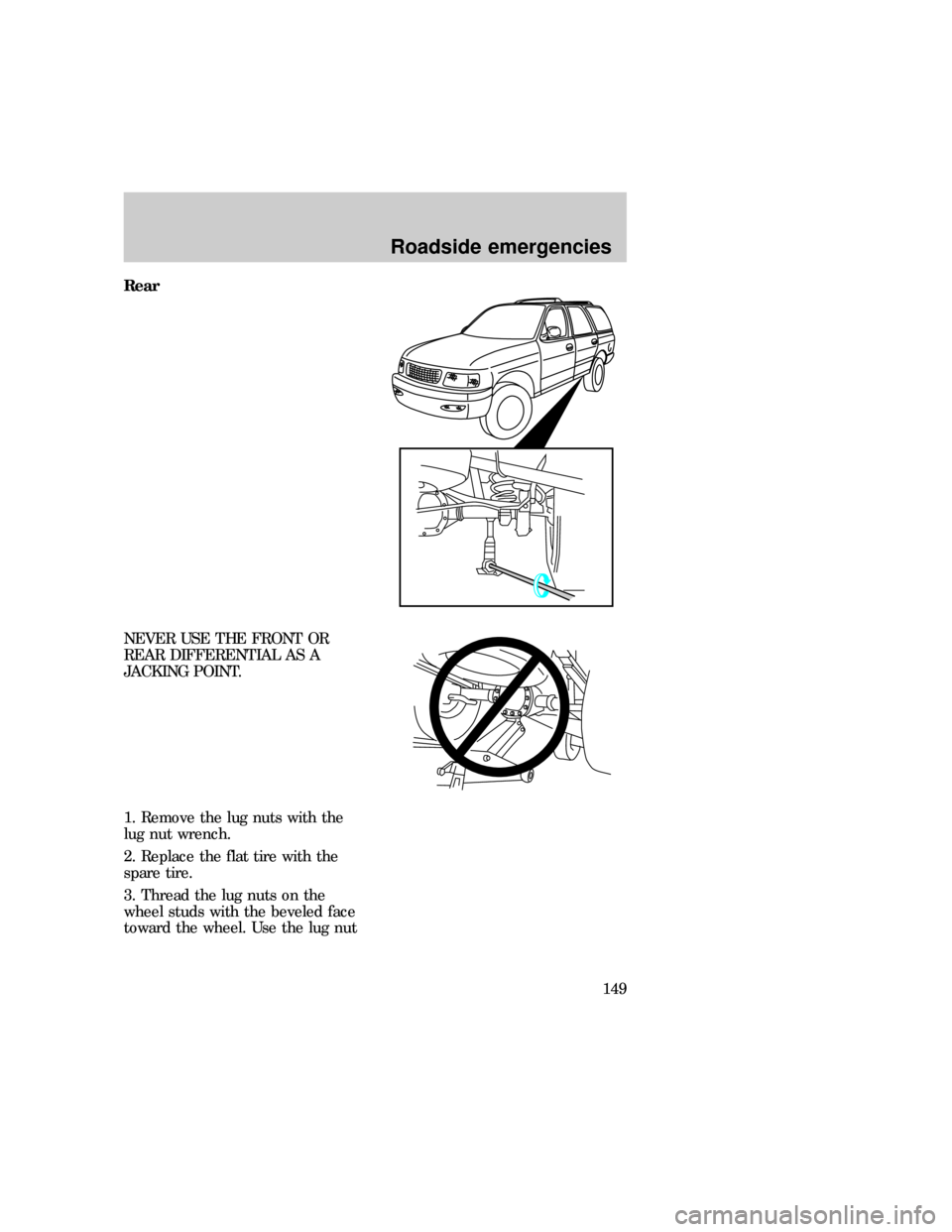
NEVER USE THE FRONT OR
REAR DIFFERENTIAL AS A
JACKING POINT.
1. Remove the lug nuts with the
lug nut wrench.
2. Replace the flat tire with the
spare tire.
3. Thread the lug nuts on the
wheel studs with the beveled face
toward the wheel. Use the lug nut
Roadside emergencies
149
Page 149 of 224
wrench to screw the lug nut snug
against the wheel, but do not
tighten.
4. Lower the vehicle by turning the
jack handle counterclockwise.
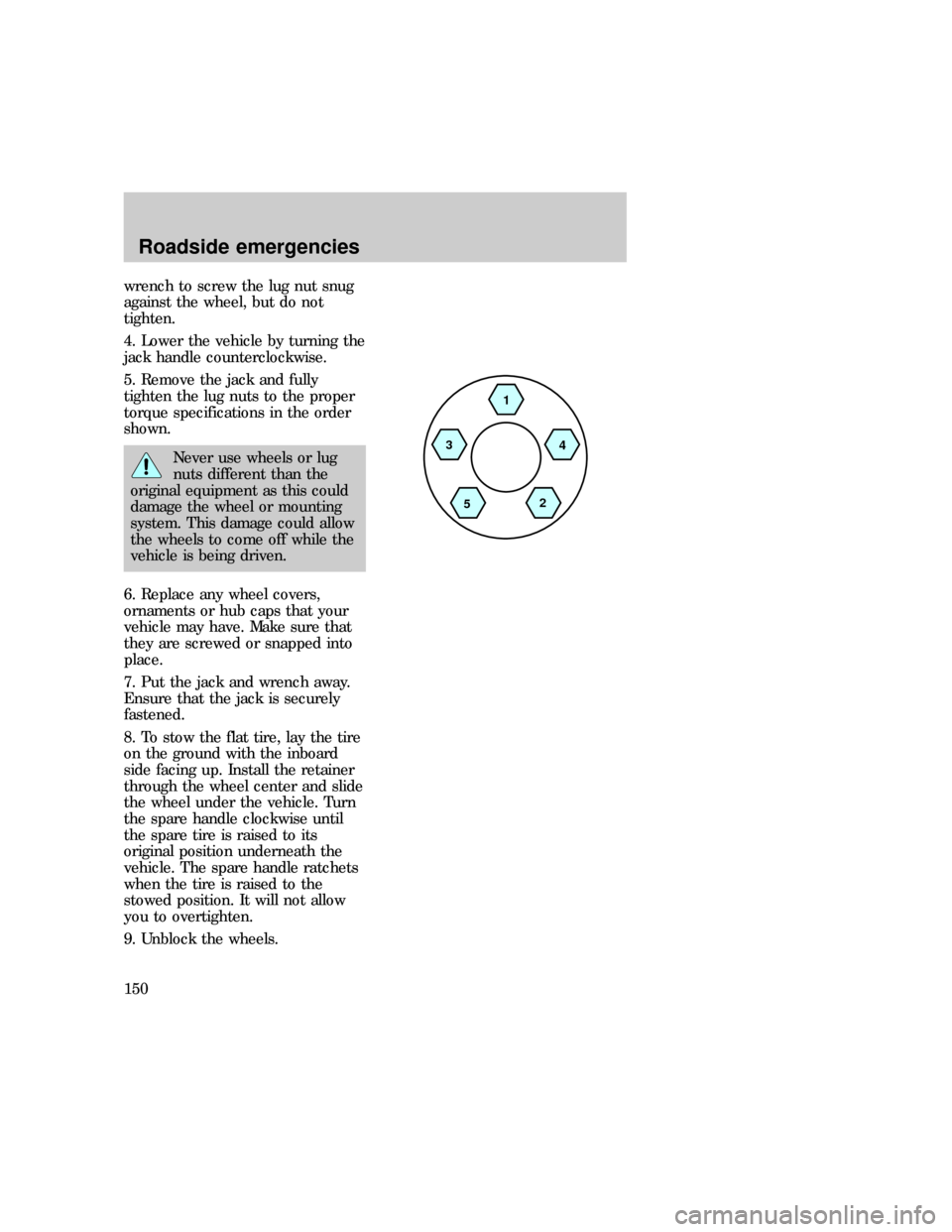
5. Remove the jack and fully
tighten the lug nuts to the proper
torque specifications in the order
shown.
Never use wheels or lug
nuts different than the
original equipment as this could
damage the wheel or mounting
system. This damage could allow
the wheels to come off while the
vehicle is being driven.
6. Replace any wheel covers,
ornaments or hub caps that your
vehicle may have. Make sure that
they are screwed or snapped into
place.
7. Put the jack and wrench away.
Ensure that the jack is securely
fastened.
8. To stow the flat tire, lay the tire
on the ground with the inboard
side facing up. Install the retainer
through the wheel center and slide
the wheel under the vehicle. Turn
the spare handle clockwise until
the spare tire is raised to its
original position underneath the
vehicle. The spare handle ratchets
when the tire is raised to the
stowed position. It will not allow
you to overtighten.
9. Unblock the wheels.
1
4
2
5 3
Roadside emergencies
150
Page 152 of 224
3. Once the engine has been
started, run both vehicles for a
further three minutes before
disconnecting the leads.
Removing the jumper cables
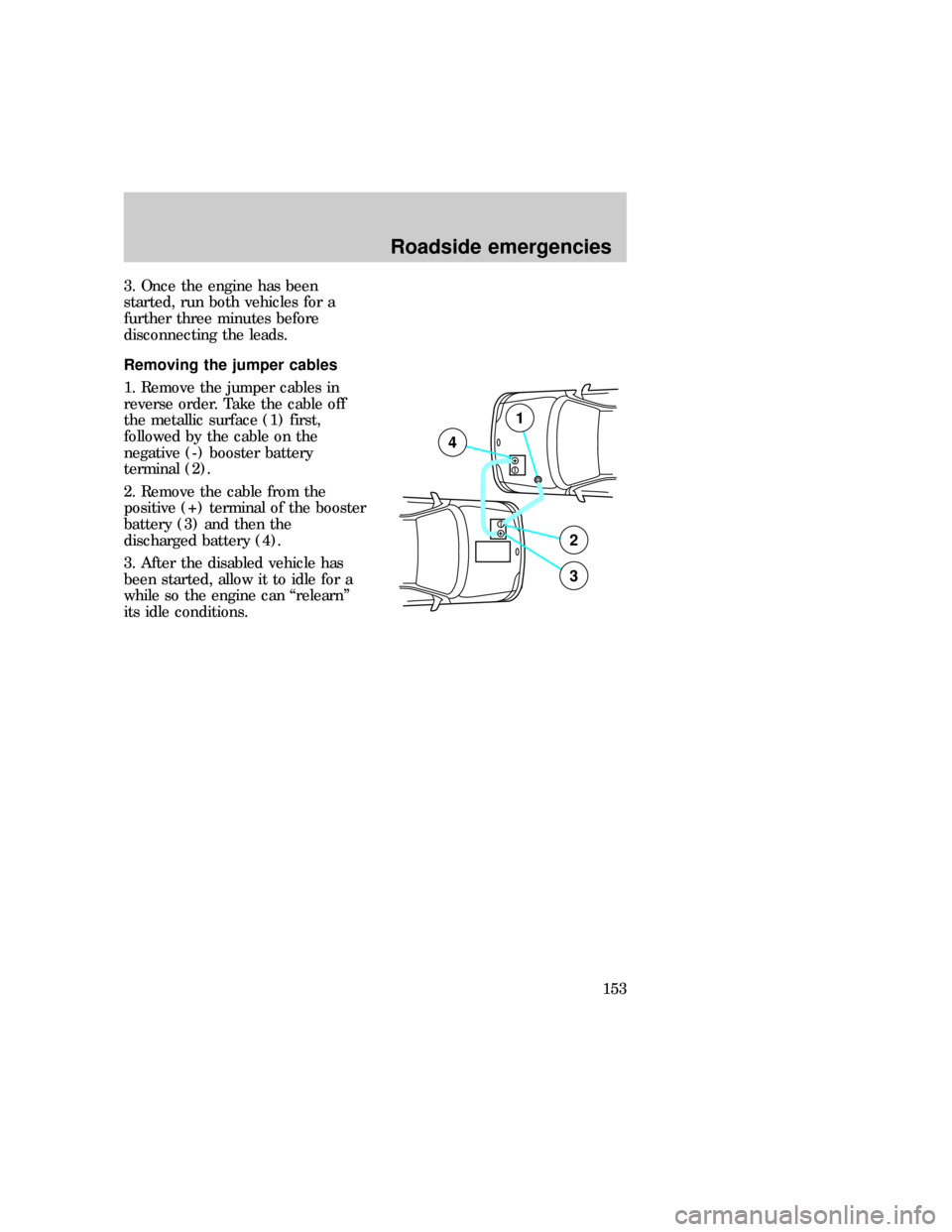
1. Remove the jumper cables in
reverse order. Take the cable off
the metallic surface (1) first,
followed by the cable on the
negative (-) booster battery
terminal (2).
2. Remove the cable from the
positive (+) terminal of the booster
battery (3) and then the
discharged battery (4).
3. After the disabled vehicle has
been started, allow it to idle for a
while so the engine can ªrelearnº
its idle conditions.
+–
+–
2
3
4
1
com_removing_cables.01
exd_wrecker_towing
Roadside emergencies
153
Page 153 of 224
WRECKER TOWING
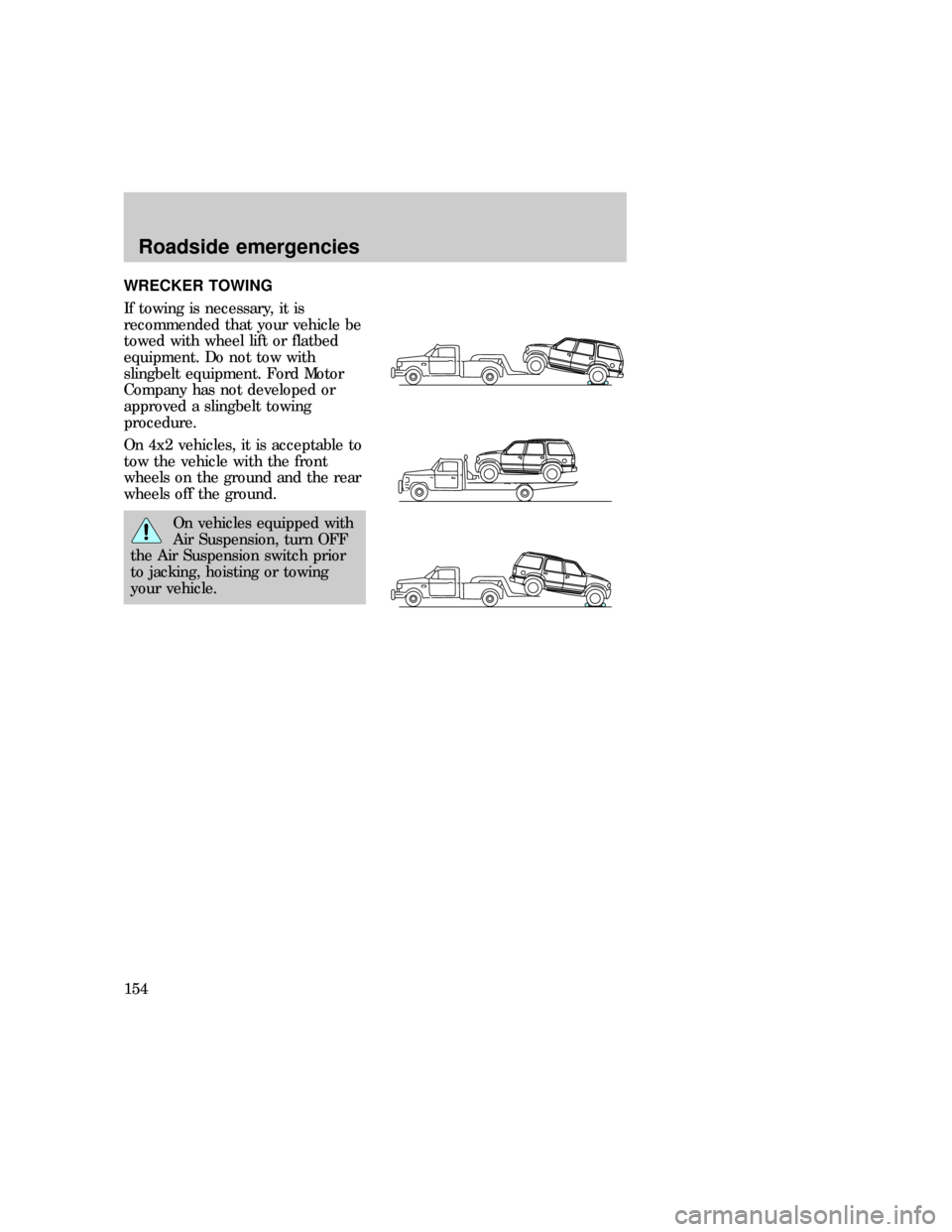
If towing is necessary, it is
recommended that your vehicle be
towed with wheel lift or flatbed
equipment. Do not tow with
slingbelt equipment. Ford Motor
Company has not developed or
approved a slingbelt towing
procedure.
On 4x2 vehicles, it is acceptable to
tow the vehicle with the front
wheels on the ground and the rear
wheels off the ground.
On vehicles equipped with
Air Suspension, turn OFF
the Air Suspension switch prior
to jacking, hoisting or towing
your vehicle.
Roadside emergencies
154
Page 161 of 224

Changing the engine oil and
filter
Change your engine oil and filter
according to the following
kilometers (mileage) and time
requirements, whichever occurs
first:
²Normal Schedule ± 8,000 km
(5,000 miles) or six months.
²Severe Duty Schedule ± 5,000
km (3,000 miles) or three
months. Severe duty operation
would include extensive idling,
trailer towing, driving in severe
dust and police, taxi or delivery
service.
Ford production and aftermarket
(Motorcraft) oil filters are designed
for added engine protection and
long life. If a replacement oil filter
is used that does not meet Ford
material and design specifications,
startup engine noises or knock
may be experienced.
It is recommended you use the
appropriate Motorcraft oil filter (or
another brand meeting Ford
specifications) for your engine
application.
Checking and adding brake
fluid
Brake fluid should be checked and
refilled as needed at least once
each year:
exd_fix-me
com_checking-adding_fluid.01
Maintenance and care
162
Page 164 of 224
Washer fluid in the liftgate
reservoir
Washer fluid for liftgate wiper and
washer operation is supplied by
the washer fluid reservoir located
in the engine compartment. For
information on adding fluid to this
main reservoir, refer toWasher
fluid in the windshield reservoir
in this chapter.
CHECKING AND ADDING
ENGINE COOLANT
Adding engine coolant
Do not put engine coolant
in the container for the
windshield washer fluid.
If sprayed on the windshield,
engine coolant could make it
difficult to see through the
windshield.
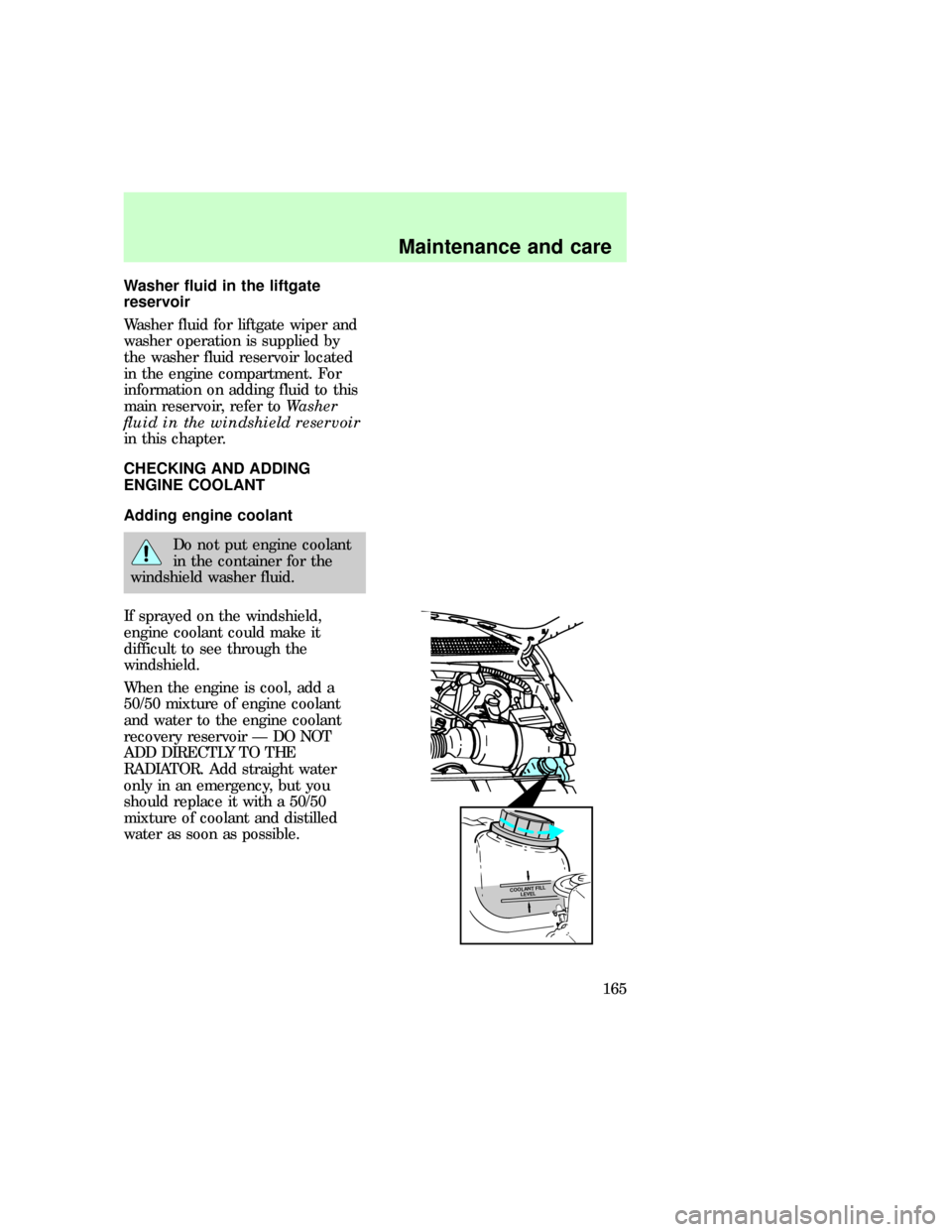
When the engine is cool, add a
50/50 mixture of engine coolant
and water to the engine coolant
recovery reservoir Ð DO NOT
ADD DIRECTLY TO THE
RADIATOR. Add straight water
only in an emergency, but you
should replace it with a 50/50
mixture of coolant and distilled
water as soon as possible.
COOLANT FILL
LEVEL
exd_coolant
exd_adding_coolant
Maintenance and care
165
Page 180 of 224
To replace the wiper blades:
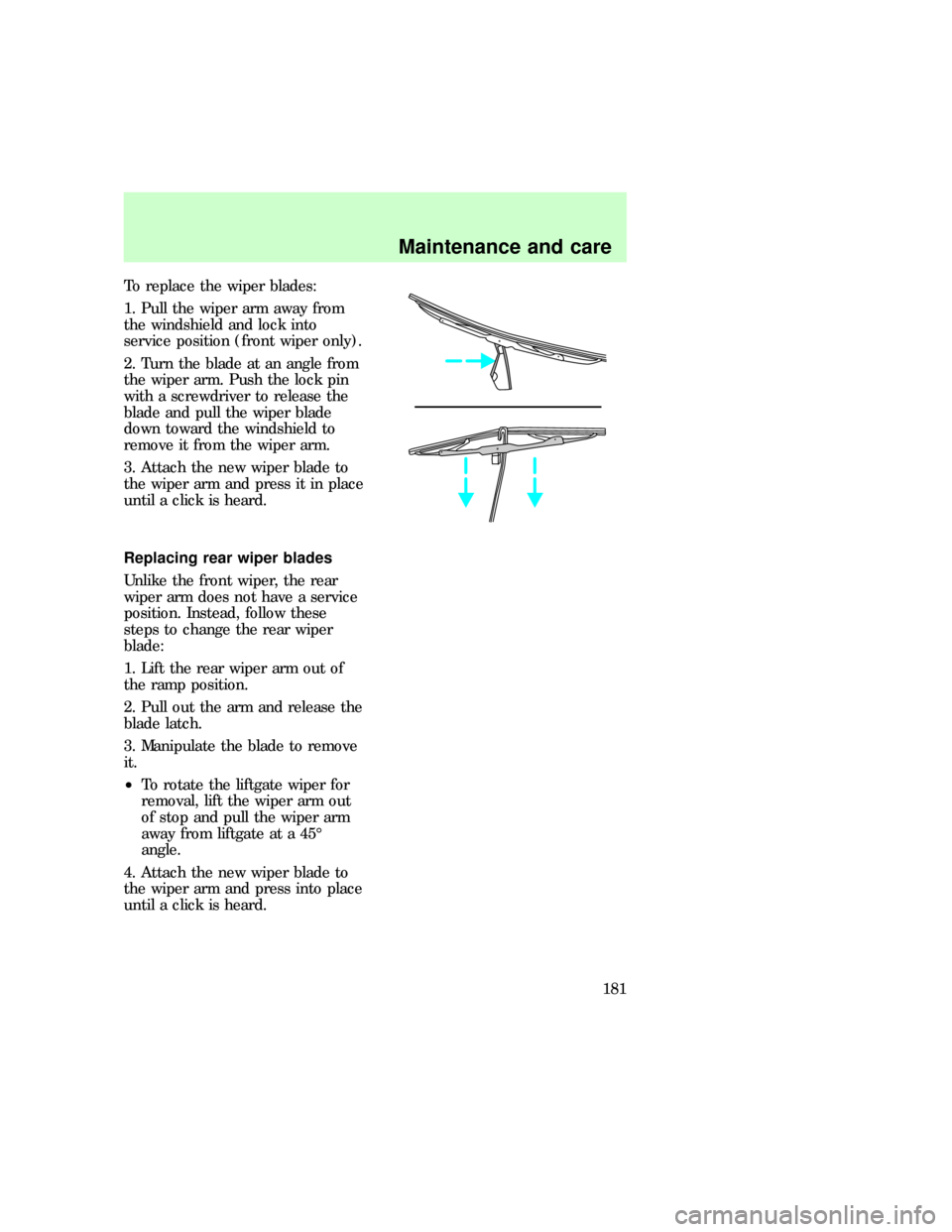
1. Pull the wiper arm away from
the windshield and lock into
service position (front wiper only).
2. Turn the blade at an angle from
the wiper arm. Push the lock pin
with a screwdriver to release the
blade and pull the wiper blade
down toward the windshield to
remove it from the wiper arm.
3. Attach the new wiper blade to
the wiper arm and press it in place
until a click is heard.
Replacing rear wiper blades
Unlike the front wiper, the rear
wiper arm does not have a service
position. Instead, follow these
steps to change the rear wiper
blade:
1. Lift the rear wiper arm out of
the ramp position.
2. Pull out the arm and release the
blade latch.
3. Manipulate the blade to remove
it.
²To rotate the liftgate wiper for
removal, lift the wiper arm out
of stop and pull the wiper arm
away from liftgate at a 45É
angle.
4. Attach the new wiper blade to
the wiper arm and press into place
until a click is heard.
exd_rear_wiper_replace
exd_maint-tires
Maintenance and care
181