Page 167 of 224
Severe winter climate
If you drive in extremely cold
climates [less than 36ÉC (34ÉF)], it
may be necessary to increase the
coolant concentration above 50%.
Refer to the chart on the coolant
container to ensure the coolant
concentration in your vehicle is such
that the coolant will not freeze at
the temperature level in which you
drive during winter months. Never
increase the engine coolant
concentration above 60%. Leave a
50/50 mixture of engine coolant and
water in your vehicle year-round in
non-extreme climates.
Checking the cooling system
hoses
Inspect all engine and heater system
hoses and hose connections for:
com_checking_hoses.01
Maintenance and care
168
Page 168 of 224
²deterioration
²leaks
²loose hose clamps
What you should know about
fail-safe cooling
Vehicles equipped with 4.6L, and
5.4L engines have a fail-safe
cooling mode. If the engine coolant
supply is depleted, this feature
allows the vehicle to be driven
temporarily before incremental
component damage is incurred.
The ªfail safeº distance depends on
ambient temperatures, vehicle load
and terrain.
When fail-safe mode is
activated
²Pull off the road as soon as
possible.
²Immediately turn the engine off
to prevent severe engine
damage.
²Wait for the engine to cool.
²Check the coolant level.
exd_failsafe_cooling
com_activated_failsafe.01
exd_how_failsafe
Maintenance and care
169
Page 169 of 224
How fail-safe cooling works
If the engine overheats, the engine
will automatically switch from
eight to alternating four cylinder
operation. Each disabled cylinder
acts as an air pump and cools the
engine.
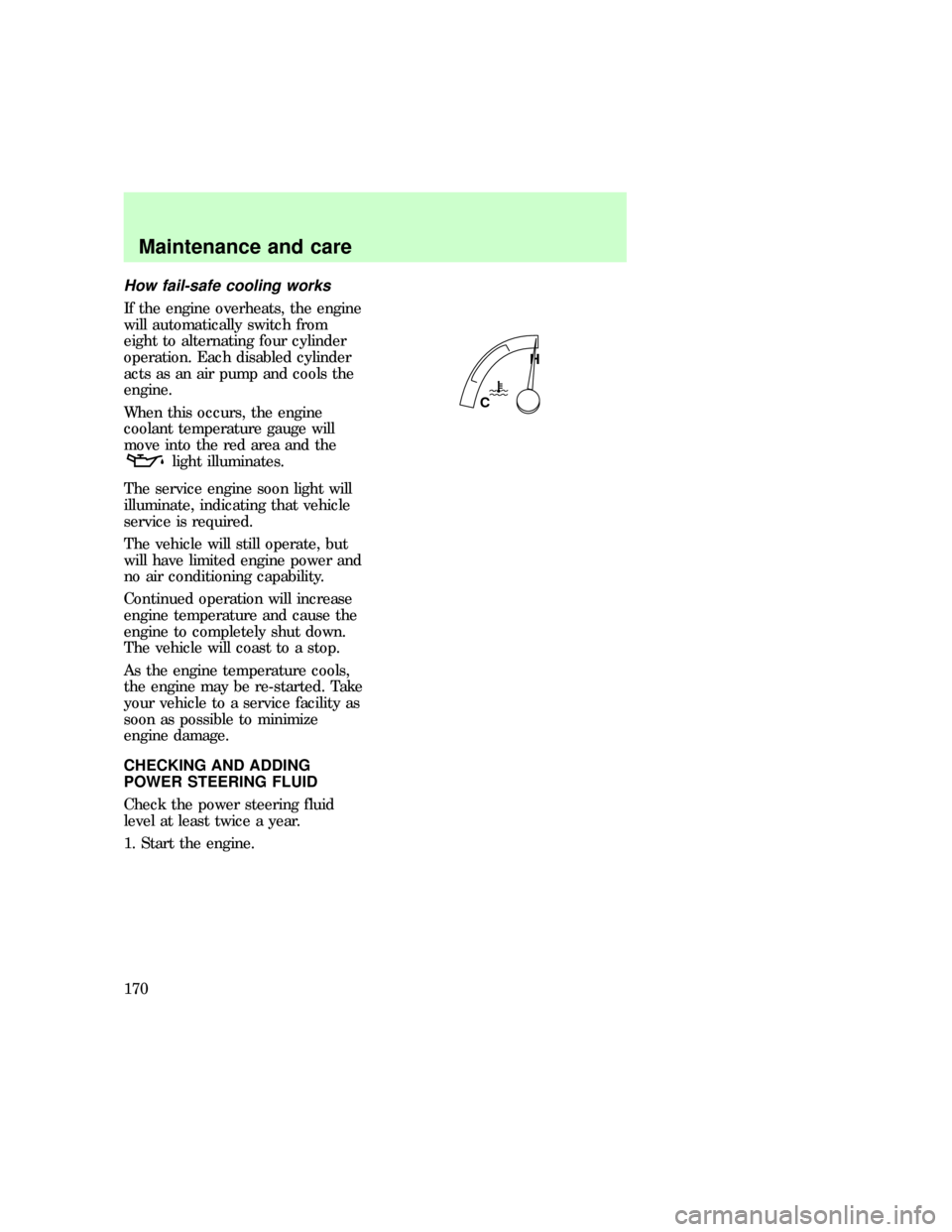
When this occurs, the engine
coolant temperature gauge will
move into the red area and the
light illuminates.
The service engine soon light will
illuminate, indicating that vehicle
service is required.
The vehicle will still operate, but
will have limited engine power and
no air conditioning capability.
Continued operation will increase
engine temperature and cause the
engine to completely shut down.
The vehicle will coast to a stop.
As the engine temperature cools,
the engine may be re-started. Take
your vehicle to a service facility as
soon as possible to minimize
engine damage.
CHECKING AND ADDING
POWER STEERING FLUID
Check the power steering fluid
level at least twice a year.
1. Start the engine.
CH
exd_power_steering
Maintenance and care
170
Page 171 of 224
CHECKING AND ADDING
TRANSMISSION FLUID
Checking and adding automatic
transmission fluid (if equipped)
Service the automatic transmission
according to the scheduled
intervals in the9Service Guide.9
Before adding any fluid, make sure
the correct type will be used. This
information is indicated on the
dipstick.
²4R7OW automatic transmissions
are used with 4.6 L engine
applications.
²E4OD automatic transmissions
are used with 5.4 L engine
applications.
Do not drive the vehicle if the fluid
level is below the bottom hole on
the blade type dipstick (4R70W
transmission) or below the COLD
area on the bullet type dipstick
(E4OD transmission) and outside
temperatures are above 10ÉC
(50ÉF).
Your vehicle does not use up
transmission fluid. However, it is
recommended that you check the
transmission fluid at least twice a
year. The fluid level should be
checked if the transmission is not
working properly, i.e., if the
transmission slips or shifts slowly
or if you notice some sign of fluid
leakage.
It is preferable to check the
transmission fluid level at normal
operating temperature, afterexd_checking_adding_autotrans
Maintenance and care
172
Page 172 of 224
approximately 32 km (20 miles) of
driving. However, you can check
the fluid level without driving to
obtain a normal operating
temperature if the outside
temperature is above 10ÉC (50ÉF).
If your vehicle has been operated
for an extended period at high
speeds, in city traffic during hot
weather or pulling a trailer, the
vehicle should be turned off for
about 30 minutes to allow the fluid
to cool before checking.
1. Park the vehicle on a level
surface.
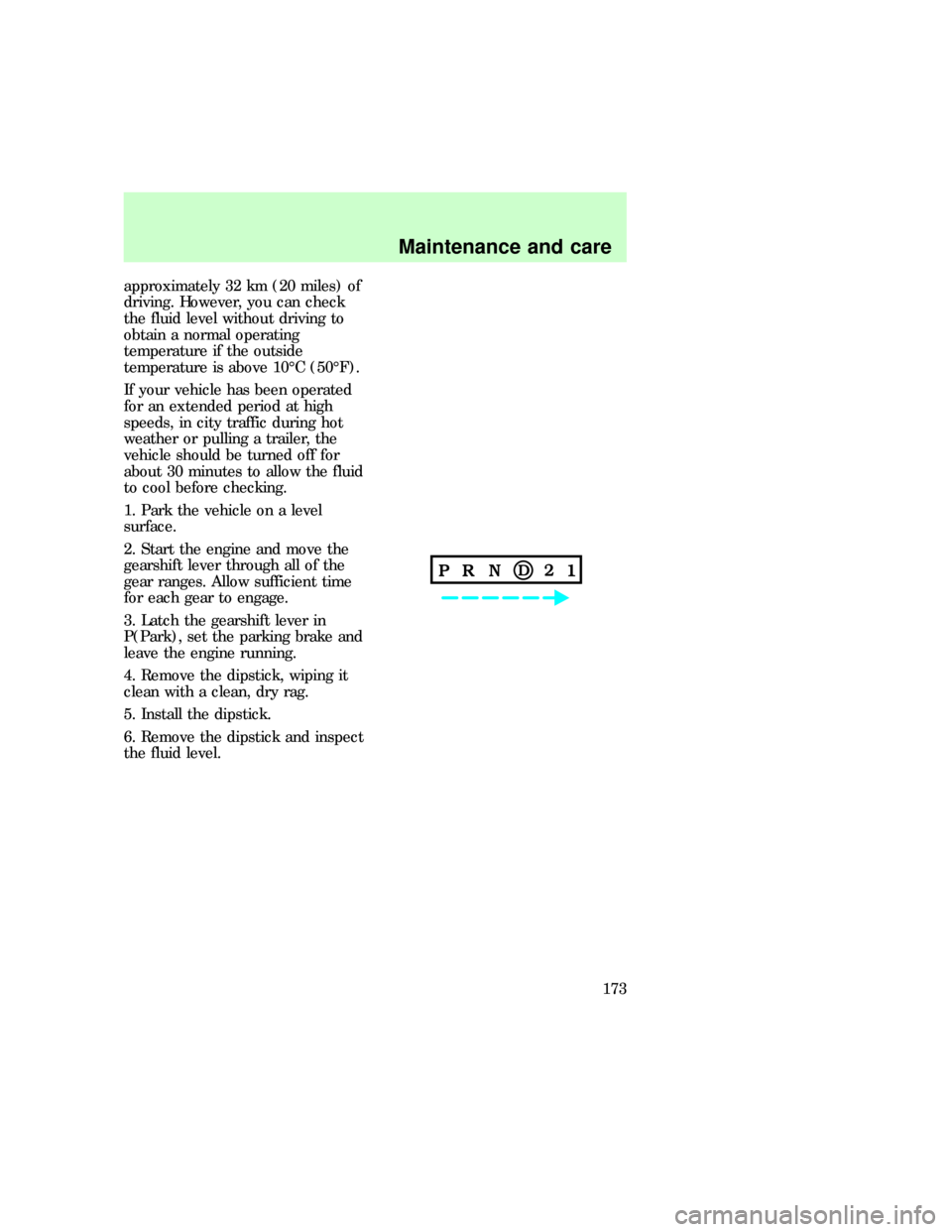
2. Start the engine and move the
gearshift lever through all of the
gear ranges. Allow sufficient time
for each gear to engage.
3. Latch the gearshift lever in
P(Park), set the parking brake and
leave the engine running.
4. Remove the dipstick, wiping it
clean with a clean, dry rag.
5. Install the dipstick.
6. Remove the dipstick and inspect
the fluid level.
Maintenance and care
173
Page 178 of 224
AIR CLEANER FILTER
MAINTENANCE
Refer to the ªService Guideº for
the appropriate intervals for
changing the air cleaner filter.
Do not start your engine
with the air cleaner
removed and do not remove it
while the engine is running.
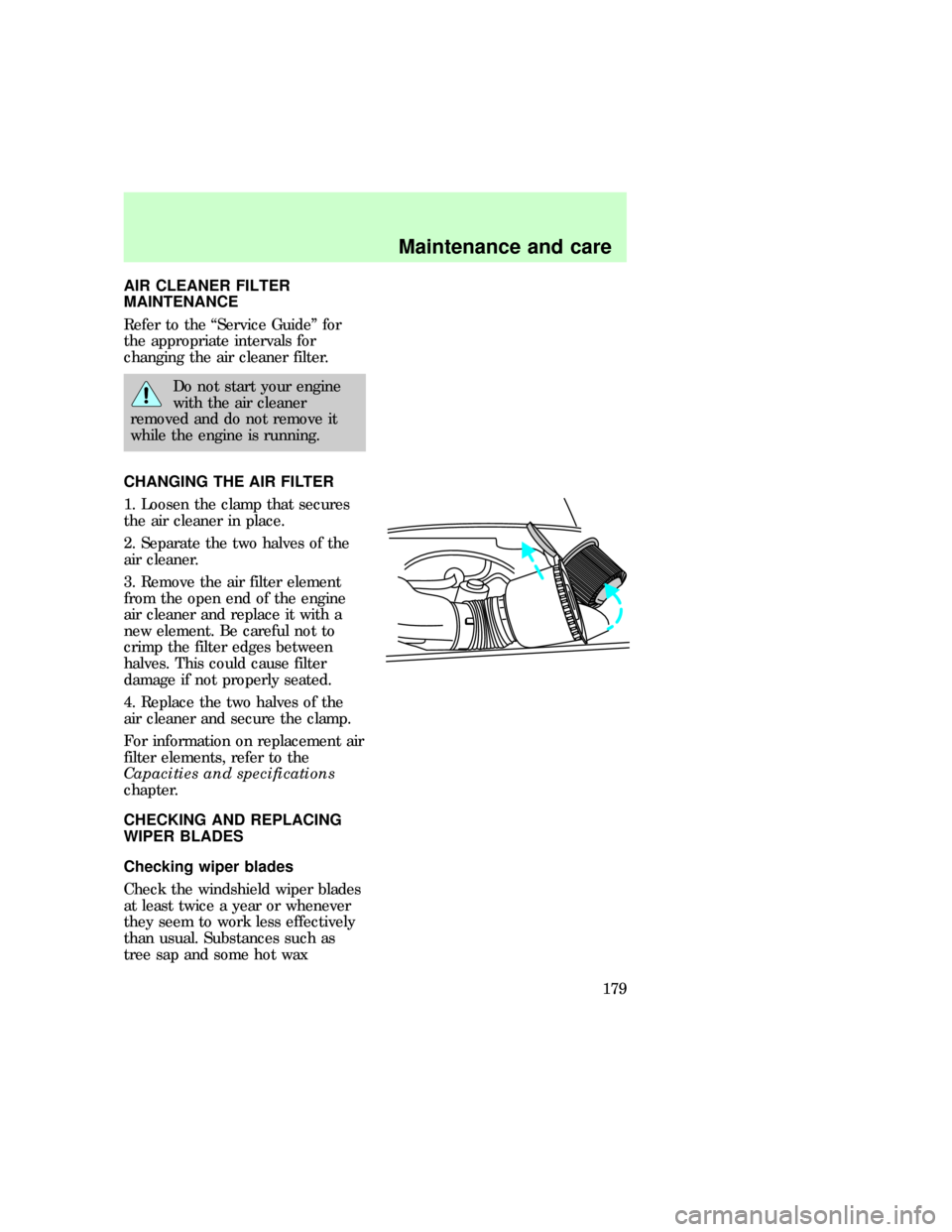
CHANGING THE AIR FILTER
1. Loosen the clamp that secures
the air cleaner in place.
2. Separate the two halves of the
air cleaner.
3. Remove the air filter element
from the open end of the engine
air cleaner and replace it with a
new element. Be careful not to
crimp the filter edges between
halves. This could cause filter
damage if not properly seated.
4. Replace the two halves of the
air cleaner and secure the clamp.
For information on replacement air
filter elements, refer to the
Capacities and specifications
chapter.
CHECKING AND REPLACING
WIPER BLADES
Checking wiper blades
Check the windshield wiper blades
at least twice a year or whenever
they seem to work less effectively
than usual. Substances such as
tree sap and some hot wax
exd_changing_air_filter
exd_wiper
exd_checking_wipers
Maintenance and care
179
Page 192 of 224
![FORD EXPEDITION 1997 1.G Owners Manual ²The help reduce early nozzle
shut offs and fuel spillage, park
your vehicle so that the fuel
filler door is level.
²Avoid excessively fast fuel
dispensing rates (over 38 L [10
gallons] per minute).](/manual-img/11/4905/w960_4905-191.png "FORD EXPEDITION 1997 1.G Owners Manual ²The help reduce early nozzle
shut offs and fuel spillage, park
your vehicle so that the fuel
filler door is level.
²Avoid excessively fast fuel
dispensing rates (over 38 L [10
gallons] per minute).")
²The help reduce early nozzle
shut offs and fuel spillage, park
your vehicle so that the fuel
filler door is level.
²Avoid excessively fast fuel
dispensing rates (over 38 L [10
gallons] per minute).
²If you spill any fuel on the body
of your vehicle, clean it off
immediately. The fuel may dull
or soften the paint if it is not
washed off promptly.
3. To replace the fuel cap, align
the tabs on the cap with the
notches on the filler pipe. Turn it
clockwise until it stops.
4. Push the fuel door closed.
If the check engine warning light
illuminates and remains illuminated
while the engine is started, the
fuel cap may not be properly
seated. Turn off the engine,
remove the fuel cap and replace it.
being sure to align the cap
properly.
If the fuel cap is lost, replace it
with an authorized Motorcraft or
equivalent part.
Calculating fuel economy
To accurately calculate your
vehicle's fuel economy:
1. Fill the tank completely and
record the initial odometer
reading.
2. Each time you fill the tank,
record the amount of fuel added
(in liters or gallons).
com_calculating_economy.01
Maintenance and care
193
Page 196 of 224
specifies that additional city and
highway driving is necessary to
complete the check of the OBD II
system.
The driving modes required to
reach the ready condition consist
of a minimum of 30 minutes of city
and highway driving:
²At least 20 minutes driving in
stop and go city-type traffic with
at least four idle periods.
²At least ten minutes of driving
on an expressway or highway.
Before completing the above
driving modes, the engine must be
warmed up and at operating
temperature. Once started, the
vehicle must not be turned off
during these modes.
exd_bulbs
Maintenance and care
197
![FORD EXPEDITION 1997 1.G Owners Manual Severe winter climate
If you drive in extremely cold
climates [less than 36ÉC (34ÉF)], it
may be necessary to increase the
coolant concentration above 50%.
Refer to the chart on the coolant
containe](/manual-img/11/4905/w960_4905-166.png "FORD EXPEDITION 1997 1.G Owners Manual Severe winter climate
If you drive in extremely cold
climates [less than 36ÉC (34ÉF)], it
may be necessary to increase the
coolant concentration above 50%.
Refer to the chart on the coolant
containe")