Page 128 of 224
with all of the vehicle wheels on
the ground.
Towing trailers beyond the
maximum recommended
gross trailer weight exceeds the
limit of the vehicle and could
result in engine damage,
transmission damage, structural
damage, loss of control and
personal injury.
Preparing to tow
Use the proper equipment for
towing a trailer and make sure that
it is properly attached to your
vehicle. See your dealer or a
reliable trailer retailer if you
require assistance.
If your vehicle is not equipped
with the factory heavy duty trailer
tow option, auxiliary coolers are
recommended for the automatic
transmission system if you are
planning on:
²traveling farther than 80 km (50
miles)
²towing in hilly terrain
²towing frequently
Calculating trailer loads
To determine the amount of weight
that your vehicle can carry:
²Obtain ratings from the Safety
Compliance Certification label
and the trailer towing
specifications in this chapter.
exd_preparing_tow
exd_calculating_load
Driving
129
Page 130 of 224

vehicle frame or hook retainers
(not the bumper). Make sure there
is enough slack to allow the vehicle
to turn corners.
For more information, refer to
ªFord Recreational Vehicle and
Trailer Towing Guideº available
from your Ford dealer.
Using trailer lamps
See your local trailer retailer or
rental agency for proper
instructions and equipment for
hooking up trailer lamps.
Do not hook the trailer lights
directly into the vehicle's wiring
system. If the trailer lamps are not
connected properly, the warning
lights in the instrument cluster
may not work properly.
Using a hitch
Do not use hitches that:
²clamp onto the vehicle bumper
²attach to the axle.
Distribute the load so that only 10
to 15% of the total weight of the
trailer is on the tongue. Tie down
the load so that it does not shift
and change the weight on the
hitch. Follow the towing
instructions of a reputable rental
agency.
Using a load-equalizing hitch
Follow the hitch manufactures
guidelines for the installation and
specific use of a load equalizing
hitch on this vehicle. In no cases
exd_lamps_trailer
exd_hitch_using
exd_load_equalizing_hitch
Driving
131
Page 131 of 224
should the vehicle weight ratings
per axle or combination truck and
trailer exceed the weight ratings
listed on the Safety Compliance
Certification label located on the
driver's side door.
When connecting a trailer hitch:
1. Turn off the air suspension
switch.
2. Connect the trailer.
3. Turn the air suspension back on.
Adjusting an equalizing
hitch so the rear bumper
of the vehicle is lower or higher
than it was unloaded will defeat
the function of the load
equalizing hitch and may cause
unpredictable handling.
Driving while towing a trailer
Speed control (if equipped) may
not work properly while towing on
long, steep grades.
Driving with an automatic
transmission:
²use D, 1 or 2 rather than
Dwhile towing up or down
steep hills
²anticipate stops and brake
gradually.
Towing behind another vehicle
Your vehicle can not be flat towed
with all wheels on the ground.
No neutral tow kit is available for
your vehicle.
exd_driving_trailer
exd_towing_another_vehicle
exd_servicing_while_towing
Driving
132
Page 132 of 224
Servicing while towing
If you tow a trailer for long
distances, your vehicle requires
more frequent service than a
vehicle not used for towing. Refer
to the ªService GuideºSevere
Duty Schedulefor more
information on maintenance
intervals.
Using a step bumper
The rear bumper is equipped with
an intregal hitch and requires only
a ball with a 1 inch shank
diameter. The bumper has a 1814
kg (4000 lb) trailer weight and 181
kg (400 lb) tongue weight
capability.
Use a frame mounted weight
distributing hitch for trailers over
1814 kg (4000 lb).
FUEL CONSUMPTION
Fuel economy can be improved by
avoiding:
²lack of regular, scheduled
maintenance
²excessive speed
²rapid acceleration
exd_step_bumper
com_fuel_consumption.01
Driving
133
Page 145 of 224
4. Remove the end of the cable
from the wheel and slide the spare
out from under the vehicle.
To re-install the spare tire or tools,
reverse the removal procedure.
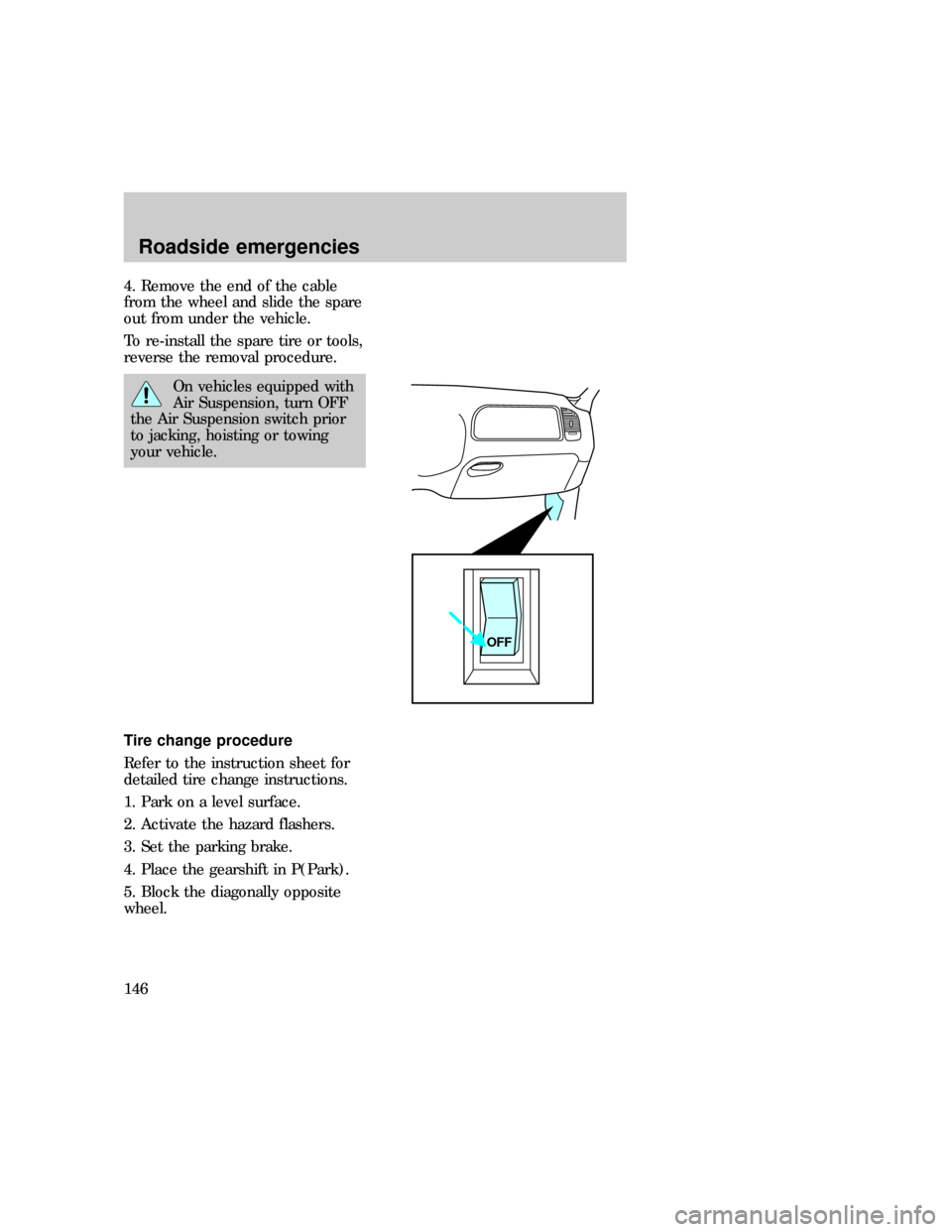
On vehicles equipped with
Air Suspension, turn OFF
the Air Suspension switch prior
to jacking, hoisting or towing
your vehicle.
Tire change procedure
Refer to the instruction sheet for
detailed tire change instructions.
1. Park on a level surface.
2. Activate the hazard flashers.
3. Set the parking brake.
4. Place the gearshift in P(Park).
5. Block the diagonally opposite
wheel.
OFF
exd_change_proc
exd_removing_flat
Roadside emergencies
146
Page 152 of 224
3. Once the engine has been
started, run both vehicles for a
further three minutes before
disconnecting the leads.
Removing the jumper cables
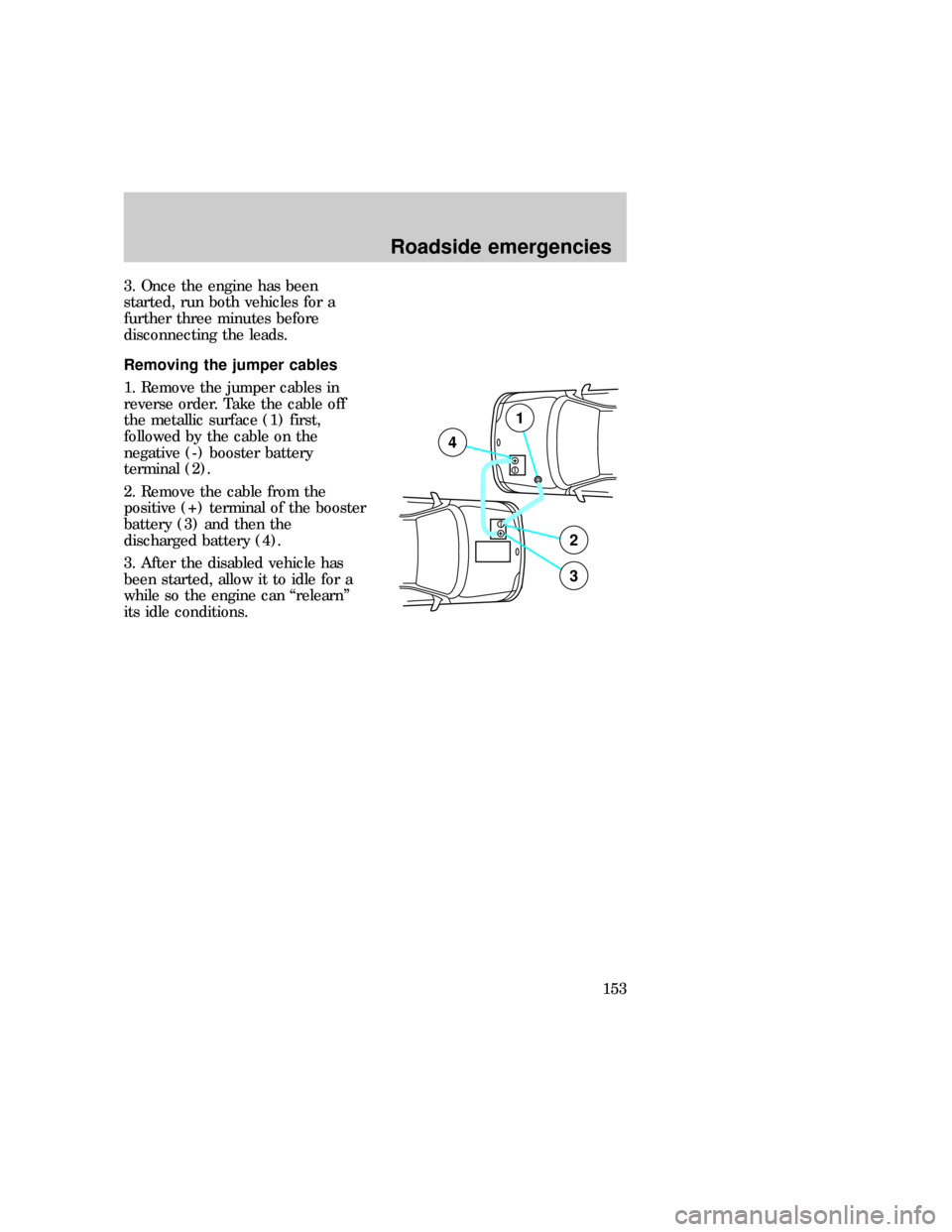
1. Remove the jumper cables in
reverse order. Take the cable off
the metallic surface (1) first,
followed by the cable on the
negative (-) booster battery
terminal (2).
2. Remove the cable from the
positive (+) terminal of the booster
battery (3) and then the
discharged battery (4).
3. After the disabled vehicle has
been started, allow it to idle for a
while so the engine can ªrelearnº
its idle conditions.
+–
+–
2
3
4
1
com_removing_cables.01
exd_wrecker_towing
Roadside emergencies
153
Page 153 of 224
WRECKER TOWING
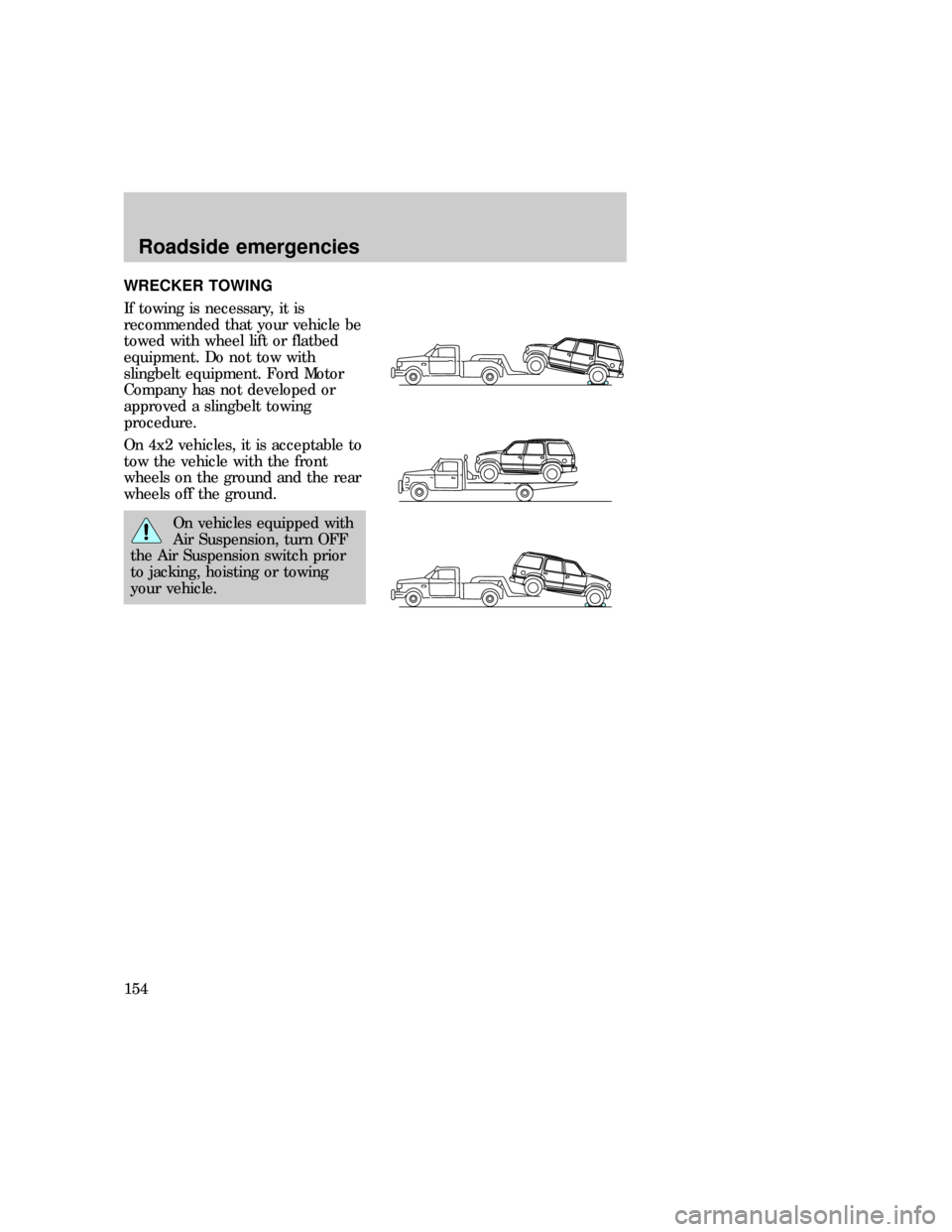
If towing is necessary, it is
recommended that your vehicle be
towed with wheel lift or flatbed
equipment. Do not tow with
slingbelt equipment. Ford Motor
Company has not developed or
approved a slingbelt towing
procedure.
On 4x2 vehicles, it is acceptable to
tow the vehicle with the front
wheels on the ground and the rear
wheels off the ground.
On vehicles equipped with
Air Suspension, turn OFF
the Air Suspension switch prior
to jacking, hoisting or towing
your vehicle.
Roadside emergencies
154
Page 161 of 224

Changing the engine oil and
filter
Change your engine oil and filter
according to the following
kilometers (mileage) and time
requirements, whichever occurs
first:
²Normal Schedule ± 8,000 km
(5,000 miles) or six months.
²Severe Duty Schedule ± 5,000
km (3,000 miles) or three
months. Severe duty operation
would include extensive idling,
trailer towing, driving in severe
dust and police, taxi or delivery
service.
Ford production and aftermarket
(Motorcraft) oil filters are designed
for added engine protection and
long life. If a replacement oil filter
is used that does not meet Ford
material and design specifications,
startup engine noises or knock
may be experienced.
It is recommended you use the
appropriate Motorcraft oil filter (or
another brand meeting Ford
specifications) for your engine
application.
Checking and adding brake
fluid
Brake fluid should be checked and
refilled as needed at least once
each year:
exd_fix-me
com_checking-adding_fluid.01
Maintenance and care
162