Page 91 of 224
safety seats made especially for
children. Check your local and
state laws for specific
requirements regarding the safety
of children in your vehicle.
Never let a passenger hold
a child on his or her lap
while the vehicle is moving. The
passenger cannot protect the
child from injury in a collision.
Do not leave children,
unreliable adults, or pets
unattended in your vehicle.
Always follow the instructions and
warnings that come with any infant
or child restraint you might use.
If possible, place children in the
rear seat of your vehicle. Accident
statistics suggest that children are
safer when properly restrained in
rear seating positions than when
they are restrained in front seating
positions.
CHILDREN AND SAFETY BELTS
Children who are too large for
child safety seats (as specified by
your child safety seat
manufacturer) should always wear
safety belts.
Follow all the important safety
restraint and air bag precautions
that apply to adult passengers in
your vehicle.
If the shoulder belt portion of a
combination lap and shoulder belt
com_safety_belts.01
Seating and safety restraints
92
Page 92 of 224
can be positioned so it does not
cross or rest in front of the child's
face or neck, the child should wear
the lap and shoulder belt. Moving
the child closer to the center of
the vehicle may help provide a
good shoulder belt fit.
If the shoulder belt cannot be
properly positioned:
²move the child to one of the
seats with a lap belt only (if
equipped)
OR
²if the child is the proper size,
restrain the child in a safety
seat.
Do not leave children,
unreliable adults, or pets
unattended in your vehicle.
To improve the fit of lap and
shoulder belts on children who
have outgrown child safety seats,
Ford recommends use of a
belt-positioning booster seat that is
labelled as conforming to all
Federal motor vehicle safety
standards. Belt-positioning booster
seats raise the child and provide a
shorter, firmer seating cushion that
encourages safer seating posture
and better fit of lap and shoulder
belts on the child. A
belt-positioning booster should be
used if the shoulder belt rests in
front of the child's face or neck, or
if the lap belt does not fit snugly
on both thighs, or if the thighs are
too short to let the child sit all the
Seating and safety restraints
93
Page 93 of 224
way back on the seat cushion
when the lower legs hang over the
edge of the seat cushion. You may
wish to discuss the special needs
of your child with your
pediatrician.
INSTALLING CHILD SAFETY
SEATS IN THE REAR SEATING
POSITIONS
To install a child safety seat in a
center rear seating position:
1. Tip the tongue and pull to
lengthen the lap belt.
2. Place the child safety seat in the
center seating position.
3. Route the lap belt through the
child safety seat according to the
manufacturer's instructions.
4. Insert the tongue into the
proper buckle.
5. Push down on the child safety
seat while pulling the loose part of
the belt webbing to tighten the
belt.
6. Before placing the child in the
safety seat, forcibly tilt the seat
from side to side and forward and
back to make sure that the seat is
held securely in place. If the child
seat moves excessively, repeat
steps five and six, install a tether
strap or properly install the child
seat in another seating position.
exd_safety_seats_kids
com_installing_seats.01
Seating and safety restraints
94
Page 94 of 224
Installing child safety seats in
combination lap and shoulder
belt seating positions
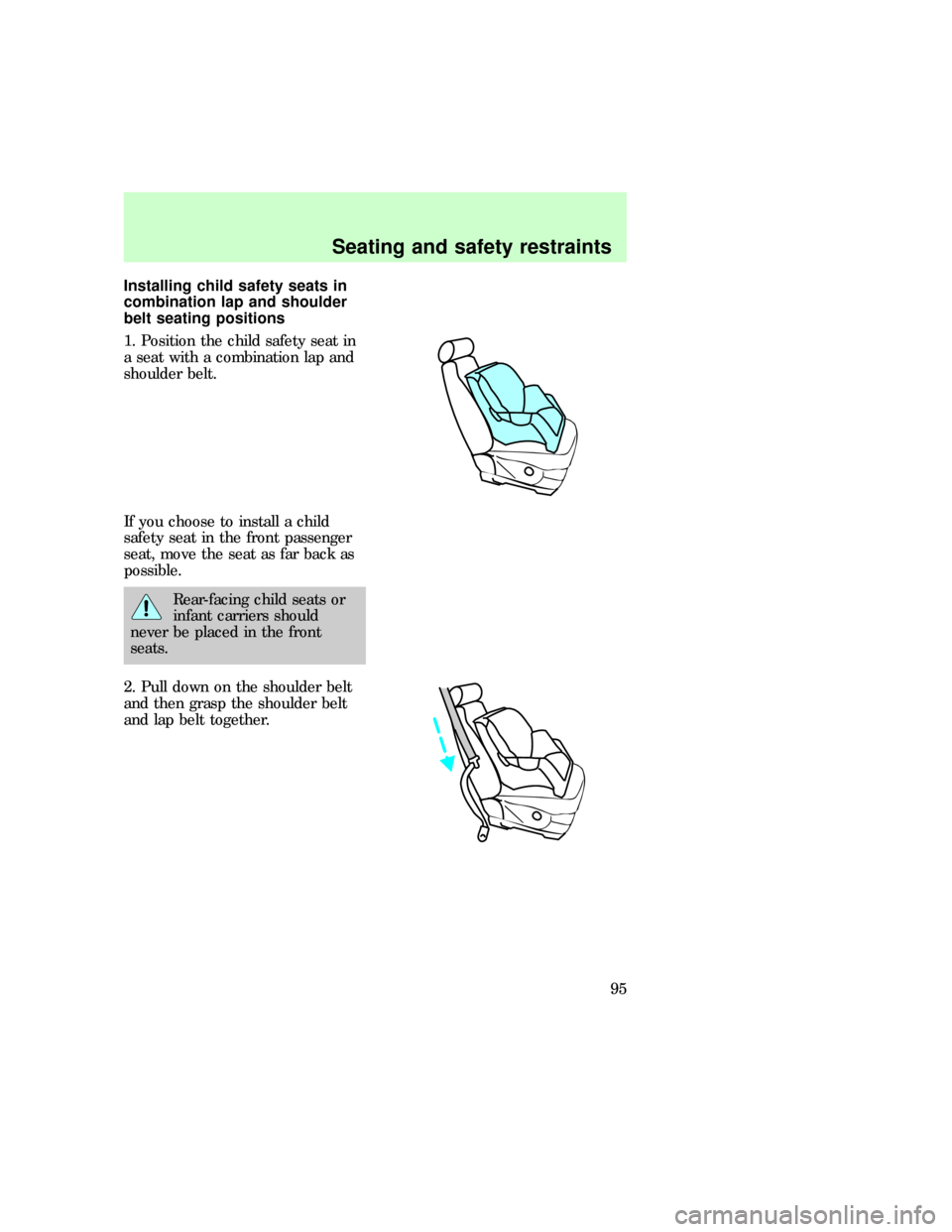
1. Position the child safety seat in
a seat with a combination lap and
shoulder belt.
If you choose to install a child
safety seat in the front passenger
seat, move the seat as far back as
possible.
Rear-facing child seats or
infant carriers should
never be placed in the front
seats.
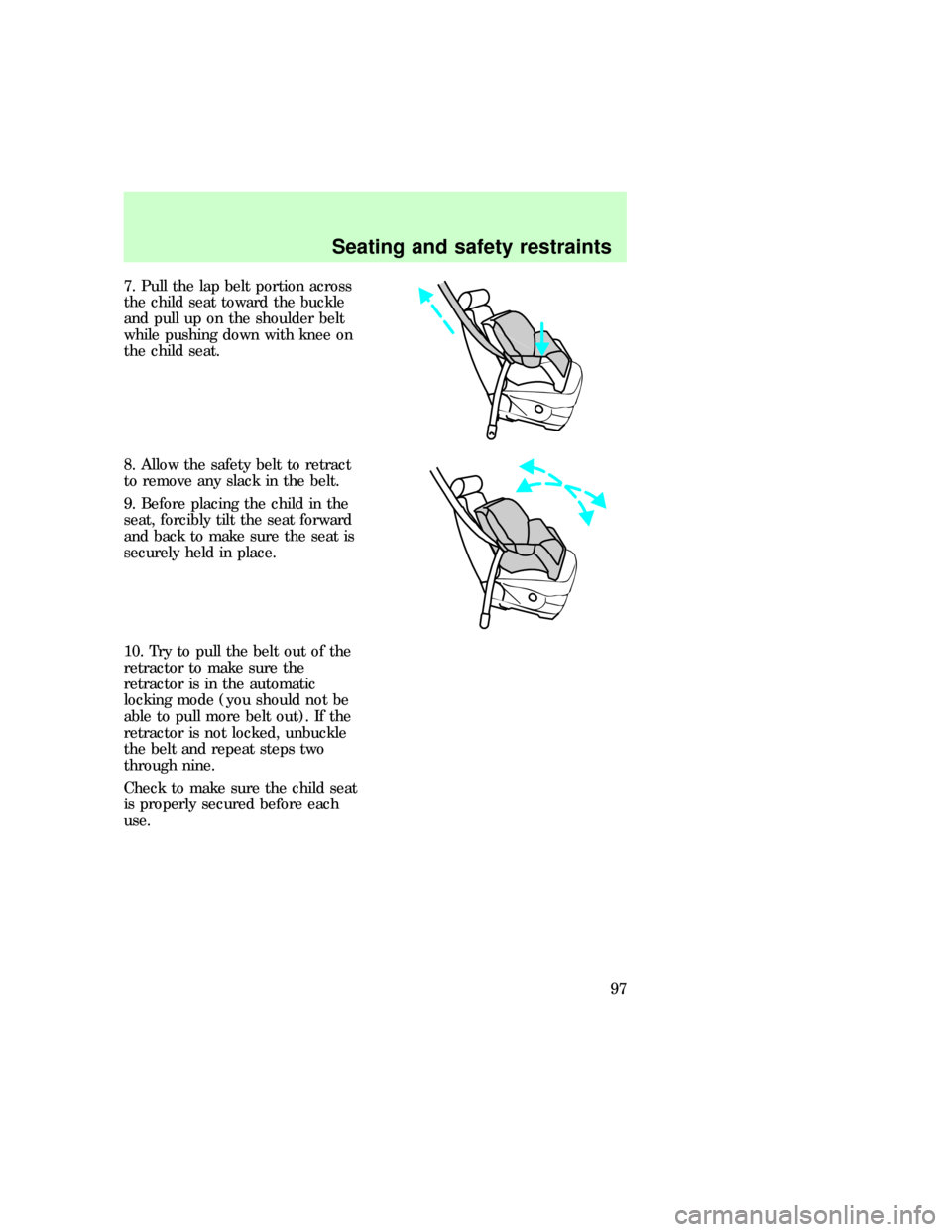
2. Pull down on the shoulder belt
and then grasp the shoulder belt
and lap belt together.
Seating and safety restraints
95
Page 96 of 224
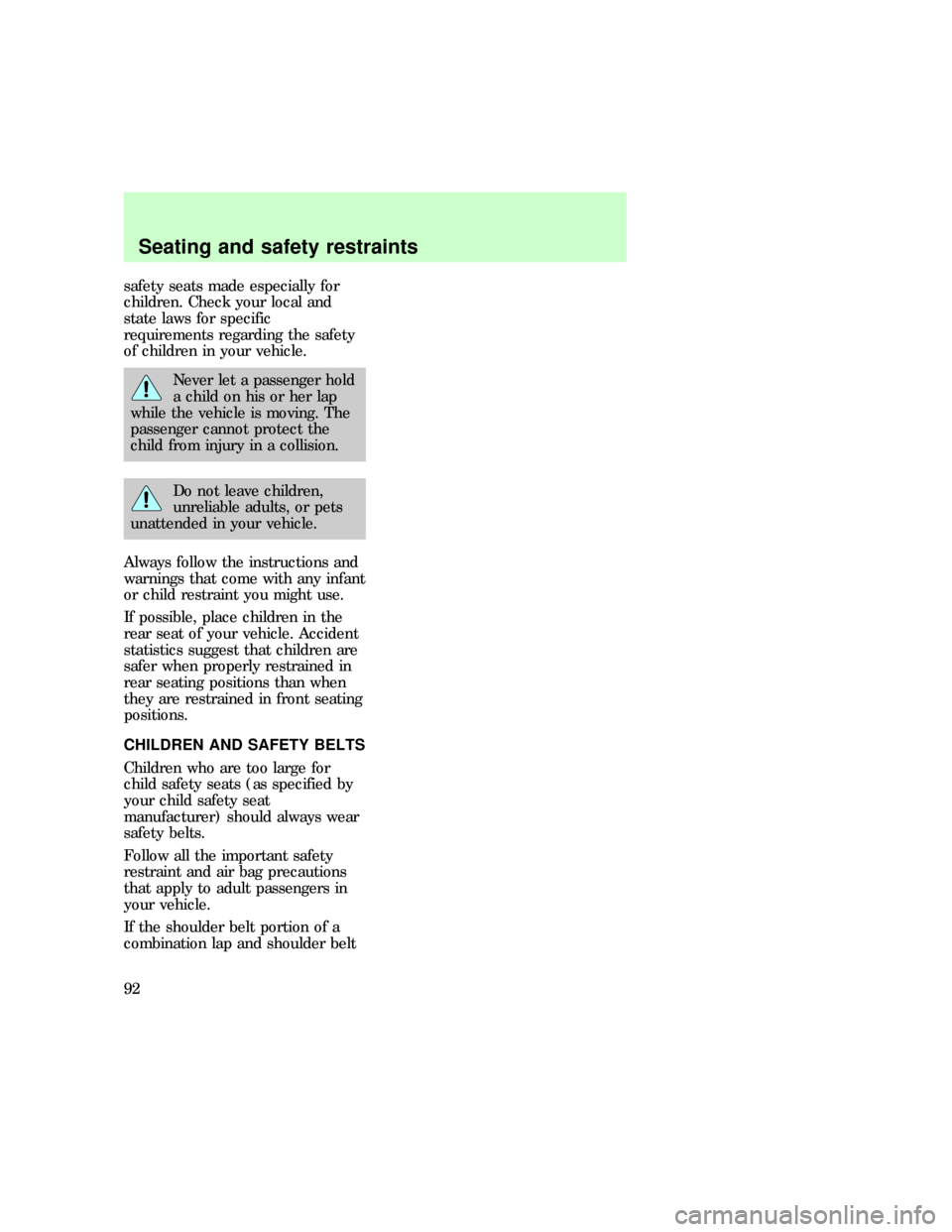
7. Pull the lap belt portion across
the child seat toward the buckle
and pull up on the shoulder belt
while pushing down with knee on
the child seat.
8. Allow the safety belt to retract
to remove any slack in the belt.
9. Before placing the child in the
seat, forcibly tilt the seat forward
and back to make sure the seat is
securely held in place.
10. Try to pull the belt out of the
retractor to make sure the
retractor is in the automatic
locking mode (you should not be
able to pull more belt out). If the
retractor is not locked, unbuckle
the belt and repeat steps two
through nine.
Check to make sure the child seat
is properly secured before each
use.
com_safety_seats.01
Seating and safety restraints
97
Page 97 of 224
Child and infant or child safety
seats
Carefully follow all of the
manufacturer's instructions
included with the safety seat you
put in your vehicle. If you do not
install and use the safety seat
properly, the child may be
injured in a sudden stop or
collision.
Ford recommends the use of a
child safety seat having a top
tether strap. Install the child safety
seat in a seating position which is
capable of providing a tether
anchorage. For more information
on top tether straps seeAttaching
safety seats with tether strapsin
this chapter.
When installing a child safety seat:
²Use the correct safety belt
buckle for that seating position.
²Make sure the tongue is
securely fastened in the buckle.
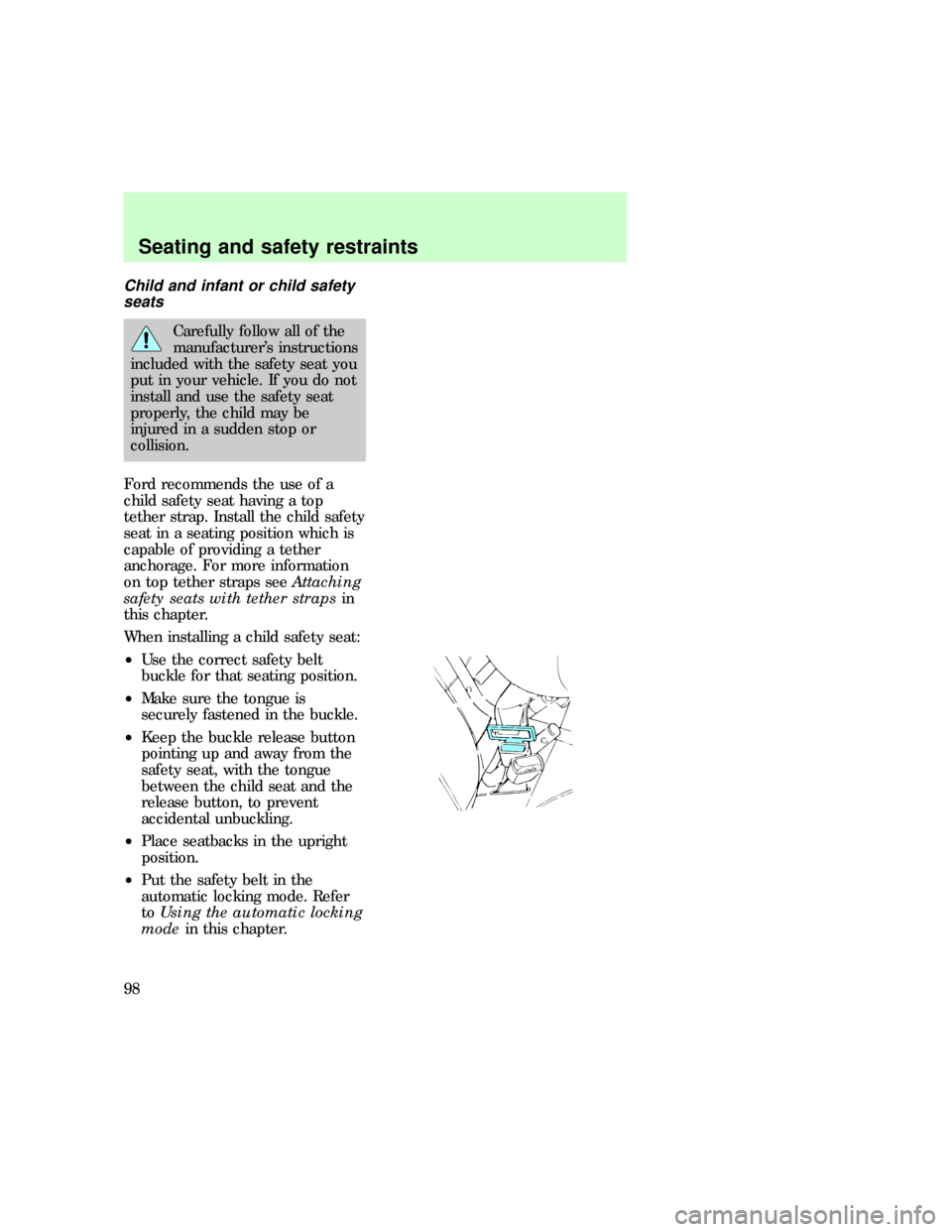
²Keep the buckle release button
pointing up and away from the
safety seat, with the tongue
between the child seat and the
release button, to prevent
accidental unbuckling.
²Place seatbacks in the upright
position.
²Put the safety belt in the
automatic locking mode. Refer
toUsing the automatic locking
modein this chapter.
exd_using_tether
Seating and safety restraints
98
Page 98 of 224
Using a tether strap
Ford recommends using child
safety seats with a top tether
strap. Contact the manufacturer of
your safety seat for information
about ordering a tether strap if one
is not provided to you.
Ford recommends you attach
tether safety seats in a rear seating
position (if possible), with the
tether strap attached to the tether
anchor bracket.
Tether anchor brackets may also
be installed to the floor behind the
second row seats.
Tether anchor hardware
A tethered seat can be installed in
the front seat; put the tether strap
over the seatback and attach it to
a anchor bracket.
A anchor bracket can be installed
on the rear edge of the front seat
cushion.
The provision (attaching hole) is
provided in the rear edge of the
front passenger seat cushion
frame. The anchor bracketmust
be installed using the
instructions provided with the
kit.
Contact your Ford dealer for a free
tether anchor kit (613D74).
Carefully follow the instructions
provided with the kit.
exd_anchor_hardware
Seating and safety restraints
99
Page 122 of 224
LOADING YOUR VEHICLE
It is extremely dangerous
to ride in a cargo area,
inside or outside of a vehicle. In
a collision, people riding in these
areas are more likely to be
seriously injured or killed. Do not
allow people to ride in any area
of your vehicle that is not
equipped with seats and safety
belts. Be sure everyone in your
vehicle is in a seat and using a
safety belt properly.
Before loading your vehicle,
familiarize yourself with the
following terms:
²Base curb weight :Weight of the
vehicle including any standard
equipment, fluids, lubricants,
etc. It does not include
passengers or aftermarket
equipment.
²Payload :Combined maximum
allowable weight of passengers,
cargo and optional equipment.
²GVW (Gross Vehicle Weight) Ð
Base curb weight plus the
payload weight. The GVW is not
a limit or a specification.
²GVWR (Gross Vehicle Weight
Rating) :Maximum total weight
of the base vehicle, passengers,
optional equipment and cargo.
The GVWR is specific to each
vehicle and is listed on the
Safety Compliance Certification
Label on the driver's door pillar.
²GAWR (Gross Axle Weight
Driving
123