Page 88 of 191
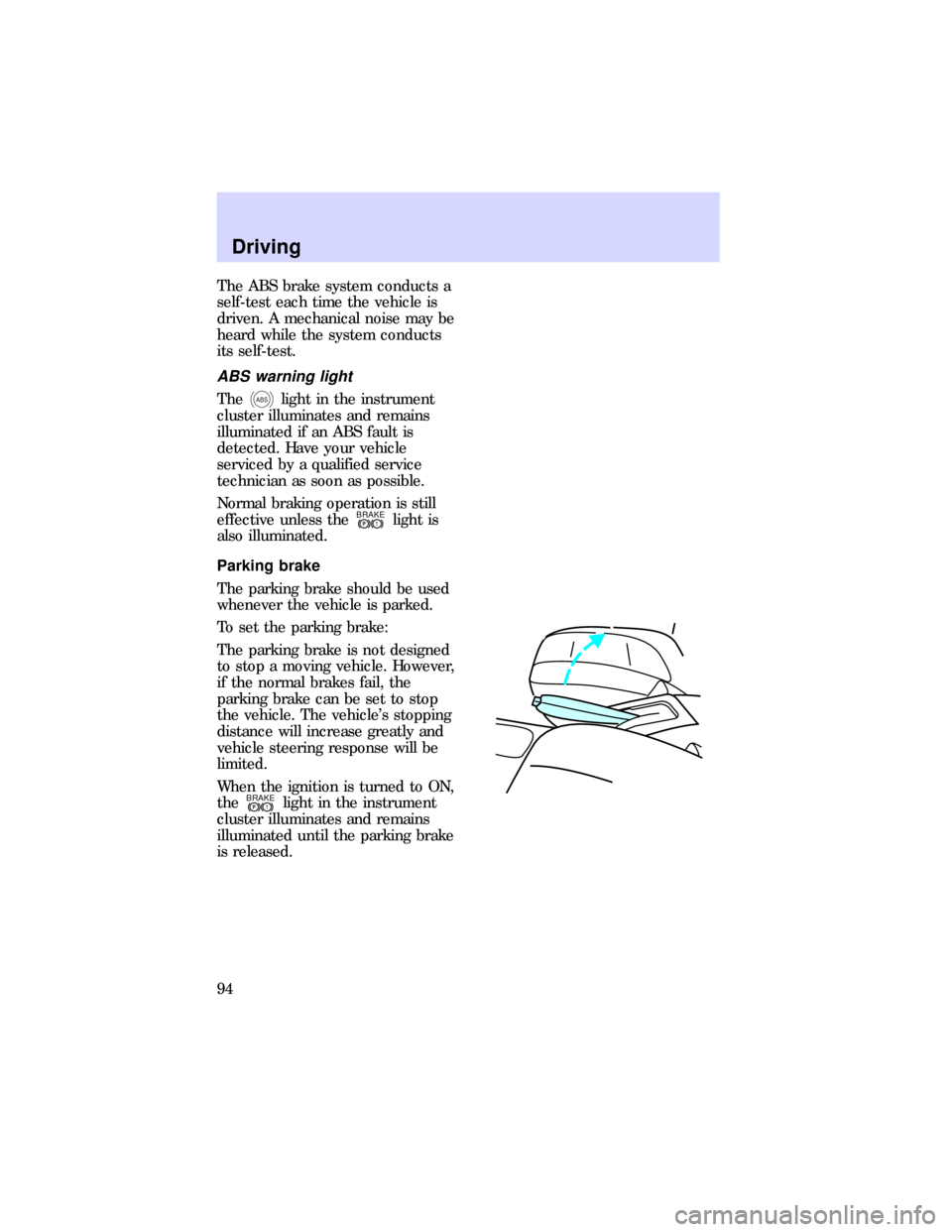
4. Turn the key to the ON position
(without turning the key to
START). Make sure the following
lights illuminate briefly. If a light
fails to illuminate, have the vehicle
serviced.
If the driver's safety belt is
fastened, the
light does not
illuminate.
STARTING THE VEHICLE
After completing the steps under
Preparing to start the vehicle:
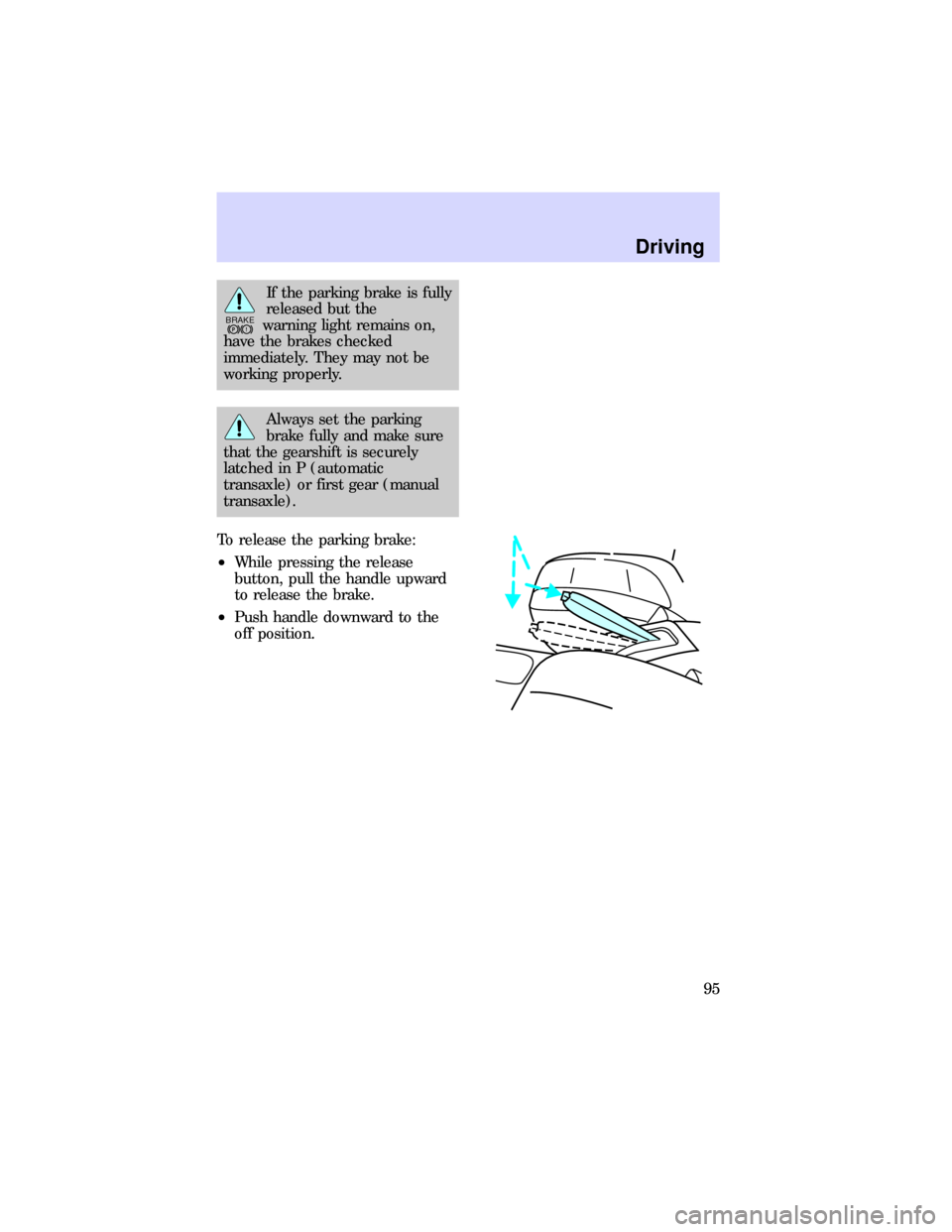
1. Turn the key to START and
release.Do notpress the
accelerator.
²The key will return to the ON
position.
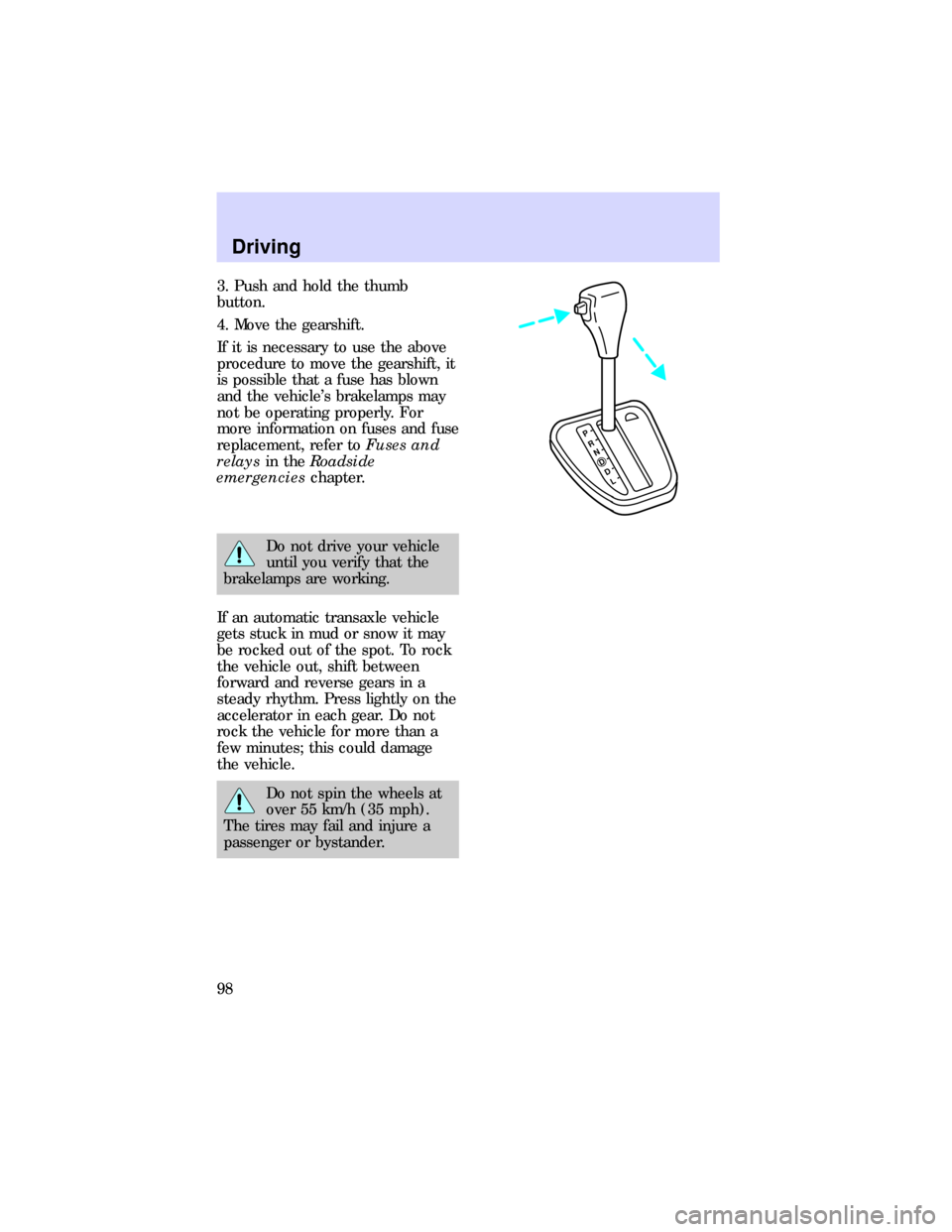
2. After idling for a few seconds,
apply the brake and release the
parking brake.
ON
II
ACC
I
LOCK
0
START
III
MP
km/10 203040520 4060
80
SERVICE
ENGINE
SOON
LOW
FUELABS
0
80
90
10 0
12 011 012 0
16 0
18 0 140
200
CHECK
COOLANTTHEFT
ON
II
ACC
I
LOCK
0
START
III
Starting
88
Page 93 of 191
BRAKES
Power-assisted brakes
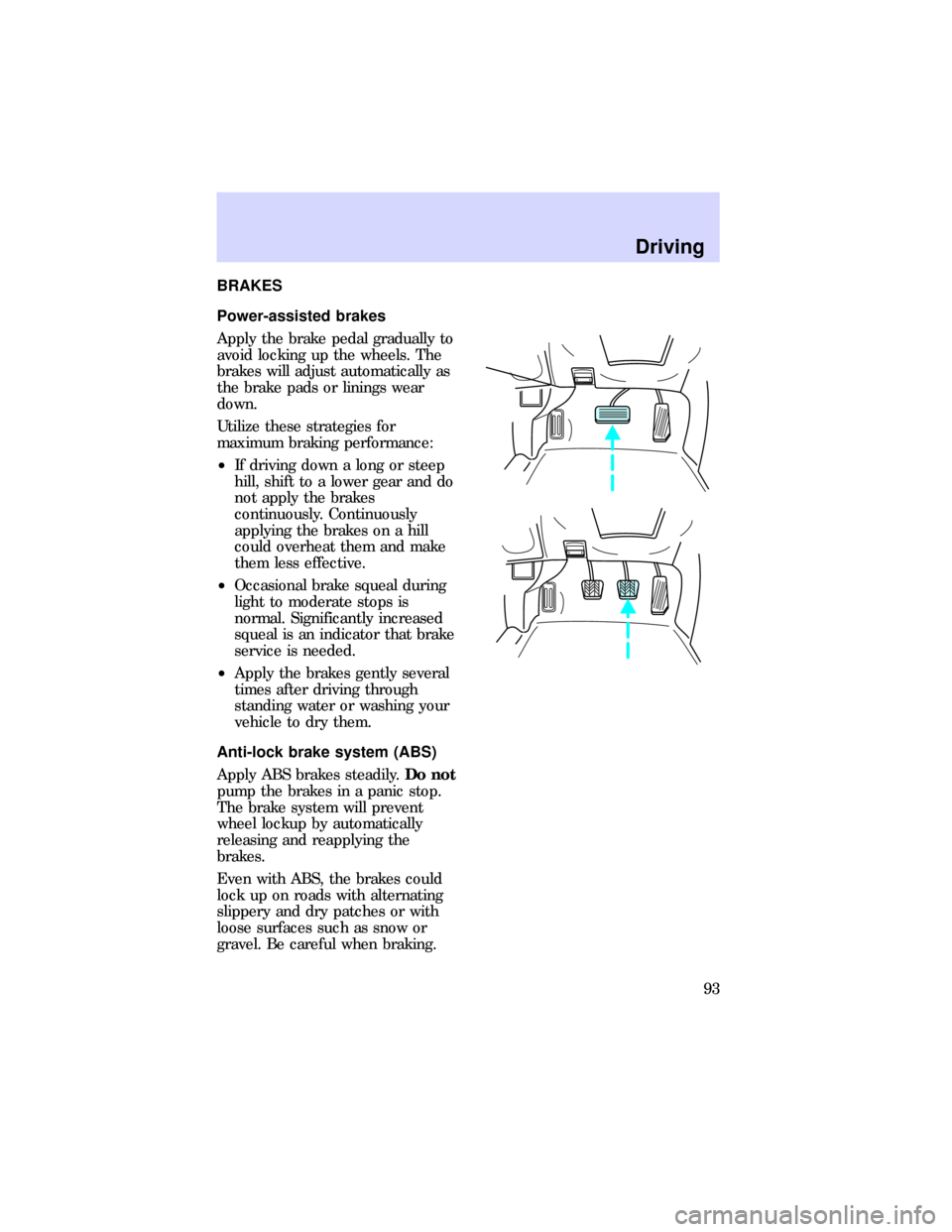
Apply the brake pedal gradually to
avoid locking up the wheels. The
brakes will adjust automatically as
the brake pads or linings wear
down.
Utilize these strategies for
maximum braking performance:
²If driving down a long or steep
hill, shift to a lower gear and do
not apply the brakes
continuously. Continuously
applying the brakes on a hill
could overheat them and make
them less effective.
²Occasional brake squeal during
light to moderate stops is
normal. Significantly increased
squeal is an indicator that brake
service is needed.
²Apply the brakes gently several
times after driving through
standing water or washing your
vehicle to dry them.
Anti-lock brake system (ABS)
Apply ABS brakes steadily.Do not
pump the brakes in a panic stop.
The brake system will prevent
wheel lockup by automatically
releasing and reapplying the
brakes.
Even with ABS, the brakes could
lock up on roads with alternating
slippery and dry patches or with
loose surfaces such as snow or
gravel. Be careful when braking.
Driving
93
Page 94 of 191
The ABS brake system conducts a
self-test each time the vehicle is
driven. A mechanical noise may be
heard while the system conducts
its self-test.
ABS warning light
TheABSlight in the instrument
cluster illuminates and remains
illuminated if an ABS fault is
detected. Have your vehicle
serviced by a qualified service
technician as soon as possible.
Normal braking operation is still
effective unless the
P!BRAKElight is
also illuminated.
Parking brake
The parking brake should be used
whenever the vehicle is parked.
To set the parking brake:
The parking brake is not designed
to stop a moving vehicle. However,
if the normal brakes fail, the
parking brake can be set to stop
the vehicle. The vehicle's stopping
distance will increase greatly and
vehicle steering response will be
limited.
When the ignition is turned to ON,
the
P!BRAKElight in the instrument
cluster illuminates and remains
illuminated until the parking brake
is released.
Driving
94
Page 95 of 191
If the parking brake is fully
released but the
P!BRAKEwarning light remains on,
have the brakes checked
immediately. They may not be
working properly.
Always set the parking
brake fully and make sure
that the gearshift is securely
latched in P (automatic
transaxle) or first gear (manual
transaxle).
To release the parking brake:
²While pressing the release
button, pull the handle upward
to release the brake.
²Push handle downward to the
off position.
Driving
95
Page 98 of 191
3. Push and hold the thumb
button.
4. Move the gearshift.
If it is necessary to use the above
procedure to move the gearshift, it
is possible that a fuse has blown
and the vehicle's brakelamps may
not be operating properly. For
more information on fuses and fuse
replacement, refer toFuses and
relaysin theRoadside
emergencieschapter.
Do not drive your vehicle
until you verify that the
brakelamps are working.
If an automatic transaxle vehicle
gets stuck in mud or snow it may
be rocked out of the spot. To rock
the vehicle out, shift between
forward and reverse gears in a
steady rhythm. Press lightly on the
accelerator in each gear. Do not
rock the vehicle for more than a
few minutes; this could damage
the vehicle.
Do not spin the wheels at
over 55 km/h (35 mph).
The tires may fail and injure a
passenger or bystander.
P
R
N
D
D
L
Driving
98
Page 100 of 191
Upshifting
For normal acceleration:
Upshift from... At the following speed:
1 to 2 22 km/h (14 mph)
2 to 3 40 km/h (25 mph)
3 to 4 58 km/h (36 mph)
4 to 5 72 km/h (45 mph)
For cruising:
Upshift from... At the following speed:
1 to 2 18 km/h (11 mph)
2 to 3 35 km/h (22 mph)
3 to 4 51 km/h (32 mph)
4 to 5 66 km/h (41 mph)
Upshift light (if equipped)
Thelight in the instrument
cluster illuminates to indicate
when to shift for the best fuel
economy. The vehicle will not be
harmed if the transaxle is not
shifted when the light illuminates,
but the vehicle will use more fuel.
The
light can be ignored when
you are:
²downshifting
²driving on steep hills
²using the engine to brake the
vehicle
²seeking more power for a
difficult acceleration
To maximize gearshift
performance:
Driving
100
Page 104 of 191
and change the weight on the
hitch.
Using trailer brakes
Use electric brakes or manual,
automatic, or surge-type hydraulic
brakes that meet federal and local
regulations. Install and adjust the
brakes according to the
manufacturer's instructions.
Do not connect a trailer's
hydraulic brake system
directly to your vehicle's brake
system. Your vehicle may not
have enough braking power and
your chances of having a
collision greatly increase.
Using safety chains
Always connect the trailer's safety
chains to the vehicle. To connect
the chains, cross the chains under
the trailer tongue and attach to the
vehicle frame or hook retainers
(not the bumper). Make sure there
is enough slack to allow the vehicle
to turn corners.
Using trailer lamps
See your local trailer dealer or
rental agency for the proper
instructions and equipment for
hooking up trailer lamps.
Do not hook the trailer lights
directly into the vehicle's lighting
system wiring. If the trailer lamps
are not installed properly, the
warning lights in the instrument
cluster may not work properly.
Driving
104
Page 111 of 191
Fuse rating Color
10 amp Red
15 amp Blue
20 amp Yellow
30 amp Light Green
30 amp fuse link Pink
40 amp Green
60 amp fuse link Yellow
80 amp fuse link Black
100 amp fuse link Blue
Instrument panel fuse panel
Number Fuse amperage
ratingCircuits protected
1 Stop 15 amp Brakelamps, shift lock
2 Tail 15 amp Instrument cluster
illumination, license
plate lamp, parking
lamps, side marker
lamps, tail lamps,
(radio, climate control
illumination)
3 Sun roof Ð Not used
4 ASC 10 amp Speed control
5 Ð Ð Not used
6 (Door lock) 30 amp Power door locks
7 Horn 15 amp Horn
8 (Air Conditioning) 15 amp A/C, clutch
Roadside emergencies
111