Page 126 of 191
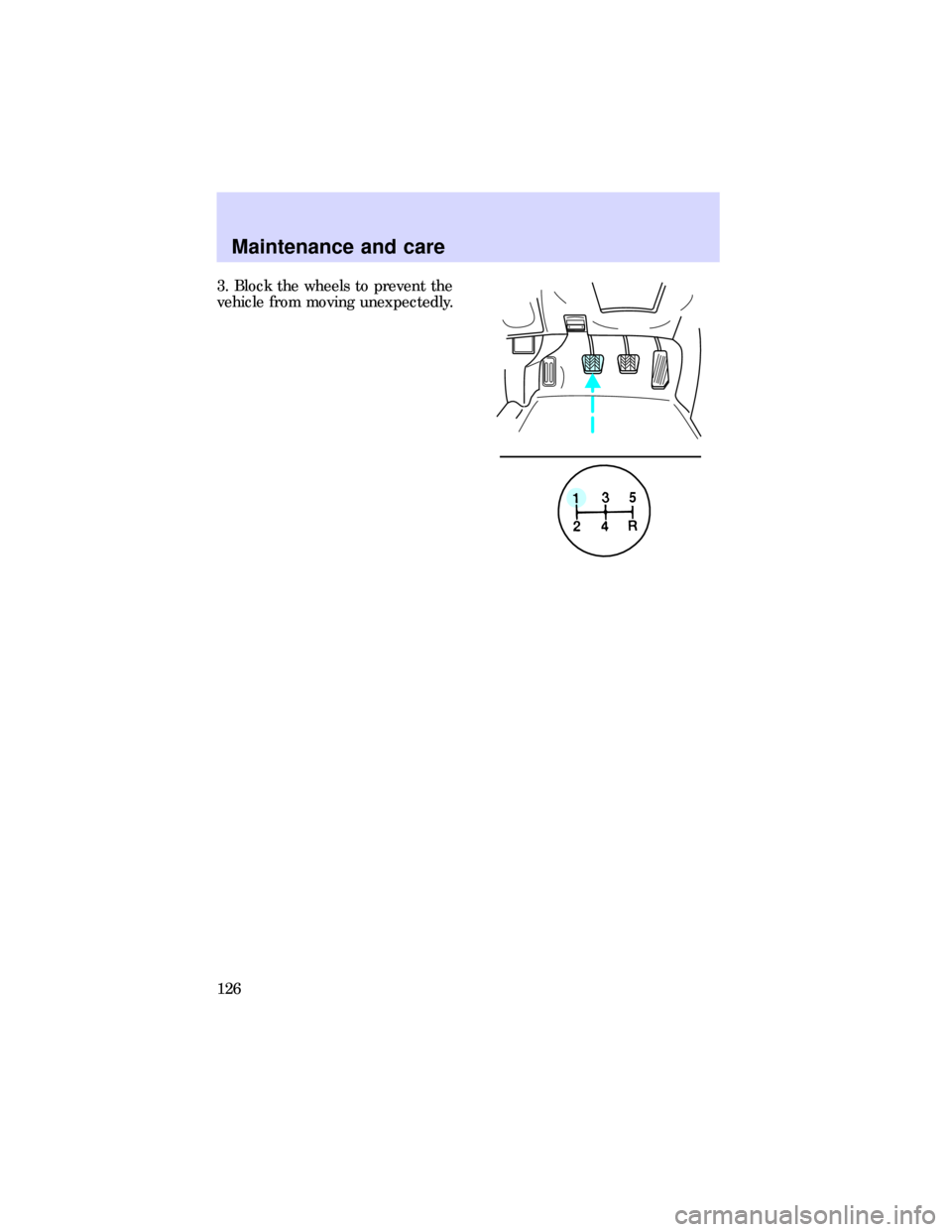
3. Block the wheels to prevent the
vehicle from moving unexpectedly.
5
Maintenance and care
126
Page 127 of 191
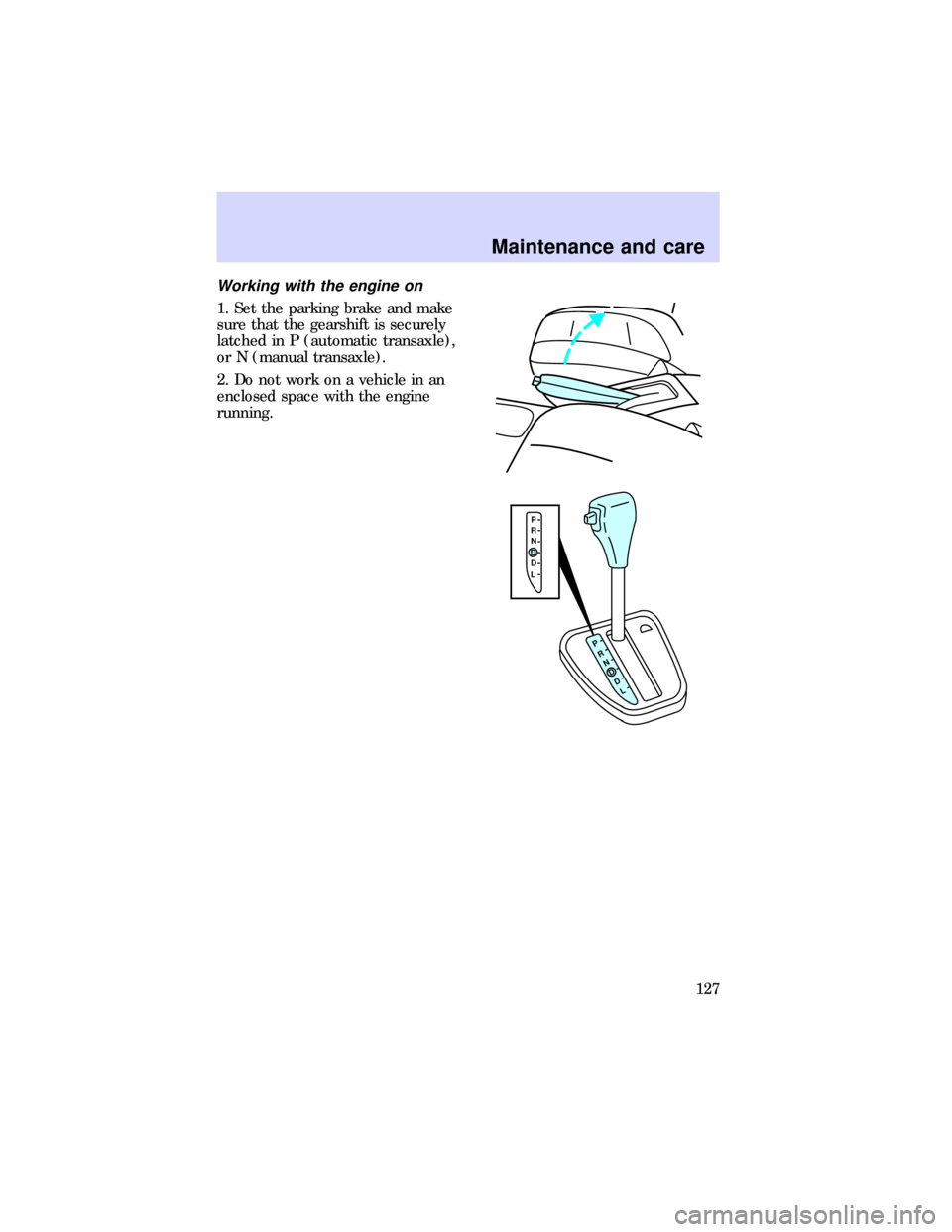
Working with the engine on
1. Set the parking brake and make
sure that the gearshift is securely
latched in P (automatic transaxle),
or N (manual transaxle).
2. Do not work on a vehicle in an
enclosed space with the engine
running.
P
R
N
D
D
L
R
N
D
D
LP
Maintenance and care
127
Page 128 of 191
3. Block the wheels to prevent the
vehicle from moving unexpectedly.
4. If work must be done with the
engine running, avoid wearing
loose clothing or jewelry that could
get caught in moving parts. Take
appropriate precautions with long
hair.
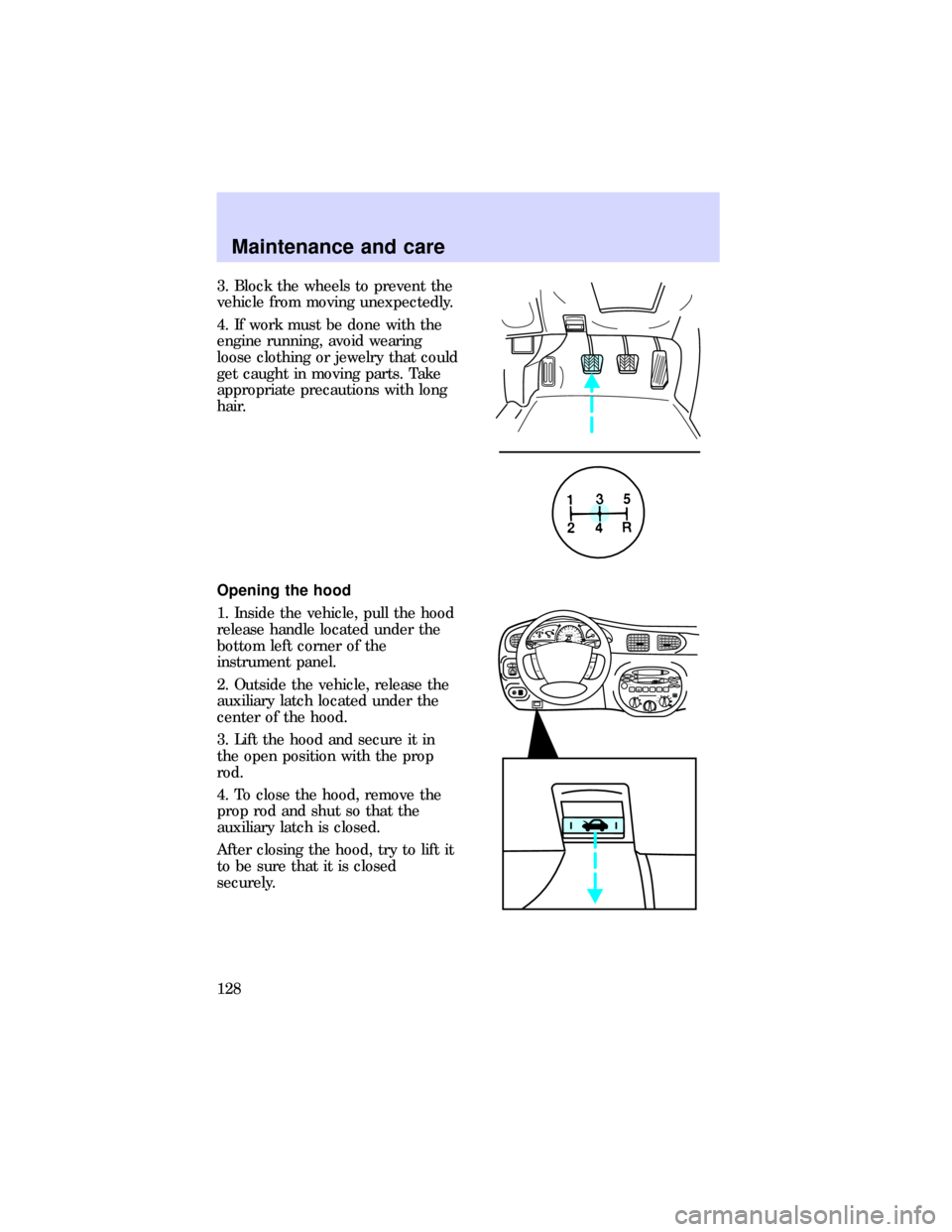
Opening the hood
1. Inside the vehicle, pull the hood
release handle located under the
bottom left corner of the
instrument panel.
2. Outside the vehicle, release the
auxiliary latch located under the
center of the hood.
3. Lift the hood and secure it in
the open position with the prop
rod.
4. To close the hood, remove the
prop rod and shut so that the
auxiliary latch is closed.
After closing the hood, try to lift it
to be sure that it is closed
securely.
5
HI LOOFF*A/C*MAX
A/C
TUNE
DISCS
SEEK
TUNE
SCAN
EJ REW FF
BAL BASSTREBFADE TAPE
CD AM
FM
–+1
SIDE 1-22
345
COMP1
SIDE 1-2VOL–
PUSH ON
LMIRRORR
0000000002030405060
70
80
90
10 0
11 020 40608010 0
12 0
16 0
18 0 140FUEL FILLCHEF1/22
13RPM x 1000
RESET
SET
ACC
SET XXXX XXXOFF2INT
1 OFF MIST
Maintenance and care
128
Page 129 of 191
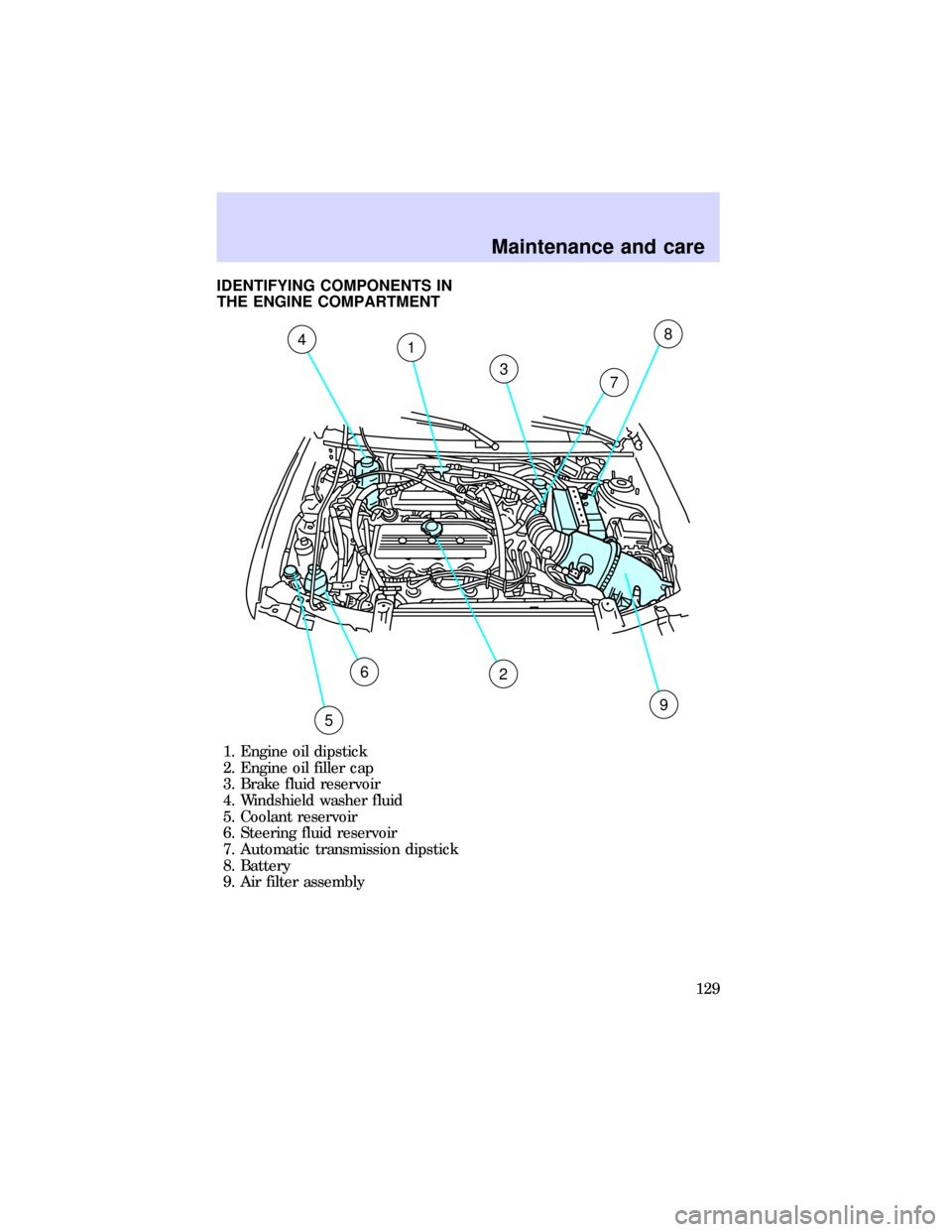
IDENTIFYING COMPONENTS IN
THE ENGINE COMPARTMENT
41
3
9
6
5
2
7
8
1. Engine oil dipstick
2. Engine oil filler cap
3. Brake fluid reservoir
4. Windshield washer fluid
5. Coolant reservoir
6. Steering fluid reservoir
7. Automatic transmission dipstick
8. Battery
9. Air filter assembly
Maintenance and care
129
Page 130 of 191
CHECKING AND ADDING
ENGINE OIL
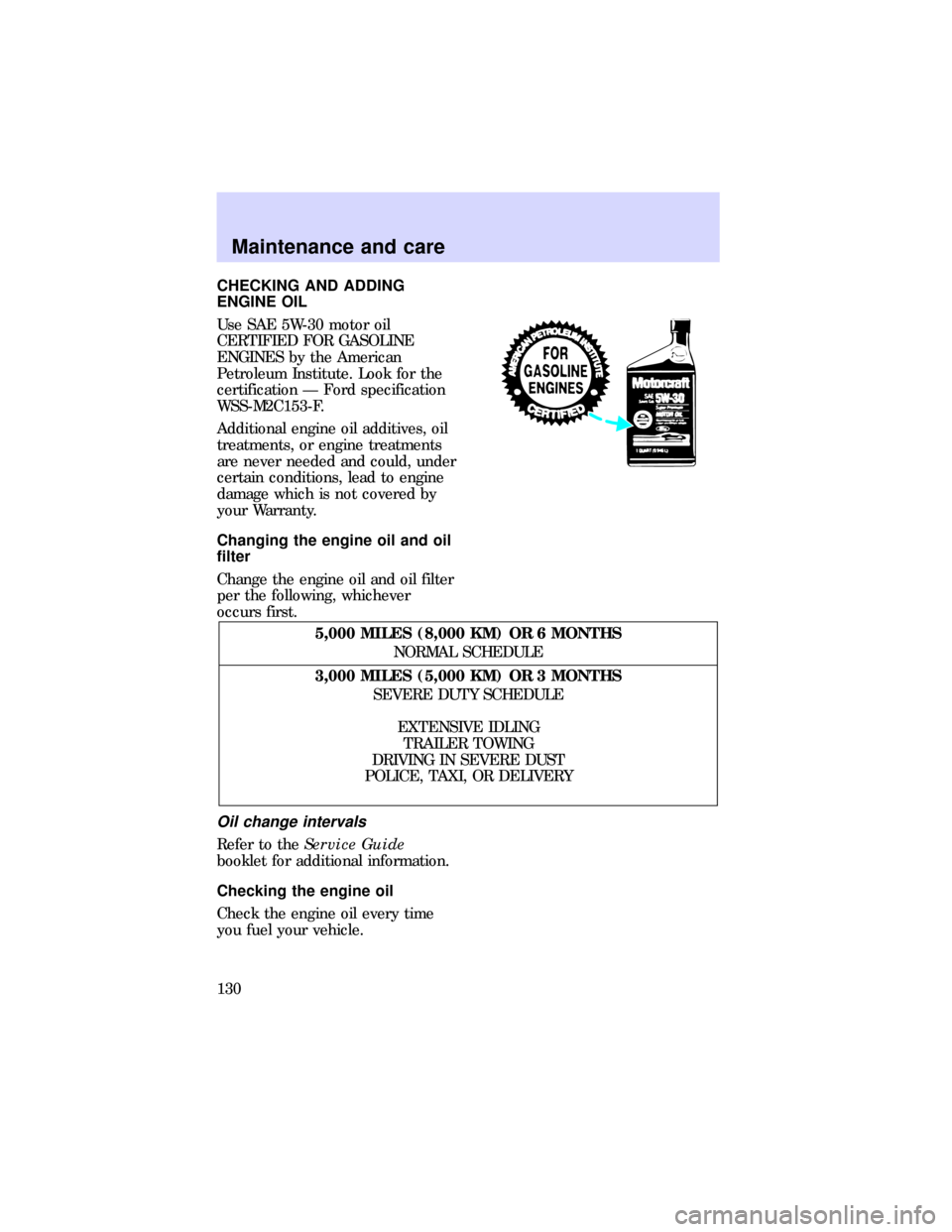
Use SAE 5W-30 motor oil
CERTIFIED FOR GASOLINE
ENGINES by the American
Petroleum Institute. Look for the
certification Ð Ford specification
WSS-M2C153-F.
Additional engine oil additives, oil
treatments, or engine treatments
are never needed and could, under
certain conditions, lead to engine
damage which is not covered by
your Warranty.
Changing the engine oil and oil
filter
Change the engine oil and oil filter
per the following, whichever
occurs first.
5,000 MILES (8,000 KM) OR 6 MONTHS
NORMAL SCHEDULE
3,000 MILES (5,000 KM) OR 3 MONTHS
SEVERE DUTY SCHEDULE
EXTENSIVE IDLING
TRAILER TOWING
DRIVING IN SEVERE DUST
POLICE, TAXI, OR DELIVERY
Oil change intervals
Refer to theService Guide
booklet for additional information.
Checking the engine oil
Check the engine oil every time
you fuel your vehicle.
Maintenance and care
130
Page 131 of 191
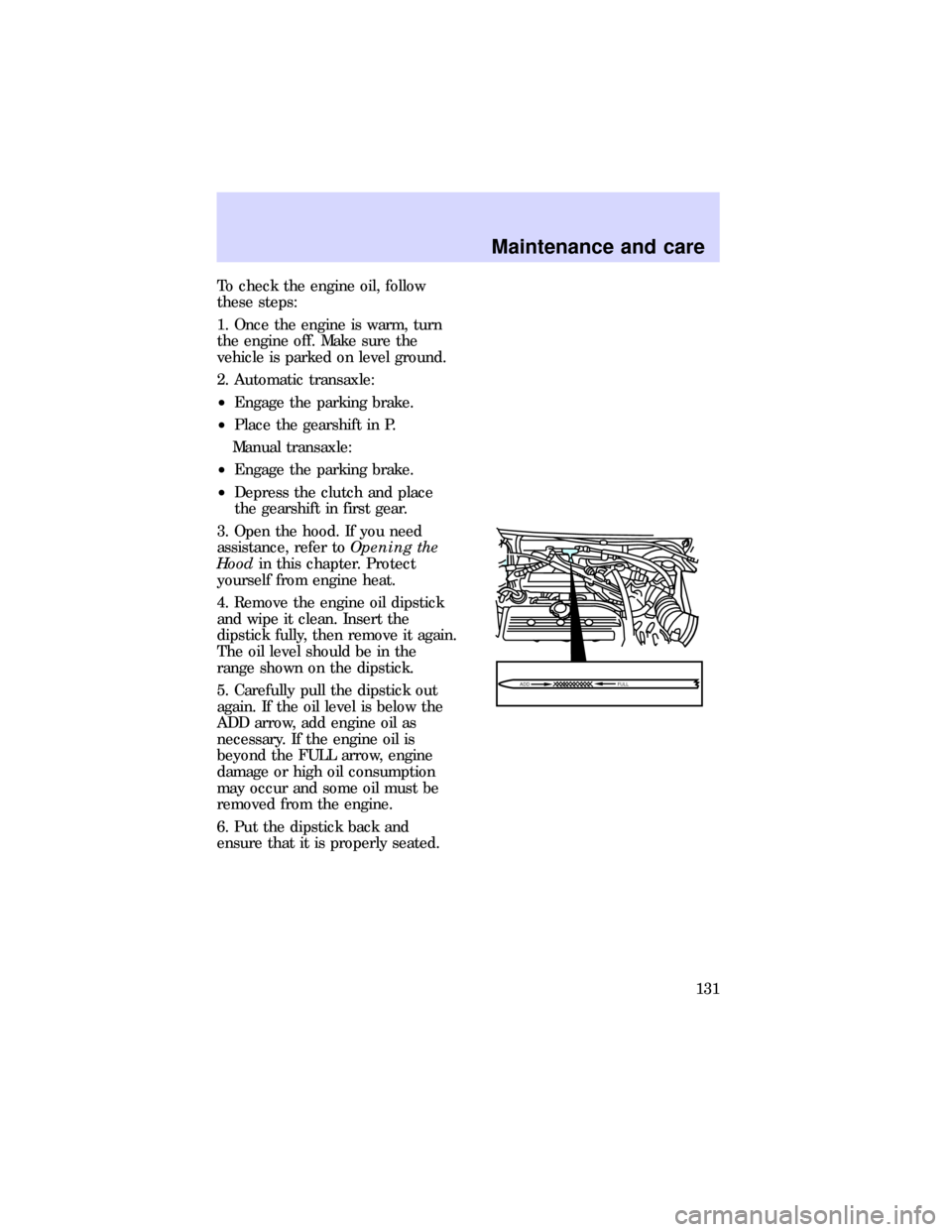
To check the engine oil, follow
these steps:
1. Once the engine is warm, turn
the engine off. Make sure the
vehicle is parked on level ground.
2. Automatic transaxle:
²Engage the parking brake.
²Place the gearshift in P.
Manual transaxle:
²Engage the parking brake.
²Depress the clutch and place
the gearshift in first gear.
3. Open the hood. If you need
assistance, refer toOpening the
Hoodin this chapter. Protect
yourself from engine heat.
4. Remove the engine oil dipstick
and wipe it clean. Insert the
dipstick fully, then remove it again.
The oil level should be in the
range shown on the dipstick.
5. Carefully pull the dipstick out
again. If the oil level is below the
ADD arrow, add engine oil as
necessary. If the engine oil is
beyond the FULL arrow, engine
damage or high oil consumption
may occur and some oil must be
removed from the engine.
6. Put the dipstick back and
ensure that it is properly seated.
ADD FULL
Maintenance and care
131
Page 132 of 191
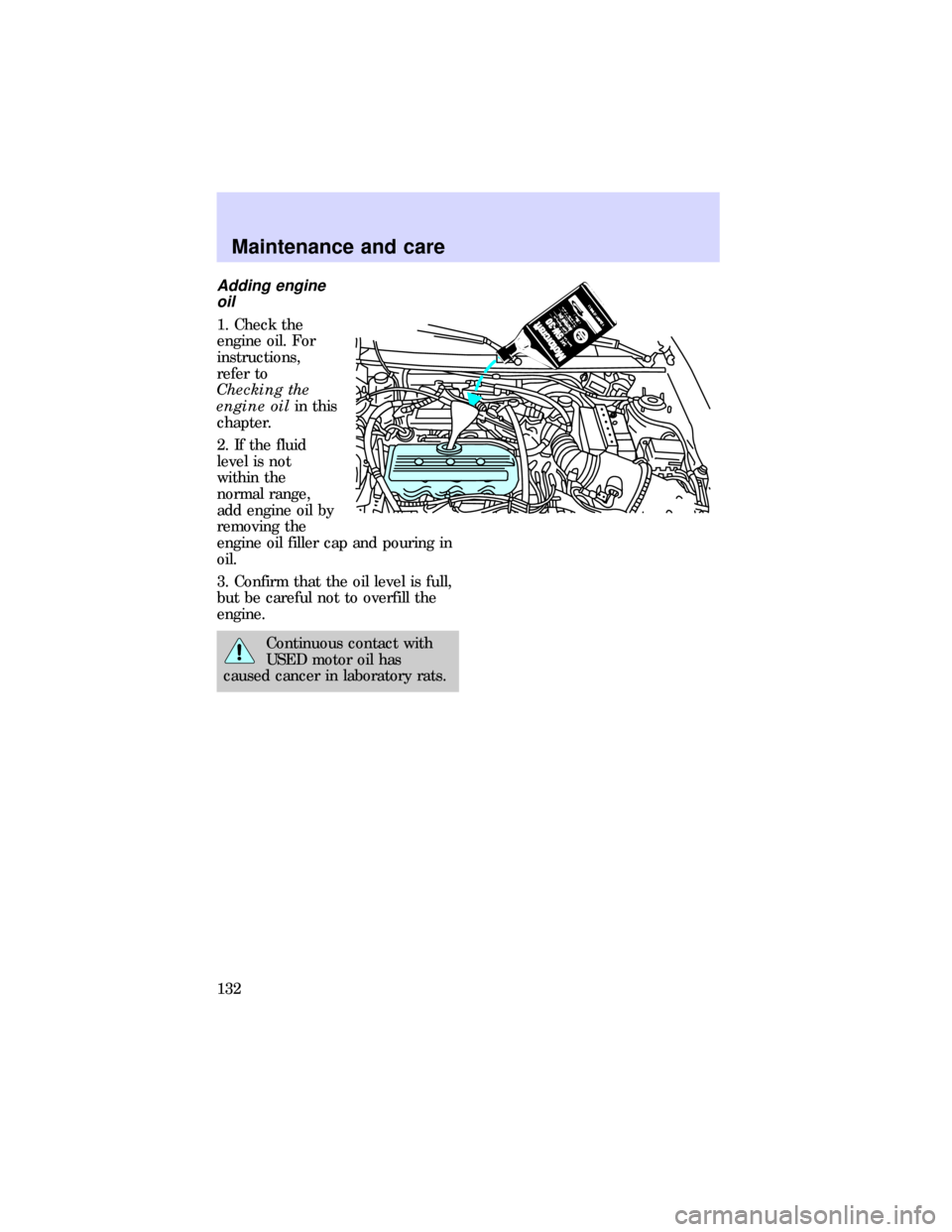
Adding engine
oil
1. Check the
engine oil. For
instructions,
refer to
Checking the
engine oilin this
chapter.
2. If the fluid
level is not
within the
normal range,
add engine oil by
removing the
engine oil filler cap and pouring in
oil.
3. Confirm that the oil level is full,
but be careful not to overfill the
engine.
Continuous contact with
USED motor oil has
caused cancer in laboratory rats.
Maintenance and care
132
Page 133 of 191
CHECKING AND ADDING
BRAKE FLUID
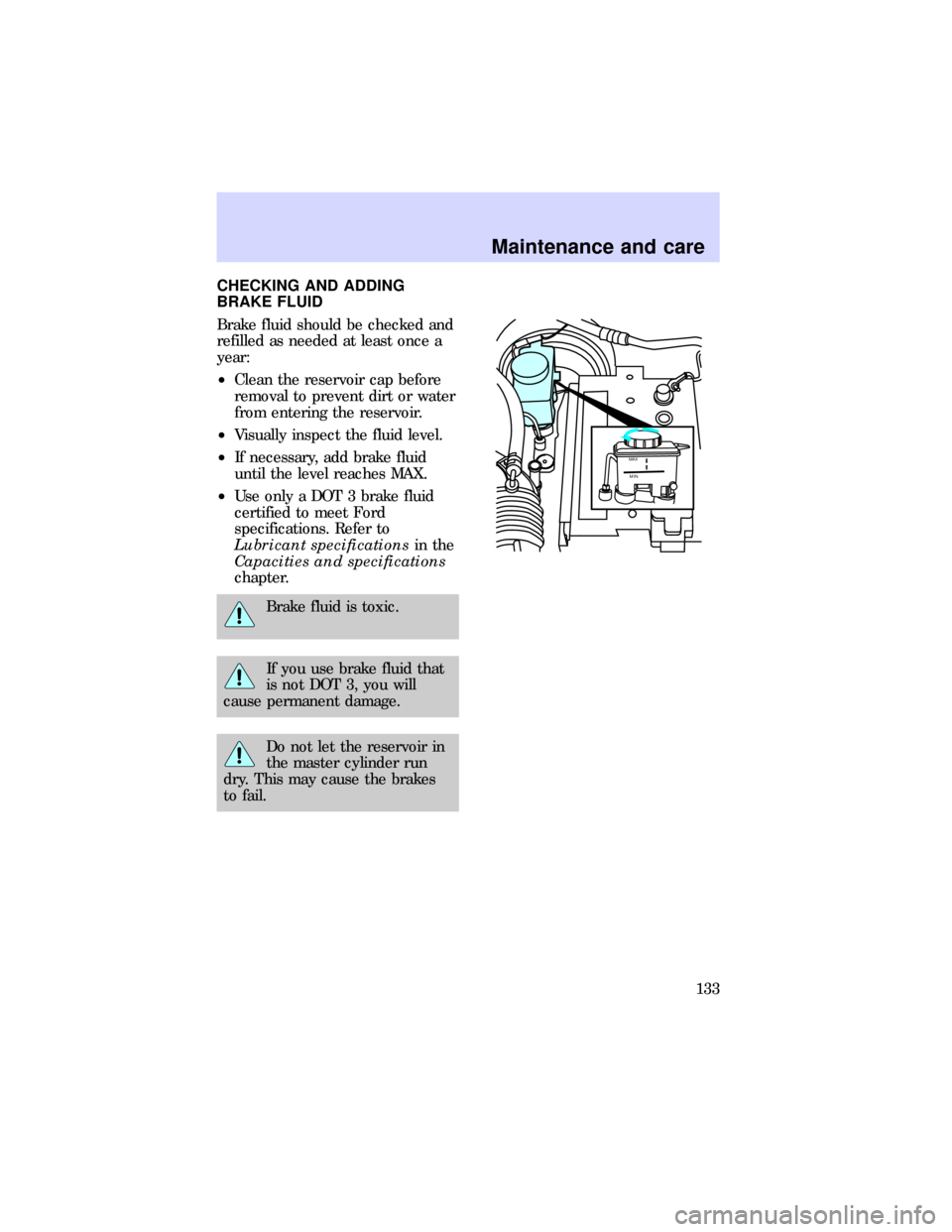
Brake fluid should be checked and
refilled as needed at least once a
year:
²Clean the reservoir cap before
removal to prevent dirt or water
from entering the reservoir.
²Visually inspect the fluid level.
²If necessary, add brake fluid
until the level reaches MAX.
²Use only a DOT 3 brake fluid
certified to meet Ford
specifications. Refer to
Lubricant specificationsin the
Capacities and specifications
chapter.
Brake fluid is toxic.
If you use brake fluid that
is not DOT 3, you will
cause permanent damage.
Do not let the reservoir in
the master cylinder run
dry. This may cause the brakes
to fail.
MAX
MIN
Maintenance and care
133