Page 134 of 192
Ford production and aftermarket
(Motorcraft) oil filters are designed
for added engine protection and
long life. If a replacement oil filter
is used that does not meet Ford
material and design specifications,
startup engine noises or knock
may be experienced.
It is recommended you use the
appropriate Motorcraft oil filter (or
another brand meeting Ford
specifications) for your engine
application.
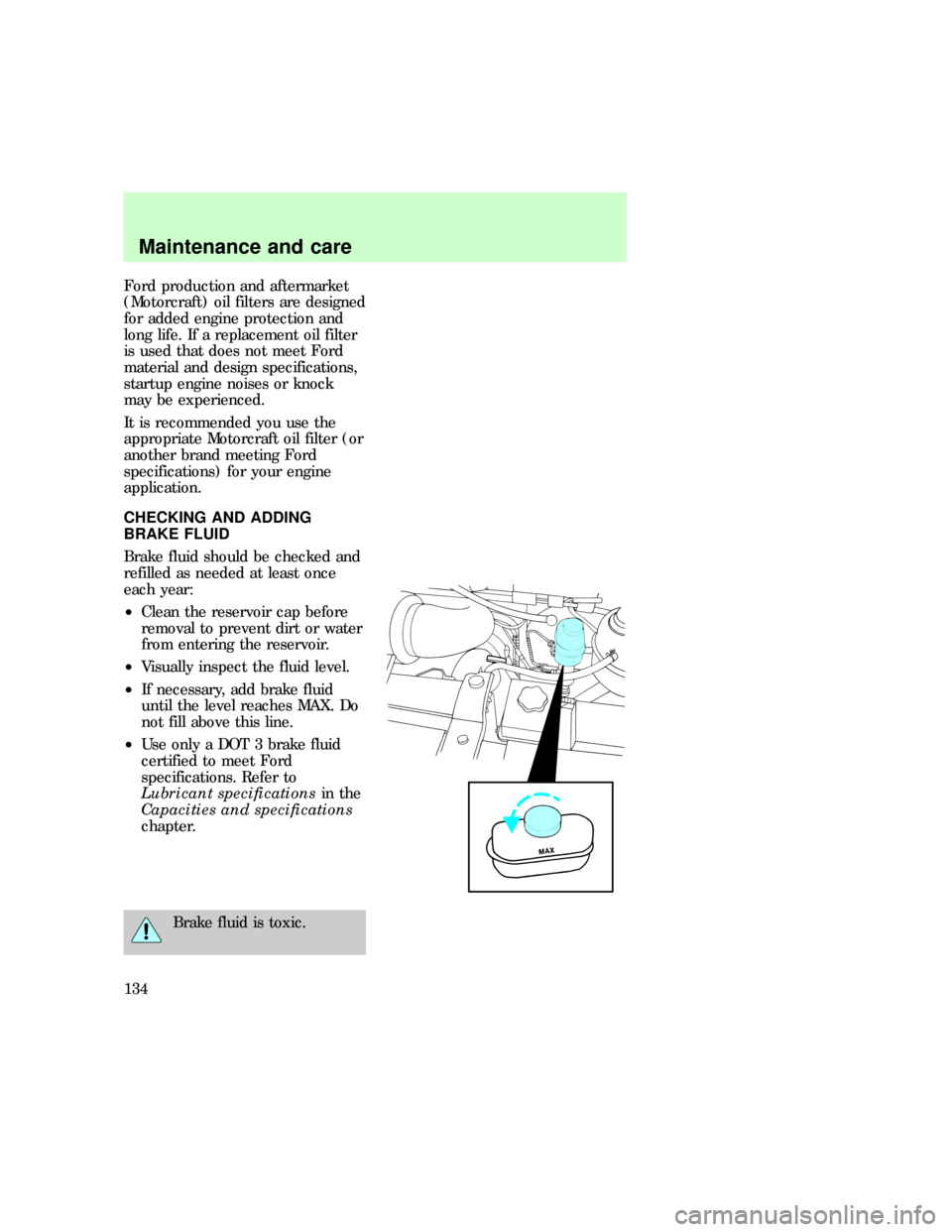
CHECKING AND ADDING
BRAKE FLUID
Brake fluid should be checked and
refilled as needed at least once
each year:
²Clean the reservoir cap before
removal to prevent dirt or water
from entering the reservoir.
²Visually inspect the fluid level.
²If necessary, add brake fluid
until the level reaches MAX. Do
not fill above this line.
²Use only a DOT 3 brake fluid
certified to meet Ford
specifications. Refer to
Lubricant specificationsin the
Capacities and specifications
chapter.
Brake fluid is toxic.
com_checking-adding_fluid.01
Maintenance and care
134
Page 135 of 192
If you use a brake fluid
that is not DOT 3, you will
cause permanent damage to your
brakes.
Do not let the reservoir for
the master cylinder run
dry. This may cause the brakes
to fail.
WASHER FLUID
Use specially formulated
windshield washer fluid rather
than plain water, because specially
formulated washer fluids contain
additives that dissolve road grime.
Washer fluids containing an
appropriate antifreeze such as
methanol should be used in
freezing weather (temperatures
below 0ÉC [32ÉF]). State or local
regulations on volatile organic
compounds may restrict the use of
methanol, a common type of
antifreeze. Use a non-methanol
antifreeze to provide cold weather
protection only if the fluid does
not damage the paint finish, wiper
blades or washer system.
eco_washer_fluid
eco_adding_washer_fluid
Maintenance and care
135
Page 142 of 192
speeds, in city traffic during hot
weather or pulling a trailer, the
vehicle should be turned off for
about 30 minutes to allow the fluid
to cool before checking.
1. Park the vehicle on a level
surface.
2. Start the engine and move the
gearshift lever through all of the
gear ranges. Allow sufficient time
for each gear to engage.
3. Latch the gearshift lever in P
(Park), set the parking brake and
leave the engine running.
4. Remove the dipstick, wiping it
clean with a clean, dry rag.
5. Install the dipstick.
6. Remove the dipstick and inspect
the fluid level.
For 4R70W transmissions, the fluid
level should be within the
crosshatched area, or if the vehicle
has not been driven, between the
holes near the bottom of the
indicator.
P RN 21D
DON'T ADD IF IN CROSSHATCHED AREA - CHECK WHEN HOT IDLING IN PARK
Maintenance and care
142
Page 156 of 192
Using snow tires and chains
Snow tires must be the
same size and grade as the
tires you currently have on your
vehicle.
The tires on your vehicle have
allÐweather treads to provide
traction in rain and snow. However,
in some climates, using snow tires
and chains may be necessary. Ford
offers tire cables as a Ford
approved accessory and
recommends use of these or their
equivalents. See your dealer or
qualified service technician for
more information on tire cables for
your vehicle. Follow these
guidelines when using snow tires
and chains:
²Install chains securely, verifying
that the chains do not touch any
wiring, brake lines or fuel lines.
²Install the chains on the rear
tires only.
²Drive cautiously. If you hear the
chains rub or bang against the
vehicle, stop and retighten
them. If this does not work,
remove the chains to prevent
vehicle damage.
²Avoid overloading your vehicle.
²Remove the tire chains when
they are no longer needed. Do
not use chains on dry roads.
²The suspension insulation and
bumpers will help prevent
vehicle damage. Do not remove
Maintenance and care
156
Page 165 of 192
REPLACING BULBS
Replacing exterior bulbs
It is a good idea to check the
operation of the following lights
frequently:
²Headlamps
²Tail lamps
²Brakelamps
²High-mount brakelamp
²Backup lamps
²Hazard flashers
²Turn signals
²License plate lamp
Do not remove lamp bulbs unless
they will be replaced immediately.
If a bulb is removed for an
extended period of time,
contaminants may enter the lamp
and affect performance.
Headlamp bulb (aerodynamic)
Handle a halogen
headlamp bulb carefully
and keep out of children's reach.
Grasp the bulb only by its plastic
base and do not touch the glass.
The oil from your hand could
cause the bulb to break the next
time the headlamps are
operated.
eco_replacing_bulbs
eco_replacing_headlamp_aero
Maintenance and care
165
Page 166 of 192
1. Open the hood.
2. Push each clip tab toward the
engine compartment and lift
upward to the stop position.
3. Remove the headlamp assembly.
4. Remove bulb retention ring by
turning it counterclockwise about
1/4 turn.
5. Pull bulb assembly out of
headlamp assembly.
6. Pull out bulb.
7. Replace bulb.
8. Reverse steps 1±3 to replace
headlamp assembly.
Bulb specifications
DescriptionNumber of
BulbsTrade Number
Front Lamps - Exterior
Headlamps (low series) 2 H6054
Headlamps (high series) 2 9007
Park lamp and turn signal 2 3157NAK
Rear Lamps - Exterior
Back-up lamps 2 3156K
License plate lamp 2 186
Stop/Tail/Side marker lamp 2 3357K
Turn lamp 2 3156K
High-mount brakelamp 2 912
eco_bulb_specifications
Maintenance and care
166
Page 167 of 192
DescriptionNumber of
BulbsTrade Number
Interior Courtesy Lamps
Cargo lamp 1 211-2
Dome lamp (standard) 1 912
Instrument panel
illumination2 194
Map/reading lamp 2 211-2
Radio Illumination
1
Instrument Panel
Automatic transmission
gear selector1 194
Instrument Panel Controls
A/C control 1 161
Heater control 1 161
Instrument Cluster
Seat belt light 1 194
High beam indicator 1 194
Brake Warning 1 194
Turn signal indicator 1 194
Anti-lock brake system 1 194
Service engine soon 1 194
Air bag readniness 1 194
Door ajar 1 194
Oil pressure/engine
coolant1 194
1Replaceable at Ford authorized
radio service centers.
NA Ð Natural amber
K Ð Krypton filled bulb
com_cleaning_caring.01
Maintenance and care
167
Page 168 of 192

CLEANING AND CARING FOR
YOUR VEHICLE
Refer to the ªCustomer Assistance
Guideº for a list of Ford-approved
cleaners, polishes and waxes.
Washing your vehicle
Wash your vehicle regularly with
cold or lukewarm water. Never use
strong detergents or soap. If your
vehicle is particularly dirty, use a
quality car wash detergent. Always
use a clean sponge, washing glove
or similar device and plenty of
water for best results. To avoid
spots, avoid washing when the
hood is still warm, immediately
after or during exposure to strong
sunlight.
During winter months, it is
especially important to wash the
vehicle on a regular basis. Large
quantities of dirt and road salt are
difficult to remove, and they also
cause damage to the vehicle.
Remove any exterior accessories,
such as antennas, before entering
a car wash.
²After washing, apply the brakes
several times to dry them.
Waxing your vehicle
The best way to determine when
the paintwork needs waxing is by
noting when water stops beading
on the surface. This could be every
three or four months, depending
on operating conditions.
Use only carnauba or
synthetic-based waxes. Remove
com_washing_vehicle.01
com_waxing_vehicle.01
Maintenance and care
168