Page 62 of 192
²Put the safety belt in the
automatic locking mode. Refer
toUsing the automatic locking
modein this chapter.
Installing child safety seats in
combination lap and shoulder
belt seating positions
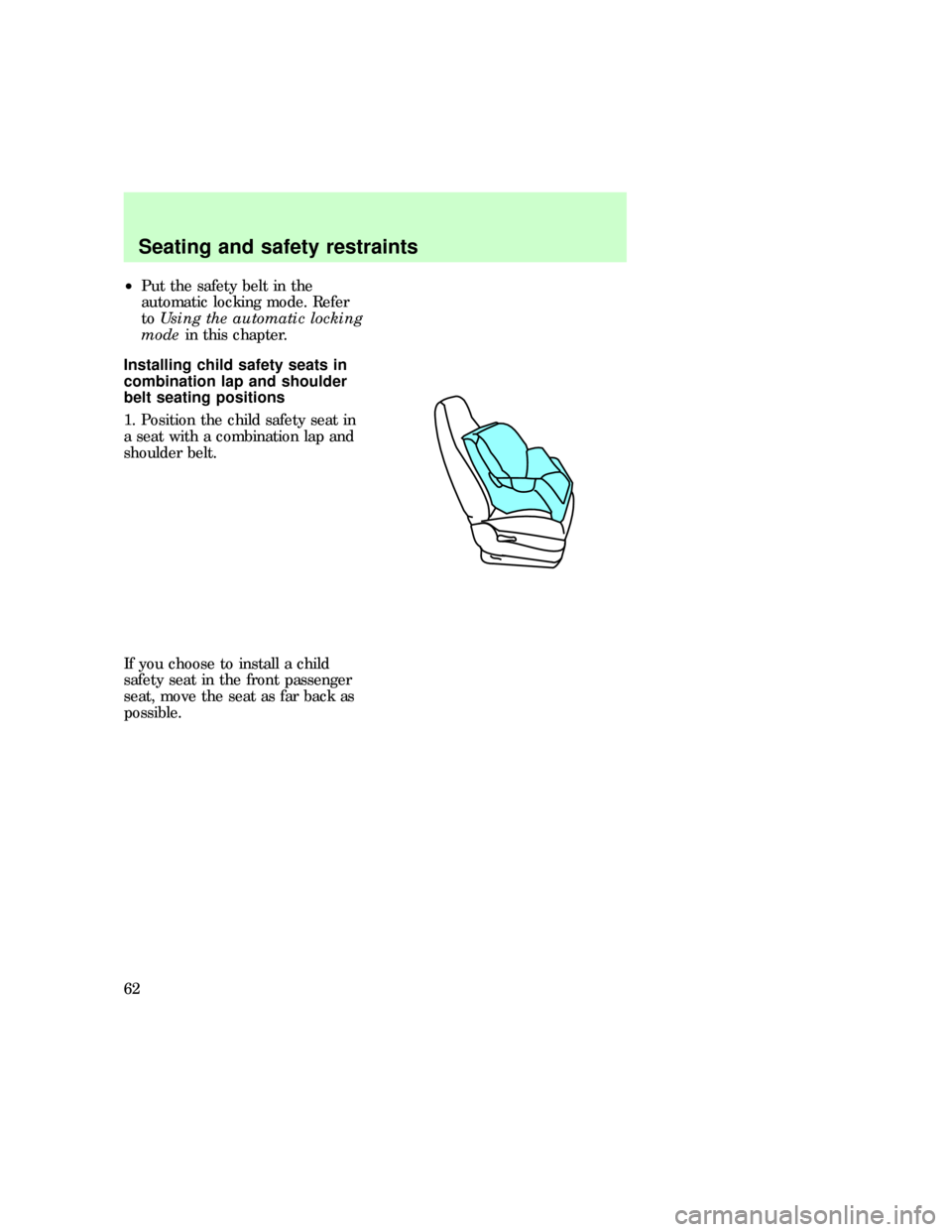
1. Position the child safety seat in
a seat with a combination lap and
shoulder belt.
If you choose to install a child
safety seat in the front passenger
seat, move the seat as far back as
possible.
com_installing_seats.01
Seating and safety restraints
62
Page 63 of 192
Rear-facing child seats or
infant carriers should
never be placed in the front
seats.
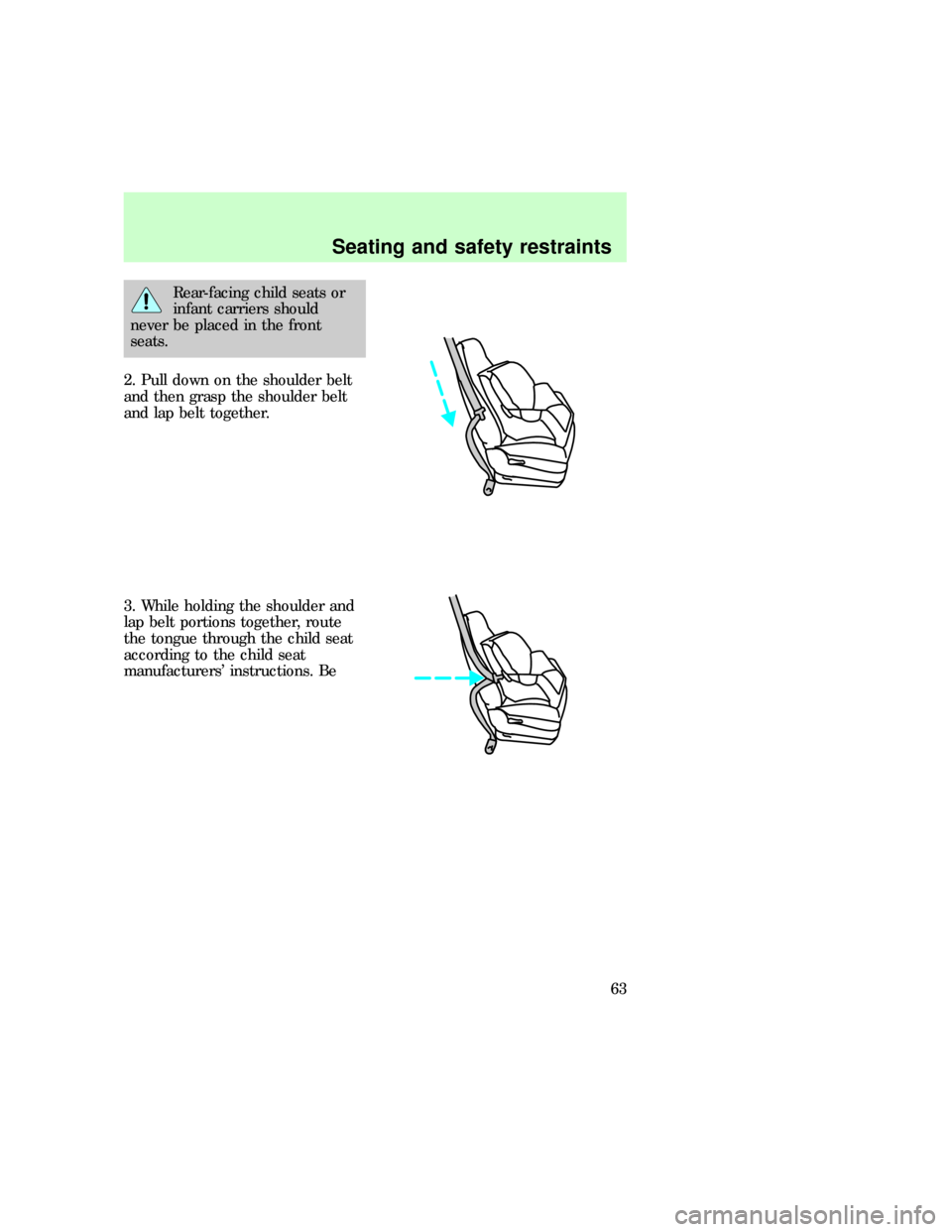
2. Pull down on the shoulder belt
and then grasp the shoulder belt
and lap belt together.
3. While holding the shoulder and
lap belt portions together, route
the tongue through the child seat
according to the child seat
manufacturers' instructions. Be
Seating and safety restraints
63
Page 67 of 192
repeat steps 5 and 6, or properly
install the child seat in a different
seating position.
Attaching safety seats with
tether straps
Some manufacturers make safety
seats that include a tether strap
that goes over the back of the
vehicle seat and attaches to an
anchoring point. Other
manufacturers offer the tether
strap as an accessory. Contact the
manufacturer of your child safety
seat for information about ordering
a tether strap.
Tether anchorage
Children should be placed
in the rear in an
appropriate child safety seat that
is properly secured to the
vehicle.
Rear-facing infant seats
must always be secured in
the rear seat. In vehicles without
a rear seat, a rear-facing infant
seat should be secured in the
front seat only if your vehicle
does not have a passenger side
air bag or your vehicle is
equipped with a passenger air
bag deactivate switch and the
switch is turned to ªOFF.º
eco_tether-straps
eco_tether_anchorage
Seating and safety restraints
67
Page 68 of 192
When using forward-facing
child safety seats in
vehicles with only two seating
positions so the forward-facing
child safety seat cannot be
placed in the rear of the vehicle,
move the passenger seat as far
back from the instrument panel
as possible.
Front passenger seating
position
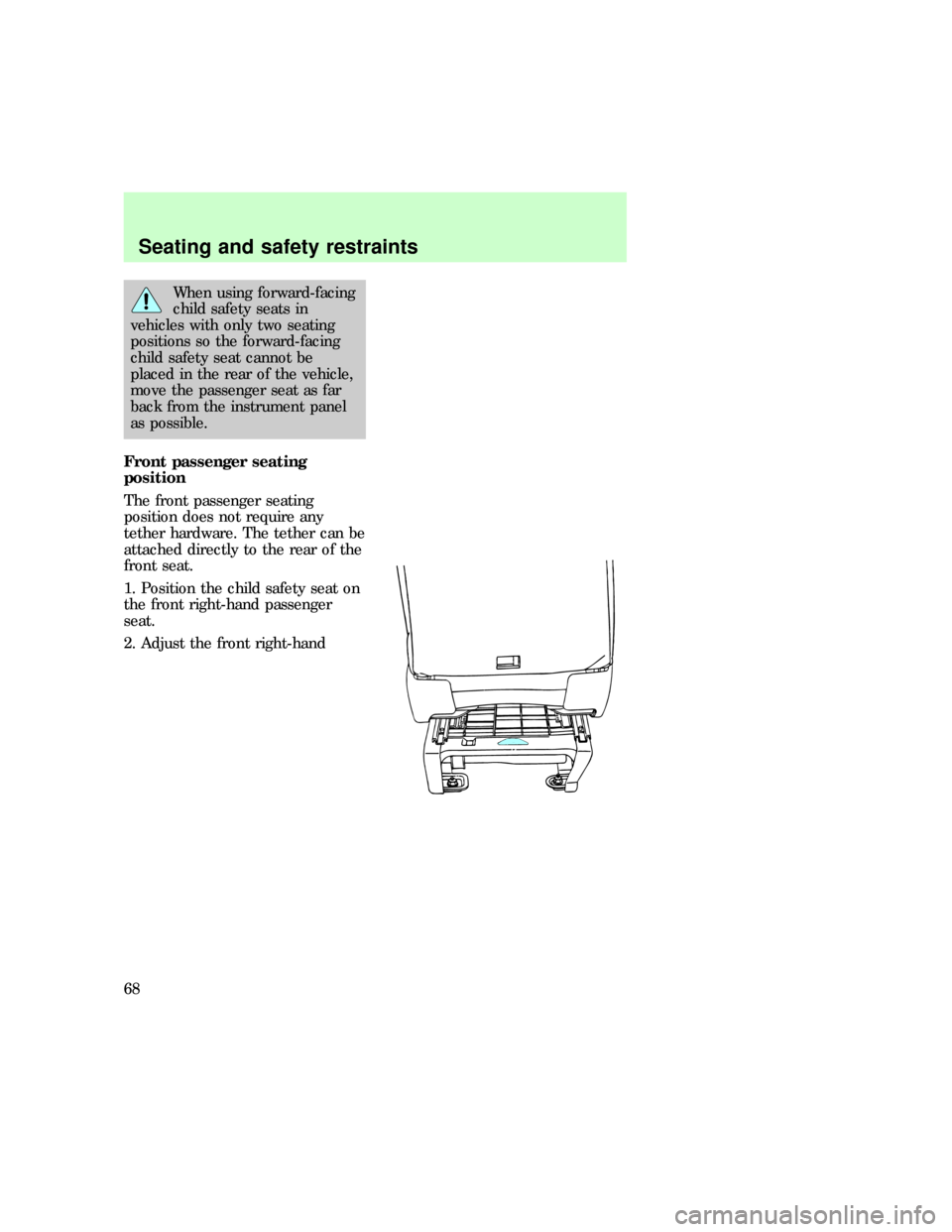
The front passenger seating
position does not require any
tether hardware. The tether can be
attached directly to the rear of the
front seat.
1. Position the child safety seat on
the front right-hand passenger
seat.
2. Adjust the front right-hand
Seating and safety restraints
68
Page 71 of 192
properly in the event of a collision.
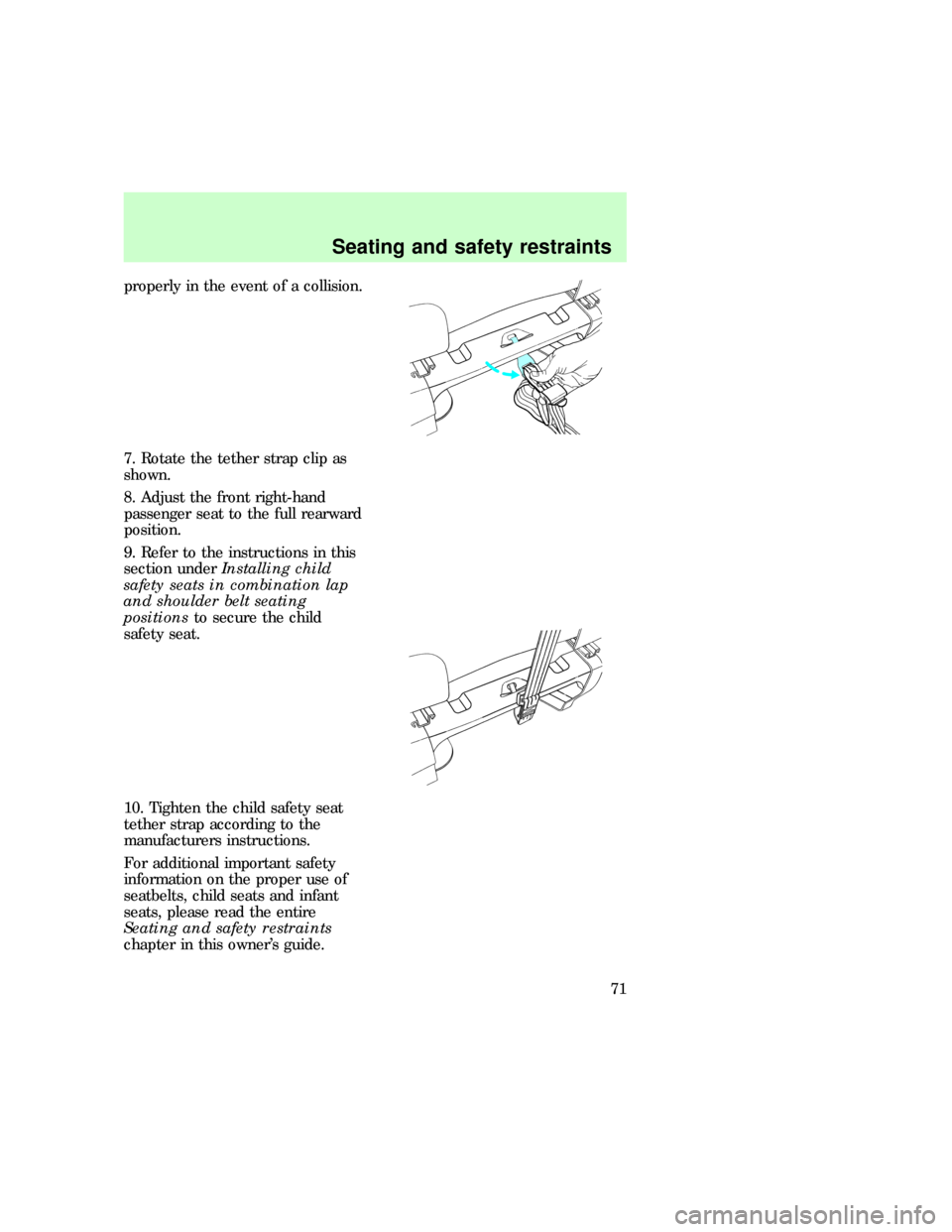
7. Rotate the tether strap clip as
shown.
8. Adjust the front right-hand
passenger seat to the full rearward
position.
9. Refer to the instructions in this
section underInstalling child
safety seats in combination lap
and shoulder belt seating
positionsto secure the child
safety seat.
10. Tighten the child safety seat
tether strap according to the
manufacturers instructions.
For additional important safety
information on the proper use of
seatbelts, child seats and infant
seats, please read the entire
Seating and safety restraints
chapter in this owner's guide.
Seating and safety restraints
71
Page 72 of 192
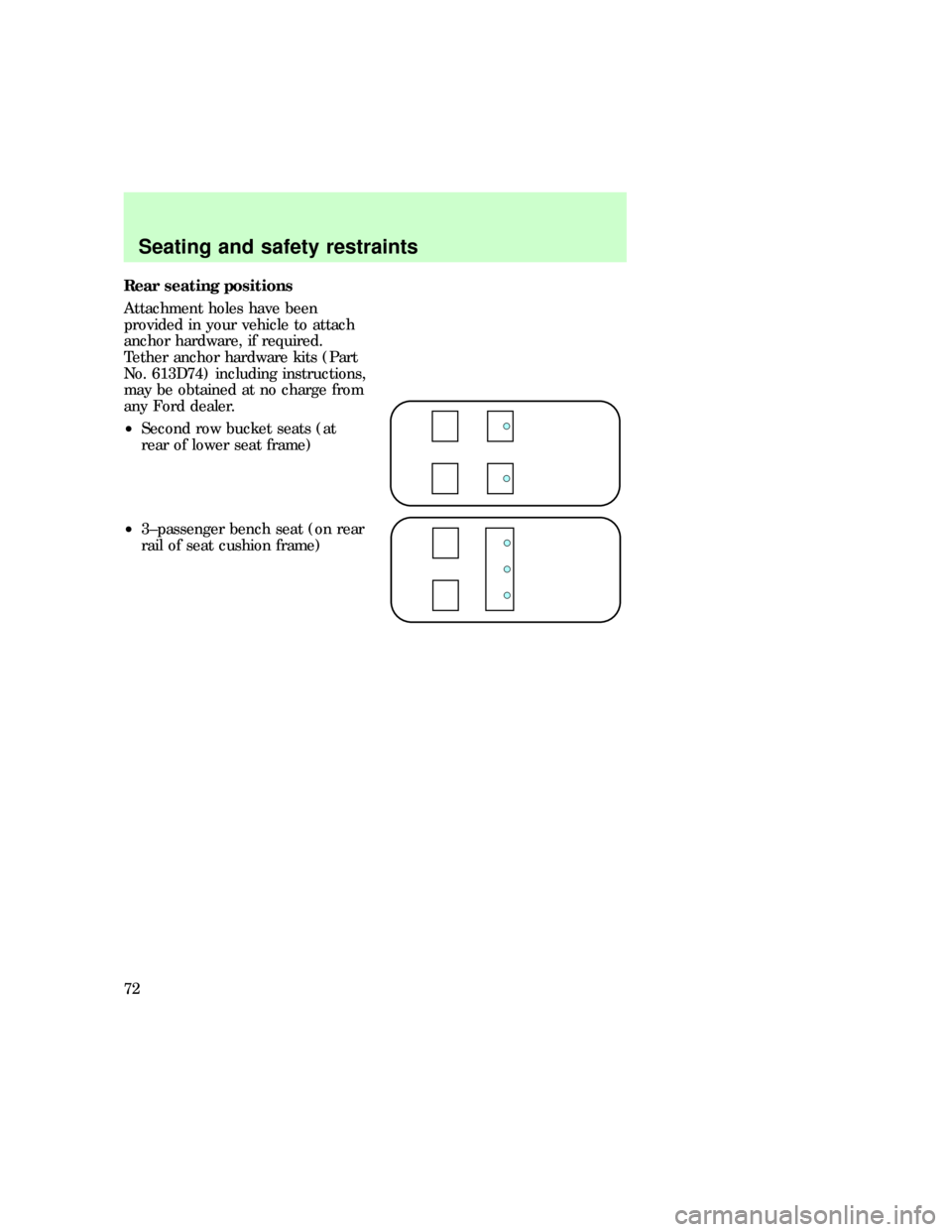
Rear seating positions
Attachment holes have been
provided in your vehicle to attach
anchor hardware, if required.
Tether anchor hardware kits (Part
No. 613D74) including instructions,
may be obtained at no charge from
any Ford dealer.
²Second row bucket seats (at
rear of lower seat frame)
²3±passenger bench seat (on rear
rail of seat cushion frame)
Seating and safety restraints
72
Page 86 of 192
5. Shift the transmission to N
(Neutral).
6. Start the vehicle.
If you need to use the above
procedure, it is possible that a fuse
has blown and your brakelamps
may not be functioning. Refer to
theRoadside emergencies
chapter for instructions on
replacing fuses.
Do not drive your vehicle
until you verify that the
brakelamps are working.
VEHICLE LOADING
It is extremely dangerous
to ride in a cargo area,
inside or outside of a vehicle. In
a collision, people riding in these
areas are more likely to be
seriously injured or killed. Do not
allow people to ride in any area
of your vehicle that is not
equipped with seats and safety
belts. Be sure everyone in your
vehicle is in a seat and using a
safety belt properly.
Before loading a vehicle, familiarize
yourself with the following terms:
²Base Curb Weight:Weight of
the vehicle including any
standard equipment, fluids,
lubricants, etc. It does not
include passengers or
aftermarket equipment.
eco_heavy-load
Driving
86
Page 106 of 192
Number Fuse amperage
ratingCircuits protected
8 30 amp Noise supression
capacitor, ignition coil
positive feed, PCM
relay diode/PCM
power relay, fuel
heater (diesel), glow
plug relay (diesel)
9 30 amp Wiper control module,
wiper motor
10 20 amp Headlamp switch
(exterior lamps),
Multi-function switch
(flash-to-pass)
11 15 amp Stoplight switch, brake
pressure switch,
multi-function switch
12 15 amp Digital transmission
range sensor (backup
lamps), auxiliary
battery relay
13 15 amp A/C mode switch,
blend door actuator
14 5 amp Instrument cluster (air
bag and charge
indicator lamps)
15 5 amp Trailer tow battery
charge relay (coil)
16 30 amp Power seats
17 - Not used
18 - Not used
19 10 amp Air bag module
20 5 amp Overdrive cancel
switch
Roadside emergencies
106