Page 51 of 192

Use only extensions manufactured
by the same supplier as the safety
belt. Manufacturer identification is
located at the end of the webbing
on the label. Also, use the safety
belt extension only if the safety
belt is too short for you when fully
extended. Do not use extension to
change the fit of the shoulder belt
across the torso.
Safety belt indicator light and
warning chime
The seat belt warning light
illuminates in the instrument
cluster and a chime sounds to
remind the occupants to fasten
their safety belts.
Conditions of operation
If... Then...
The driver's safety belt is not
buckled before the ignition key
is turned to ON...The safety belt indicator illuminates
and the warning chime/buzzer
sounds for four to eight seconds.
The driver's side safety belt is
buckled while the indicator
light is illuminated and the
warning chime is sounding...The safety belt warning chime turns
off.
The driver's safety belt is
buckled before the ignition key
is turned to ON...The safety belt indicator
chime/buzzer remains off.
Safety belt inspection after a
collision, maintenance and care
Check the safety belt system
periodically to make sure that it
works properly and is not
damaged. Check the safety belts to
eco_warning-light_chime
eco_light-chime_operation
eco_belt_maintenance
Seating and safety restraints
51
Page 57 of 192

²one or more impact and safing
sensors,
²a readiness light and tone,
²driver and front passenger
safety belt buckle pretensioners
²and the electrical wiring which
connects the components.
The diagnostic module monitors its
own internal circuits and the
supplemental air bag electrical
system readiness (including the
impact sensors), the system wiring,
the air bag system readiness light,
the air bag back up power and the
air bag ignitors.
Determining if the system is
operational
The SRS uses a readiness light in
the instrument cluster or a tone to
indicate the condition of the
system. Refer to theAir bag
readinesssection in the
Instrumentationchapter. Routine
maintenance of the air bag is not
required.
A difficulty with the system is
indicated by one or more of the
following:
²The readiness light will either
flash or stay lit.
²The readiness light will not
illuminate immediately after
ignition is turned on.
²A group of five beeps will be
heard. The tone pattern will
repeat periodically until the
problem and light are repaired.
com_determing_operational.01
Seating and safety restraints
57
Page 77 of 192
Make sure the corresponding lights
illuminate briefly. If a light fails to
illuminate, have the vehicle
serviced.
²If the driver's safety belt is
fastened, the
light does not
illuminate.
STARTING PROCEDURE
Starting the engine
1. Turn the key to 5 (Start)
without pressing the accelerator.
The key will return to 4 (On).
2. If the engine does not start
within five seconds, wait ten
seconds and try again.
3. If the engine does not start in
two attempts OR the temperature
is below Ð12ÉC (10ÉF), depress
accelerator and start the engine
while holding the accelerator
down. Release accelerator when
engine starts.
4. After idling for a few seconds,
apply the brake and release the
parking brake.
Using the engine block heater
(if equipped)
An engine block heater warms the
engine coolant, which improves
starting, warms up the engine
3
2
1
5
4
eco_start_title
com_starting_vehicle.01
com_engine_heater.01
Starting
77
Page 81 of 192
vehicle. However, if the normal
brakes fail, the parking brake can
be used to stop your vehicle in an
emergency. Since the parking
brake applies only the rear brakes,
the vehicle's stopping distance will
increase greatly and the handling
of your vehicle will be adversely
affected.
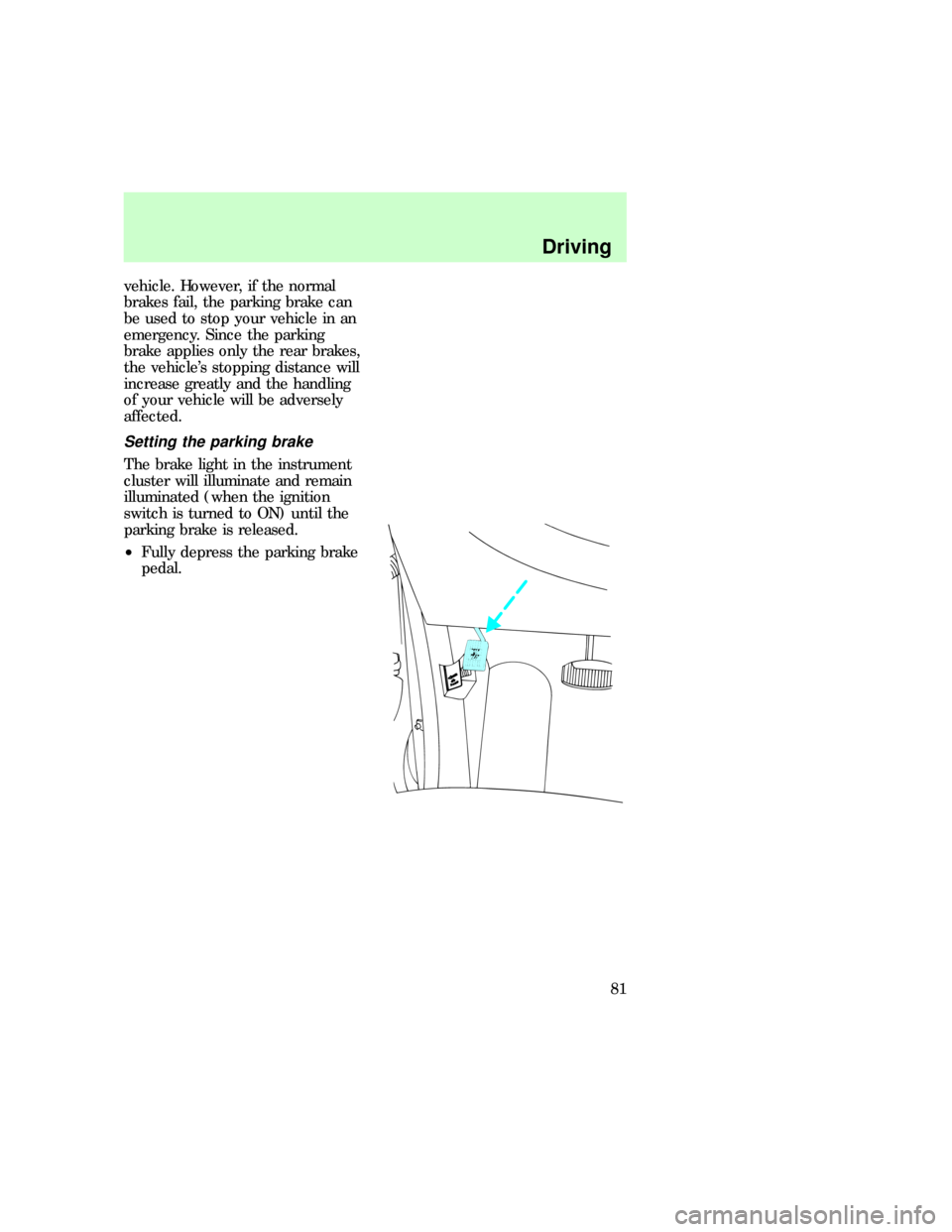
Setting the parking brake
The brake light in the instrument
cluster will illuminate and remain
illuminated (when the ignition
switch is turned to ON) until the
parking brake is released.
²Fully depress the parking brake
pedal.
eco_setting_pbrake eco_releasing_pbrake
Driving
81
Page 82 of 192
Releasing parking brake
²Push parking brake pedal down
firmly, then release.
If the parking brake is fully
released, but the Brake
System light remains on, have
the brakes checked immediately.
They may not be working
properly.
STEERING YOUR VEHICLE
If the amount of effort needed to
steer your vehicle changes at a
constant speed, have the vehicle
power steering system checked.
Never hold the steering wheel to
the extreme left or right for more
than five seconds if the engine is
running. This can damage the
power steering pump.
After any severe impact or
collision involving the front end,
observe the steering wheel
alignment. If the spoke of the
eco_steeing_vehicle
Driving
82
Page 84 of 192
N (Neutral)Ð Vehicle is free to
roll.
D(Overdrive)Ð The normal
driving position for the best fuel
economy. Transmission operates
automatically in gears one through
four.
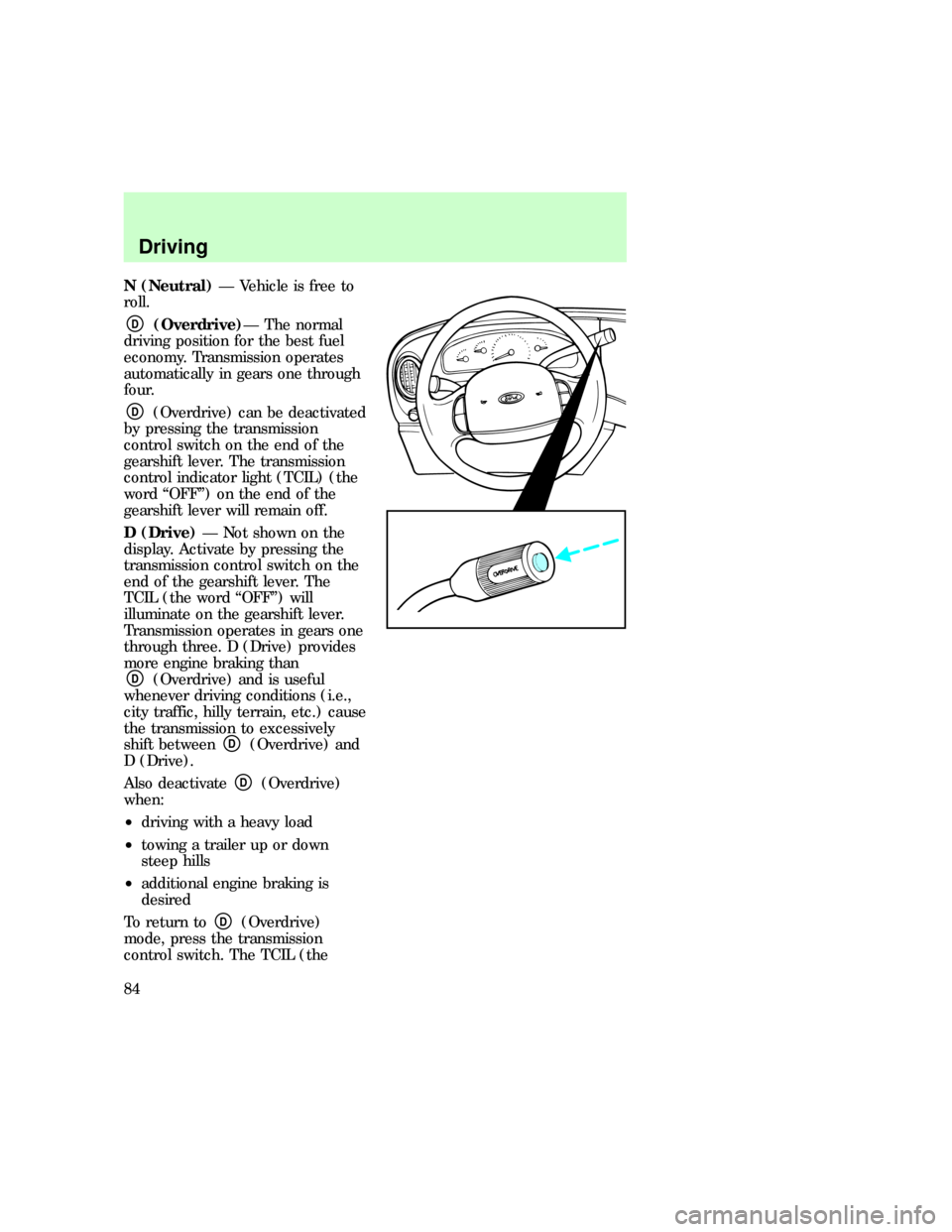
D(Overdrive) can be deactivated
by pressing the transmission
control switch on the end of the
gearshift lever. The transmission
control indicator light (TCIL) (the
word ªOFFº) on the end of the
gearshift lever will remain off.
D (Drive)Ð Not shown on the
display. Activate by pressing the
transmission control switch on the
end of the gearshift lever. The
TCIL (the word ªOFFº) will
illuminate on the gearshift lever.
Transmission operates in gears one
through three. D (Drive) provides
more engine braking than
D(Overdrive) and is useful
whenever driving conditions (i.e.,
city traffic, hilly terrain, etc.) cause
the transmission to excessively
shift between
D(Overdrive) and
D (Drive).
Also deactivate
D(Overdrive)
when:
²driving with a heavy load
²towing a trailer up or down
steep hills
²additional engine braking is
desired
To return to
D(Overdrive)
mode, press the transmission
control switch. The TCIL (the
Driving
84
Page 97 of 192

hilly country or on hot days.
Speed control may shut off if you
are towing on very long, steep
grades.
When towing a trailer
If towing a trailer and your vehicle
is not equipped with the Ford
trailer tow package, an auxiliary
transmission fluid cooler is
recommended.
²Use D (Drive) rather than
D(Overdrive) while towing up
or down steep hills. This will
eliminate excessive downshifting
and upshifting for optimum fuel
economy and transmission
cooling.
²Anticipate stops and brake
gradually.
²Allow more room for stopping
with a trailer attached.
²Practice turning, stopping and
backing in an area before
starting on a trip to get the feel
of the vehicle/trailer
combination.
²When turning, drive slightly
beyond the normal turning point
so the trailer wheels will clear
curbs and other obstacles.
²When stopped in traffic for long
periods of time in hot weather,
place the gearshift in P (Park)
to increase idle speed. This aids
engine cooling and air
conditioner efficiency.
²Vehicles with trailers should not
be parked on a grade. If you
eco_when_towing
Driving
97
Page 100 of 192
HAZARD LIGHTS CONTROL
Use only in an emergency to warn
traffic of vehicle breakdown,
approaching danger, etc. Depress
to activate all indicators
simultaneously. Depress again to
switch off. The warning lights can
be operated when the ignition is
off.
FUEL PUMP SHUT-OFF SWITCH
If the engine cranks but does not
start after a collision, the fuel
pump shut±off switch may have
been activated. The shut±off
switch is a device intended to stop
the electric fuel pump when your
vehicle has been involved in a
substantial jolt.
1. Turn the ignition switch to the
OFF position.
2. Check fuel system for leaks.com_hazard_switch.01
eco_fuel_shut-off
Roadside emergencies
100