Page 168 of 388

&.’ What should I do if my vehicle stalls, or is about
A: If this happens, there are some things you should
to stall, and I can’t make it up the hill?
do, and there are some things you must not do.
First, here’s what you
should do:
Push the brake pedal to stop the vehicle and keep it
from rolling backwards. Also, apply the parking brake.
If your engine is still running, shift the transmission
to REVERSE (R), release the parking brake, and
slowly back down the hill in REVERSE
(R).
If your engine has stopped running, you’ll need to
restart
it. With the brake pedal depressed and the
parking brake still applied, shift the transmission to
PARK
(P) (or, shift to NEUTRAL (N) if your
vehicle has a manual transmission) and restart the
engine. Then, shift to REVERSE (R), release the
parking brake, and slowly back down the hill as
straight as possible in REVERSE (R).
0 As you are backing down the hill, put your left hand
on the steering wheel at the 12 o’clock position. This
way, you’ll be able to tell
if your wheels are straight and maneuver
as you back down. It’s best that you
back down the hill with your wheels straight rather
than in the left or right direction. Turning the wheel
too far to the left or right will increase the possibility
of a rollover.
Here are some things you
must not do if you stall, or
are about to stall, when going up a hill.
Never attempt to prevent a stall by shifting into
NEUTRAL
(N) (or depressing the clutch, if you
have a manual transmission) to “rev-up” the engine
and regain forward momentum. This won’t work.
Your vehicle will roll backwards very quickly and
you could go out of control.
Instead, apply the regular brake to stop the vehicle. Then
apply the parking brake. Shift to REVERSE (R), release
the parking brake, and slowly back straight down.
Never attempt to turn around if you are about to stall
when going up a hill. If the hill is steep enough to
stall your vehicle, it’s steep enough to cause you to
roll over if you turn around.
If you can’t make it up
the hill,
you must back straight down the hill.
4-22
I
ProCarManuals.com
Page 222 of 388
How to Add Coolant to the Radiator
2. Then keep turning the pressure cap, but now push
down as you turn it. Remove the pressure cap.
1. You can remove the radiator pressure cap when the
cooling system, including the radiator pressure cap
and upper radiator hose, is no longer hot.
Turn the
pressure cap slowly counterclockwise until it first
stops. (Don’t press down while turning the
pressure cap.)
If you hear a
hiss, wait for that to stop. A hiss means
there is still some pressure left.
5-20
ProCarManuals.com
Page 229 of 388
k
Remove wheel nuts with the wheel wrench.
Remove the spare tire from the mounting bracket and
place it near your flat tire.
Attach the jack handle to the jack bolt. Turn the jack
handle clockwise. That will raise the lift head
a little.
Removing the Flat Tire and Installing the
Spare Tire
I. Using the wheel wrench, loosen all the wheel nuts.
Don't remove them yet.
5-27
I
ProCarManuals.com
Page 231 of 388
4. Remove all the wheel
nuts and take off the
flat tire.
3. Raise the vehicle by turning the jack handle
clockwise. Raise the vehicle far enough
off the
ground
so there is enough room for the spare
tire to fit.
5. Remove any rust or dirt
from the wheel bolts,
mounting surfaces and
spare wheel.
5-29
ProCarManuals.com
Page 233 of 388
a 8. Tighten the wheel nuts firmly in a criss-cross
sequence
as shown.
7. Lower the vehicle by turning the jack handle
counterclockwise. Lower the jack completely.
5-31
ProCarManuals.com
Page 244 of 388

The cap is behind a hinged door on the passenger’s side
of your vehicle. On four-door models, use the key to the
vehicle to unlock the
fuel door.
To take off the cap, turn it slowly
to the left
(counterclockwise).
1 /1 CAUTION:
If you get gasoline on yourself and then
something ignites it, you could be badly burned.
Gasoline can spray out on you
if you open the
fuel filler cap
too quickly. This spray can happen
if your tank is nearly full, and is more likely in
hot weather. Open the fuel filler cap slowly and
wait for any “hiss” noise
to stop. Then unscrew
the cap all the
way.
Be careful not to spill gasoline. Clean gasoline from
painted surfaces
as soon as possible. See “Cleaning the
Outside of Your Geo”
in the Index. When you
put the cap back on, turn it to the right
(clockwise)
until you hear at least three clicks. Make
sure you
fully install the cap. The diagnostic system can
determine
if the fuel cap has been left off or improperly
installed. This would allow fuel to evaporate into the
atmosphere. See “Malfunction Indicator Lamp”
in
the Index.
I
NOTICE:
If you need a new cap, be sure to get the right
type. Your dealer can get one for you. If you get
the wrong type, it may not fit or have proper
venting. This may cause
your malfunction
indicator lamp to light and your fuel tank and
emissions system may be damaged. See
“Malfunction Indicator Lamp” in the Index.
6-6
ProCarManuals.com
Page 272 of 388
Headlamps
To replace the headlamp bulb:
1. Open the hood.
2. Push in on both sides of the electrical connector. Pull
up and rearward, to disconnect it from the bulb. The
plastic clip on the electrical connector may need
to
be lifted gently with a screwdriver.
3. Turn the lock ring counterclockwise to release
the bulb.
6-34
ProCarManuals.com
Page 273 of 388
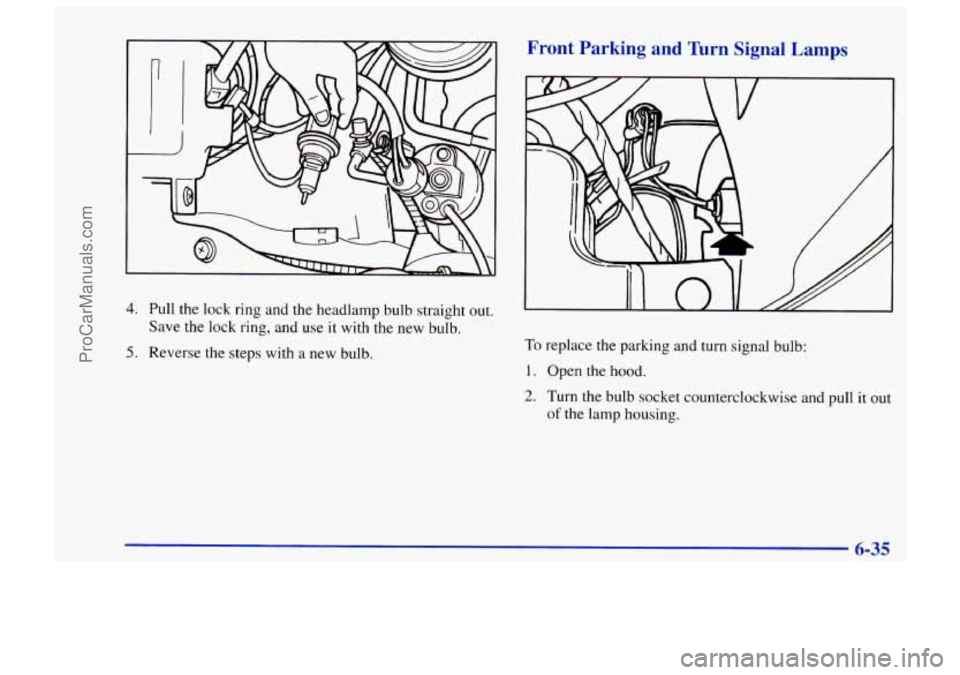
4. Pull the lock ring and the headlamp bulb straight out.
Save the lock ring, and use it with the new bulb.
5. Reverse the steps with a new bulb.
Front Parking and Turn Signal Lamps
To replace the parking and turn signal bulb:
I. Open the hood.
2. Turn the bulb socket counterclockwise and pull it out
of the lamp housing.
6-35
I
ProCarManuals.com