1997 CHEVROLET TAHOE automatic transmission
[x] Cancel search: automatic transmissionPage 231 of 433
Downloaded from www.Manualslib.com manuals search engine Making ’hms
NOTICE:
Making very sharp turns while trailering could
cause the trailer to come in contact with the
vehicle. Your vehicle could be damaged. Avoid
making very sharp turns while trailering.
When you’re turning with a trailer, make wider turns than
normal.
Do this so your trailer won’t strike soft shoulders,
curbs, road signs, trees or other objects. Avoid jerky or
sudden maneuvers. Signal well
in advance.
Turn Signals When Towing a Trailer
The arrows on your instrument panel will flash
whenever you signal a turn or lane change. Properly
hooked up, the trailer lamps will also flash, telling other
drivers you’re about to turn, change lanes or stop.
When towing a trailer, the arrows on your instrument
panel will flash for turns even
if the bulbs on the trailer
are burned out. Thus, you may think drivers behind you
are seeing your signal when they are not. It’s important
to check occasionally to be sure the trailer bulbs are
still working.
Driving On Grades
Reduce speed and shift to a lower gear before you start
down a long or steep downgrade. If you don’t shift
down, you might have
to use your brakes so much that
they would get hot and no longer work well.
On a long uphill grade, shift down and reduce your
speed to around
45 mph (70 kmh) to reduce the
possibility of engine and transmission overheating.
If you have an automatic transmission, you can tow
in
AUTOMATIC OVERDRIVE (0). You may want to
shift the transmission to THIRD
(3) or, if necessary, a
lower gear selection if the transmission shifts too often
(e.g., under heavy loads and/or hilly conditions).
When towing at high altitude on steep uphill grades,
consider the following: Engine coolant will boil at a
lower temperature than at normal altitudes. If you turn
your engine off immediately after towing at high altitude
on steep uphill grades, your vehicle may show signs
similar
to engine overheating. To avoid this, let the
engine run while parked (preferably on level ground)
with the automatic transmission in PARK
(P) for a few
minutes before turning the engine off. If you do get the
overheat warning, see “Engine Overheating” in
the Index.
4-52
Page 233 of 433
Downloaded from www.Manualslib.com manuals search engine When You Are Ready to Leave After
Parking
on a Hill
1. Apply your regular brakes and hold the pedal down
while you:
Start your engine;
0 Shift into a gear; and
0 Release the parking brake.
2. Let up on the brake pedal.
3. Drive slowly until the trailer is clear of the chocks.
4. Stop and have someone pick up and store the chocks.
Maintenance When Trailer Towing
Your vehicle will need service more often when you’re
pulling a trailer. See the Maintenance Schedule for more
on this. Things that are especially important in trailer
operation are automatic transmission fluid (don’t
overfill), engine oil, axle lubricant, belt, cooling system
and brake adjustment. Each
of these is covered in this
manual, and the Index will help you find them quickly.
If you’re trailering, it’s a good idea to review these
sections before you start your trip.
Check periodically to see that all hitch nuts and bolts
are tight.
Trailer Wiring Harness
A seven-wire harness is stored under the rear of your
vehicle, between the frame rails. An electrical connector
will need to be added at the trailer end
of the harness, by
a qualified electrical technician. For additional trailer
wiring and towing information, please consult your
dealer. Securely attach the harness to the trailer, then
tape or strap it to your vehicle’s frame rail. Be sure you
leave it loose enough
so the wiring won’t bind or break
when turning with the trailer, but not
so loose that it
drags on the ground. Store the harness in its original
position. Wrap the harness together and tie it neatly
so it
won’t be damaged. If you tow a trailer, your Center
High-Mounted Stoplamp (CHMSL) may not be
properly visible from behind. You should select a trailer
with a CHMSL
on it or, if one is not available, have one
installed. See your GM dealer about how to connect
your vehicle’s wiring to
a trailer CHMSL.
4-54
Page 240 of 433
Downloaded from www.Manualslib.com manuals search engine Other Warning Devices
If you carry reflective triangles, you can set one up at
the side of the road about
300 feet (100 m) behind
your vehicle.
Jump Starting
If your battery (or batteries) has run down, you may
want to
use another vehicle and some jumper cables to
start your vehicle. But please use the following steps to
do it safely.
Batteries can hurt you. They can be
dangerous because:
0 They contain acid that can burn you.
0 They contain gas that can explode or ignite.
0 They contain enough electricity to burn you.
If you don’t follow these steps exactly, some or all
of these things can hurt you.
NOTICE:
Ignoring these steps could result in costly damage
to your vehicle that wouldn’t be covered
by your
vehicle warranty.
Trying to start your vehicle by pushing
or pulling
it could damage your vehicle. With an automatic
transmission, it won’t start that
way.
1. Check the other vehicle. It must have a 12-volt
battery with a negative ground system.
2. Get the vehicles close enough
so the jumper cables
can reach, but be sure the vehicle’s aren’t touching
each other. If they are, it could cause a ground
connection you don’t want. You wouldn’t be able to
start your vehicle, and the bad grounding could
damage the electrical systems.
To avoid the possibility of the vehicles rolling, set the
parking brake
fiiy on both vehicles involved in the
jump
start procedure. Put an automatic transmission
in
PARK (P). If you have a four-wheel-drive vehicle,
be sure the transfer case is not
in NEUTRAL (N).
5-3
Page 249 of 433
Downloaded from www.Manualslib.com manuals search engine If No Steam Is Coming From Your Engine
If you get the overheat warning but see or hear no
steam, the problem may not be too serious. Sometimes
the engine can get a little too hot when you:
Climb a long hill on a hot day.
Stop after high-speed driving.
Idle for long periods in traffic.
0 Tow a trailer. See “Driving on Grades” in the Index.
If you get the overheat warning with no sign of steam,
try this for a minute or
so:
1. If you have an air conditioner, turn it off.
2. Turn on your heater to full hot at the highest fan
speed and open the window as necessary.
3. If you’re in a traffic jam, shift to NEUTRAL (N);
otherwise, shift to the highest gear while
driving
-- AUTOMATIC OVERDRIVE (a)
for automatic transmissions. If you
no longer have
the overheat warning, you can
drive. Just to be safe, drive slower for about
10 minutes.
If the warning doesn’t come back on, you can
drive normally.
If the warning continues, pull over, stop, and park your
vehicle right away.
If there’s still no sign
of steam, push the accelerator until
the engine speed is about twice as fast as normal idle
speed. Bring the engine speed back to normal idle speed
after two or three minutes. Now see if the warning stops,
But then, if you still have the warning,
turn oflthe
engine
and get everyone out of the vehicle until it
cools down.
YOU may decide not
to lift the hood but to get service
help right away.
5-12
Page 280 of 433
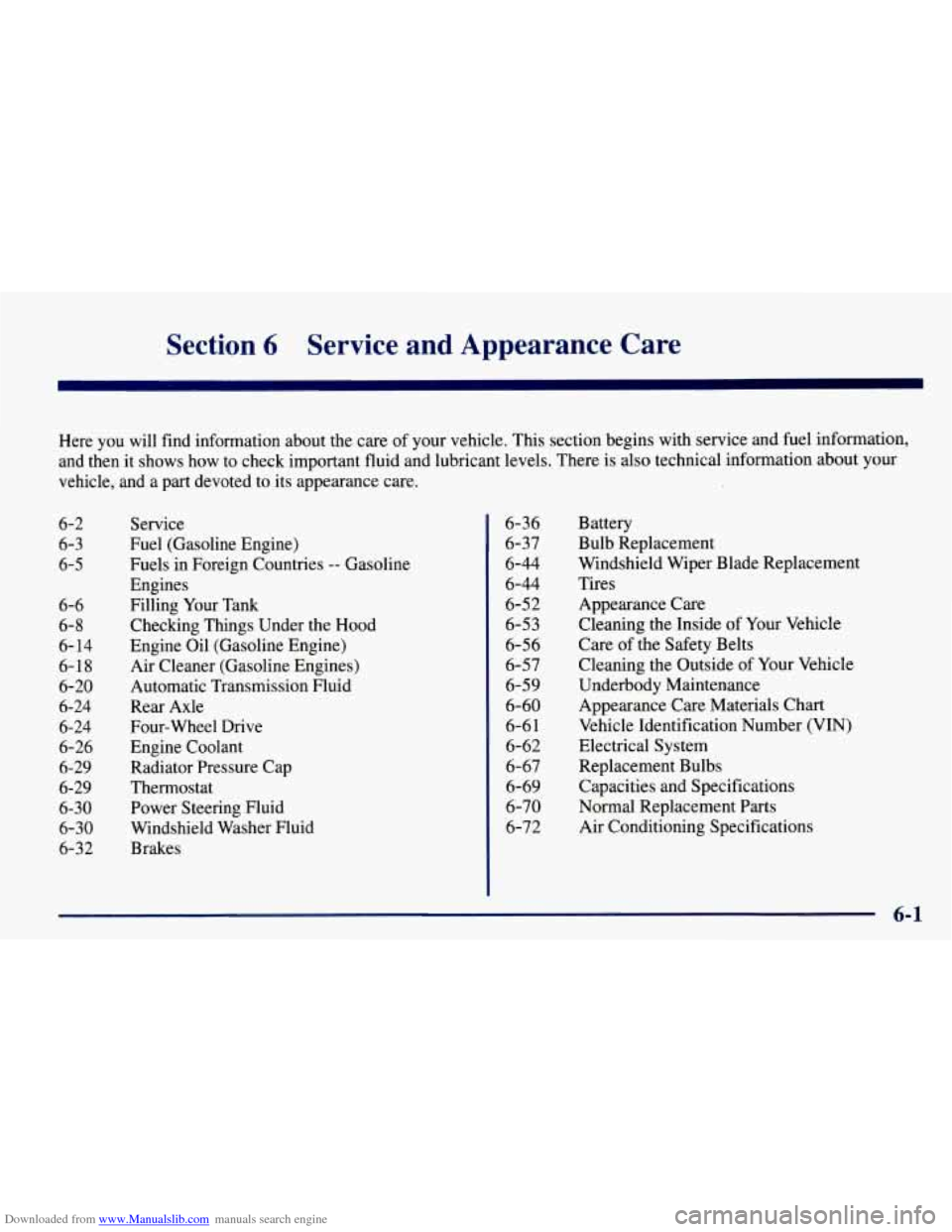
Downloaded from www.Manualslib.com manuals search engine Section 6 Service and Appearance Care
Here you will find information about the care of your vehicle. This section begins with service and fuel information,
and then it shows how to check important fluid and lubricant levels. There is also technical information about your
vehicle, and a part devoted to its appearance care.
6-2
6-3
6-5
6-6
6-8
6- 14
6-18
6-20
6-24 6-24
6-26
6-29
6-29
6-30
6-30
6-32 Service
Fuel (Gasoline Engine)
Fuels
in Foreign Countries -- Gasoline
Engines
Filling Your Tank
Checking Things Under the Hood
Engine Oil (Gasoline Engine)
Air Cleaner (Gasoline Engines)
Automatic Transmission Fluid
Rear Axle
Four-wheel Drive
Engine Coolant
Radiator Pressure Cap
Thermostat
Power Steering Fluid
Windshield Washer Fluid
Brakes
6-36
6-37
6-44
6-44
6-52
6-53
6-56
6-57
6-59
6-60 6-6 1
6-62
6-67
6-69
6-70
6-72 Battery
Bulb Replacement
Windshield Wiper Blade Replacement
Tires Appearance Care
Cleaning the Inside
of Your Vehicle
Care of the Safety Belts
Cleaning the Outside of Your Vehicle
Underbody Maintenance
Appearance Care Materials Chart
Vehicle Identification Number (VIN)
Electrical System
Replacement Bulbs
Capacities and Specifications
Normal Replacement Parts
Air Conditioning Specifications
6-1
Page 290 of 433
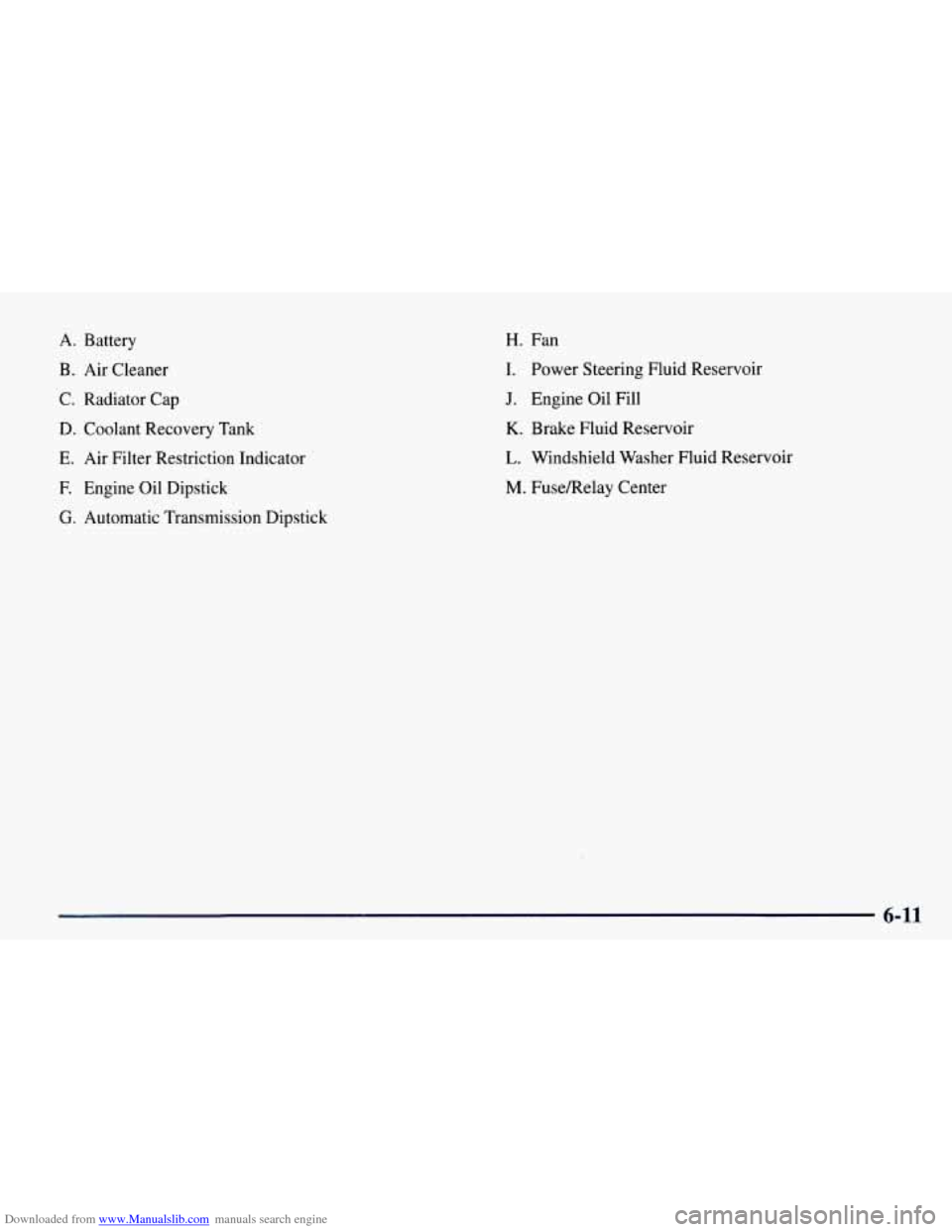
Downloaded from www.Manualslib.com manuals search engine A. Battery
B. Air Cleaner
C. Radiator Cap
D. Coolant Recovery Tank
E. Air Filter Restriction Indicator
F. Engine Oil Dipstick
G. Automatic Transmission Dipstick
H. Fan
I. Power Steering Fluid Reservoir
J. Engine Oil Fill
K. Brake Fluid Reservoir
L. Windshield Washer Fluid Reservoir
M. Fusemelay Center
6-11
Page 292 of 433
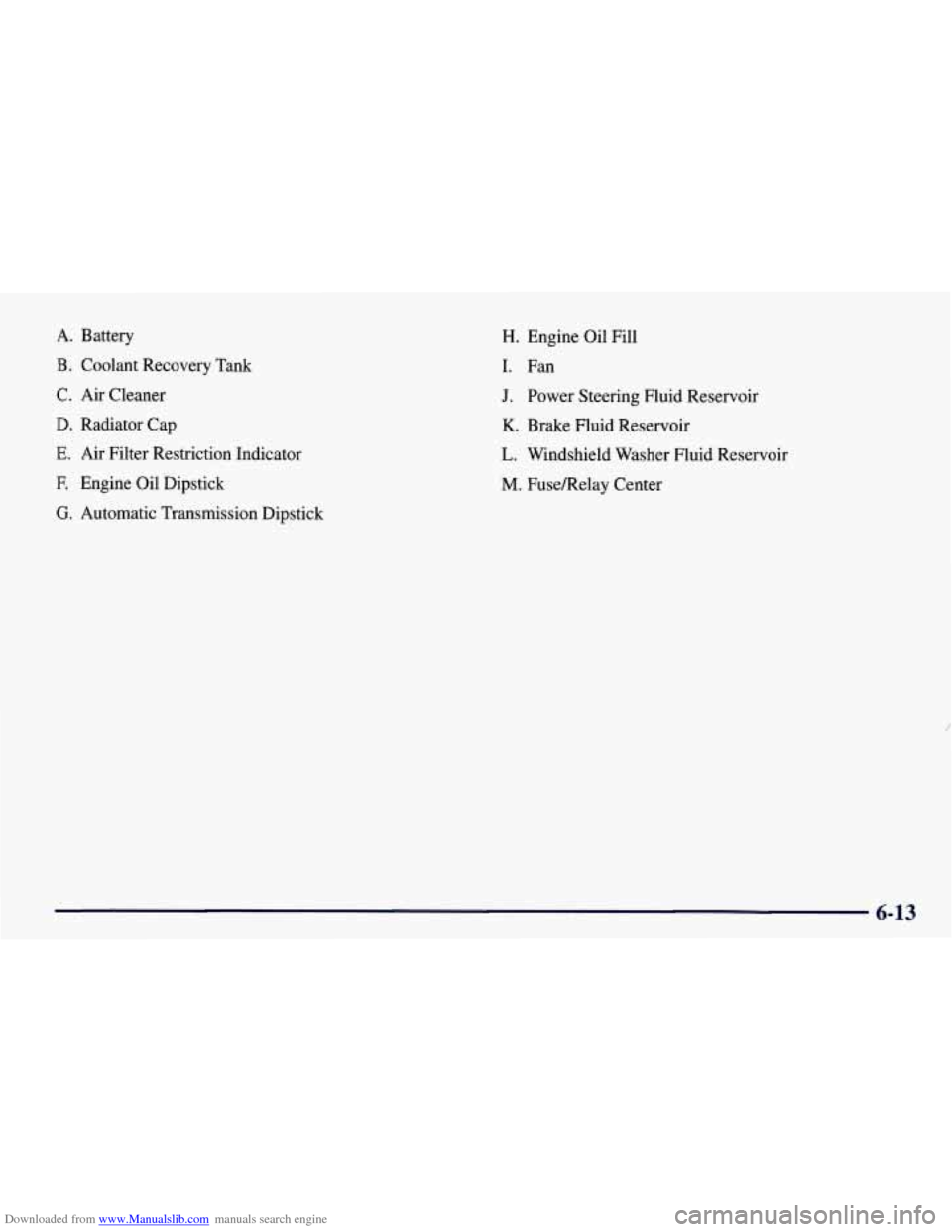
Downloaded from www.Manualslib.com manuals search engine A. Battery
B. Coolant Recovery Tank
C.
Air Cleaner
D. Radiator Cap
E. Air Filter Restriction Indicator
F. Engine Oil Dipstick
G. Automatic Transmission Dipstick
H. Engine Oil Fill
I. Fan
J. Power Steering Fluid Reservoir
K. Brake Fluid Reservoir
L. Windshield Washer Fluid Reservoir
M. FuseRelay Center
6-13
Page 299 of 433

Downloaded from www.Manualslib.com manuals search engine Refer to the Maintenance Schedule to determine when to
replace the
air filter. See “Owner Checks and Services”
in the Index.
A CAUTION:
Operating the engine with the air cleaner off can
cause you or others to be burned. The air cleaner
not only cleans the air, it stops flame if the engine
backfhes.
If it isn’t there, and the engine
backfires, you could be burned. Don’t drive with
it
off, and be careful working on the engine with
the
air cleaner off.
NOTICE:
If the air cleaner is off, a backfire can cause a
damaging engine fire. And, dirt can easily get
into your engine, which will damage
it. Always
have the air cleaner in place when you’re driving.
Automatic Transmission Fluid
When to Check and Change
A good time to check your automatic transmission fluid
level is when the engine oil is changed.
Change both the fluid and filter every
50,000 miles
(83 000 km) if the vehicle is mainly driven under one or
more
of these conditions:
0 In heavy city traffic where the outside temperature
regularly reaches
90°F (32 “C) or higher.
In hilly or mountainous terrain.
When doing frequent trailer towing.
0 Uses such as found in taxi, police or delivery service.
If you do not use your vehicle under any of these
conditions, the fluid and filter do not require changing.
See “Scheduled Maintenance Services” in the Index.
How to Check
Because this operation can be a little difficult, you
may choose to have this done at your
GM dealership
Service Department.