Page 22 of 433
A safety belt that is twisted or not properly
attached won’t provide the protection needed in
a
crash. The person wearing the belt could be
seriously injured. After installing the seat, always
check to be sure that the safety belts are not
twisted and are properly attached.
Removing the Rear (Suburban Third Seat)
If your vehicle has a rear seat, it can be taken out for
more cargo space.
Before removing the seat, unlatch the outside passenger
position safety belts from the seat frame.
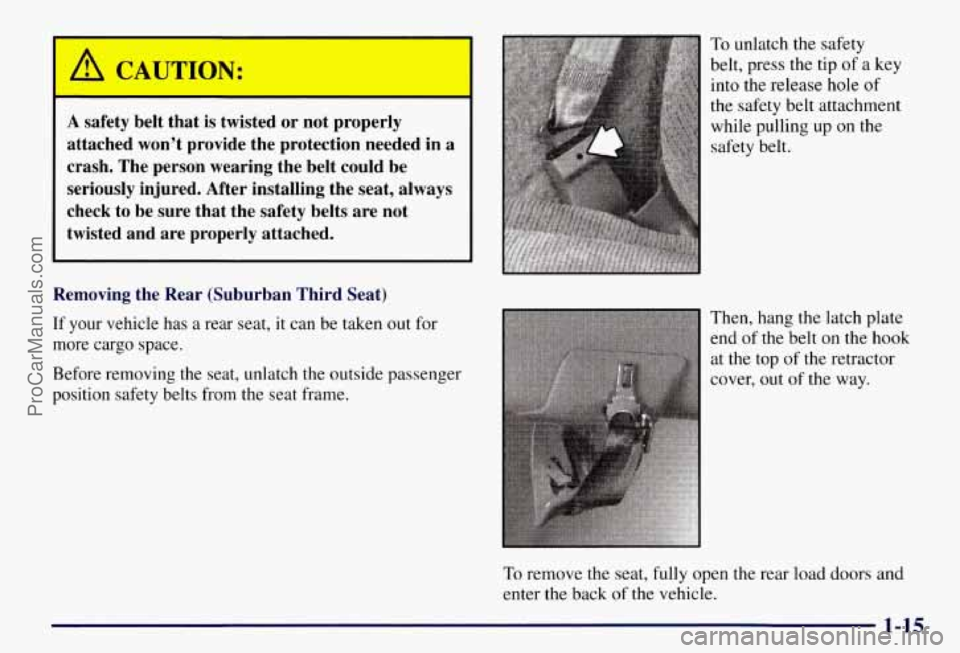
To unlatch the safety
belt, press the tip
of a key
into the release hole of
the safety belt attachment
while pulling up
on the
safety belt.
Then, hang the latch plate
end of the belt
on the hook
at the top of the retractor
cover, out
of the way.
To remove the seat, fully open the rear load doors and
enter the back
of the vehicle.
1-15
ProCarManuals.com
Page 38 of 433
The best way to protect the fetus is to protect the
mother. When a safety belt is worn properly, it’s more
likely that the fetus won’t be hurt in a crash. For
pregnant women, as for anyone, the key to making
safety belts effective is wearing them properly.
Right Front Passenger Position
The right front passenger’s safety belt works the same
way as the driver’s safety belt. See “Driver Position”
earlier in this section.
When the lap belt is pulled out all the way,
it will lock.
(This is the child restraint locking feature working
normally.) If the belt locks, let it
go back all the way
and start again.
Supplemental Inflatable
Restraint System
This part explains the Supplemental Inflatable Restraint
system or air bag system.
Your vehicle has two air bags
-- one air bag for the
driver and another air bag for the right front passenger. Here are the most
important things to know about the air
bag system:
You can be severely injured or killed in a crash if
you aren’t wearing your safety belt
-- even if you
have air bags. Wearing your safety belt during
a
crash helps reduce your chance of hitting things
inside the vehicle or being ejected from it. Air
bags are “supplemental restraints’’ to the safety
belts.
All air bags are designed to work with
safety belts, but don’t replace them. Air
bags are
designed to work only in moderate to severe
crashes where the front of your vehicle hits
something. They aren’t designed to inflate at all
in rollover, rear, side or low-speed frontal
crashes. Everyone in your vehicle should wear
a
safety belt properly -- whether or not there’s an
air bag for that person.
1-31
ProCarManuals.com
Page 43 of 433
0
0 Your vehicle is equipped with a crash sensing and
diagnostic module, which records information about
the air bag system. The module records information
about the readiness
of the system, when the sensors
are activated and driver’s safety belt usage at
deployment.
Let only qualified technicians work on your air
bag system. Improper service can mean that your
air bag system won’t work properly. See your dealer
for service.
Servicing Your Air Bag-Equipped Vehicle
Air bags affect how your vehicle should be serviced.
There
are parts of the air bag system in several places
around your vehicle. You don’t want the system to
inflate while someone is working on your vehicle. Your
GM dealer and the service manual have information
about servicing your vehicle and the air bag system. To
purchase a service manual, see “Service and Owner
Publications’’ in the Index.
NOTICE:
If you damage the covering for the driver’s or the
right front passenger’s
air bag, the bag may not
work properly. You may have to replace the air
bag module in the steering wheel or both the air
bag module and the instrument panel for the
passenger’s air bag.
Do not open or break the air
bag coverings.
I
For up to 10 minutes after the ignition key is
turned
off and the battery is disconnected, an air
bag can still inflate during improper service. You
can be injured if you are close to an air bag when
it inflates. Avoid wires wrapped with yellow tape
or yellow connectors. They are probably part of
the air bag system. Be sure to follow proper
service procedures, and make sure the person
performing work for you is qualified to
do so.
The air bag system does not need regular maintenance.
1-36
ProCarManuals.com
Page 72 of 433
Section 2 Features and Controls
Here you can learn about the many standard and optional features on your vehicle, and information on starting,
shifting and braking. Also explained are the instrument panel and the warning systems that tell you if everything is
working properly
-- and what to do if you have a problem.
2-2
2-3
2-6
2-8
2-11
2- 12
2- 12
2- 13
2- 15
2- 16
2-20
2-20
2-25
2-26
2-28 Keys
Door Locks
Keyless Entry System
Your Doors and How They Work
Theft
New Vehicle “Break-In”
Ignition Positions
Starting Your Gasoline Engine
Engine Coolant Heater
Automatic Transmission Operation
Locking Rear Axle
Four-wheel Drive
Parking Brake
Shifting Into PARK (P)
Shifting Out of PARK
(P)
2-29
2-29
2-30
2-3
1
2-33
2-3 3
2-40
2-42
2-44
2-48
2-5 8
2-59
2-60
2-62
2-64 Parking Over
Things That Burn
Engine Exhaust
Running Your Engine While You’re Parked
Windows
Tilt Wheel
Multifunction Lever
Lamps
Interior Lamps
Mirrors
Storage Compartments
Ashtrays and Cigarette Lighter
Sun Visors
Instrument Panel
Instrument Panel Cluster
Warning Lights, Gages and Indicators
ProCarManuals.com
Page 73 of 433
Keys
I
A CAUTION:
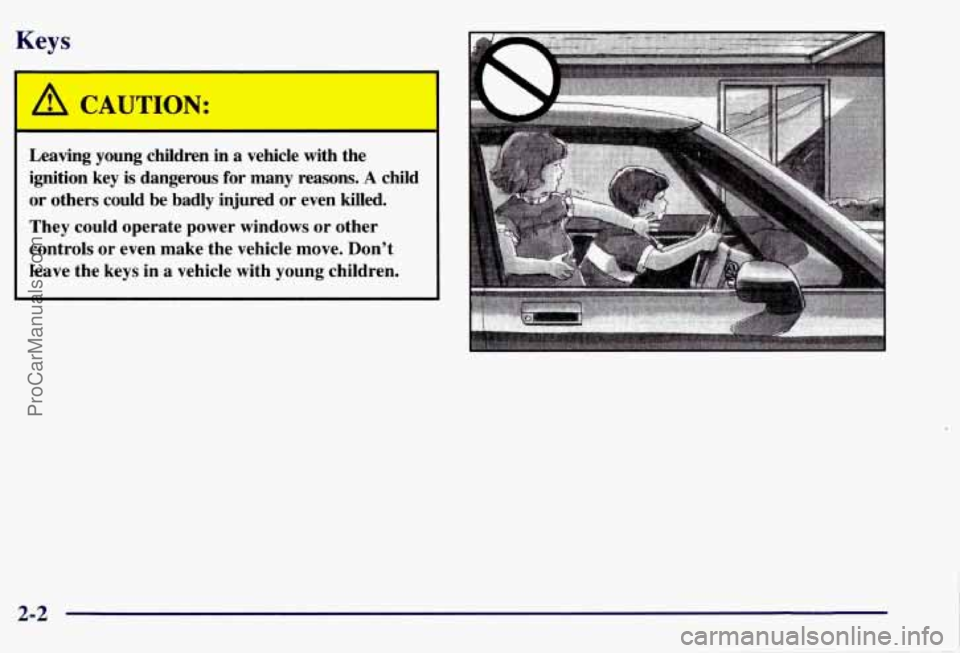
Leaving young children in a vehicle with the
ignition key is dangerous for many reasons.
A child
or others could be badly injured or even
killed.
They could operate power windows or other
controls or even make the vehicle move. Don’t
leave the keys in a vehicle with young children.
2-2
ProCarManuals.com
Page 74 of 433
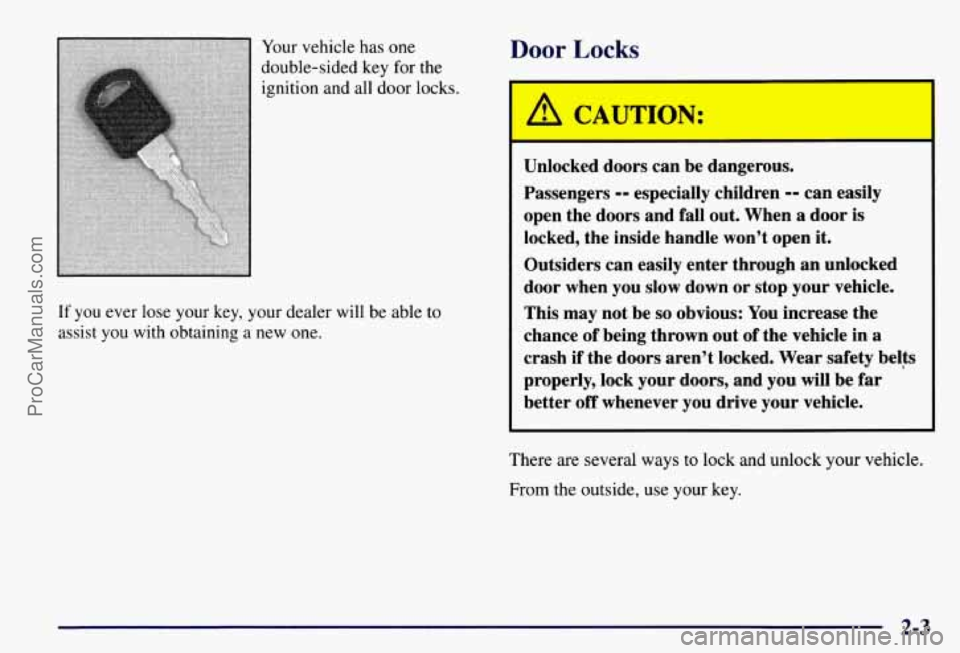
Your vehicle has one
double-sided key for the
ignition and all door locks.
If you ever lose your key, your dealer will be able to
assist you with obtaining a new one.
Door Locks
I! CAUTION:
Unlocked doors can be dangerous.
Passengers
-- especially children -- can easily
open the doors and fall out. When
a door is
locked, the inside handle won’t open it.
Outsiders can easily enter through an unlocked
door when you slow down or stop your vehicle.
This may not be
so obvious: You increase the
chance of being thrown out of the vehicle in a
crash if the doors aren’t locked. Wear safety belts
properly, lock your doors, and you will be far
better
off whenever you drive your vehicle.
There are several ways to lock and unlock your vehicle.
From
the outside, use your key.
2-3
ProCarManuals.com
Page 76 of 433
On the passenger side of the
rear cargo door or tailgate,
there is a power lock switch
which can be used to lock or
unlock all
of the doors.
On vehicles with cargo doors, if the rear cargo lock
switch
is pressed with the cargo doors open, all of the
doors will lock five seconds after the cargo doors are
closed. If the cargo doors are closed, the vehicle doors
will lock when a power door lock switch is pressed.
Child Security Locks
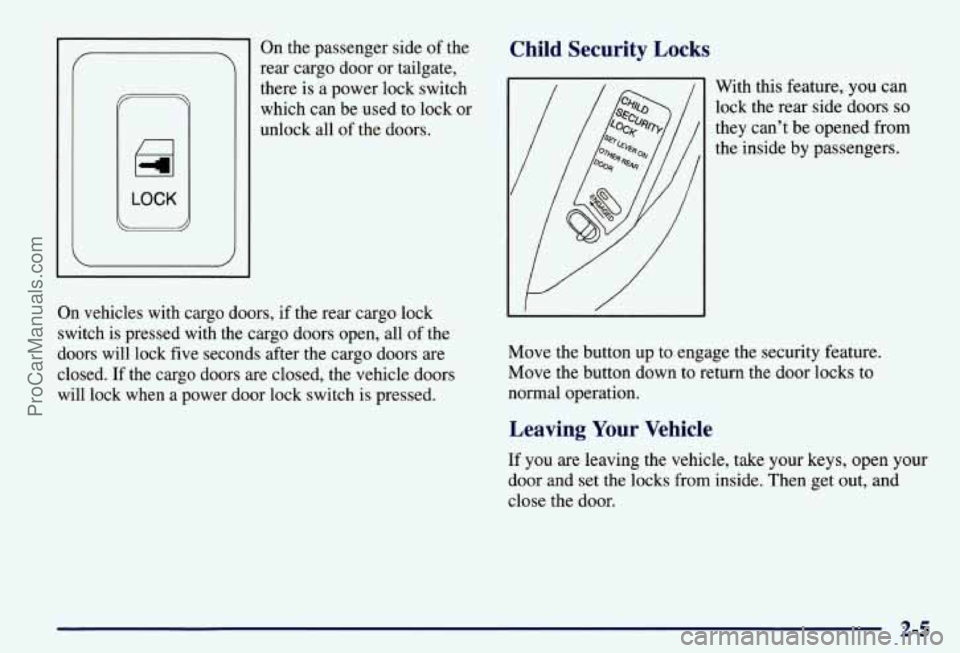
With this feature, you can
lock the rear
side doors so
they can’t be opened from
the inside by passengers.
Move the button up to engage the security feature.
Move the button down to return the door locks to
normal operation.
Leaving Your Vehicle
If you are leaving the vehicle, take your keys, open your
door and set the locks from inside. Then get out, and
close the door.
2-5
ProCarManuals.com
Page 77 of 433
Keyless Entry System (If Equipped)
If your vehicle has this option, you can lock and unlock
your doors or your tailgate from about
3 feet (1 m) up to
30 feet (9 m) away using the remote keyless entry
transmitter supplied with your vehicle.
In addition, your interior lamps will be illuminated for a
set period of time when the transmitter signal is received
by the Keyless Entry System.
Your Keyless Entry System operates on a radio
frequency subject
to Federal Communications
Commission (FCC) Rules and with Industry Canada.
This device complies with Part 15 of the FCC Rules.
Operation is subject to the following two conditions:
(1) this device may not cause harmful interference, and
(2) this device must accept any interference received,
including interference that may cause undesired operation.
This device complies with RSS-210 of Industry
Canada. Operation is subject to the following two
conditions:
(1) this device may not cause interference,
and
(2) this device must accept any interference
received, including interference that may cause
undesired operation of the device. This system has
a range
of about 3 feet (1 m) up to
30 feet (9 m). At times you may notice a decrease in
range. This
is normal for any remote keyless entry
system. If the transmitter does not work or if you have
to stand closer to your vehicle for the transmitter to
work, try this:
Check to determine if battery replacement or
transmitter resynchronization is necessary. See the
instructions that follow.
Check the distance. You may be too far from your
vehicle. You may need to stand closer during rainy
or snowy weather.
Check the location. Other vehicles or objects may be
blocking the signal. Take a few steps to the left or
right, hold the transmitter higher, and
try again.
0 If you’re still having trouble, see your GM dealer or
a qualified technician for service.
Changes or modifications to this system by other than an
authorized service facility could void authorization to
use this equipment.
2-6
ProCarManuals.com