1997 CHEVROLET SUBURBAN height
[x] Cancel search: heightPage 15 of 433
Rear Seats
I
~ If a head restraint is not installed on the seatback
~ or stored in the vehicle properly, it could be
1 thrown about the vehicle in a crash or sudden
maneuver. People in the vehicle could be injured.
Remove the head restraints only-when you need
to fold the seat, and be sure that the head
restraints are stored securely in the storage bag
and placed under the rear seat. When the seat is
returned to the passenger position, be sure the
head restraints are installed properly. Folding
the Rear Seat (2-Door Utility Model)
If your vehicle has a rear seat, the seat can be folded flat
for more cargo space. Before folding, make sure that
nothing is under or in front of the seat. When the seat is
folded, it will lay almost flat on the floor.
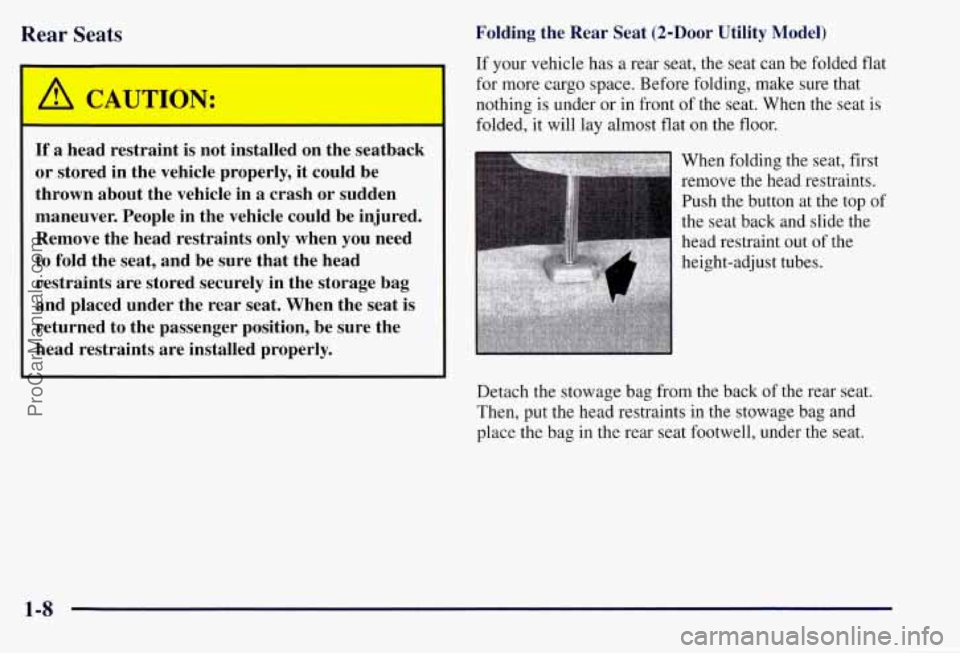
When folding the seat, first
remove the head restraints.
Push the button at the top of
the seat back and slide the
head restraint out of the
height-adjust tubes.
Detach the stowage bag from the back of the rear seat.
Then, put the head restraints in the stowage bag and
place the bag in the rear seat footwell, under the seat.
1-8
ProCarManuals.com
Page 17 of 433
After returning the seat to the passenger position, pull
forward on the seatback to make sure it is locked into
place. Also, return the safety belts and head restraints
to
their original positions, so they will be available for rear
seat passengers to use.
Folding the Rear Seat (&Door Utility Model)
If your vehicle has a 60/40 rear seat, either side may be
folded down
to give you more cargo space.
Before folding, place the latch portion of the center
safety belt in the center armrest. That way, the center
safety belt will be out of the way when the seat is folded
and also will be easily available for passengers to use
when the seat is returned to the passenger position. Also,
make sure that nothing is under or in front of the seat.
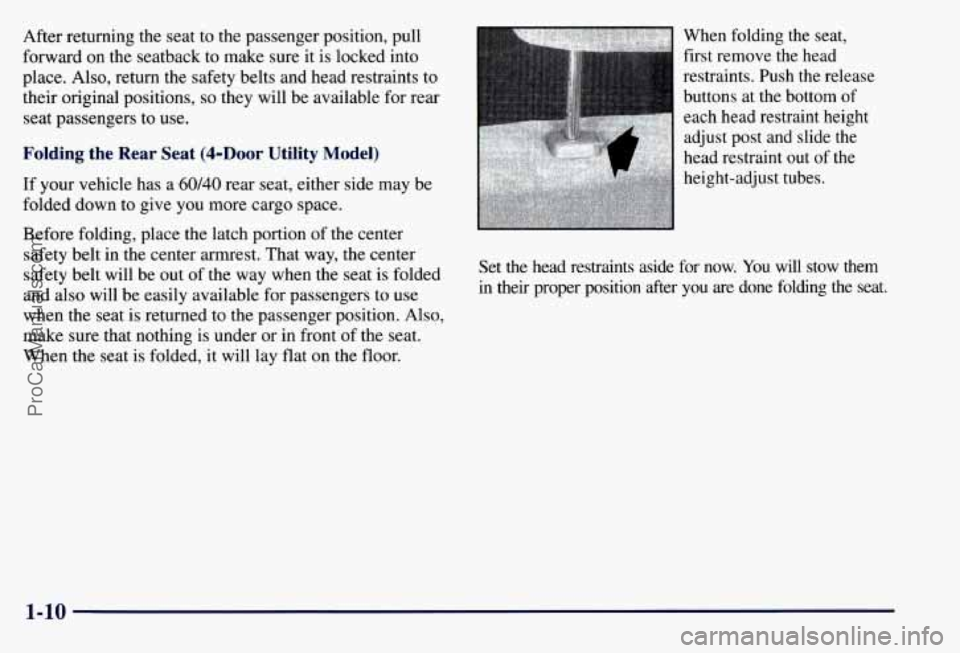
When the seat is folded, it will lay flat on the floor. When folding
the seat,
first remove the head
restraints. Push the release
buttons at the bottom of
each head restraint height
adjust post and slide the
head restraint out of the
height-adjust tubes.
Set the head restraints aside for now. You will stow them
in their proper position after you are done folding the seat.
1-10
ProCarManuals.com
Page 19 of 433
Folding the Second Seat (Suburban)
If your vehicle has a 60/40 rear seat, either side may be
folded down to give
you more cargo space.
Before folding, place the latch portion
of the center
safety belt in the center armrest. That way, the center
safety belt will be out of the way when the seat is folded
and also will be easily available for passengers to use
when the seat is returned to the passenger position. Also,
make sure that nothing is under or in front of the seat.
When the seat is folded, it will lay flat on the floor.
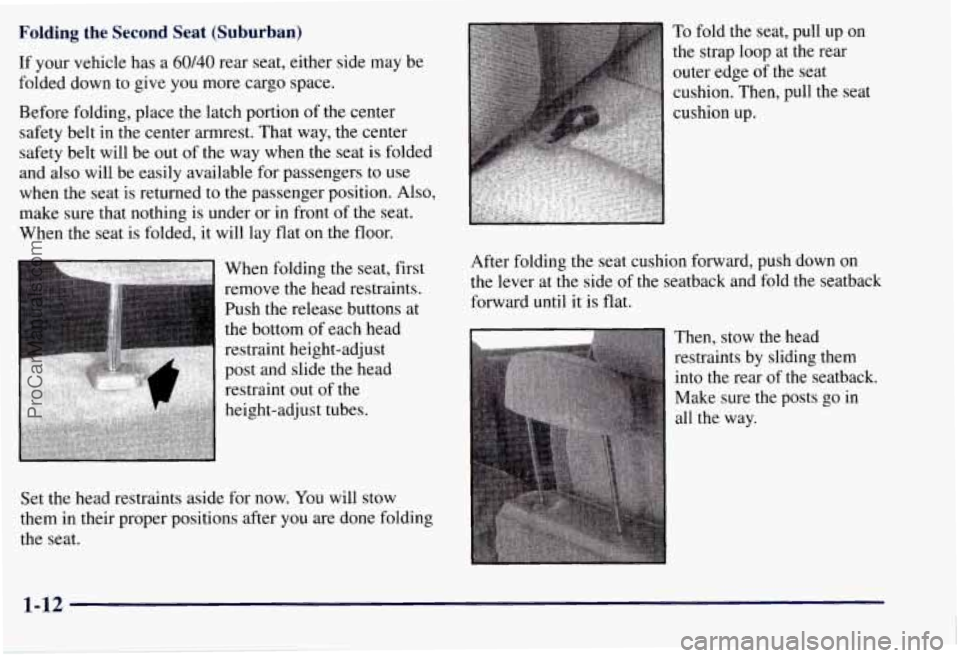
When folding the seat, first
remove the head restraints.
Push the release buttons at
the bottom
of each head
restraint height-adjust
post and slide the head
restraint
out of the
height-adjust tubes.
Set the head restraints aside for now.
You will stow
them in their proper positions after you are done folding
the seat. To
fold the seat, pull up on
the strap loop at the rear
outer edge
of the seat
cushion. Then, pull the seat
cushion up.
After folding the seat cushion forward, push down on
the lever at the side
of the seatback and fold the seatback
forward until it is flat.
Then, stow the head
restraints by sliding them
into the rear of the seatback.
Make sure the posts go in
all the way.
ProCarManuals.com
Page 31 of 433
Shoulder Belt Height Adjuster
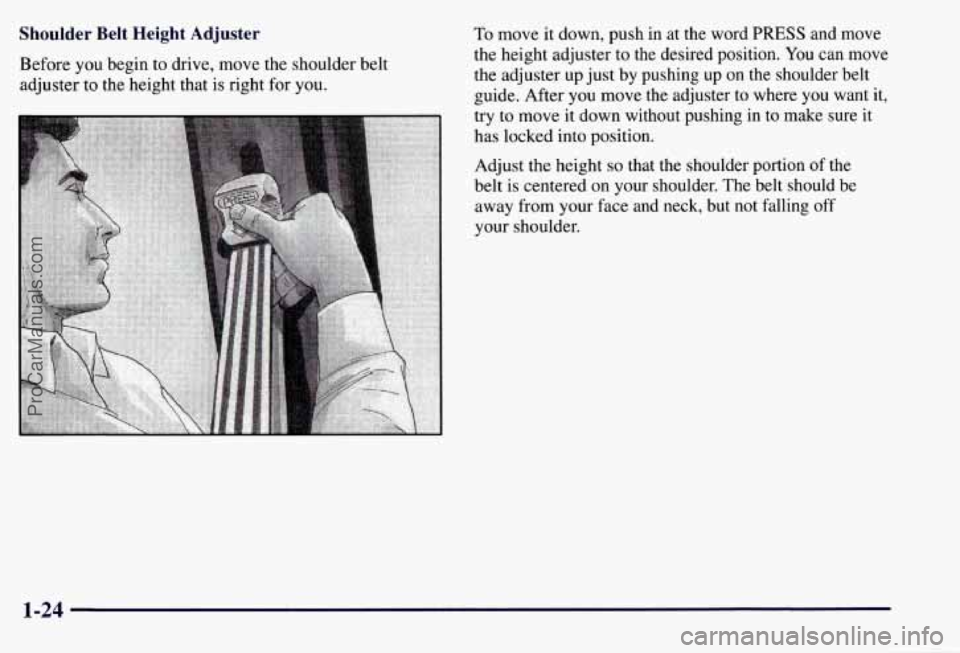
Before you begin to drive, move the shoulder belt
adjuster to the height that is right for you.
To move it down, push in at the word PRESS and move
the height adjuster to the desired position. You can move
the adjuster
up just by pushing up on the shoulder belt
guide. After you move the adjuster to where you want it,
try to move it down without pushing in to make sure it
has locked into position.
Adjust the height
so that the shoulder portion of the
belt is centered on your shoulder. The belt should be
away from your face and neck, but not falling off
your shoulder.
1-24
ProCarManuals.com
Page 44 of 433
Adding Equipment to Your Air
Bag-Equipped Vehicle
e.’ If I add a push bumper or a bicycle rack to the
front of my vehicle, will it keep the air bags
from working properly?
A: As long as the push bumper or bicycle rack is
attached to your vehicle so that the vehicle’s basic
structure isn’t changed, it’s not likely to keep the
air bags from working properly in a crash.
e.’ Is there anything I might add to the front of the
vehicle that could keep the air bags from
working properly?
A: Yes. If you add things that change your vehicle’s
frame, bumper system, front end sheet metal or
height, they may keep the
air bag system from
working properly. Also, the
air bag system may not
work properly
if you relocate any of the air bag
sensors.
If you have any questions about this, you
should contact Customer Assistance before you
modify your vehicle. (The phone numbers
and
addresses for Customer Assistance are in Step Two of
the Customer Satisfaction Procedure in this manual.
See “Customer Satisfaction Procedure”
in the Index.)
What if I add a snow plow? Will it keep the air
bags from working properly?
A: We’ve designed our air bag systems to work
properly under a wide range of conditions,
including snow plowing with vehicles equipped
with the optional Snow Plow Prep Package
(RPO
VYU). But don’t change or defeat the snow
plow’s “tripping mechanism.” If
you do, it can
damage your snow plow and your vehicle, and it
may cause an air bag inflation.
1-37
ProCarManuals.com
Page 50 of 433
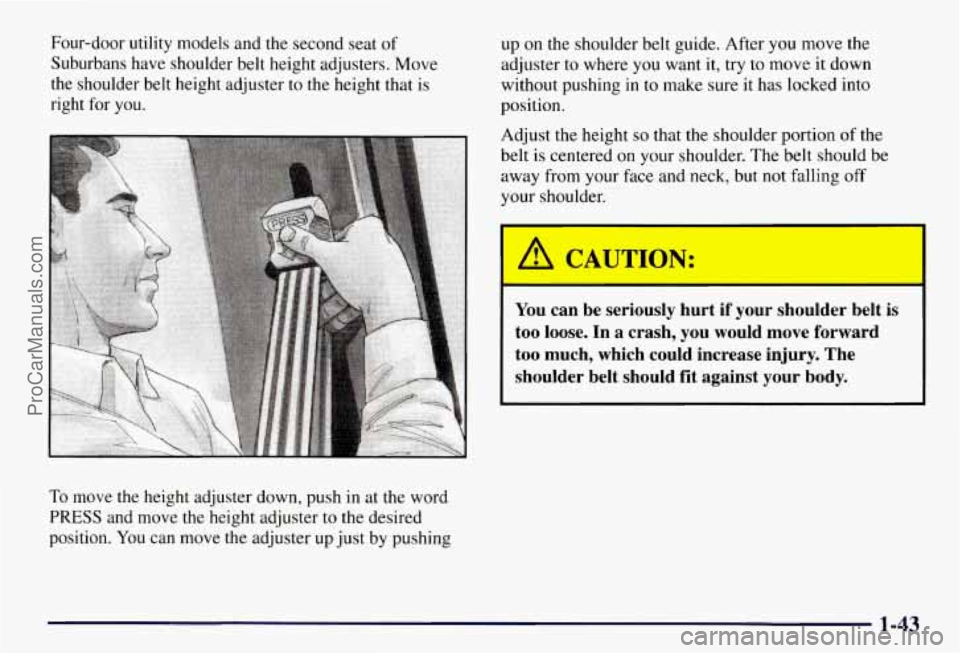
Four-door utility models and the second seat of
Suburbans have shoulder belt height adjusters. Move
the shoulder belt height adjuster to the height that is
right for you.
To move the height adjuster down, push in at the word
PRESS and move the height adjuster to the desired
position.
You can move the adjuster up just by pushing
up on the shoulder belt guide. After you move the
adjuster to where
you want it, try to move it down
without pushing in to make sure it has locked into
position.
Adjust the height
so that the shoulder portion of the
belt is centered on your shoulder. The belt should be
away from your face and neck, but not falling
off
your shoulder.
I
You can be seriously hurt if your shoulder belt is
too loose. In a crash, you would move forward
too much, which could increase injury. The
shoulder belt should fit against your body.
1-43
ProCarManuals.com
Page 314 of 433
Properly torqued wheel nuts are necessary to help
prevent brake pulsation. When tires are rotated, inspect
brake pads for wear and
evenly torque wheel nuts in the
proper sequence to
GM specifications.
Your rear drum brakes don’t have wear indicators, but
if
you ever hear a rear brake rubbing noise, have the rear
brake linings inspected. Also, the rear brake drums
should be removed and inspected each time the tires
are removed for rotation or changing. When you have
the front brake pads replaced, have the rear brakes
inspected, too.
Brake linings should always be replaced
as complete
axle sets.
See “Brake System Inspection”
in Section 7 of this manual
under Part
C “Periodic Maintenance Inspections.’’
Brake Pedal Travel
See your dealer if the brake pedal does not return to
normal height, or
if there is a rapid increase in pedal
travel. This could be a sign
of brake trouble.
Brake Adjustment
Every time you make a brake stop, your disc brakes
adjust for wear.
If your brake pedal goes down farther than normal, your
rear drum brakes may need adjustment. Adjust them by
backing up and firmly applying the brakes
a few times.
Replacing Brake System Parts
The braking system on a modern vehicle is complex.
Its many parts have to be of top quality and work well
together if the vehicle is to have really good braking.
Your vehicle was designed and tested with top-quality
GM brake parts. When you replace parts of your braking
system
-- for example, when your brake linings wear
down and you have to have new ones put in
-- be sure
you get new approved
GM replacement parts. If you
don’t, your brakes may no longer work properly. For
example, if someone puts in brake linings that are wrong
for your vehicle, the balance between your front and
rear brakes can change
-- for the worse. The braking
performance you’ve come to expect can change in many
other ways if someone puts
in the wrong replacement
brake parts.
6-35
ProCarManuals.com
Page 330 of 433
I A CAUTION:
Using the wrong replacement wheels, wheel bolts
or wheel nuts on your vehicle can be dangerous.
It could affect the braking and handling of your
vehicle, make your tires lose air and make you
lose control. You could have a collision in which
you or others could be injured. Always use the
correct wheel, wheel bolts and wheel nuts
for replacement.
-
I NOTICE:
The wrong wheel can also cause problems with
bearing life, brake cooling, speedometer or
odometer calibration, headlamp aim, bumper
height, vehicle ground clearance and tire or tire
chain clearance to the body and chassis.
See “Changing a Flat
Tire” in the Index for
more information. Used
Replacement Wheels
I
Putting a used wheel on your vehicle is
dangerous. You can’t know how
it’s been used or
how far it’s been driven. It could fail suddenly
and cause an accident. If you have to replace
a
wheel, use a new GM original equipment wheel.
Tire Chains
NOTICE:
If your vehicle has P265/75R16 size tires, don’t
use tire chains. They can damage your vehicle
because there’s not enough clearance.
NOTICE: (Continued)
6-51
ProCarManuals.com