Page 311 of 433
Brakes
Brake Fluid
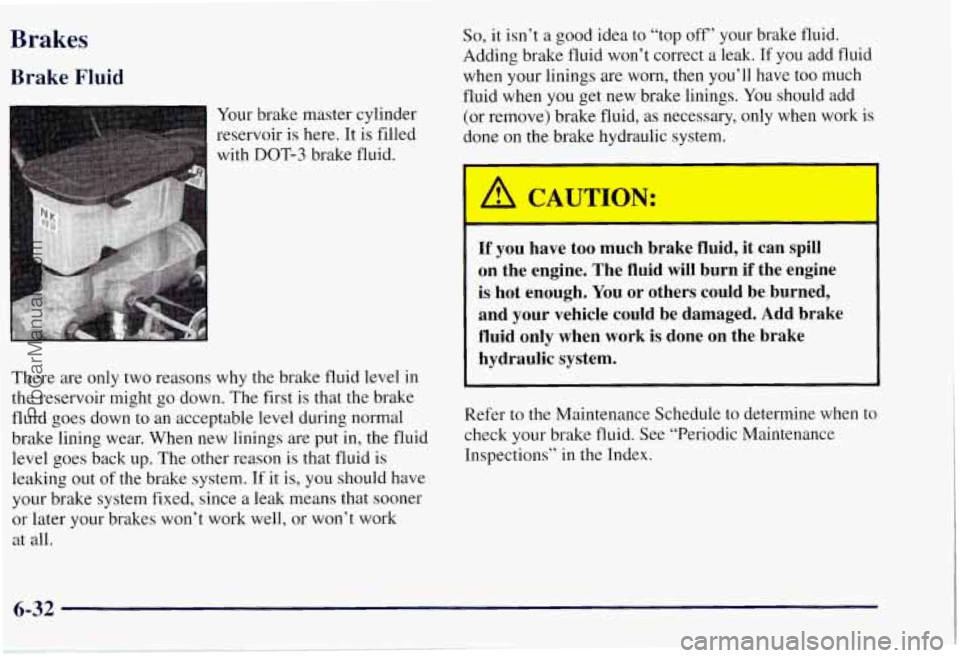
Your brake master cylinder
reservoir
is here. It is filled
with DOT-3 brake fluid.
So, it isn’t a good idea to “top off’ your brake fluid.
Adding brake fluid won’t correct a leak.
If you add fluid
when your linings are worn, then you’ll have too much
fluid when you get new brake linings.
You should add
(or remove) brake fluid, as necessary, only when work is
done on the brake hydraulic system.
KCAUTION:
If you have too much brake fluid, it can spill
on the engine. The fluid
will burn if the engine
is hot enough.
You or others could be burned,
and your vehicle could be damaged. Add brake
fluid only when work is done on the brake
hydraulic system.
There are only two reasons why the brake fluid level in
the reservoir might go down. The first is that the brake
fluid goes down to an acceptable level during normal Refer to the Maintenance Schedule to determine when to
brake lining wear. When
new linings are put in, the fluid check your brake fluid. See “Periodic Maintenance
level goes back up. The other reason is that fluid is Inspections’’ in the Index.
leaking out of the brake system. If it is, you should have
your brake system fixed, since a leak means that sooner
or later your brakes won’t work well, or won’t work
at all.
6-32
ProCarManuals.com
Page 312 of 433
Checking Brake Fluid What to Add
You
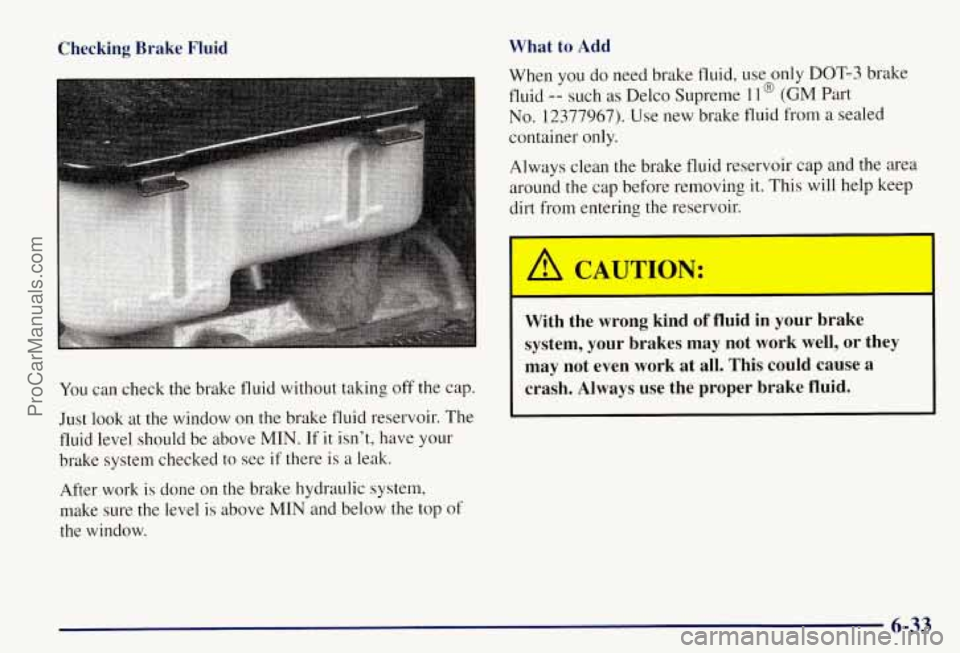
can check the brake fluid without taking off the cap.
Just look at the window on the brake fluid reservoir. The
fluid level should be above MIN. If
it isn’t, have your
brake system checked to see if there is a leak.
After work
is done on the brake hydraulic system,
make sure the level is above MIN and below the top
of
the window. When
you do need brake fluid, use only DOT-3 brake
fluid
-- such as Delco Supreme 11 @ (GM Part
No. 12377967). Use new brake fluid from a sealed
container only.
Always clean the brake fluid reservoir cap and the area
around the cap before removing it. This will help keep
dirt from entering the reservoir.
With the wrong kind of fluid in your brake
system, your brakes may not work well, or they
may not even work at all. This could cause a crash. Always use the proper brake fluid.
-1
6-33
ProCarManuals.com
Page 313 of 433
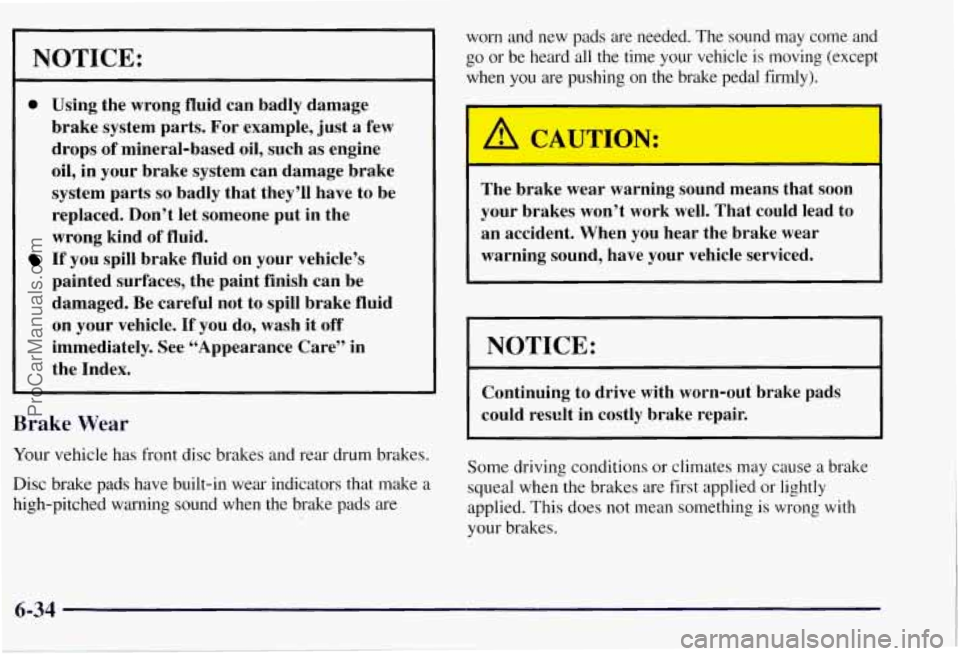
NOTICE:
0 Using the wrong fluid can badly damage
brake system parts. For example, just
a few
drops of mineral-based oil, such
as engine
oil, in your brake system can damage brake
system parts
so badly that they’ll have to be
replaced. Don’t let someone put in the
wrong kind of fluid.
If you spill brake fluid on your vehicle’s
painted surfaces, the paint finish can be
damaged. Be careful not to spill brake fluid
on your vehicle. If you do, wash it off
immediately. See “Appearance Care” in
the Index.
Brake Wear
worn and new pads are needed. The sound may come and
go or be heard all the time your vehicle is moving (except
when you are pushing on the brake pedal firmly).
I
The brake wear warning sound means that soon
your brakes won’t work well. That could lead to
an accident. When you hear the brake wear
warning sound, have your vehicle serviced.
I NOTICE:
r
Continuing to drive with worn-out brake pads
could result in costly brake repair.
Your vehicle has front disc brakes and rear drum brakes.
Disc brake pads have built-in wear indicators that make a
high-pitched warning sound when the brake pads are Some
driving conditions or climates may cause a brake
squeal when the brakes are first applied or lightly
applied. This does not mean something is wrong with
your brakes.
ProCarManuals.com
Page 315 of 433
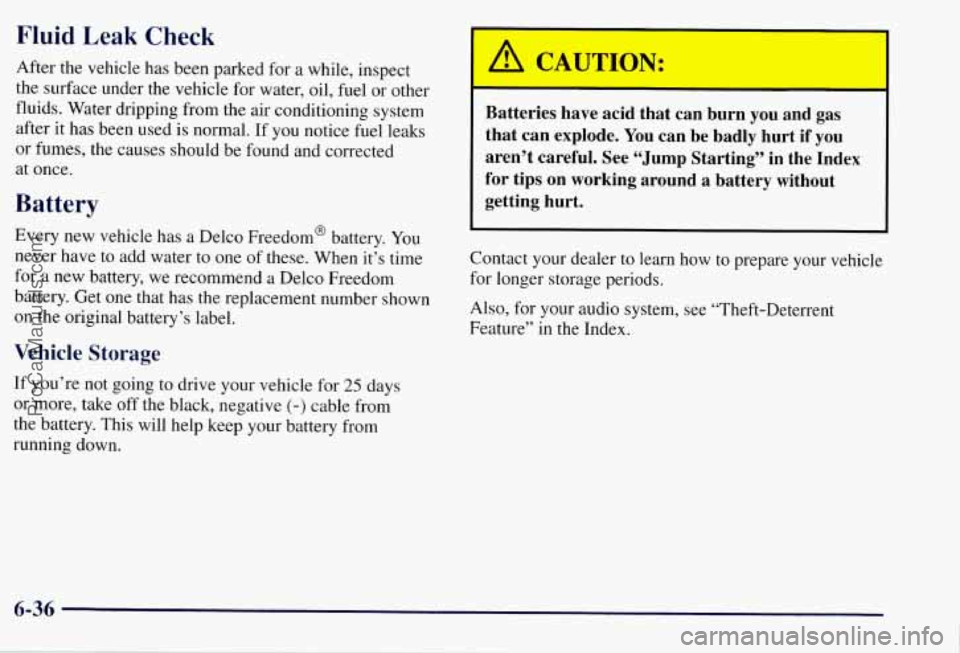
Fluid Leak Check
After the vehicle has been parked for a while, inspect
the surface under the vehicle for water, oil, fuel or other
fluids. Water dripping from the air conditioning system
after
it has been used is normal. If you notice fuel leaks
or fumes, the causes should be found and corrected
at once.
Battery
Every new vehicle has a Delco Freedom@ battery. You
never have to add water to one of these. When it’s time
for a new battery, we recommend a Delco Freedom
battery. Get one that has the replacement number shown
on the original battery’s label.
Vehicle Storage
If you’re not going to drive your vehicle for 25 days
or more, take off the black, negative
(-) cable from
the battery. This will help keep your battery from
running down.
/d CAUTION:
Batteries have acid that can burn you and gas
that can explode. You can be badly hurt if
you
aren’t careful. See “Jump Starting” in the Index
for tips on working around a battery without
getting hurt.
Contact your dealer to learn how to prepare your vehicle
for longer storage periods.
Also, for your audio system, see “Theft-Deterrent
Feature” in the Index.
6-36
ProCarManuals.com
Page 336 of 433
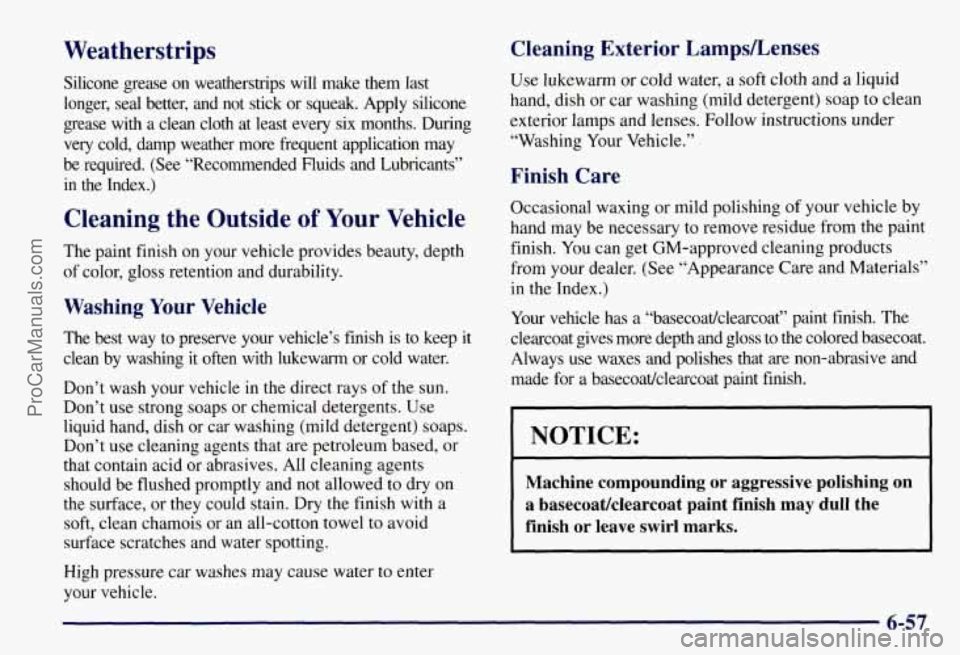
Cleaning Exterior LampsLenses Weatherstrips
silicone grease on weatherstrips will make them last
longer, seal better, and not stick or squeak. Apply silicone
grease with a clean cloth at least every six months. During
very cold, damp weather more frequent application may
be required. (See “Recommended Fluids and Lubricants” in the Index.)
Cleaning the Outside of Your Vehicle
The paint finish on your vehicle provides beauty, depth
of color, gloss retention and durability.
Washing Your Vehicle
The best way to preserve your vehicle’s finish is to keep it
clean by washing it often with lukewarm or cold water.
Don’t wash your vehicle in the direct rays
of the sun.
Don’t use strong soaps or chemical detergents. Use
liquid hand, dish or car washing (mild detergent) soaps.
Don’t use cleaning agents that are petroleum based, or
that contain acid or abrasives. All cleaning agents
should be flushed promptly and not allowed to dry on
the surface, or they could stain. Dry the finish with a
soft, clean chamois or an all-cotton towel to avoid
surface scratches and water spotting. Use lukewarm
or cold water, a soft cloth and a liquid
hand, dish or car washing (mild detergent) soap to clean
exterior lamps and lenses. Follow instructions under
“Washing Your Vehicle.”
Finish Care
Occasional waxing or mild polishing of your vehicle by
hand may be necessary to remove residue from the paint
finish. You can get GM-approved cleaning products
from your dealer. (See “Appearance Care and Materials”
in the Index.)
Your vehicle has a “basecoatklearcoat” paint finish. The
clearcoat gives more depth and gloss to the colored basecoat.
Always use waxes and polishes that are non-abrasive and
made for a basecoatklearcoat paint finish.
I NOTICE:
Machine compounding or aggressive polishing on
a basecoatklearcoat paint finish may dull the
finish
or leave swirl marks.
High pressure car washes may cause water to enter
your vehicle.
6-57
ProCarManuals.com
Page 344 of 433
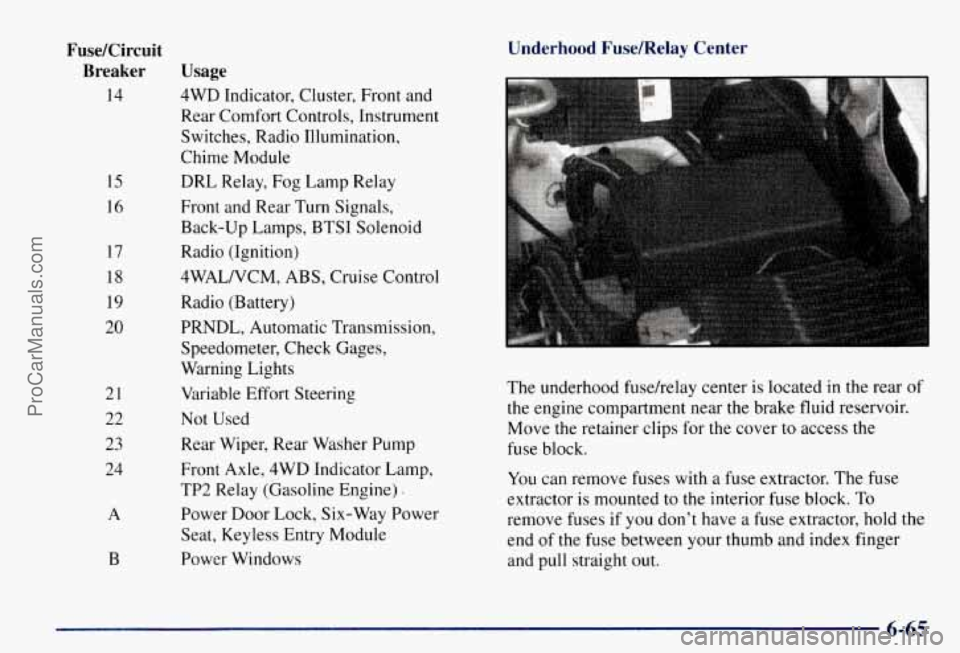
15
16
Fuse/Circuit Breaker Usage
14 4WD Indicator, Cluster, Front and
Rear Comfort Controls, Instrument
Switches, Radio Illumination,
Chime Module
DRL Relay, Fog Lamp Relay
17
18
19
20
21
22
23
24
A
B Front and Rear Turn Signals,
Back-up
Lamps, BTSI Solenoid
Radio (Ignition)
4WALNCM, ABS, Cruise Control
Radio (Battery)
PRNDL, Automatic Transmission, Speedometer, Check Gages,
Warning Lights
Variable Effort Steering
Not Used
Rear Wiper, Rear Washer Pump
Front Axle, 4WD Indicator Lamp,
TP2 Relay (Gasoline Engine)
Power Door Lock, Six-Way Power
Seat, Keyless Entry Module
Power Windows
Underhood Fuse/Relay Center
The underhood fusehelay center is located in the rear of
the engine compartment near the brake fluid reservoir.
Move the retainer clips for the cover to access the
fuse block.
You can remove fuses with a fuse extractor. The fuse
extractor is mounted to the interior fuse block. To
remove fuses if you don't have a fuse extractor, hold the
end of the fuse between your thumb and index finger
and pull straight out.
6-65
ProCarManuals.com
Page 348 of 433
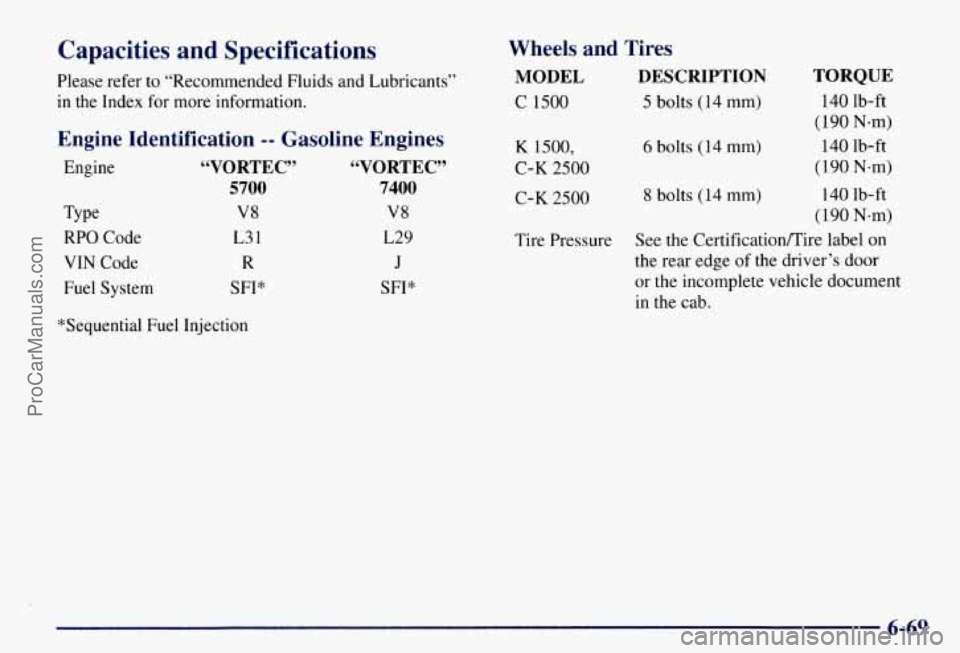
Capacities and Specifications
Please refer to “Recommended Fluids and Lubricants”
in the Index for more information.
Type
RPO Code
VIN Code
Fuel System
Engine Identification -- Gasoline Engines
Engine “VORTEC” “VORTEC”
5700 7400
V8 V8
L3 1 L29
R J
SFI* SFI*
*Sequential Fuel Injection
Wheels and Tires
MODEL DESCRIPTION
C 1500 5 bolts ( 14 mm)
K 1500, 6 bolts (14 mm)
C-IS
2500
TORQUE
(190 Nam)
(190 N-m) 140 lb-ft
140 lb-ft
C-K 2500 8 bolts ( 14 mm) 140 lb-ft
(190 N-m)
Tire Pressure See the Certificationmire label on
the rear edge of the driver’s door
or the incomplete vehicle document in the cab.
6-69
ProCarManuals.com
Page 354 of 433
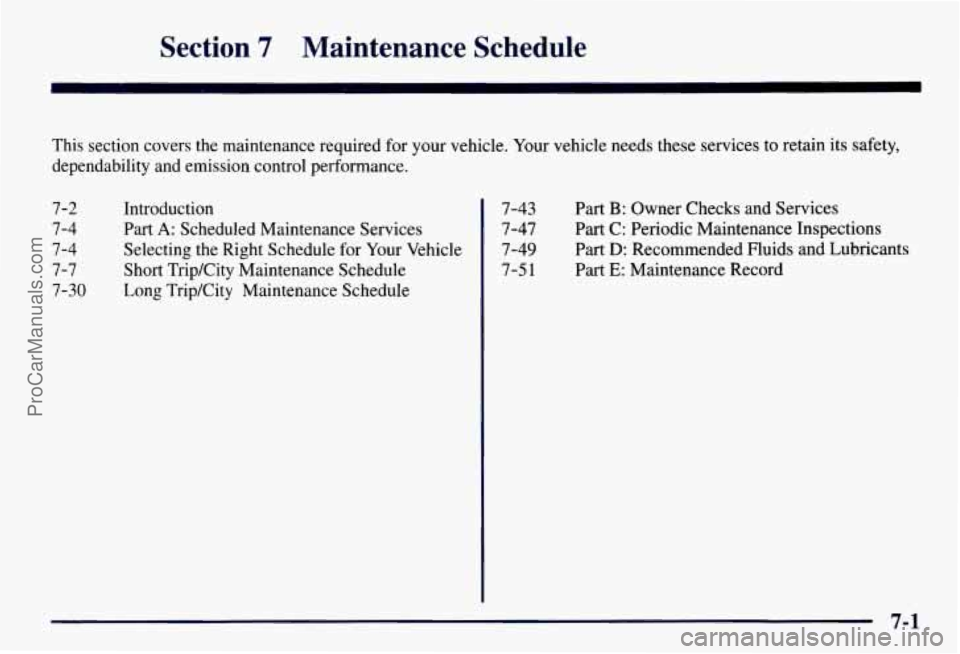
Section 7 Maintenance Schedule
This section covers the maintenance required for your vehicle. Your vehicle needs these services to retain its safety,
dependability and emission control performance.
7-2
7-4
7-4
7-7
7-30
Introduction
7-47 Part A: Scheduled Maintenance Services 7-43
Long Trip/City Maintenance Schedule
7-5 1 Short Trip/City Maintenance Schedule 7-49
Selecting the Right Schedule for Your Vehicle
Part B: Owner Checks and Services
Part C: Periodic Maintenance Inspections
Part
D: Recommended Fluids and Lubricants
Part E: Maintenance Record
7-1
ProCarManuals.com