Page 301 of 433
Checking the Fluid Hot or Cold
Park your vehicle on a level place. Keep the
engine running.
With the parking brake applied, place the shift lever
in PARK
(P).
With your foot on the brake pedal, move the shift
lever through each gear range, pausing for about
three seconds in each range. Then, position the shift
lever in PARK (P). Then, without shutting
off the engine, follow these steps:
Let the engine run at idle for three minutes or more.
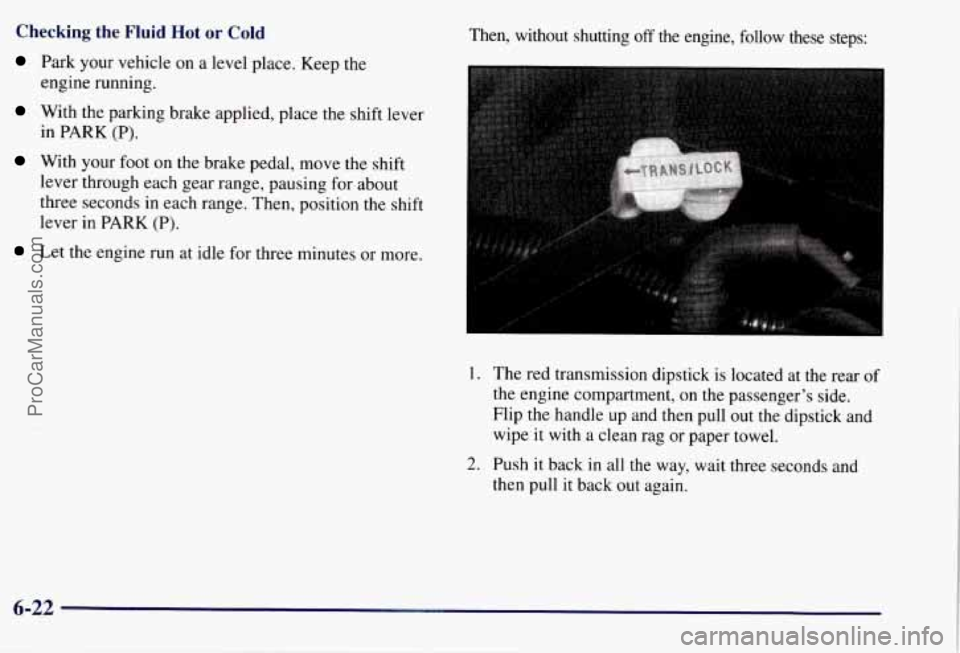
1. The red transmission dipstick is located at the rear of
the engine compartment, on the passenger’s side.
Flip the handle up and then pull out the dipstick and
wipe it with a clean rag or paper towel.
2. Push it back in all the way, wait three seconds and
then pull
it back out again.
ProCarManuals.com
Page 311 of 433
Brakes
Brake Fluid
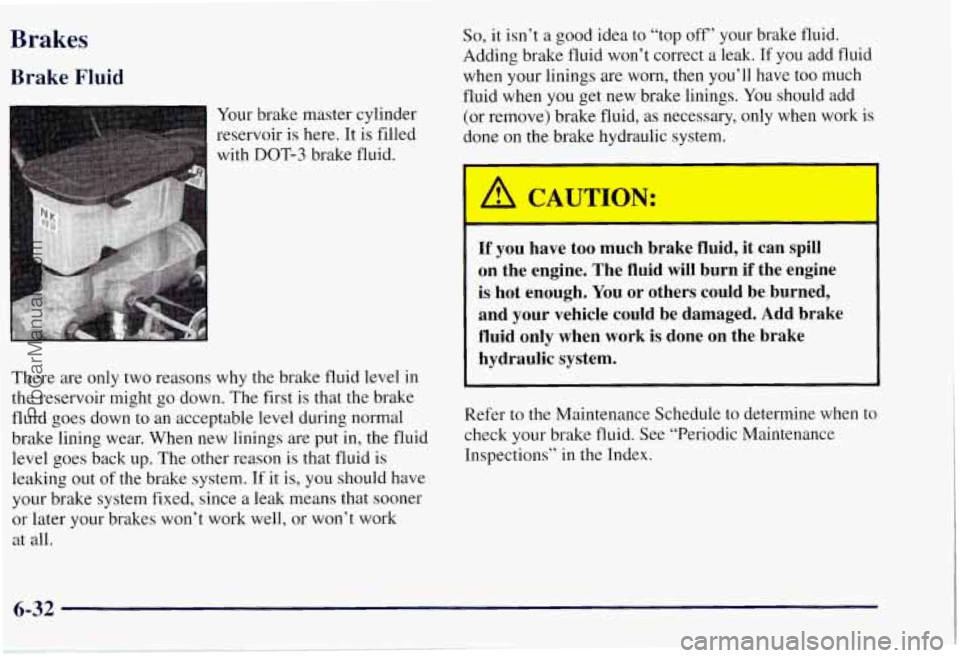
Your brake master cylinder
reservoir
is here. It is filled
with DOT-3 brake fluid.
So, it isn’t a good idea to “top off’ your brake fluid.
Adding brake fluid won’t correct a leak.
If you add fluid
when your linings are worn, then you’ll have too much
fluid when you get new brake linings.
You should add
(or remove) brake fluid, as necessary, only when work is
done on the brake hydraulic system.
KCAUTION:
If you have too much brake fluid, it can spill
on the engine. The fluid
will burn if the engine
is hot enough.
You or others could be burned,
and your vehicle could be damaged. Add brake
fluid only when work is done on the brake
hydraulic system.
There are only two reasons why the brake fluid level in
the reservoir might go down. The first is that the brake
fluid goes down to an acceptable level during normal Refer to the Maintenance Schedule to determine when to
brake lining wear. When
new linings are put in, the fluid check your brake fluid. See “Periodic Maintenance
level goes back up. The other reason is that fluid is Inspections’’ in the Index.
leaking out of the brake system. If it is, you should have
your brake system fixed, since a leak means that sooner
or later your brakes won’t work well, or won’t work
at all.
6-32
ProCarManuals.com
Page 312 of 433
Checking Brake Fluid What to Add
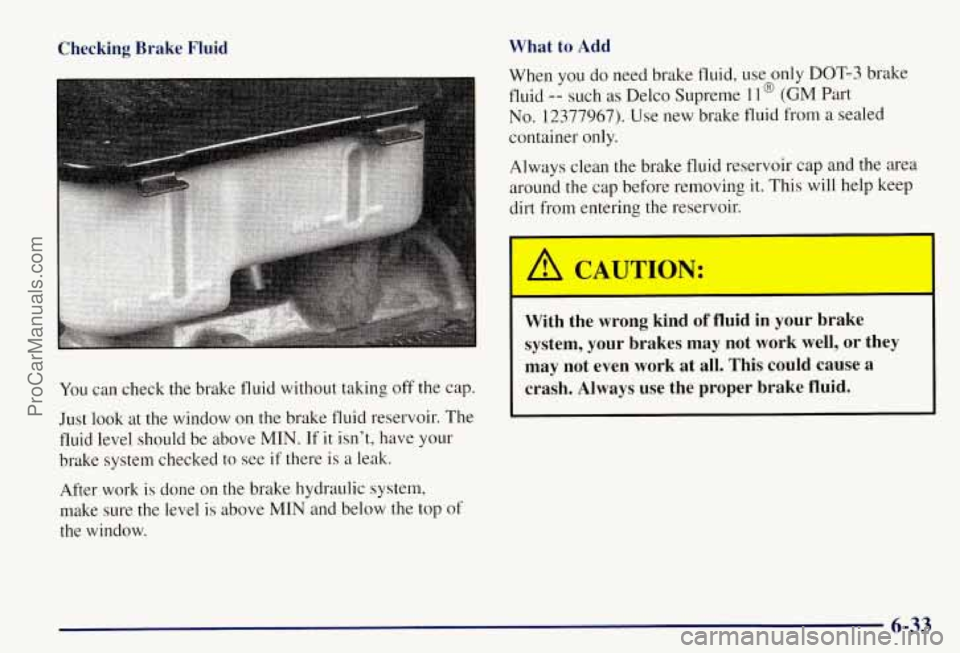
You
can check the brake fluid without taking off the cap.
Just look at the window on the brake fluid reservoir. The
fluid level should be above MIN. If
it isn’t, have your
brake system checked to see if there is a leak.
After work
is done on the brake hydraulic system,
make sure the level is above MIN and below the top
of
the window. When
you do need brake fluid, use only DOT-3 brake
fluid
-- such as Delco Supreme 11 @ (GM Part
No. 12377967). Use new brake fluid from a sealed
container only.
Always clean the brake fluid reservoir cap and the area
around the cap before removing it. This will help keep
dirt from entering the reservoir.
With the wrong kind of fluid in your brake
system, your brakes may not work well, or they
may not even work at all. This could cause a crash. Always use the proper brake fluid.
-1
6-33
ProCarManuals.com
Page 313 of 433
NOTICE:
0 Using the wrong fluid can badly damage
brake system parts. For example, just
a few
drops of mineral-based oil, such
as engine
oil, in your brake system can damage brake
system parts
so badly that they’ll have to be
replaced. Don’t let someone put in the
wrong kind of fluid.
If you spill brake fluid on your vehicle’s
painted surfaces, the paint finish can be
damaged. Be careful not to spill brake fluid
on your vehicle. If you do, wash it off
immediately. See “Appearance Care” in
the Index.
Brake Wear
worn and new pads are needed. The sound may come and
go or be heard all the time your vehicle is moving (except
when you are pushing on the brake pedal firmly).
I
The brake wear warning sound means that soon
your brakes won’t work well. That could lead to
an accident. When you hear the brake wear
warning sound, have your vehicle serviced.
I NOTICE:
r
Continuing to drive with worn-out brake pads
could result in costly brake repair.
Your vehicle has front disc brakes and rear drum brakes.
Disc brake pads have built-in wear indicators that make a
high-pitched warning sound when the brake pads are Some
driving conditions or climates may cause a brake
squeal when the brakes are first applied or lightly
applied. This does not mean something is wrong with
your brakes.
ProCarManuals.com
Page 344 of 433
15
16
Fuse/Circuit Breaker Usage
14 4WD Indicator, Cluster, Front and
Rear Comfort Controls, Instrument
Switches, Radio Illumination,
Chime Module
DRL Relay, Fog Lamp Relay
17
18
19
20
21
22
23
24
A
B Front and Rear Turn Signals,
Back-up
Lamps, BTSI Solenoid
Radio (Ignition)
4WALNCM, ABS, Cruise Control
Radio (Battery)
PRNDL, Automatic Transmission, Speedometer, Check Gages,
Warning Lights
Variable Effort Steering
Not Used
Rear Wiper, Rear Washer Pump
Front Axle, 4WD Indicator Lamp,
TP2 Relay (Gasoline Engine)
Power Door Lock, Six-Way Power
Seat, Keyless Entry Module
Power Windows
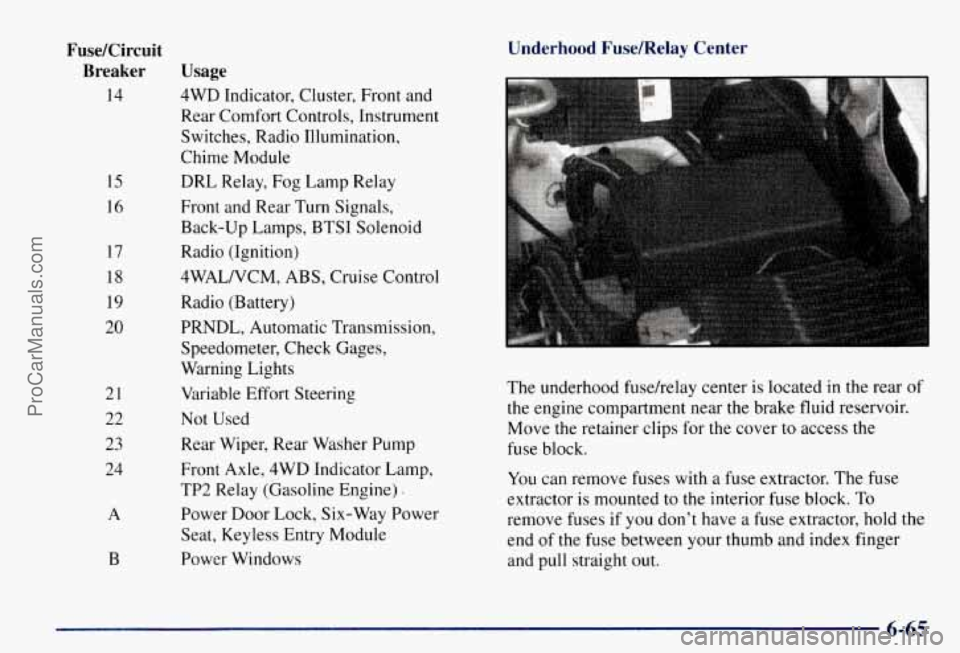
Underhood Fuse/Relay Center
The underhood fusehelay center is located in the rear of
the engine compartment near the brake fluid reservoir.
Move the retainer clips for the cover to access the
fuse block.
You can remove fuses with a fuse extractor. The fuse
extractor is mounted to the interior fuse block. To
remove fuses if you don't have a fuse extractor, hold the
end of the fuse between your thumb and index finger
and pull straight out.
6-65
ProCarManuals.com
Page 360 of 433
Short Trip/City Maintenance Schedule -- Gasoline Engines I
The services shown in this schedule up to 100,000 miles
( 166 000 km) should be performed after 100,000 miles
(166
000 km) at the same intervals. The services shown
at
150,000 miles (240 000 km) should be performed at
the same interval after 150,000 miles (240
000 km).
See “Owner Checks and Services’’ and “Periodic
Maintenance Inspections” following.
Footnotes
The U.S. Environmental Protection Agency or the
California Air Resources Board has determined that the
failure to perform this maintenance item will not nullify
the emission warranty or limit recall liability prior to the
completion of the vehicle’s useful life. We, however,
urge that all recommended maintenance services be
performed at the indicated intervals and the maintenance
be recorded.
# Lubricate the front suspension, kingpin bushings,
steering linkage, transmission shift linkage, transfer case
shift linkage, parking brake cable guides, front axle
propshaft splines and brake pedal springs. Ball joints and kingpin bushings should not
be lubricated unless
their temperature
is 10” F (- 12” C) or higher, or they
could be damaged.
+ A good time to check your brakes is during tire
rotation. See “Brake System Inspection” under “Periodic
Maintenance Inspection” in Part
C of this schedule.
** Drive axle service (see “Recommended Fluids and
Lubricants” in the Index for proper lubricant to use):
Locking Differential -- Drain fluid and refill at first
engine oil change. At subsequent oil changes, check
fluid level and add fluid as needed.
If driving in
dusty areas or towing a trailer, drain fluid and refill
every
15,000 miles (25 000 km).
Standard Differential -- Check fluid level and add
fluid as needed at every oil change.
If driving in
dusty areas or towing a trailer, drain fluid and refill
every
15,000 miles (25 000 km).
heavy-duty or off-road use.
More frequent lubrication may be required for
ProCarManuals.com
Page 363 of 433
Short Trip/City Maintenance Schedule -- Gasoline Engines
15,000 Miles (25 000 km)
0 Change engine oil and filter (or every
3 months, whichever occurs first).
An Emission Control Service.
0 Lubricate chassis components (or every
3 months, whichever occurs first).
(See footnote
#.)
Check readfront axle fluid level and add
fluid as needed. Check constant velocity
joints and axle seals for leaking.
(See footnote
**.)
0 For Two-Wheel-Drive vehicles
only: Clean
and repack the front wheel bearings (or at
each brake relining, whichever occurs first).
0 Vehicles With GVWR Above 8,500 lbs.
Only: Inspect shields and underhood
insulation for damage
or looseness. Adjust
or replace as required.
This is a Noise Emission
Control Service. Applicable only
to vehicles sold in
the United States.
DATE
SERVICED BY: ACTUAL MILEAGE
7-10
ProCarManuals.com
Page 366 of 433
Short Trip/City Maintenance Schedule -- Gasoline Engines
30,000 Miles (50 000 km)
17 Change engine oil and filter (or every
3 months, whichever occurs first).
An Emission Control Service.
CI Lubricate chassis components (or every
3 months, whichever occurs first).
(See footnote
#.)
0 Check readfront axle fluid level and add
fluid as needed. Check constant velocity
joints and axle seals for leaking.
(See footnote
**.)
0 For Two-Wheel-Drive vehicles only: Clean and repack the front wheel bearings (or at
each brake relining, whichever occurs first).
0 Replace fuel filter. An Emission Control Service.
(See footnote? .)
0 Vehicles With GVWR Above 8,500 lbs.
Only: Inspect shields and underhood
insulation for damage or looseness. Adjust
or replace as required.
This is a Noise Emission
Control Service. Applicable only to vehicles sold in
the United States.
0 Rotate tires. See “Tire Inspection and
Rotation” in the Index for proper rotation
pattern and additional information. (See footnote
+.)
7-13
ProCarManuals.com