1997 CHEVROLET S10 manual transmission
[x] Cancel search: manual transmissionPage 180 of 402

Downloaded from www.Manualslib.com manuals search engine Recreational Vehicle Towing
(Four-wheel Drive With Manual
Shift Transfer Case Only)
1 * Set the 1 'king brake: firmly.
2. Place an auromatic transmission in PARR (P) qr a
-manual transmis'siori in FIRST (1).
3. Firmly attach the vehicle .being towed to the 'to,w
vehick. Do not tow the. v&icle by the rear bumper
bar. Refer to the hitch manufactu.rer's instructions.
4. Place the manual shift transfer case- shift lever in
'NEUTRAL (N).
Shifting the transfer case into NEUTRAL (N. an
cause your vehicle
to roll evenif the transmission
is in PARK (P), for an automatic transmission, or
if your vehicle is in gear, for a manual
transmissi6n.
You or othets could be injured.
Make sure the-parking brake is firmly .set befbre
you shift the transfer case into NEUTRAL (N).
5. Release the parking brake only after the -vehicle,
being
towed is firmly attache-d to the tow vehicie.
6; Ins-ert thei-gnitiaa key into the ignitim switch md
turn it one notch fixward of the LOCK position. This
places the key in the OFF po'sitiofi; which 'ufilocks
the steering column while preventing battexy draia.
Unlocking the
steering column will allow for proper
rnovemcnt of the:front w'beel.s/tirr;s during towing.
R-ecre.ationa1 Vehicle Towing
(Except Four-Wheel Drive With
Manual Shift Transfer Case)
4-43
Page 188 of 402
Downloaded from www.Manualslib.com manuals search engine '0 If you have- an automatic transsinission5. you can
use DRIVE (Dj (m,as you need to, a lower gear)
when -towing a.tr-ailer. Operating your vehickin
DRIVE (P) when towing a trail& will minimize. heat
buildup a-nd extend the life of your transmission. If
you have -a manual eansmission and YQU'W~ towing-
a trailer, it-'s :better not to 'use FIFTH (5) gear. Just
drive in FOURTH (4). gear (or, as y-ou necd to, a
1Qwer ge.a).
Three importmt considerations have to do. with weight:
the; weight Qf the- trailer,
0 the weight of the traiirer?tongne
and the weight on-your vehicle's tires.
Weight of the Trailer
How he-avy can - a trail& safely be?'
It depends on how yosll plan to use your rig. For
example, speed, altitude, mad grades, outside
-temp&ature and how much yaw vehicle is used to pull a
trailer are -all important. An,d~, it can also depend an any
.-special equipment that you have on your vehicle.
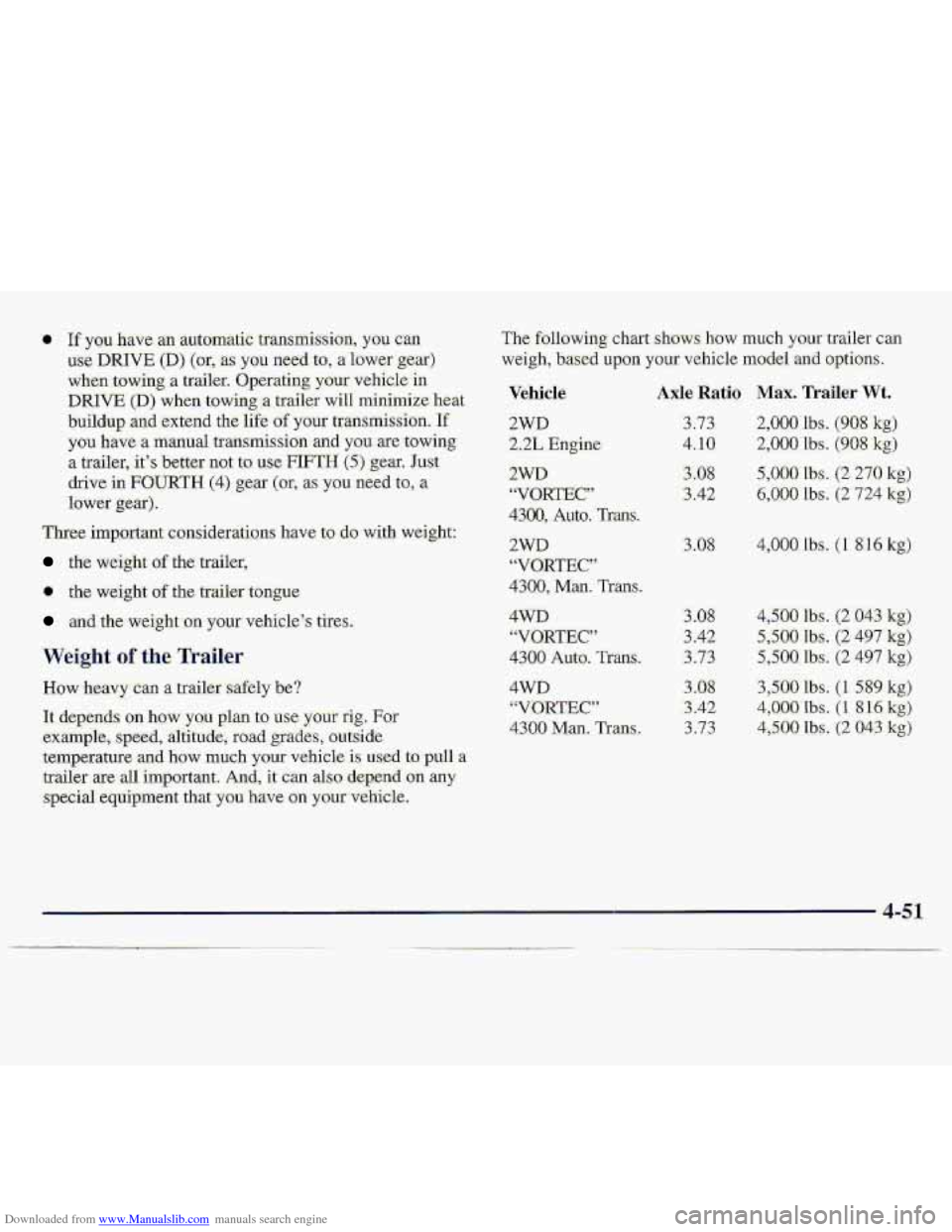
The follo-w%g chart shows haw much your trailer can
weigh, based upon your: vehicle rno.&l and. options.
Vehicle
2wD
2.2L Engine:
2wJ-J
'VOREC"'
4300, Auto. Trans.
Axle Ratio Max. Trailer Wt.
3.73
4.10
2,000.Il.?s. (90.8 kg)
2,000 lbs. (908 kg:)
3 .m
3.42
5,000.lbs. (2 270 kg)
6,O.OO lhs. (2 724 kg)
3.08 4,000 lbs. (1 g.16 kg)
4m 3.08
"VORTEC" 3 -42
4300 Auta:. Trans. 3.73
4.,500 hs. (2 043 kg)
5,500 1b.s. (2 497 kg)
$,5OOllbs.. (2 497 kg)
3,500 ibs. (I 589 kg,)
4,500 lbs. (2 043 .kg)
4,000, lbs. (1 8 1.6 kg)
Page 193 of 402
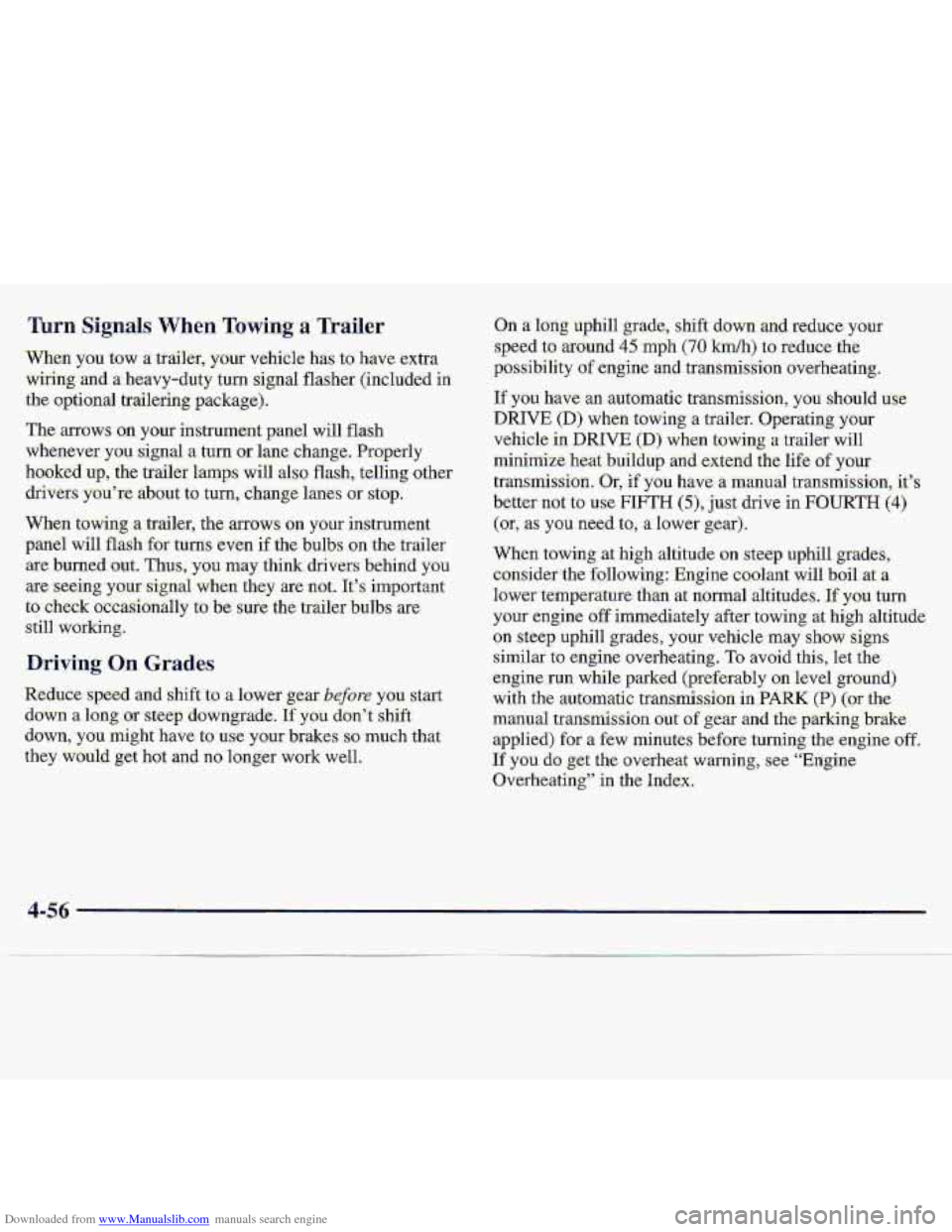
Downloaded from www.Manualslib.com manuals search engine When. you tow a tixiilkr, y-our vehicle ha.s to’have extra
wiring :and a- heavy-duty turn signal flasher. (included in
the- optional trailering package).
The arrows-on your instrument panel will flash
whenever.
you signal a turn 01- 1-me. change, Properly
hooked .up, the &&la lamps will also flash, telling other
drivers you’re
about to :turn, change lanes or stop.
When towing a:txailer,
the. arrows. on your hstrument
panel will flash for turm even if the bulbs on the trailer
are burned out. Thus, you may think drivers behind you
axe seeing your signal when they arenot. ICs important
to check. occasionally to.be sure- the trider bulbs are.
still working.
Driving On .Grades
Reduce speed and shiftlo dower. ge.ar. ,befure you start
dawn B long -or steep downgrade. If-you do-n’t shift
down,
you might have to use your brakes wmuch that
they would
get hot and no longer work weIl.
If you have an.aut~~atic-transm~ssion, you should use
DRIVE (D) when towing a trailer. Operating your
vehicle in DRIVE @) when towing a. trail& will
Mze: heat:buiidup and merid the life af y.our
transmissioil. Qr, if you have, a-manu-ai transmission,
it’s
better not to use FIFTH (S), just drive in FOURTH (4)
(or, as you need to, a lower gew).
4-56
Page 194 of 402

Downloaded from www.Manualslib.com manuals search engine Parking on Hills
You really should not park your vehicle, with a trailer
attached,
on a hll. If something goes wrong, your rig
could
start to move. People can be injured, and b.oth
your vehicle and the trailer can be damaged.
But
if you ever have to park your rig on a hill, here’s
how to do it:
1.
2.
3.
4.
5.
6.
Apply your regulafbrakes, but don’t shift into
PARK (P) yet, or into gear for a manual
transmission. When parking uphill, turn your wheels
away from the curb. When parking downhill,
turn
your wheels into the curb.
Have someone place chocks under the trailer wheels.
When the wheel chocks are in place, release the
regular brakes until the chocks absorb the load.
Reapply the regular brakes. Then apply your
parking brake, and then shift into PARK (P), or
REVERSE (R) for a manual transmission.
If.you have a four-wheel-drive vehicle with
a
manual transfer case shift lever, be sure the transfer
case
is in a drive gear -- not in NEUTRAL (N).
Release the regular brakes.
It can be dangerous to get out of pur vehicle if
the shift lever is not fully in PARK (P) with the
parking brake firmly set.
Your vehicle can roll.
If you have left the engine running, the vehicle
can move suddenly.
You or others could be
injured.
To be sure your vehicle won’t move, even
when yoa’re
on fairly level ground, use the steps
that follow.
If you have four-wheel drive with a manual
transfer case shift lever and your transfer case
is
in NEUTRAL (N), your vehicle will be free to
roll, even if your shift lever is in PARK (P). So, be
sure the transfer ca’se is in a drive gear
-- not in
NEUTRAL (N).
4-57
Page 206 of 402
Downloaded from www.Manualslib.com manuals search engine When your vehicle is being towed,. h-ave the ignition key
. md.& ;the OFF- position.. The ite,erin,g wliegl sli~ultl
be. cla-mped in- a straightdahezd position witb a clamping
&vice desi:ped for towing-service. DO fiat ust the
vehicle's steering c.olumxz I-ock for this. The transmission
should be in
NEUTRAL (N) an-d the .transfer case, if you
'31ave one, ShQuLd. be in 2HI. The p&ing.bm.ke shguld-.-lje
seleased.
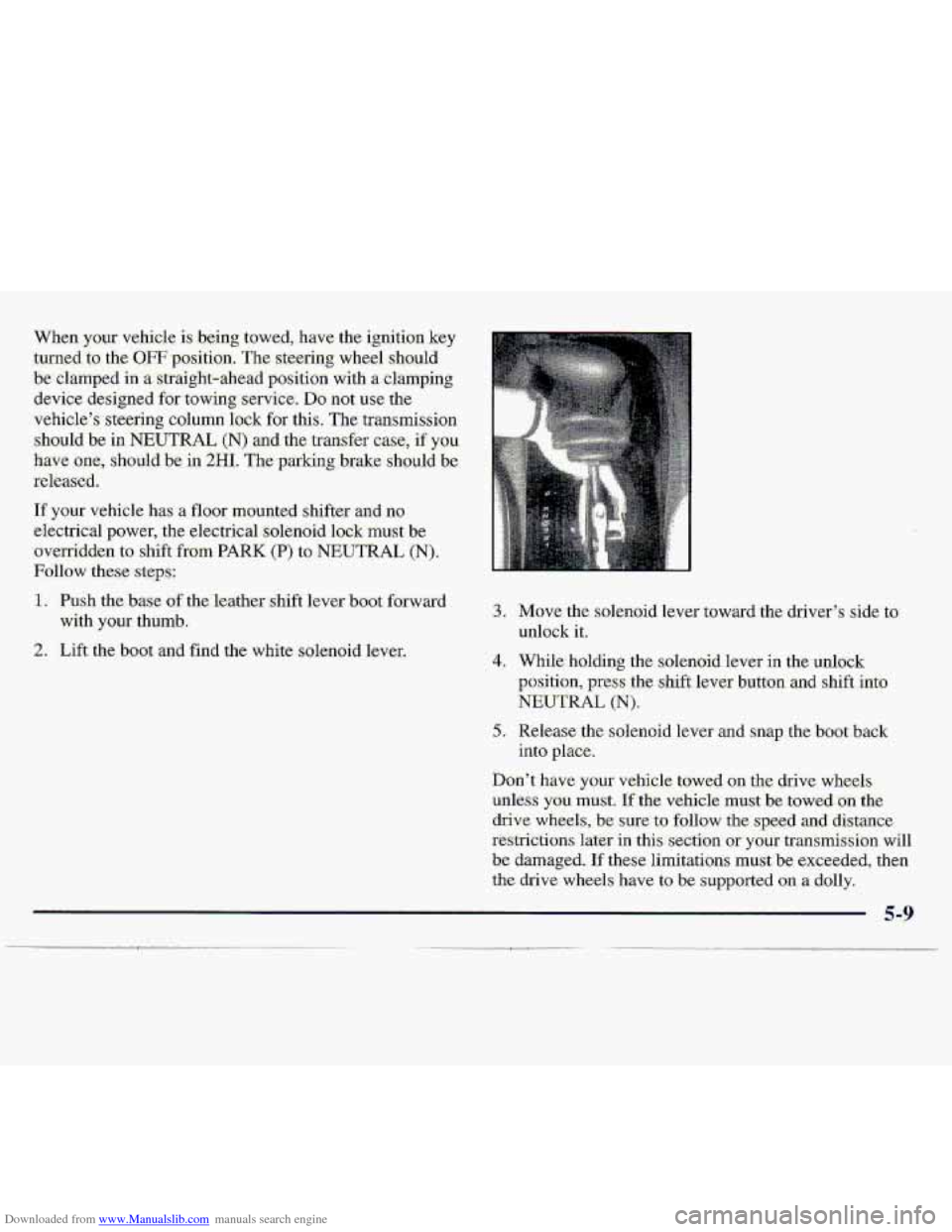
If your vehicle has. a flqor mounted shifter and no
.electrical power,
the electrical.So1enoi.d lock must be
.ovexKidd.m tu shi%t-.hm PARK (P> :to NEUTRAL (Nj.
Follow -:these. step.8:
1. Push the'bme of the.'€e.ather shift leva boat forward
with
your thumb.
L
3.
4.
5'.
'Move the solenoid. lever toward the driver's side to.
m1oc.k it;
'While holding the solenoid lever in the unlock
gosition, press the shift lever button and shift into
NEUTRAL
(N).
Release the solenoid lever and snap the b.QgL.b.a&
into place.
,... . .
Don't have your vehi-cle towed on th-e drive wheels
unless you must. If -the Vehicle .must be towed--on. the
drive wheels, be sure to follow the. sp.e.ad and distance
restrictions
Mer in this section oryour transmission will
be damaged.. If these limitations must be exceeded, the0
the drive wheels have to b:e supported on .a dolly.
Page 210 of 402
Downloaded from www.Manualslib.com manuals search engine IfNo Steam Is Coming -. From Your Engine
If y0.u get the overheat warning but s.ce or hear RO
steam, the problem may not be too serious. Sometimes
the engine
can get a 1i.ttle too hot when yau:
.O Climb a long hill OLI: a hot day.
0 S.top after high-speed driving.
0 Idle for long periods in traffic.
e- Tow a trailer. See “Dfiving on Grades” in .the Index.
If you get .the overheat warning with no sign of s-team;
try this for a minute or so:-
1. If you have an air conditioner, turn it off.
2. Turn on your heater to full hot at the highest.$gm
speed
and open the window as necessary.
3. 1% you’re in a. traffic jam, shift to NEUTRAL (N);
otherwise, shift to the highest gear while
driving -- AUTOMATlC OVERDRIVE (@) or
DRIVE (D) far automatic transmissions.
If you n.0 longer have the overheat warniiqg,. you
can drive. Just to besafe, driv.e slower for .about
10 minu.tes. If the
warning does;n’.t come back. ofl,
you can drive normdly..
If the warning c.aritinues-, pull OV&, stop, and p-~k y.Our-
vehicle right hway.
If there’s still no sign of steam, push the accelerator Uhtil
the
engine speed is about twice as fast-as normal idie
speed. Bring the. engine speed back to- normal idle sped
after two QP three minutes. Now:s.ye if the warning, stops.
But
&en-, if you still have the .warnhg-, twn qfl--fhc
engine and get Gveryona .out af rhe whicle until it
coois Eo wn.
Page 220 of 402
Downloaded from www.Manualslib.com manuals search engine If a tire goes flat, avoid further tire and wheel damage
by driving slowly to a level place. Turn on your hazard
warning flashers.
Changing a tire can cause an injury. The vehicle
can slip off the jack and roll over
you or other
people.
You and they could be badly injured.
Find
a level place to change your tire. To help
prevent the vehicle from moving:
I. Set the parking brake firmly.
2. Put an automatic transmission shift
lever in
PARK (PI or shift a manual
transmission to FIRST (1) or
REVERSE (R).
CAUTION: (Continued)
3. If you have a four-wheel-drive vehicle
with
a manual transfer case shift lever,
be sure the transfer case is in
a drive
gear
-- not in NEUTRAL (N).
4. Turn off the engine.
5. Put the wheel blocks at the front and
rear
of the tire farthest away from the
one being changed. That would be the
tire on the other side
of the vehicle, at
the opposite end.
Page 234 of 402
Downloaded from www.Manualslib.com manuals search engine NOTICE:
Spinning your wheels can destroy parts of your
vehicle as we11 as the tires. If you spin the wheels
too fast while shifting your transmission back
and forth, you can destroy your- transmission.
For information about using tire chains on your vehicle,
see “Tire Chains” in the Index.
Rocking Your Vehicle To Get It Out
First, turn your steering wheel left and right. That will
;clear the area around your front wheels. Then
shift back
,;and forth between REVERSE (R) and a forward gear (or
*with
a manual transmission, between FIRST (1) or
SECOND (2) and REVERSE(R)), spinning the wheels
as little
as possible. Release the accelerator pedal while
you shift, and press lightly on the accelerator pedal
when the transmission is in g,ear. If that doesn’t get
you
out after a few tries,. you may need to be towed out. Or,
you c.an use.your recovery hooks if your vehicle. has
::them. IT you do need
to be tawed out, see “Towing Your
”Vehicle” in the
Index,.
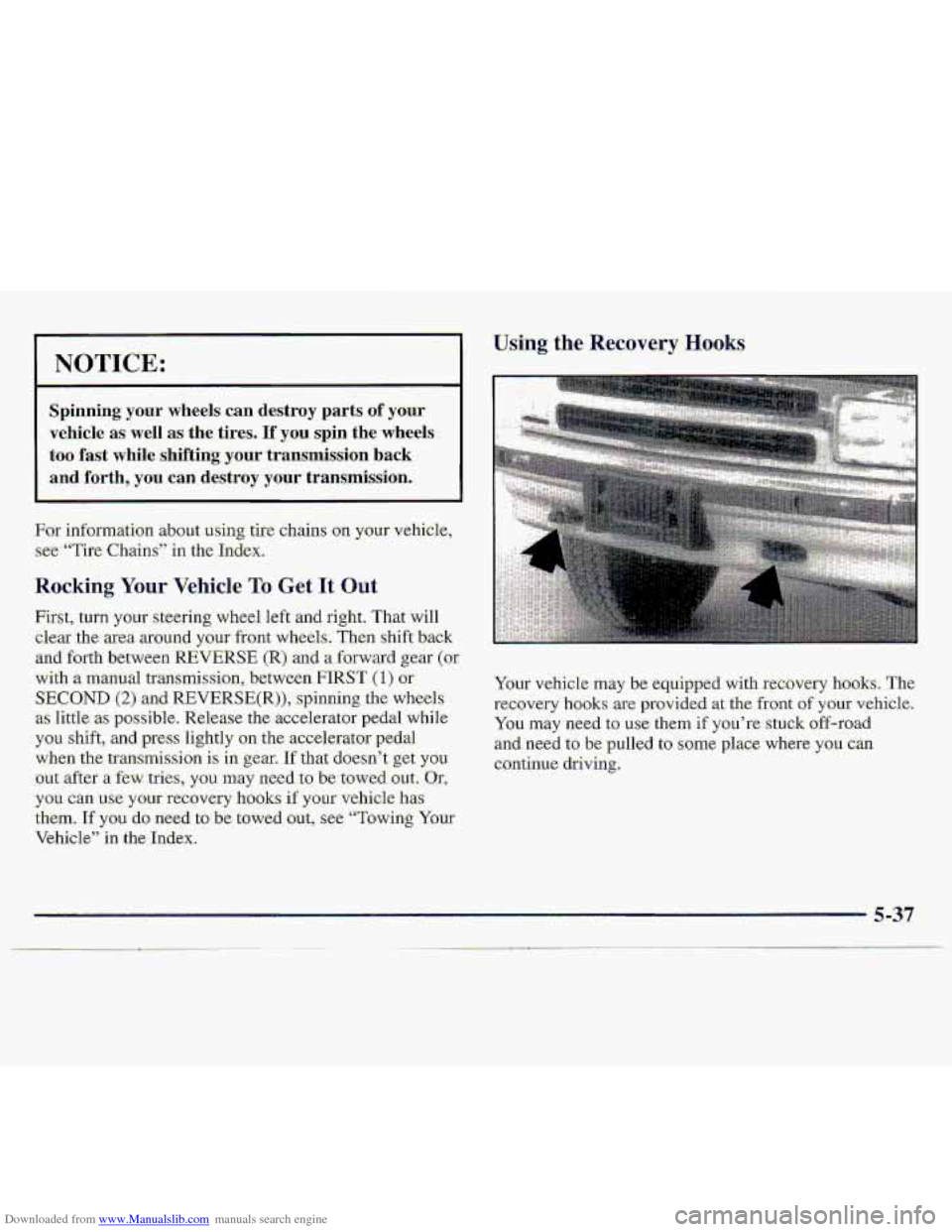
U-sing the Recovery Hooks
Tour vihilfe may be equipped with recovery hooks. The
recovery
hooks are pmvided at the front of yo-ur vehicle.
You may need to use them if you’re stuck off-road
and need to be pulled to some place where you can
wntinue driving.
5-37
____