Page 154 of 402
Downloaded from www.Manualslib.com manuals search engine 0
0
0
you approach thgs faster and you h.ave less time to
scan the terrain f&- obstacles.
you. h.ave Tess time to react..
you have more vehicle bounce when you drive
0Ter:obst~eks..
ybu’ll need. more distance for bfaking, esp-ecjally
since you’re OB an unpaved surface.
When you’re driving off-road, bouncing and
quick changes in direction can easily throw you
out of position. This could c.ause you to lose
control .and crash. So, whether you’re driving .on
or off the road, you a.nd your passengers-should
wear safety belts.
Scanning the Terrain
Off-road driving can take: you over many different
kinds
of tgrrain.. You need to be familiar with the terrain
and:its many different f&tures. Here we some things
to can-sidei-.
0 Will the surface texture change abruptly up ahead?
* Does the travel take .you uphfil or downhill? (There’s
more discussion of .these subjects latert)
Will you have :to stop suddenly or change
directi-on quickly?
. ...
Page 254 of 402
Downloaded from www.Manualslib.com manuals search engine When to Check and Change
.A goad time to check-your a0tomati.c transmission fluid
level is when the en.gine .oil is chanzed,
C.hange
both the fluid an.d filter every 50,000-miles
(8'3 000 km) if the vehicle is mainly driven under one or
more of these conditions:
In heavy city traf€ic where the-outsi.de. temperature
regularly reaches.
906F (.32'C) or higher.
In hilly or mountainom terrain.
0 When doing frequent trailer towing.
0 Uses. such as found in taxi, police or delivery service.
If
you do not use your vehicle under any of the-se
cqnditions, the fluid and filter do not require changing.
See "Scheduled Maintenance Services"
in the Index,
How to Check
B.eCanse this operation can be a little difficult, you
may cho.Oge to have this dme at your GM de-alership
Service
Department
If you do it ywrsiAf, be sure to follow all the instruaims
here, uryclu coukd get a false re.adirig on the dipstick.
NOTICE:
Too much or too little fluid can damage- your
transmission,
TQO much can mean that s.ome of
the fluid could come out and fall on hot engine
parts or exhaust system parts, starting a fire. Be
sure to getan accurate reading if .you .check .your
transmission fluid.
Wait &t least.30 minutes before checking the
transmissioil fluid
level if.you have been driving:
* When ou&ide te:mperatures ar~ above 9C>-'F (32 O C).
0 At high spe>ed fbr.quite-.a while.
0 Tn'heavy traffic -- especidly in hot weather.
While pulling
a. trailer:
To -get the right reading, the flui,d'should be at dermal
operating temperature, which- is 1:80."F to 208°F
(82QG to 33°C).
Page 257 of 402
Downloaded from www.Manualslib.com manuals search engine HOW to Add Fluid Manual TransmisSion Fluid
Referto- the. M-aintenance Schedule t~ dtztermirie. what
kind of- tram~ssion fluid to. me. See “Recommended
Fluids and Lubricants:” in. the Index.
Add fluid only after checking tktrmsmission fluid HOT.
(A COLD check is used .only as a reference.) If the fluid
levd is low, add Only enough of the proper flvid. to bring
the le,vel up t.0 the HOT area fora hat check. It doesdt
take much fluid, ,generally less than Qne pint (0.5 L).
Don t ove.$ll.
NOTICE:
We recommend you use only fluid labeled
DEXRON@-III, because. fluid with that label is
made especidy
for-. your automatic transmission.
.Damage caused.
by fluid other than DEXRON-111
is not covered by y.our new vehicle warranty.
After srddiag fluid-, recheck the fluid Ievel as
When the-correct fluid level Ls obtained, .push the
described under “How to Check.”
dipstick back
in all the way; then flip the handle
down
to lock the dipstick in place.
A good time to have it checked is when-the engine
oil is changed. However, the fluid in your manual
transmission doesn’t require charging..
How to Check
Because this operation can be a little difficult, you
may choose to have this done at.you-r GM dealership
Service Department.
‘If YOU do it yourself, be sure. to follow all the
instructions here, or
you could ge.t a false reading,
NOTICE:
Too much or too little-fluid can damage your
transmission.
Too much can mean that same: u1
the fluid could come; out and fall on hot engine.
parts
or exhaust system p-arts, starting a fire. Be
sure
to get an accurate reading if you check your
tranqmission fluid.
Page 284 of 402
Downloaded from www.Manualslib.com manuals search engine When, U’s Time for Nk-W Tires
Rust-or dirt on a wheel,. or on the parts to which
it is fastened, can make wheel nuts bec:ome lo-ose
a-ftep a. time. The wheel coukd come off and cause:
an accident. When you change a wheel, remove
any .rust or dirt from places where the wheel
attaches
to the vehicle. In an emwgency, you can
use a cloth or a paper: towel to do this; but be
sgre to use a scraper or wim brush later, if you
need to, to get all the rust or dirt off. (See
“Changing a Flat Tire” in .the Index.)
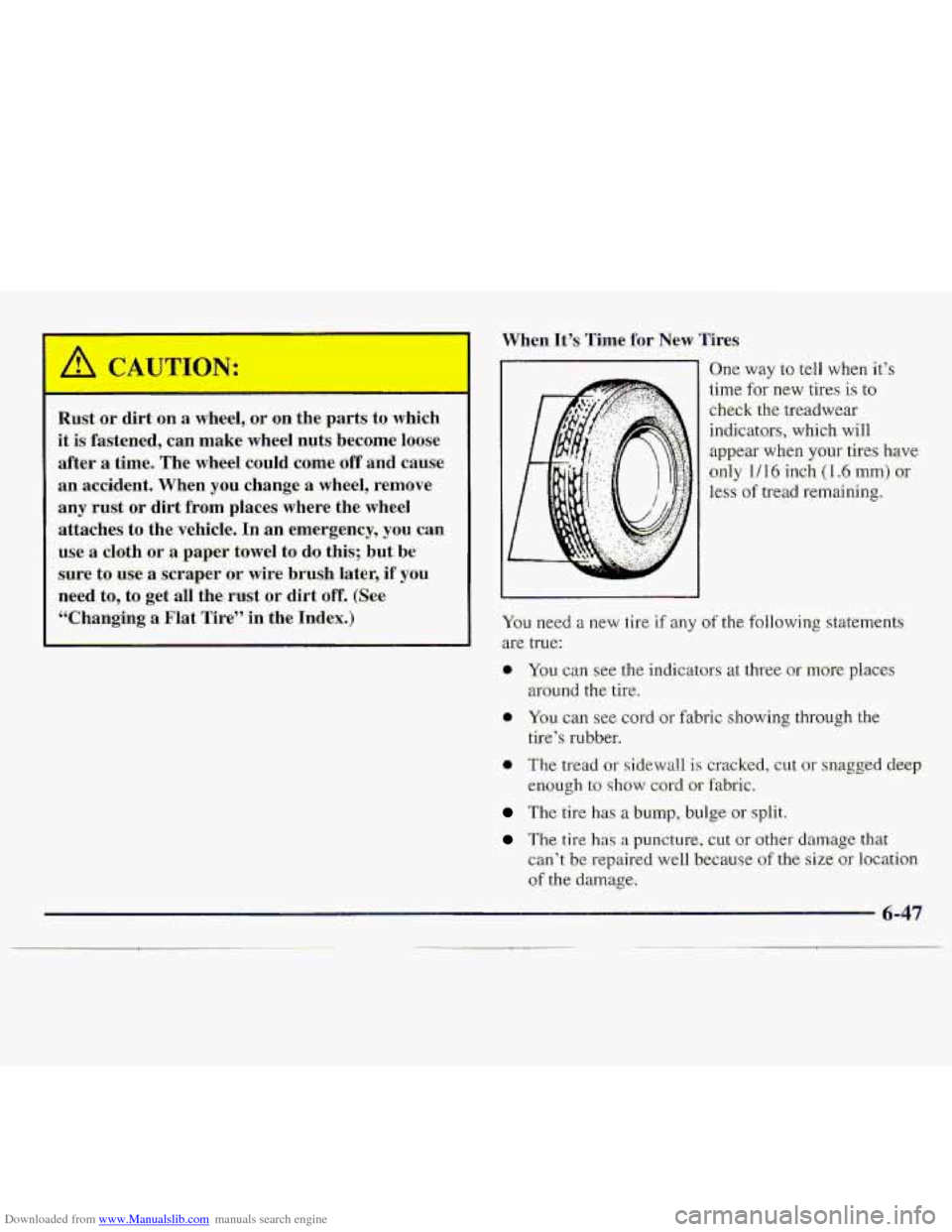
One way to tell when it’s
time
for new tires is to
check the treadwear
indicators, which wil’l
appear when yo-ur tires have
only l/ 16 inch (1.6 mnm) or
less of tread remaining.
10 You can see the indicators at three 01: mn1-e places
around. thetire-.
a You can see cord .or f’abric showing through the
tire’s rubber.
The tread or sidewall is cracked, cut or snagged deep
enou.gh to show cord-or fabric.
The tire has a bump, bulge or split.
The tire hn.s a puncture, cut or other damage that
can’t be repaired well because of the size 01: :location
of the damage.
Page 316 of 402
Downloaded from www.Manualslib.com manuals search engine Short Trip/City Maintenance Schedule
+ A good .time. to check your’ brakes is during tire
rotation.
See: “Brake System Inspection” under “Periodic
Maintenance Inspection” in Part C of this schedule,
** Drive axle setvice (see “Recommended Fluids ,and
Lubricants” in the Index for proper lubricant
to use):
0
0
‘Locking Differenti,al -- .Drain fluid. and refill at first
engine oi€ change.
At- subsequent oil Changes, check
fluid level and add fluid as neede.d.. If driving in
dusty areas or towing a trailer, drain fluid and refill
every
15,000 miles (25 000 km).
Standard .Differential -- Check fluid level. and. add
fluid as needed at every oil change If driving in
,dusty areas or towing a trailer, drain fluid and refill
every
15,000. miles (25 ‘000 km).
.More frequent lubrication may
be required for
heavy-duty or off-road use.
Page 346 of 402
Downloaded from www.Manualslib.com manuals search engine The services shown in this sc.hedule up to 100,000 miles
(166 000 km) should be performed after 100,000 miles
(1 66 000 km) at the same interva1.s. -The services shown
at 150,000 miles (240 000 km) should be performed at
the
same interval after 150,000 miles (240 000 km).
;See
“Owner Chcekcs and Services” and “Periodxc-
Maintenance Inspections” following. :..
Footnotes
j’ The U.S. Environmental ProtectiQn Agen.cy or the
California
Air Resources Board-has determined that the
fail.ure to perfam this .m:ai-ntenance-item will nat‘nullify
the emissi‘on warranty
or limit recall liability prior to- the-
completion
of the vehicle’s useful life. We, however,
urge that all recommended maintenance services be
perforrne:d
at the indicated intervals and the maintenance
be recorded.
# Lubricate the front suspension, ball joints, steeking
linkagcand transfer cas-e shift linkage, parking brake
cable
guides, propshaft splines, universal joints and
brake pedal springs,
-k A good time ta check your brakes is during tire
rotation.
See “’Brake S-ystem Inspection” under “Periodic
Mafritenafice Inspections” in Part
C of this schedule.
-‘E* Drive axle service (see “Recom.mended Fluids and
Lubricants’‘ in
the Index for proper lubricant to use):
Locki.ng Differential -- Drain fluid and refill .at first.
eagine -&I change. At subsequent oil changes, check
fluid level and add fluid as need.ed.
Standard Differential -- Ch:eck fluid level and add
fluid
as needed at every engine oil change.
More frequent lubrication may be require.d for
heavy-duty or off-road use.
7-37