Page 6 of 354
Downloaded from www.Manualslib.com manuals search engine I
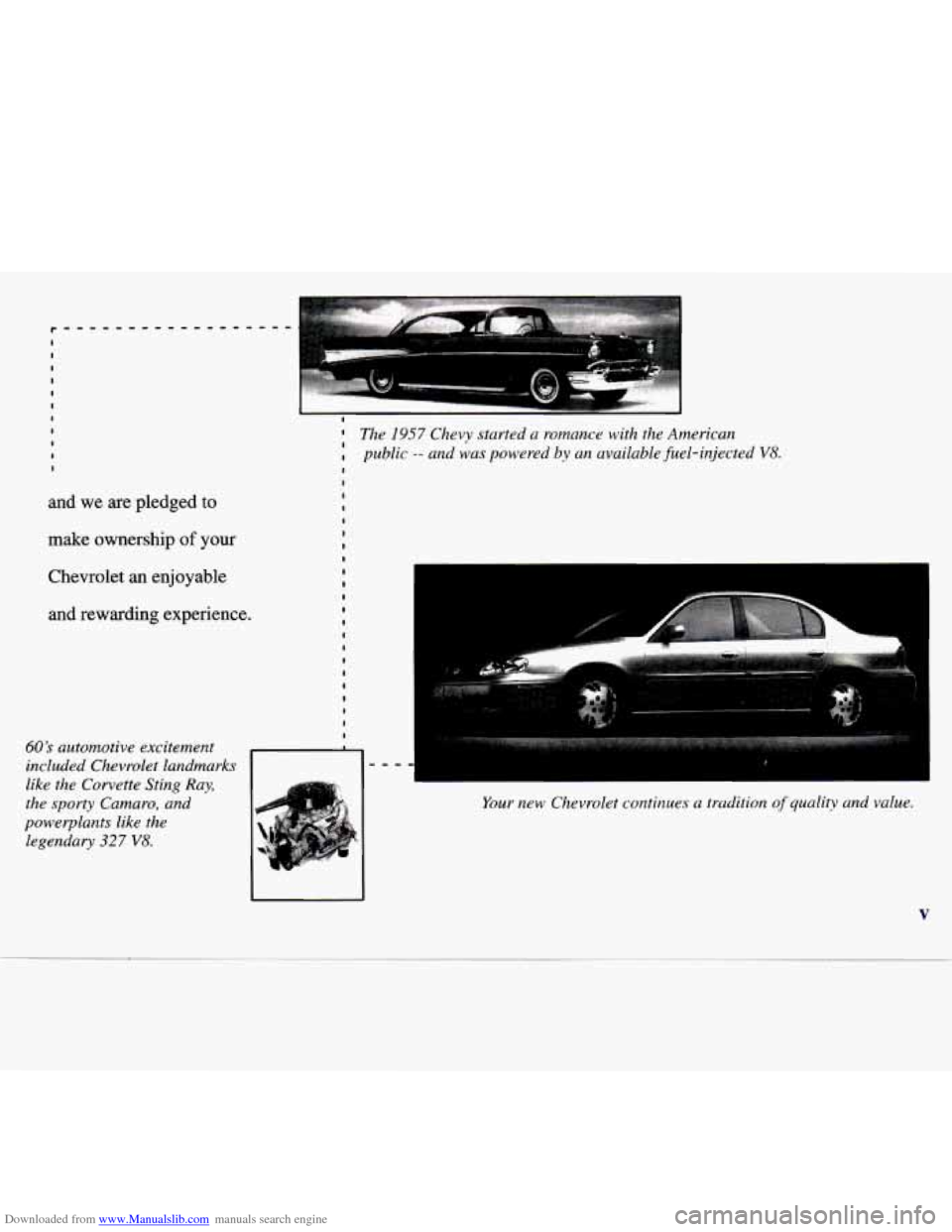
I The 1957 Chevy started a romance with the American
public
-- and was powered by an available fuel-injected V8.
I I I
I
I
I l
and we are pledged to
make
ownership of your
I I
I
I
I
I
I 1
I
I
I
I
I
I
I
Chevl-olet an enjoyable
and rewarding experience.
60's automotive excitement
included Chevrolet landmarks
like the Corvette Sting Ray,
the sporty Camaro, and
powerplants like the
legendary
327 V8.
Your new Chevrolet continues a tradition of quality and value.
V
Page 10 of 354
Downloaded from www.Manualslib.com manuals search engine Section 1 Seats and Seat Restraints
Here you’ll find information about the seats in your Chevrol\
et and how to use your safety belts properly. You can also
learn about some things you should
not do with air bags and safety belts.
1-2
1-2
1-3
1-4
1-5
1-8 1-11
1-12 1-15 Seats and Controls
Manual Seats
Power Seats
Reclining Front Seatbacks
Rear Seats
Why Safety Belts Work
Questions Many People Ask About
Safety Belts
How to Wear Safety Belts Properly
Shoulder Belt Height Adjuster 1-20
1-23
1-30
1-34
1-36
1-37
1-47
1-47 1-47 Safety Belt Use During Pregnancy
Questions and Answers About Air Bags Safety Belt Comfort Guides
How to Use Child Restraints
Important Information for Buckling Children in Child Restraints
Child Restraint Top Straps
How to Obtain a Safety Belt Extender
Checking Your Restraint Systems
Replacing Parts After a Crash
1-1
-----
Page 12 of 354
Downloaded from www.Manualslib.com manuals search engine 6-Way Power Seat (If Equipped)
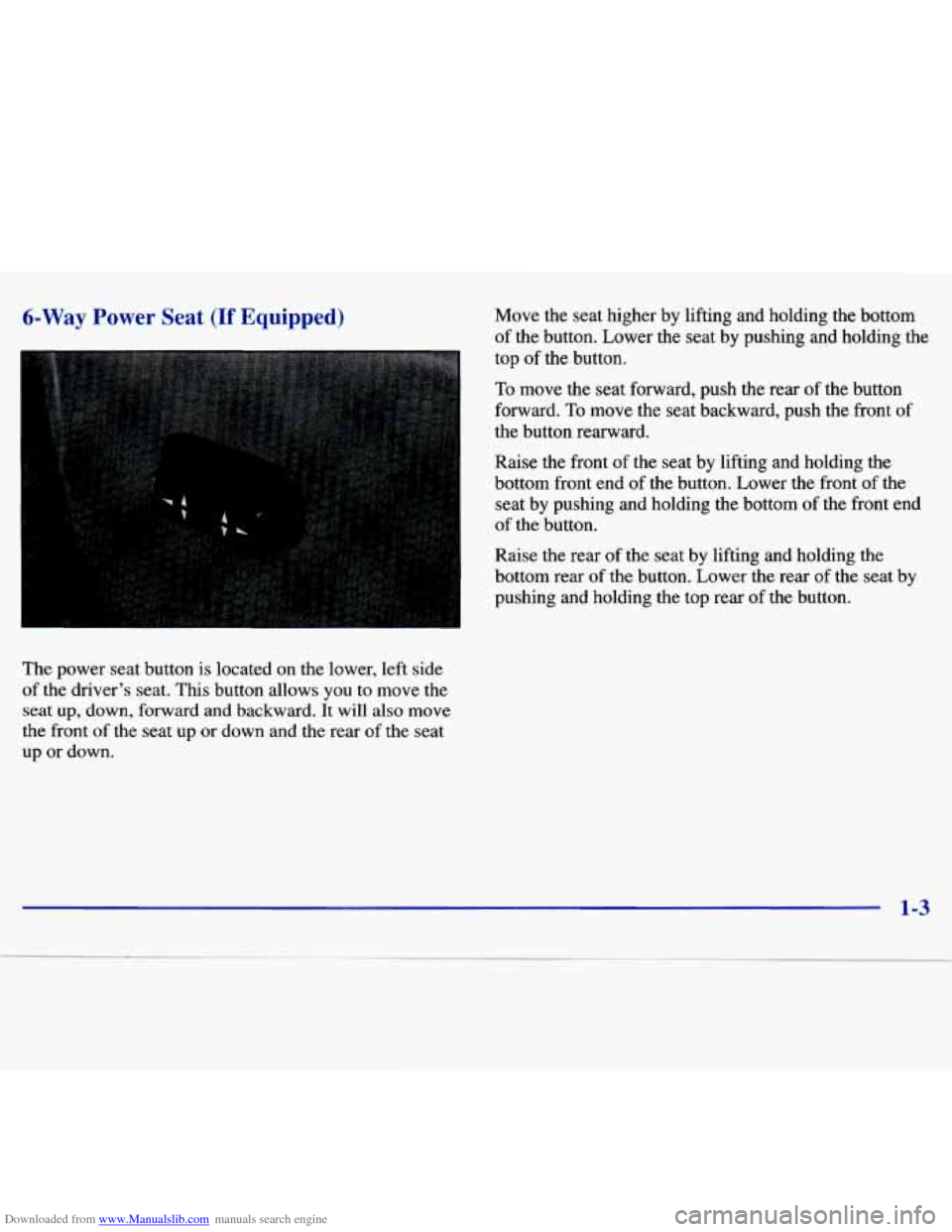
The power seat button is located on the lower, left side
of the driver’s seat. This button allows you to move the
seat up, down, forward and backward.
It will also move
the front of the seat up or down and the rear of the seat
up or down. Move the seat higher by lifting and holding the bottom
of the button. Lower the seat by pushing and holding the
top of the button.
To move the seat forward, push the rear of the button
forward. To move the seat backward, push the front of
the button rearward.
Raise the front of the seat by lifting and holding the
bottom front end of the button. Lower the front of the
seat
by pushing and holding the bottom of the front end
of the button.
Raise the rear
of the seat by lifting and holding the
bottom rear of the button. Lower
the rear of the seat by
pushing and holding the top rear of the button.
1-3
Page 59 of 354
Downloaded from www.Manualslib.com manuals search engine Keys
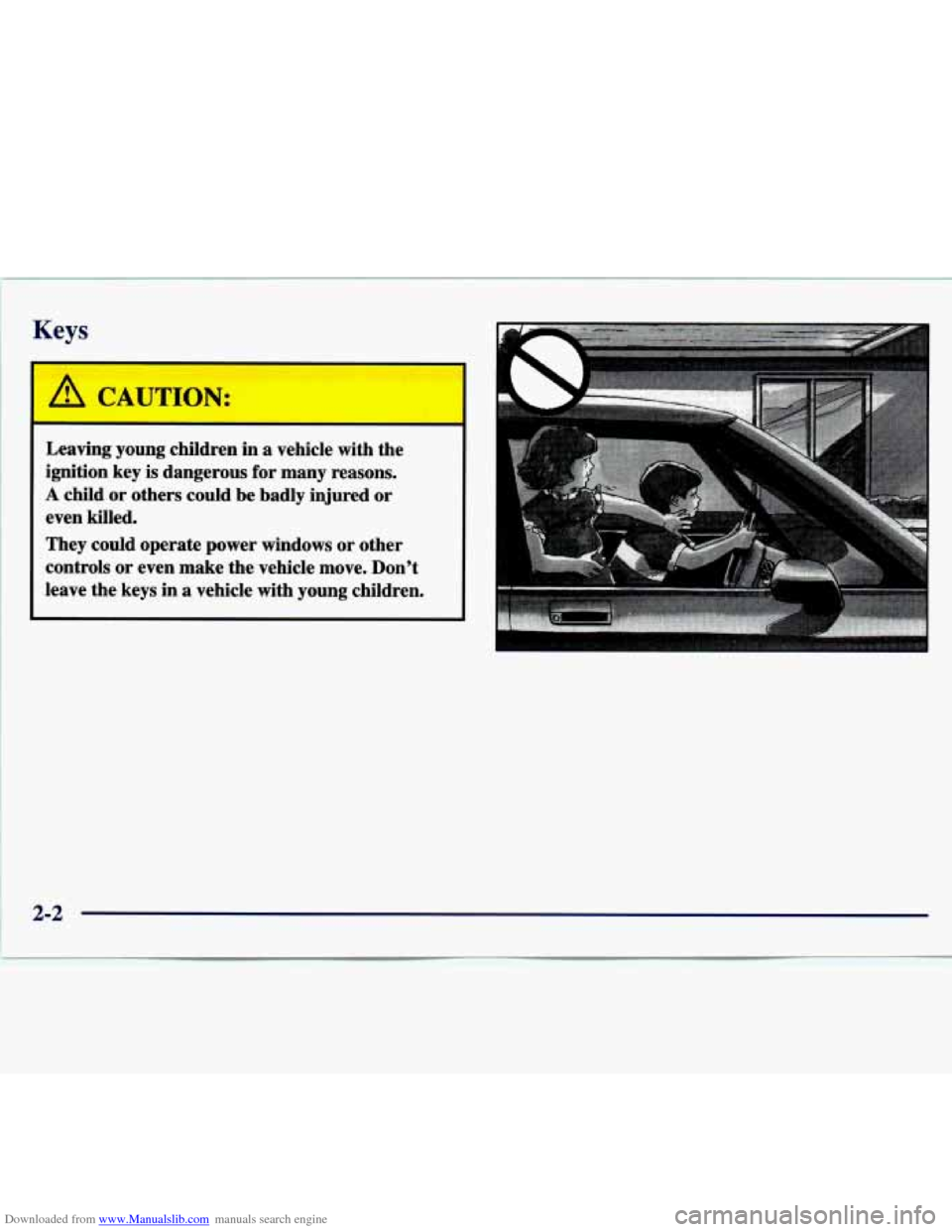
Leaving young children in a vehicle with the
ignition key is dangerous for many reasons.
A child or others could be badly injured or
even killed.
They could operate power windows or other
controls
or even make the vehicle move. Don’t
leave the keys in a vehicle with young children.
2-2
Page 62 of 354
Downloaded from www.Manualslib.com manuals search engine Power Door Locks (If Equipped)
With the power door locks,
you can unlock or lock
all
of the doors of your vehicle
from the driver or front
passenger door lock switch.
Pull up on the switch to unlock all of the doors. Push
down on it to lock
all the doors.
Door Ajar Reminder
If one of the doors of your vehicle is not closed properly,
the ignition is on and you shift from PARK (P) or
NEUTRAL (N), you will hear a chime. Also, the Door
Ajar light on the instrument panel will come on and stay
on until the doors are closed and completely latched.
Rear Door Security Locks
-
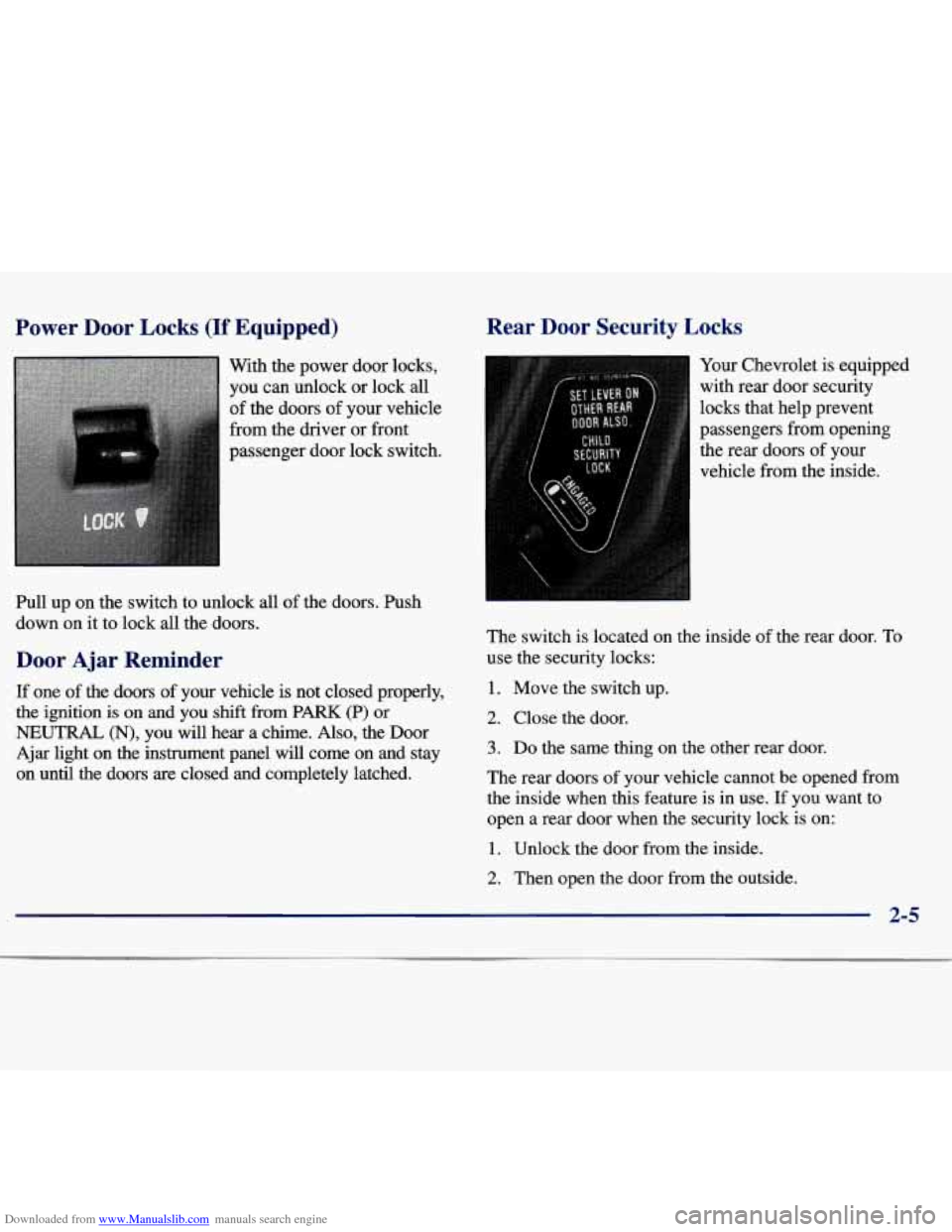
Your Chevrolet is equipped
with rear door security
locks that help prevent
passengers from opening
the rear doors
of your
vehicle from the inside.
The switch is located on the inside of the rear door.
To
use the security locks:
1. Move the switch up.
2. Close the door.
3. Do the same thing on the other rear door.
The rear doors of your vehicle cannot be opened from
the inside when this feature is in use.
If you want to
open
a rear door when the security lock is on:
1. Unlock the door from the inside.
2. Then open the door from the outside.
2-5
Page 71 of 354
Downloaded from www.Manualslib.com manuals search engine ACC (Accessory) (B): This position unlocks the
transaxle.
It also lets you use things like the radio and
windshield wipers when the engine is not running. To
use ACC, push in the key and turn it to the right. Use
this position if
your vehicle must be pushed or towed,
but never
try to push-start your vehicle.
ON (C): This position unlocks the ignition and
transaxle. This position is also where the key returns
after you start your engine and release the switch. The
switch stays in
ON when the engine is running. But even
when the engine is not running, you
can use ON to
operate your electrical power accessories, and to display some instrument panel warning lights.
START (D): This position starts the engine. When the
engine starts, release
the key. The ignition switch will
return to
ON for normal driving.
Starting Your Engine
Move your shift lever to PARK (P) or NEUTRAL (N).
Your engine won’t start in any other position -- that’s a
safety feature. To restart when you’re already moving,
use NEUTRAL (N) only.
I NOTICE:
Don’t try to shift to PARK (P) if your Chevrolet
is moving. If you do, you could damage the
transaxle. Shift to PARK
(P) only when your
vehicle is stopped.
Starting Your 2.4 Liter Engine
1. Without pushing the accelerator pedal, turn your
ignition key to START. When the engine starts, let
go of the key. The idle speed will go down as your
engine gets warm.
I NOTICE:
Holding your key in START for longer than
15 seconds at a time will cause your battery to be
drained much sooner. And the excessive heat can damage your starter motor.
2-14
Page 77 of 354

Downloaded from www.Manualslib.com manuals search engine NEUTRAL (N): In this position, your engine doesn’t
connect with the wheels. To restart when you’re already moving, use
NEUTRAL (N) only. Also, use
NEUTRAL (N) when your vehicle is being towed.
Shifting out of PARK (P) or NEUTRAL (N) while
your engine is “racing” (running at high speed) is
dangerous. Unless your foot is firmly on the
brake pedal, your vehicle could move very
rapidly. You could lose control and hit people or
objects. Don’t shift out of
PARK (P) or
NEUTRAL
(N) while your engine is racing.
~ NOTICE: I I I
Damage to your transaxle caused by shifting out
of
PARK (P) or NEUTRAL (N) with the engine
1 racing isn’t covered by your warranty. DRIVE
(D): This position
is for normal driving. If you
need more power for passing, and you’re:
Going less than 35 mph (56 M), push your
Going about 35 mph (56 M) or more, push the
accelerator all the way down. You’ll shift down to
the next gear and have more power. accelerator pedal about halfway down.
I
NOTICE:
If your
vehicle is seems to start up rather slowly,
or
if it seems not to shift gears as you go faster,
something may be wrong with a transaxle system
sensor.
If you drive very far that way, your
vehicle can be damaged.
So, if this happens, have
your vehicle serviced right away. Until then, you
can use SECOND
(2) when you are driving less
than
35 mph (56 km/h) and DRIVE (D) for
higher speeds.
Page 78 of 354
Downloaded from www.Manualslib.com manuals search engine THIRD (3): This position is also used for normal
driving, however, it offers more power and lower fuel
economy than
DRIVE (D). Here are some times you
might choose THIRD
(3) instead of DRIVE (D):
0 When driving on hilly, winding roads.
When towing a trailer, so there is less shifting
between gears.
When going down a steep hill.
SECOND (2): This position gives you more power but
lower fuel economy.
You can use SECOND (2) on hills.
It can help control your speed as you go down steep
mountain roads, but then you would also want to use
your brakes
off and on.
NOTICE:
Don’t drive in SECOND (2) for more than
25 miles (41 km), or at speeds over 55 mph
(88 km/h), or you can damage your transaxle.
Use
DRIVE (D) or THIRD (3) as much as
possible. Don’t shift into SECOND
(2) unless you
are going slower than
65 mph (105 km/h) or you
can damage your engine.
FIRST (1): This position gives you even more power
(but lower fuel economy) than
SECOND (2). You
can use it on very steep hills, or in deep snow or mud.
If the selector lever
is put in FIRST (l), the transaxle
won’t shift into first gear until the vehicle is going
slowly enough.
NOTICE:
If your front wheels can’t rotate, don’t try to
drive. This might happen if you were stuck in
very deep sand or mud
or were up against a solid
object.
You can damage your transaxle.
Also, if you stop when going uphill, don’t hold
your vehicle there with only the accelerator
pedal. This could overheat and damage the
transaxle. Use your brakes or shift into
PARK (P)
to hold your vehicle in position on a hill.
2-21