1997 CHEVROLET MALIBU coolant temperature
[x] Cancel search: coolant temperaturePage 75 of 354
Downloaded from www.Manualslib.com manuals search engine To Use the Coolant Heater
1. Turn off the engine.
2. Open the hood and unwrap the electrical cord.
3. Plug it into a normal, grounded 1 10-volt AC outlet.
A CAUL :ON:
Plugging the cord into an ungrounded outlet
could cause an electrical shock. Also, the
wrong
kind of extension cord could overheat and cause
a fire. You could be seriously injured. Plug the
cord into a properly grounded three-prong 110-volt
AC outlet. If the cord won’t reach, use a
heavy-duty three-prong extension cord rated for
at least 15 amps.
4. Before starting the engine, be sure to unplug and store
the cord as it was before to keep it away from moving
engine parts.
If you don’t, it could be damaged. How long should you keep the coolant heater plugged
in?
The answer depends on the outside temperature, the
kind of oil you have, and some other things. Instead of
trying to list everything here, we ask that you contact
your Chevrolet dealer in the area where you’ll be
parking your vehicle. The dealer can give you the best
advice for that particular area.
Automatic Transaxle Operation
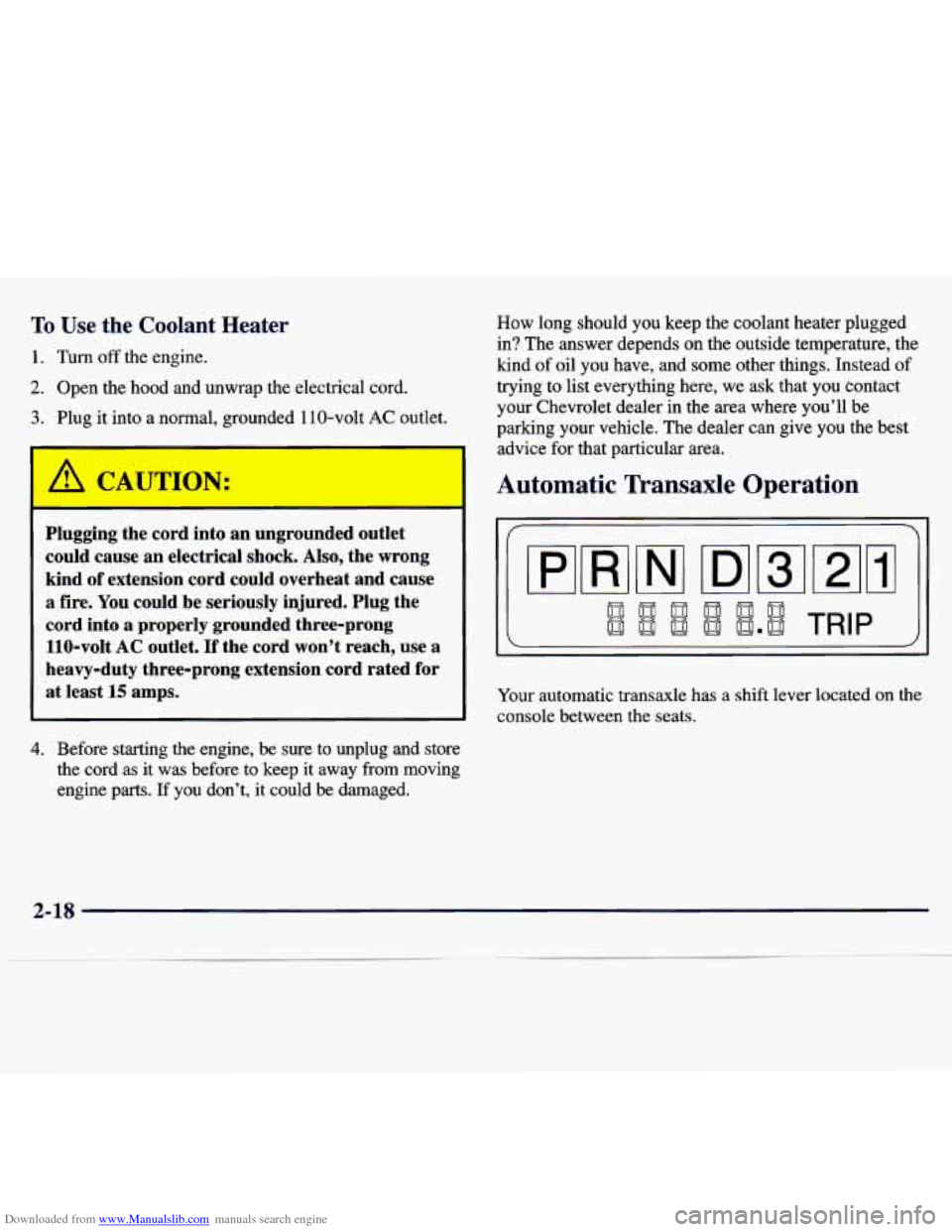
Your automatic transaxle has a shift lever located on the
console between the seats.
2-18
Page 113 of 354
Downloaded from www.Manualslib.com manuals search engine Anti-Lock Brake System Warning Light
With the anti-lock brake system, this light will come
on when you
turn your
ignition on or start your
engine and it will stay on
for three seconds.
That’s normal.
If the light stays on, turn the ignition to OFF. Or, if the
light comes on and
the chime sounds when you’re
driving, stop
as soon as possible and turn the ignition
off. Then start the engine again to reset the system. If
the light still stays on, or comes on again while you’re
driving, your Chevrolet needs service.
If the regular
brake system warning light isn’t on, you still have
brakes, but you don’t have anti-lock brakes. If the
regular brake system warning light is also on, you don’t
have anti-lock brakes and there’s a problem with your
regular brakes. See “Brake System Warning Light”
earlier in this section. The anti-lock brake system warning
light shoula come
on briefly when you
turn the ignition key to ON. If the
light doesn’t come on then, have it fixed
so it will be
ready to warn you
if there is a problem.
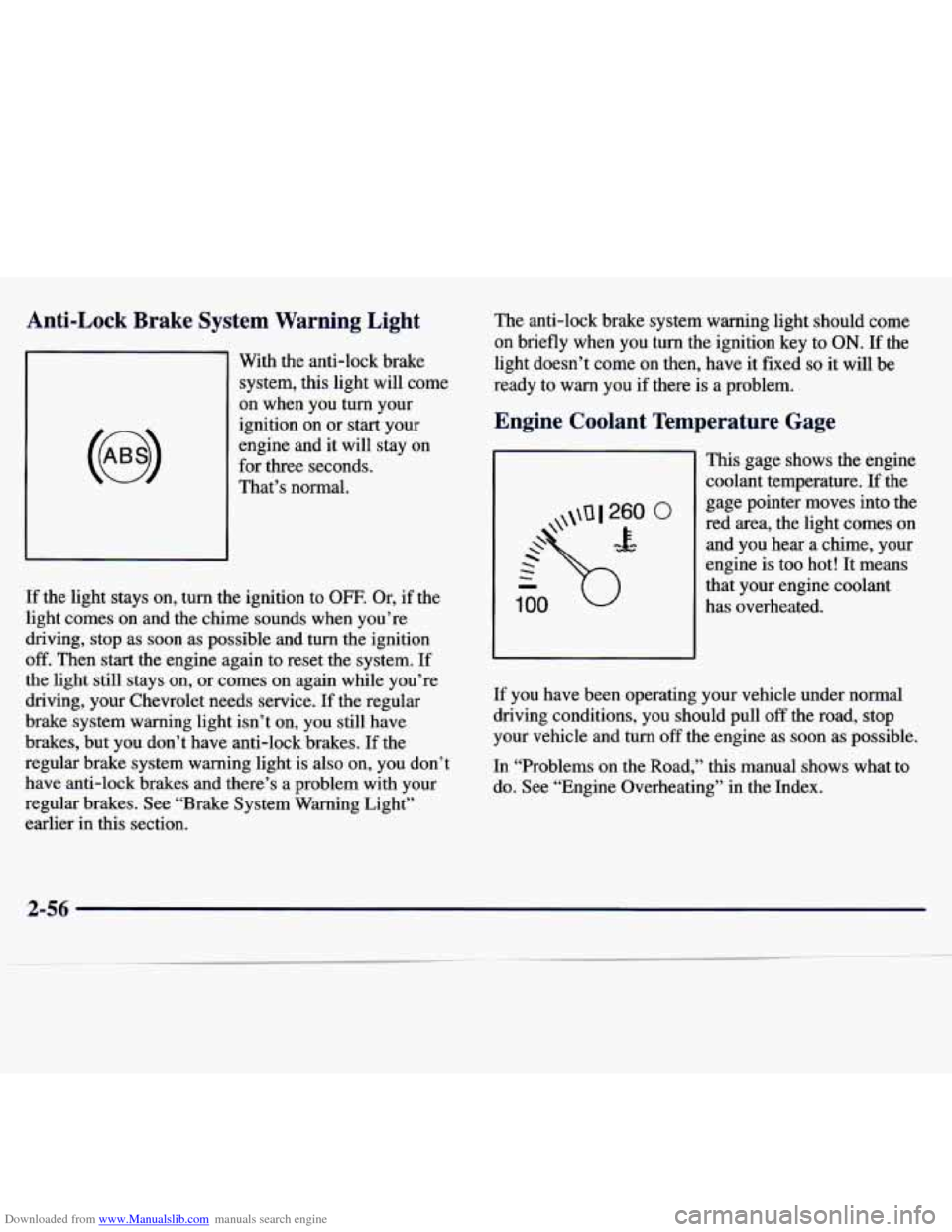
Engine Coolant Temperature Gage
0
This gage shows the engine
coolant temperature.
If the
gage pointer moves into the
red area, the light comes on and you hear
a chime, your
engine is too hot! It means
that your engine coolant
has overheated.
If you have been operating your vehicle under normal
driving conditions, you should pull
off the road, stop
your vehicle and turn
off the engine as soon as possible.
In “Problems on the Road,” this manual shows what to
do. See “Engine Overheating” in the Index.
2-56
Page 125 of 354
Downloaded from www.Manualslib.com manuals search engine Air Conditioning Heating
On cold
days, use FLOOR with the temperature knob
all the way in the red area. The system will bring in
outside air, heat it and send it to the floor ducts.
The
air conditioner and heater work best if you keep
your windows closed while using them. Your vehicle also has the flow-through ventilation system described
later in this section.
On very hot days, open the windows long enough to
let hot inside air escape. This reduces the time it takes
for your vehicle to cool down, which should help
fuel economy.
On cool, but sunny days, the sun may warm your upper
body, but your lower body may not be
warm enough.
You can use
BI-LEVEL with the temperature knob in
the middle and the A/C button pushed in. The system
will bring in outside air and direct slightly warmer air
to your lower body.
For quick cool-down on very hot days, use
VENT with
the temperature knob all the way in the blue area and the
A/C and RECIRCULATION buttons pressed. If this
setting is used for long periods of time, the air in your
vehicle may become too dry.
For normal cooling on hot days, use
VENT with the
temperature knob in the blue area and the
NC button
pushed
in. The system will bring in outside air and cool it.
Your vehicle has heat ducts that are directed toward the
rear seat. Keep the area under the front seats clear
of
obstructions so the heated air can reach the rear seat
passengers.
If your vehicle has an engine coolant heater, you can use it to help your system provide warm air faster when it’s
cold outside
(0°F (-18°C) or lower). An engine coolant
heater warms the coolant your engine and heating system use to provide heat. See “Engine Coolant
Heater” in the Index.
Defogging and Defrosting Windows
Your system has two settings for clearing the front and
side windows. For each setting, adjust the temperature
control as desired.
To defrost the windows quickly, rotate the temperature control knob
all the way in the red area. Use DEFROST
and adjust the fan to the highest speed. To warm
passengers while keeping the windows clean, use DEFOG.
3-4
Page 186 of 354
Downloaded from www.Manualslib.com manuals search engine Driving On Grades
NOTICE:
Do not tow on steep continuous grades exceeding
6 miles (9.6 km). Extended, higher than normal
engine and transaxle temperatures may result
and damage your vehicle. Frequent stops are
very important to allow the engine and transaxle
to cool.
Reduce speed and shift to a lower gear before you start
down a long or steep downgrade. If you don’t shift
down, you might have to use your brakes
so much that
they would get hot and no longer work well.
On a long uphill grade, shift down and reduce your
speed to around
45 mph (70 kmh) to reduce the
possibility of engine and transaxle overheating.
Parking on Hills
You really should not park your vehicle, with a trailer
attached, on a hill.
If something goes wrong, your rig
could start to move. People can be injured, and both
your vehicle and the trailer can be damaged.
But if you ever have to park your rig
on a hill, here’s
how to do it:
1. Apply your regular brakes, but don’t shift into
2. Have someone place chocks under the trailer wheels.
3. When the wheel chocks are in place, release the
regular brakes until the chocks absorb the load.
brake and shift into PARK
(P).
PARK (P) yet.
4. Reapply the regular brakes. Then apply your parking
5. Release the regular brakes.
Pay attention to the engine coolant gage. If the indicator
is in the red area, turn off the air conditioning (if you
have this option) to reduce engine load (see “Engine
Overheating” in the Index).
4-39
Page 199 of 354
Downloaded from www.Manualslib.com manuals search engine Engine Overheating I1
You will find a coolant temperature gage on your
Chevrolet’s instrument panel. See “Engine Coolant
Temperature Gage’’
in the Index. You will also find a
low coolant level warning light on your Chevrolet’s
instrument panel. See
“LOW Coolant Warning Light” in
the Index.
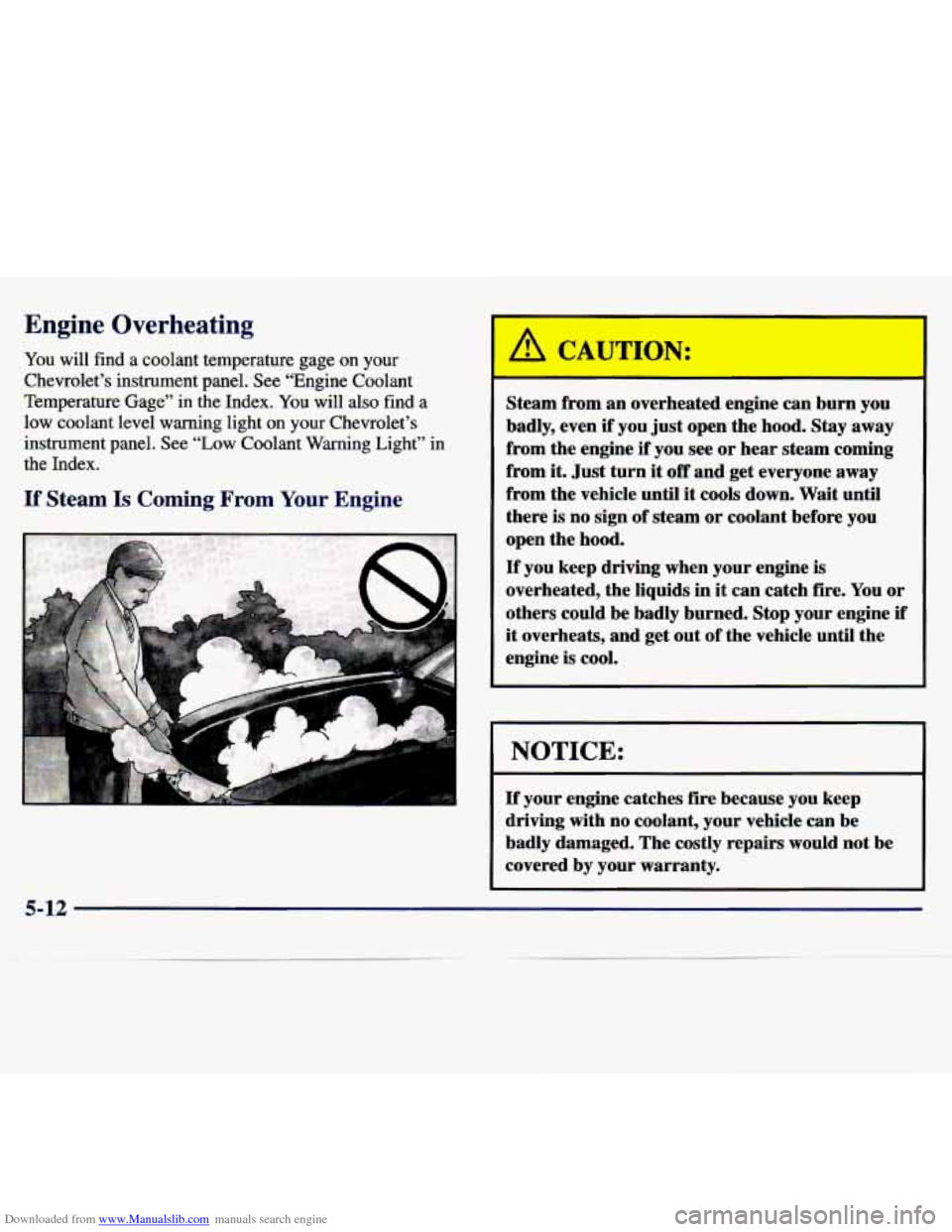
If Steam Is Coming From ’ hgine
I I
Steam from an overheated engine can burn you
badly, even if you just open the hood. Stay away
from the engine if you see or hear steam coming
from it. Just turn it
off and get everyone away
from the vehicle until it cools down. Wait until
there is no sign
of steam or coolant before you
open the hood.
If you keep driving when your engine is
overheated, the liquids in it can catch fire. You
or
others could be badly burned. Stop your engine if
it overheats, and get out of the vehicle until the
engine is cool.
1 NOTICE: I
If your engine catches fire because you keep
driving
with no coolant, your vehicle can be
badly damaged. The costly repairs would not be
covered by your warranty.
Page 240 of 354
Downloaded from www.Manualslib.com manuals search engine A 50/50 mixture of water and the proper coolant for
your Chevrolet will:
Give freezing protection down to -34°F (-37°C).
Give boiling protection up to 265 OF (129 O C).
Protect against rust and corrosion.
Help keep the proper engine temperature.
Let the warning lights and gages work as they should.
NOTICE:
When adding coolant, it is important that you use
only
DEX-COOL TM (silicate-free) coolant.
If silicated coolant is added to the system,
premature engine, heater core or radiator
corrosion may result. In addition, the engine
coolant will require change sooner
-- at
30,000 miles (50 000 km) or 24 months,
whichever occurs first.
What to Use
Use a mixture of one-half clean water (preferably
distilled) and one-half
DEX-COOL TM coolant which
won’t damage aluminum parts.
If you use this mixture,
you don’t need to add anything else.
Adding only plain water to your cooling system
can be dangerous. Plain water, or some other
liquid like alcohol, can boil before the proper
coolant mix will. Your vehicle’s coolant warning
system is set for the proper coolant mix. With
plain water or the wrong mix, your engine could
get too hot but you wouldn’t get the overheat
warning. Your engine could catch fire and
you or
others could be burned. Use a
50/50 mix of clean
water and
DEX-COOL TM coolant.
6-19
Page 243 of 354
Downloaded from www.Manualslib.com manuals search engine Surge Tank Pressure Cap
NOTICE:
Your pressure cap is an 15 psi (105 kPa)
pressure-type cap and must be tightly installed to
prevent coolant
loss and possible engine damage
from overheating.
When you replace your surge tank pressure cap, a GM
cap is recommended.
Thermostat Power Steering Fluid
Engine coolant temperature
is controlled by a thermostat
in the engine coolant system. The thermostat stops the
flow of coolant through the radiator until the coolant
reaches a preset temperature.
When
you replace your thermostat, an AC@ thermostat
is recommended.
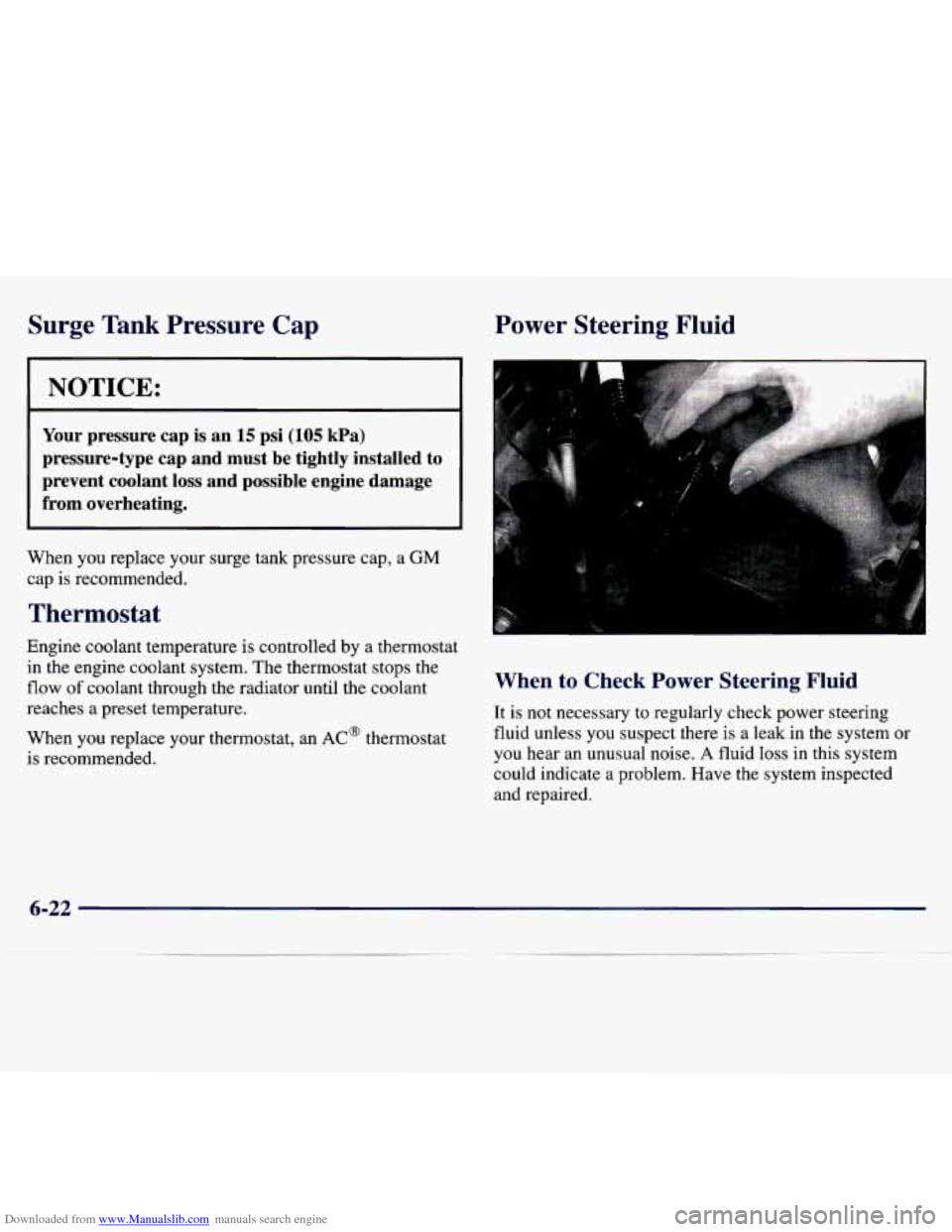
When to Check Power Steering Fluid
It is not necessary to regularly check power steering
fluid unless you suspect there is a leak in the system or
you hear an unusual noise.
A fluid loss in this system
could indicate a problem. Have the system inspected
and repaired.
6-22
Page 345 of 354
Downloaded from www.Manualslib.com manuals search engine Electrical Equipment. Adding ..... 2.15.2.16.3.22. 6.64
Electrical System
............................... 6-54
Engine
.................................. 6.10. 6.11
Coolant
..................................... 6-18
Coolant Heater
............................... 2-17
Coolant Levelcheck
.......................... 7-37
Coolant Temperature Gage
..................... 2-56
Exhaust
...................... 2.10.2.26.4.27. 4.36
FuseBlock
.................................. 6-58
Identification
................................ 6-53
Oil Level Check
.............................. 7-37
Overheating
................................. 5-12
Running While Parked
......................... 2-26
Specifications
................................ 6-62
Starting Your
........................... 2- 14. 2. 16
EngineOil .................................... 6-12
Adding
..................................... 6-13
Additives
................................... 6-16
Checking ................................... 6-13
Pressure Warning Light
........................ 2-60
Used
....................................... 6-17
What Kind to Use
............................. 6- 15
Ethanol ........................................ 6-4
Exterior Lamps
................................. 2-36
Whentochange
.............................. 6-16
Fabric Cleaning ............................... 6-45
FillingYourTank
................................ 6-5
Filter. Air
..................................... 6-17
Finishcare
.................................... 6-49 Finish Damage
................................. 6-51
First Gear. Automatic Transaxle
................... 2-21
Flashers. Hazard Warning
......................... 5-2
Flash-to-Pass .................................. 2-30
Flat Tire. Changing
............................. 5-20
Fluids and Lubricants
............................ 7-42
FogLmps
.................................... 2-38
Following Distance with a Trailer
.................. 4-37
Foreign Countries. Fuel
........................... 6-5
FrenchLanguageManual
11
FrontTowing .................................. 5-10
Fuel .......................................... 6-3
Filling Your Tank
.............................. 6-5
Gage
....................................... 2-64
In Foreign Countries
........................... 6-5
Fuses and Circuit Breakers
....................... 6-55
.. ...........................
Gages Engine Coolant Temperature
.................... 2-56
Fuel
....................................... 2-64
Tachometer
.................................. 2-52
Garment
Hook ................................. 2-46
GAWR
....................................... 4-31
Gear Positions. Automatic Transaxle
................ 2-19
GloveBox
.................................... 2-42
Gross Axle Weight Rating
........................ 4-31
Gross Vehicle Weight Rating ...................... 4-31
Guide en Frangais
11
GVWR ....................................... 4-31
.. .................................
9-4