1997 CHEVROLET MALIBU service
[x] Cancel search: servicePage 239 of 354
Downloaded from www.Manualslib.com manuals search engine Refer to the Maintenance Schedule to determine when to
replace the air filter. See “Scheduled Maintenance Services” in the Index.
Operating the engine with the air cleaner off can
cause you or others to be burned. The air cleaner
not only cleans the air,
it stops flame if the engine
backfires.
If it isn’t there, and the engine
backfires, you could be burned. Don’t drive with
it
off, and be careful working on the engine with
the
air cleaner off.
NOTICE:
If the air cleaner is off, a backfire can cause a
damaging engine fire. And, dirt can easily get
into your engine, which will damage it. Always
have the air cleaner in place when you’re driving.
Automatic Transaxle Fluid
It is not necessary to check the transaxle fluid level.
A transaxle fluid leak is the only reason for fluid loss.
If a leak occurs, take the vehicle to your Chevrolet
dealership Service Department and have it repaired as
soon as possible. You may
also have your fluid level
checked by your dealer or service center when you have
your oil changed.
Engine Coolant
The cooling system in your vehicle is filled with new
DEX-COOL” engine coolant. This coolant is designed
to remain in your vehicle for
5 years or 150,000 miles
(240 000 km), whichever occurs fist, if you add only
DEX-COOL TM extended life coolant.
The following explains your cooling system
and how to
add coolant when it is low.
If you have a problem with
engine overheating, see “Engine Overheating” in
the Index.
Page 248 of 354
Downloaded from www.Manualslib.com manuals search engine Brake Wear
Your Chevrolet has front disc brakes and rear drum brakes.
Disc brake pads have built-in wear indicators that make a
high-pitched warning sound when the brake pads are worn and new pads
are needed. The sound may come and go or
be heard
all the time your vehicle is moving (except when
you
are pushing on the brake pedal firmly).
A CAUTION:
The brake wear warning sound means that soon
your brakes won’t work well. That could lead to
an accident. When you hear the brake wear
warning sound, have your vehicle serviced.
NOTICE:
Continuing to drive with worn-out brake pads
could result
in costly brake repair.
Some driving conditions or climates may cause a brake
squeal when the brakes are first applied or lightly
applied.
This does not mean something is wrong with
your brakes.
Properly torqued wheel nuts are necessary to help
prevent brake pulsation. When tires are rotated, inspect
brake pads for wear and evenly torque wheel nuts in the
proper sequence to GM specifications.
Your rear drum brakes don’t have wear indicators, but
if
you ever hear a rear brake rubbing noise, have the rear
brake linings inspected.
Also, the rear brake drums
should be removed and inspected each time the tires are
removed for rotation or changing. When you have the
front brake pads replaced, have the rear brakes
inspected, too.
Brake linings should always be replaced as complete
axle sets.
See “Brake System Inspection” in Section 7 of this manual
under
Part C “Periodic Maintenance Inspections.”
6-27
Page 250 of 354
Downloaded from www.Manualslib.com manuals search engine Vehicle Storage
If you’re not going to drive your vehicle for 25 days or
more, take
off the black, negative (-) cable from
the battery. This will help keep your battery from
running down.
I
I ,. CAUTION:
Bulb Replacement
This section describes bulb changing procedures for some of your interior and exterior lamps. For bulb sizes,
see “Replacement Bulbs” in the Index. For any bulbs not
listed in this section, contact your Chevrolet dealer service department.
Batteries have acid that can burn you and gas
that can explode. You can be badly hurt if you
aren’t careful, See “Jump Starting” in the Index
for tips on working around
a battery without
getting hurt.
Contact your dealer to learn how to prepare your vehicle
for longer storage periods.
Also, for your audio system, see “Theft-Deterrent
Feature” in the Index.
Halogen Bulbs
I A CAUTIOL
t- I
Halogen bulbs have pressurized gas inside and
can burst
if you drop or scratch the bulb. You or
others could be injured. Be sure
to read and
follow the instructions on the bulb package,
6-29
Page 256 of 354
Downloaded from www.Manualslib.com manuals search engine Windshield Wiper Blade Replacement
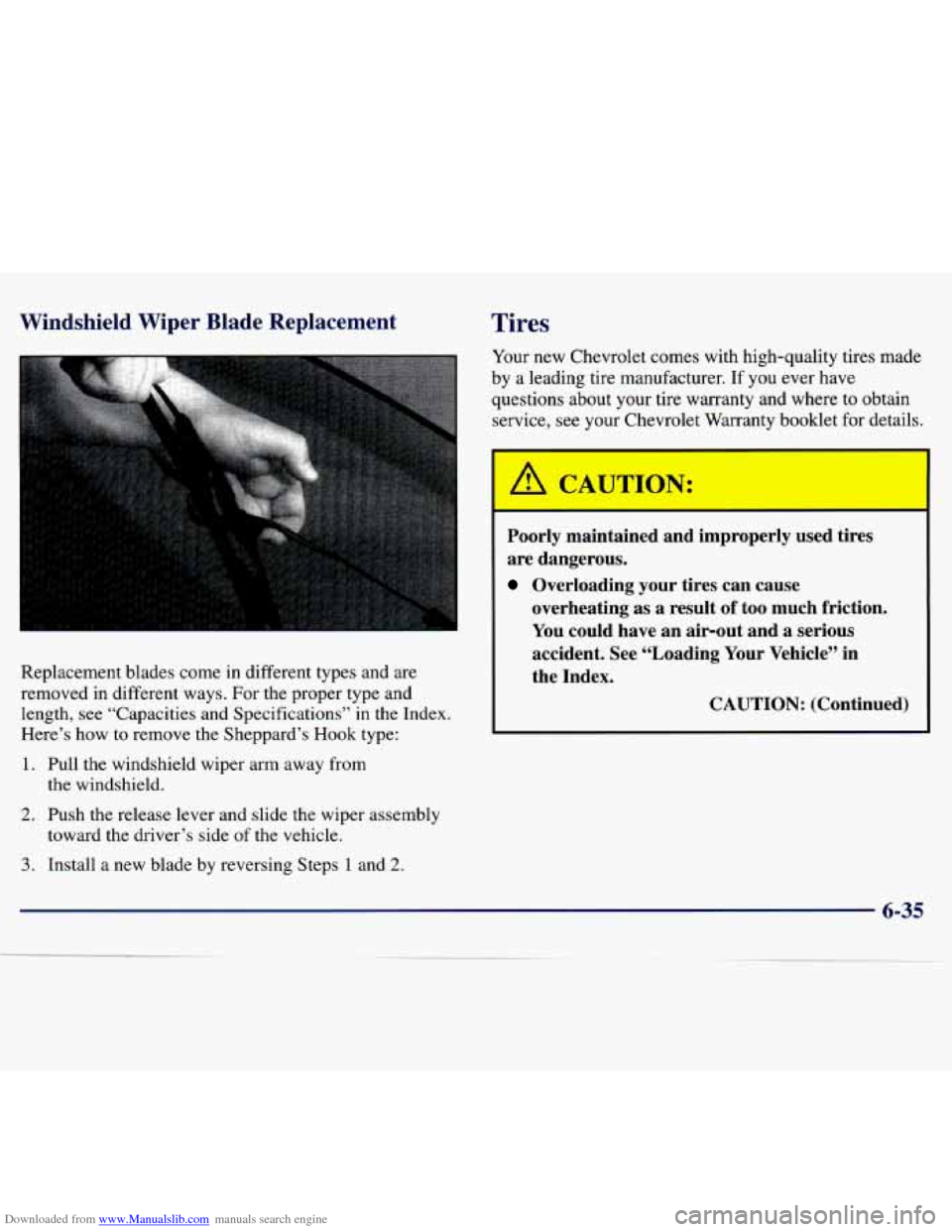
Replacement blades come in different types and are
removed in different ways. For the proper type and length, see “Capacities and Specifications’’
in the Index.
Here’s how to remove the Sheppard’s
Hook type:
1. Pull the windshield wiper arm away from
the windshield.
2. Push the release lever and slide the wiper assembly
toward the driver’s side of the vehicle.
3. Install a new blade by reversing Steps 1 and 2.
Tires
Your new Chevrolet comes with high-quality tires made
by a leading tire manufacturer. If
you ever have
questions about your tire warranty and where to obtain
service, see your Chevrolet Warranty booklet for details.
‘ ”AUTION: d
Poorly maintained and improperly used tires
are dangerous.
Overloading your tires can cause
overheating as a result
of too much friction.
You could have an air-out and a serious
accident. See “Loading Your Vehicle” in
the Index.
CAUTION: (Continued)
6-35
Page 258 of 354
Downloaded from www.Manualslib.com manuals search engine When to Check
Check your tires once a month or more.
Don’t forget your compact spare tire. It should be
at
60 psi (420 Ea).
How to Check
Use a good quality pocket-type gage to check tire
pressure.
You can’t tell if your tires are properly inflated
simply by looking at them. Radial tires may look
properly inflated even when they’re underinflated.
Be sure to put the valve caps back on the valve
stems. They help prevent leaks by keeping out
dirt and moisture.
Tire Inspection and Rotation
Tires should be rotated every 6,000 to 8,000 miles
(10 0oO to 13 0o0 km). Any time you notice unusual wear,
rotate
your tires as soon as possible and check wheel
alignment.
Also check for damaged tires or wheels. See
“When It’s Time for New Tires” and “Wheel
Replacement” later
in this section for more information.
The purpose
of regular rotation is to achieve more
uniform wear
for all tires on the vehicle. The first
rotation is the most important. See “Scheduled
Maintenance Services” in the Index for scheduled
rotation intervals.
6-37
Page 260 of 354
Downloaded from www.Manualslib.com manuals search engine When It’s Time for New Tires
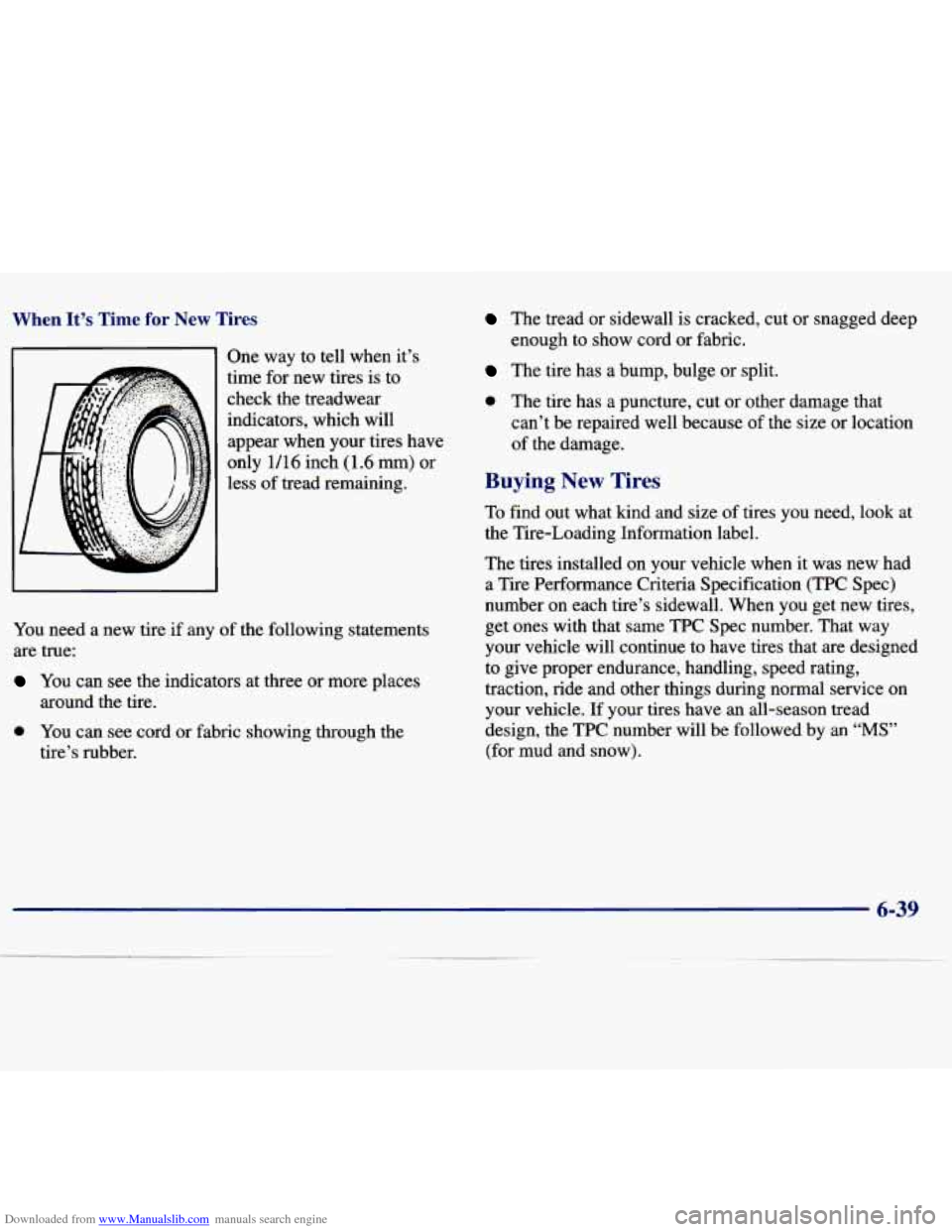
One way to tell when it’s
time for new tires is to
check the treadwear
indicators, which will appear when your tires have
only
1/16 inch (1.6 mm) or
less of tread remaining.
You need a new tire if any of the following statements
are true:
You can see the indicators at three or more places
around the tire.
0 You can see cord or fabric showing through the
tire’s rubber.
The tread or sidewall is cracked, cut or snagged deep
enough to show cord or fabric.
The tire has a bump, bulge or split.
0 The tire has a puncture, cut or other damage that
can’t be repaired well because
of the size or location
of the damage.
Buying New Tires
To find out what kind and size of tires you need, look at
the Tire-Loading Information label.
The tires installed on your vehicle when it was new had
a Tire Performance Criteria Specification (TPC Spec)
number on each tire’s sidewall. When you get new tires, get ones with that same
TPC Spec number. That way
your vehicle will continue to have tires that are designed
to give proper endurance, handling, speed rating,
traction, ride and other things during normal service on
your vehicle.
If your tires have an all-season tread
design, the
TPC number will be followed by an “MS”
(for mud and snow).
6-39
Page 262 of 354
Downloaded from www.Manualslib.com manuals search engine Treadwear
The treadwear grade is a comparative rating based on
the wear rate of the tire when tested under controlled
conditions
on a specified government test course. For
example, a tire graded
150 would wear one and a half
(1 1/2) times as well on the government course as a tire
graded
100. The relative performance of tires depends
upon the actual conditions of their use, however, and
may depart significantly from the norm due to variations
in driving habits, service practices and differences in
road characteristics and climate.
Temperature -- A, B, C
The temperature grades are A (the highest), B, and C,
representing the tire’s resistance to the generation of
heat and its ability to dissipate heat when tested under
controlled conditions on a specified indoor laboratory
test wheel. Sustained high temperature can cause the
material of the tire to degenerate and reduce tire life, and
excessive temperature can lead to sudden tire failure.
The grade
C corresponds to a level of performance
which all passenger car tires must meet under the
Federal Motor Vehicle Safety Standard
No. 109. Grades
B and A represent higher levels of performance on the
laboratory test wheel than the minimum required
by law.
Warning: The temperature grade for this tire is
established for a tire that is properly inflated and not
overloaded. Excessive speed, underinflation, or
excessive loading, either separately or in combination,
can cause heat buildup and possible tire failure. Traction -- A, B, C
The traction grades, from highest to lowest, are A, B, and
C, and they represent the tire’s ability to stop on wet
pavement
as measured under controlled conditions on
specified government test surfaces
of asphalt and concrete.
A tire marked C may have poor traction performance.
Warning: The traction grade assigned to this tire is based
on braking (straight ahead) traction tests and does not
include cornering (turning) traction.
6-41
Page 272 of 354
Downloaded from www.Manualslib.com manuals search engine Finish Damage
Any stone chips, fractures or deep scratches in the finish
should be repaired right away. Bare metal will corrode
quickly and may develop into a major repair expense.
Minor chips and scratches can be repaired with touch-up materials available from your dealer or other service
outlets. Larger areas of finish damage can be corrected
in your dealer’s body and paint shop.
t .erbody Maintenance
Chemicals used for ice and snow removal and dust control
can collect
on the underbody. If these are not removed,
accelerated corrosion (rust) can occur on the underbody
parts such as he1 lines, frame, floor pan and exhaust
system even though they have corrosion protection.
At least every spring, flush these materials from the
underbody with plain water. Clean any areas where mud and other debris can collect. Dirt packed in closed areas
of the frame should be loosened before being flushed.
Your dealer or an underbody car washing system can do
this for you.
Chemical Paint Spotting
Some weather and atmospheric conditions can create a
chemical fallout. Airborne pollutants can fall upon and
attack painted surfaces on your vehicle. This damage
can take two forms: blotchy, ringlet-shaped
discolorations, and small irregular dark spots etched into
the paint surface.
Although no defect in the paint job causes this,
Chevrolet will repair, at no charge to the owner, the surfaces of new vehicles damaged by this fallout
condition within 12 months or 12,000 miles (20
000 km)
of purchase, whichever occurs first.
6-51