1997 CHEVROLET MALIBU light
[x] Cancel search: lightPage 63 of 354
Downloaded from www.Manualslib.com manuals search engine If you don’t cancel the security lock feature, adults or
older children who ride in the rear won’t be able to open
the rear door from the inside. You should let adults and
older children know how these security locks work, and how to cancel the locks.
To cancel the rear door lock:
1. Unlock the door from the inside and open it from
the outside.
2. Move the switch down.
3. Do the same for the other rear door.
The rear doors will now work normally.
Leaving Your Vehicle
Keyless Entry System (If Equipped)
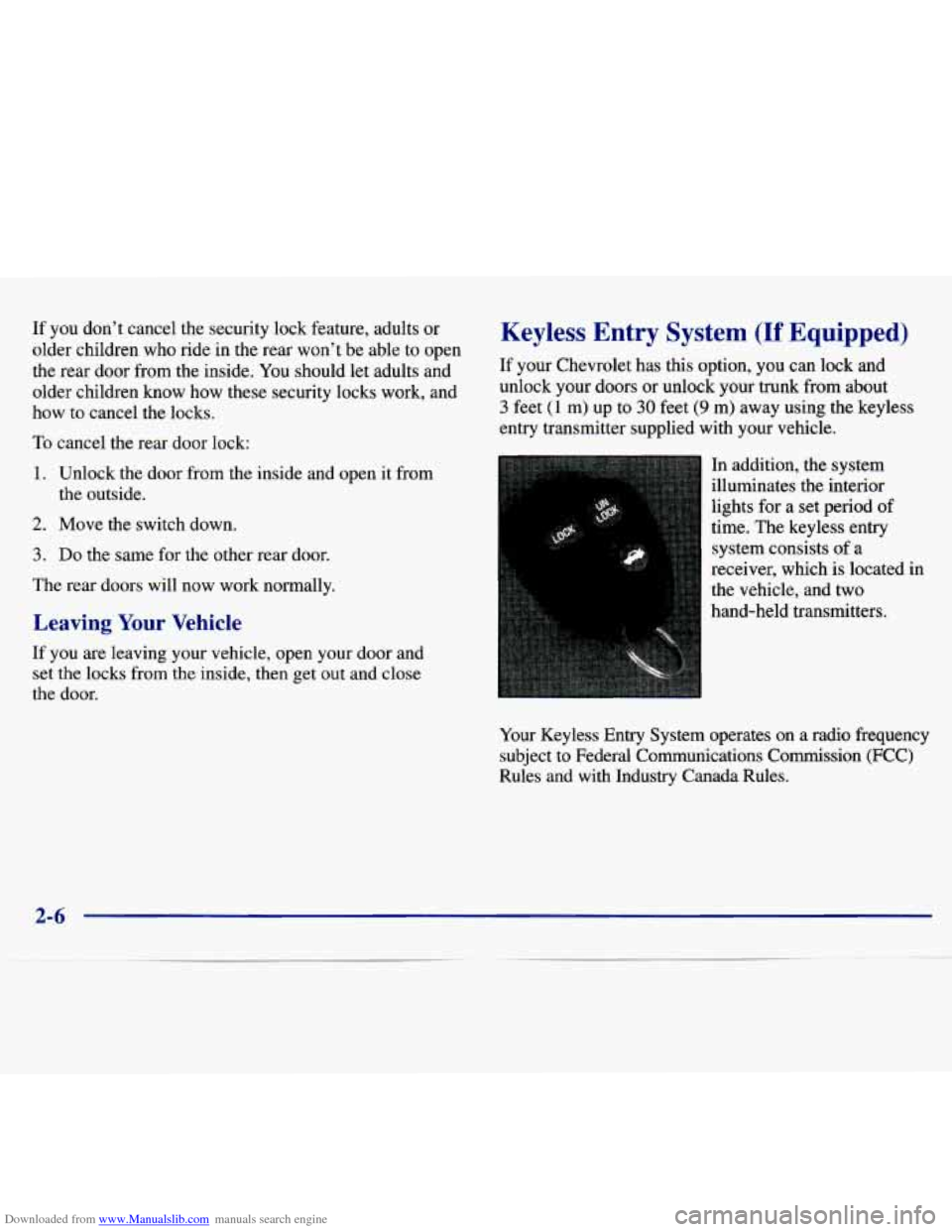
If your Chevrolet has this option, you can lock and unlock your doors or unlock your trunk from about
3 feet (1 m) up to 30 feet (9 m) away using the keyless
entry transmitter supplied with your vehicle.
In addition, the system
illuminates the interior
lights for a set period of
time. The keyless entry
system consists of a
receiver, which is located in
the vehicle, and two
hand-held transmitters.
If you are leaving your vehicle, open your door and
set the locks
from the inside, then get out and close
the door.
Your Keyless Entry System operates on a radio frequency
subject to Federal Communications Commission (FCC)
Rules and
with Industry Canada Rules.
2-6
Page 69 of 354
Downloaded from www.Manualslib.com manuals search engine Parking at Night Passlock TM
Park in a lighted spot, close all windows and lock your
vehicle. Remember to keep your valuables out of sight.
Put them
in a storage area, or take them with you.
Parking Lots
If you park in a lot where someone will be watching
your vehicle, it’s best to lock it up and take your keys. \
But what if you have to leave your key? What if you
have to leave something valuable in your vehicle?
Put your valuables in a storage area, like your trunk
or glove box.
Lock the glove box.
0 Lock all the doors except the driver’s. Your
vehicle is equipped with the Passlock
theft-deterrent system.
Passlock is a passive theft-deterrent system. The system
is armed once the key is removed from the ignition.
Passlock enables fuel
if the ignition lock cylinder is
turned with a valid key. If a correct key is not used,
fuel is disabled.
During normal operation, the THEFT SYSTEM light
will go
off after the engine is started. If the THEFT
SYSTEM light flashes, wait until the light stops flashing
before starting the engine.
If the
THEFT SYSTEM light comes on while the engine
is running, a problem has been detected and the system
may need service. See your dealer for service.
In an emergency, call the Chevrolet Roadside Assistance
Program at 1-800-CHEV-USA
(1-800-243-8872).
2-12
Page 71 of 354
Downloaded from www.Manualslib.com manuals search engine ACC (Accessory) (B): This position unlocks the
transaxle.
It also lets you use things like the radio and
windshield wipers when the engine is not running. To
use ACC, push in the key and turn it to the right. Use
this position if
your vehicle must be pushed or towed,
but never
try to push-start your vehicle.
ON (C): This position unlocks the ignition and
transaxle. This position is also where the key returns
after you start your engine and release the switch. The
switch stays in
ON when the engine is running. But even
when the engine is not running, you
can use ON to
operate your electrical power accessories, and to display some instrument panel warning lights.
START (D): This position starts the engine. When the
engine starts, release
the key. The ignition switch will
return to
ON for normal driving.
Starting Your Engine
Move your shift lever to PARK (P) or NEUTRAL (N).
Your engine won’t start in any other position -- that’s a
safety feature. To restart when you’re already moving,
use NEUTRAL (N) only.
I NOTICE:
Don’t try to shift to PARK (P) if your Chevrolet
is moving. If you do, you could damage the
transaxle. Shift to PARK
(P) only when your
vehicle is stopped.
Starting Your 2.4 Liter Engine
1. Without pushing the accelerator pedal, turn your
ignition key to START. When the engine starts, let
go of the key. The idle speed will go down as your
engine gets warm.
I NOTICE:
Holding your key in START for longer than
15 seconds at a time will cause your battery to be
drained much sooner. And the excessive heat can damage your starter motor.
2-14
Page 79 of 354
Downloaded from www.Manualslib.com manuals search engine Second-Gear Start
Your vehicle is equipped with a second-gear start
feature. Place the shift lever
in SECOND (2) gear to
provide more traction when you are starting on ice or
other slippery surfaces. The transaxle will be in
SECOND (2) gear when the vehicle begins to move.
After starting in SECOND
(2) gear, place the shift lever
in THIRD (3) or DRIVE (D).
This feature is only for improved traction only when me
road surface is slippery and is not intended for
continuous use or when the vehicle is stuck in sana,
mud, ice, snow or gravel.
Parking Brake
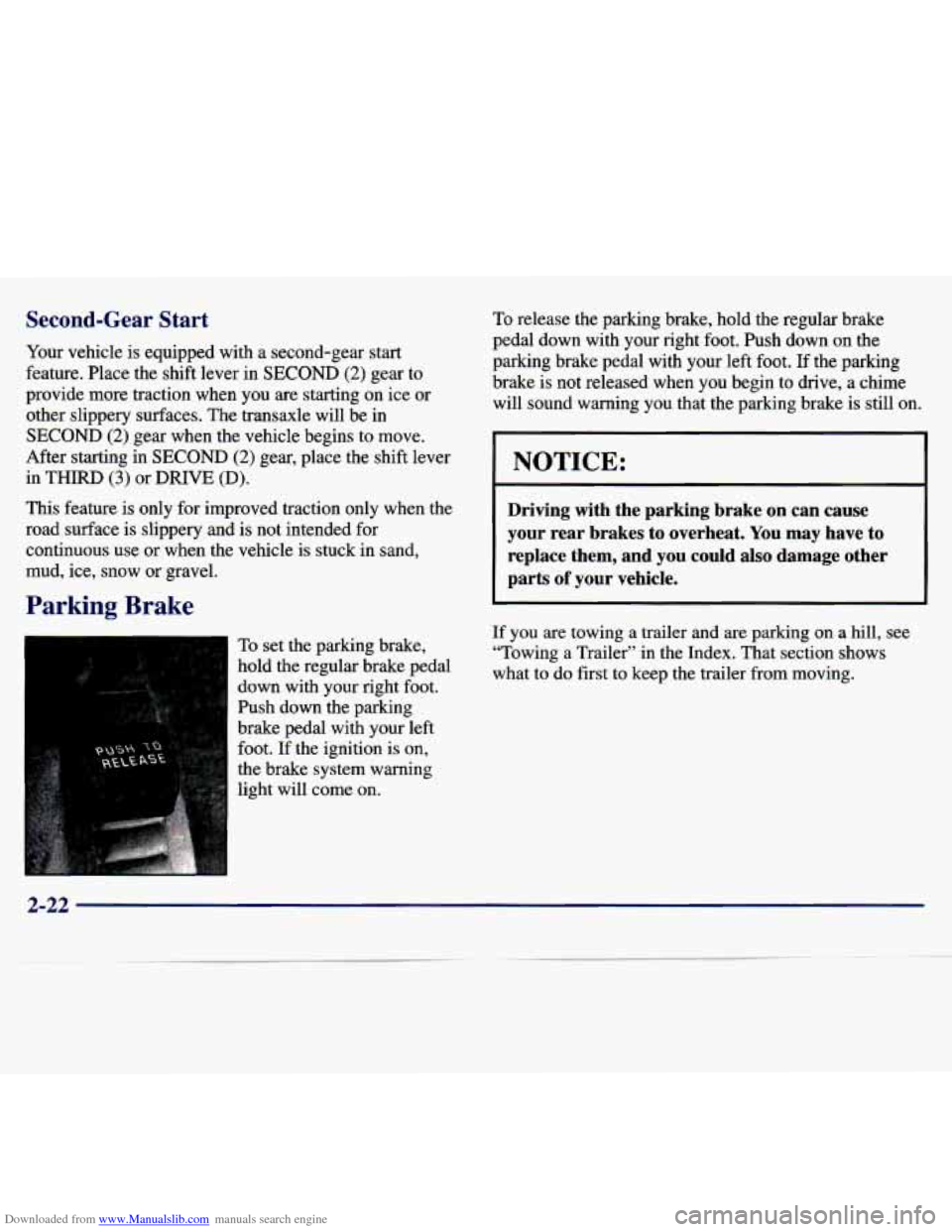
To release the parking brake, hold the regular brake
pedal down with your right foot. Push down on the
parking brake pedal with your left foot. If
the parking
brake is not released when you begin to drive, a chime
will sound warning you that the parking brake is still on
NOTICE:
To set the parking brake,
hold the regular brake pedal down with your right foot.
Push down the parking
brake pedal with your left
foot. If the ignition is on,
the brake system warning
light will come on.
~
Driving with the parking brake on can cause
your rear brakes to overheat. You may have to
replace them, and
you could also damage other
parts
of your vehicle.
If you are towing a trailer and are parking on a hill, see
“Towing a Trailer” in the Index. That section shows
what to do first to keep the trailer from moving.
2-22
Page 87 of 354
Downloaded from www.Manualslib.com manuals search engine A warning chime signal will come on if you have left
your turn signal on
for more than 3/4 mile (1 km).
As you signal a turn or a lane change, if the arrows flash
rapidly, a signal bulb may be burned out and other drivers won’t see your turn signal.
If a bulb is burned out, replace it to help avoid an
accident. If the arrows don’t go on at all when you
signal a turn, check for burned-out bulbs and then check
the fuse (see “Fuses and Circuit Breakers” in the Index).
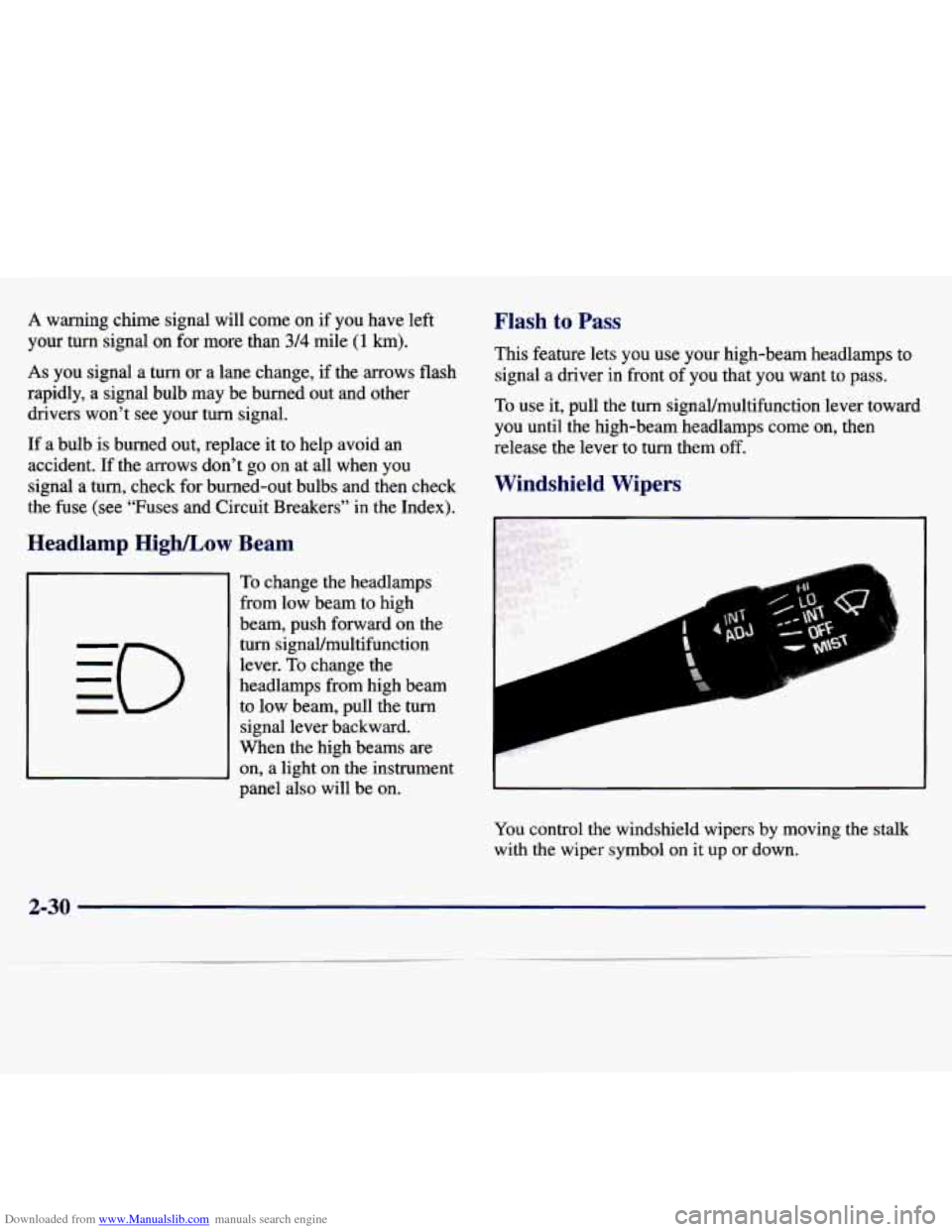
Headlamp High/Low Beam
To change the headlamps
from low beam to high
beam, push forward on the
turn signal/multifunction
lever.
To change the
headlamps from high beam
to low beam, pull the turn
signal lever backward.
When the high beams are
on, a light on the instrument
panel also will be on.
Flash to Pass
This feature lets you use your high-beam headlamps to
signal a driver in front of you that you want to pass.
To use it, pull the turn signal/multifunction lever toward
you until the high-beam headlamps come
on, then
release the lever to
turn them off.
Windshield Wipers
You control the windshield wipers by moving the stalk
with the wiper symbol on it up or down.
2-30
Page 88 of 354
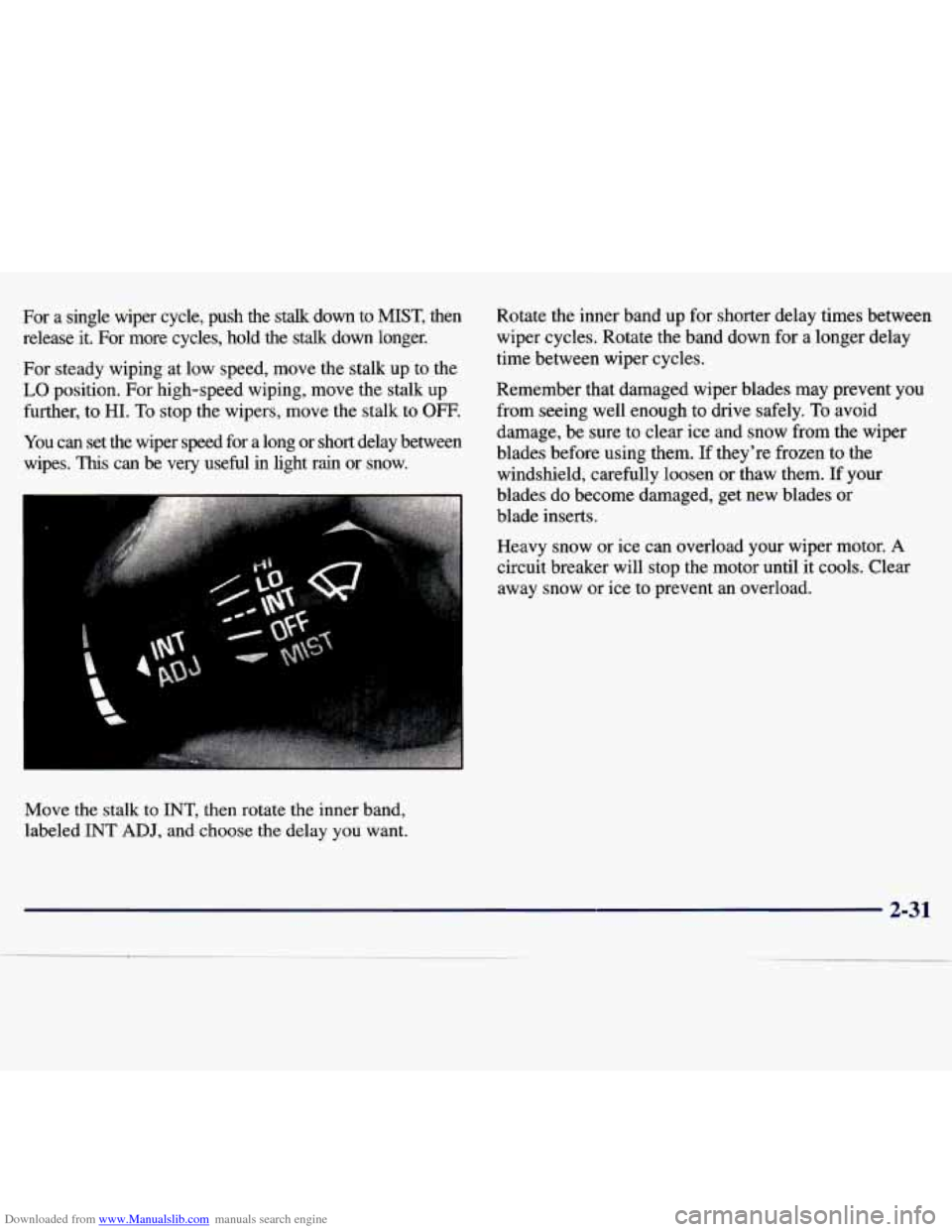
Downloaded from www.Manualslib.com manuals search engine For a single wiper cycle, push the stalk down to MIST, then
release it. For more cycles, hold the
stalk down longer.
For steady wiping at low speed, move the stalk up to the
LO position. For high-speed wiping, move the stalk up
further, to HI. To stop the wipers, move the stalk to
OFF.
You can set the wiper speed for a long or short delay between
wipes.
This can be very useful in light rain or snow.
Move the stalk to INT, then rotate the inner band,
labeled
INT ADJ, and choose the delay you want. Rotate the inner band up
for shorter delay times between
wiper cycles. Rotate the band down for a longer delay
time between wiper cycles.
Remember that damaged wiper blades may prevent you
from seeing well enough to drive safely. To avoid
damage, be sure to clear ice and snow from the wiper
blades before using them.
If they’re frozen to the
windshield, carefully loosen or thaw them. If your
blades do become damaged, get new blades or
blade inserts.
Heavy snow or ice can overload your wiper motor.
A
circuit breaker will stop the motor until it cools. Clear
away snow or ice to prevent an overload.
2-31
Page 92 of 354
Downloaded from www.Manualslib.com manuals search engine Increasing Speed. While Using Cruise Control
There are two ways to go to a higher speed.
Use the accelerator pedal to get to the higher speed.
Push the SETDECEL button, then release the button
and the accelerator pedal. You’ll now cruise at the
higher speed.
Press the RESUME/ACCEL button. Hold it there
until you get up to the speed you want, and then
release the button. To increase your speed in very
small amounts, press the RESUME/ACCEL button
for less than half a second and then release it. Each
time you do this, your vehicle will go about
1 mph
(1.6
km/h) faster.
The accelerate feature will only work after you
turn on
the cruise control by pushing the SETDECEL button.
Reducing Speed While Using Cruise Control
There are two ways to reduce your speed while using
cruise control:
Push the SETDECEL button until you reach the
To slow down in very small amounts, push the
lower
speed you want, then release it.
button for less than half a second. Each time you do
this, you’ll go 1 mph (1.6 km/h) slower.
Passing Another Vehicle While Using Cruise Control
Use the accelerator pedal to increase your speed. When
you take your foot
off the pedal, your vehicle will slow
down to the cruise control speed you set earlier.
Using Cruise Control on Hills
How well your cruise control will work on hills depends
upon your speed, load and the steepness of the hills.
When going up steep hills, you may have to step on the
accelerator pedal to maintain your speed. When going
downhill, you may have to brake or shift to a lower gear
to keep your speed down. Of course, applying the brake
takes you out of cruise control. Many drivers find this to
be
too much trouble and don’t use cruise control on
steep hills.
Ending Out of Cruise Control
There are two ways to turn off the cruise control:
Step lightly on the brake pedal;
Press the cruise control ON/OFF button.
Erasing the Cruise Speed Memory
When you turn off the cruise control or the ignition,
your cruise control set speed memory
is erased.
2-35
Page 93 of 354
Downloaded from www.Manualslib.com manuals search engine Lamps
1
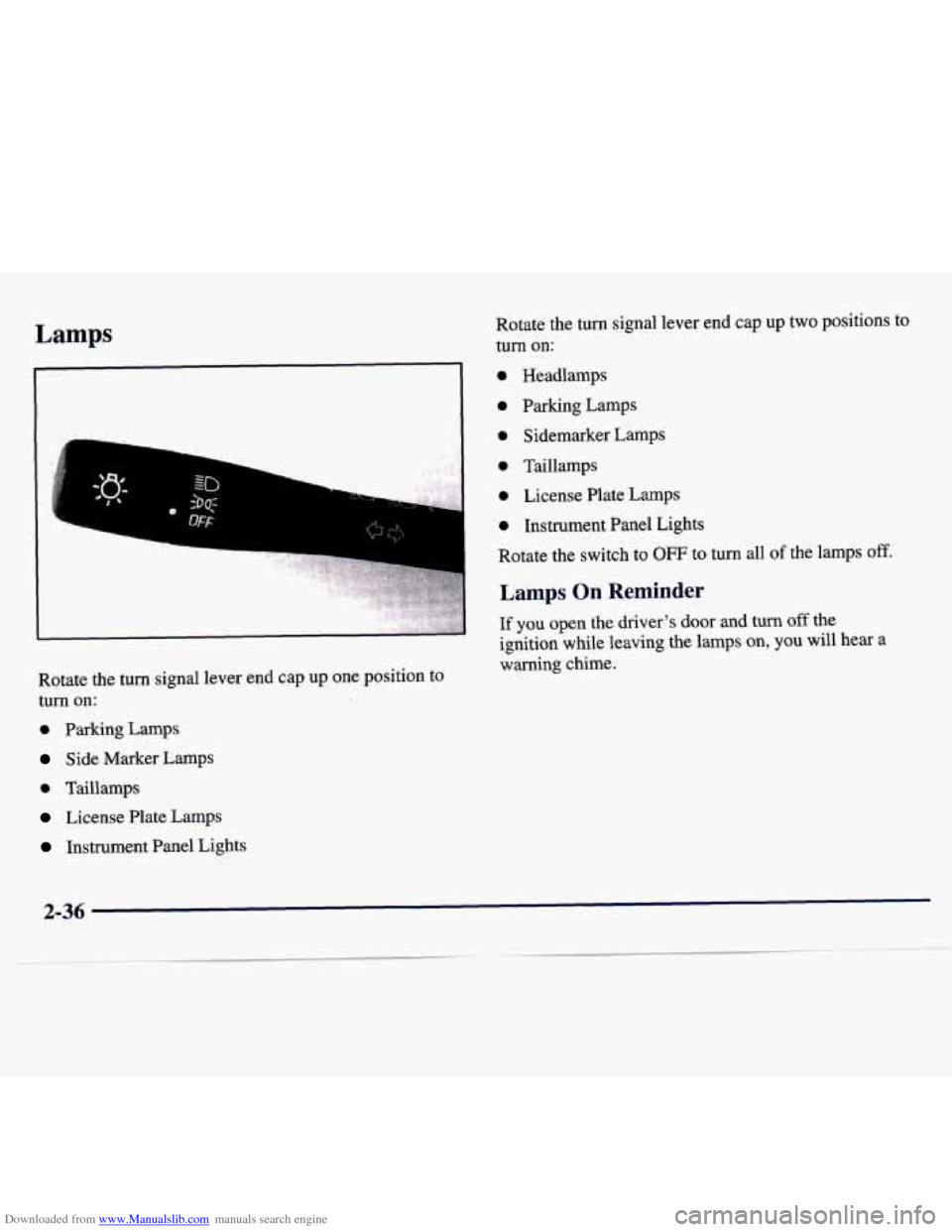
Rotate the turn signal lever end cap up one position to
turn on:
0 Parking Lamps
Side Marker Lamps
0 Taillamps
License Plate Lamps
Instrument Panel Lights Rotate the turn signal lever end cap
up two positions to
turn on:
0 Headlamps
0 Parking Lamps
0 Sidemarker Lamps
0 Taillamps
0 License Plate Lamps
0 Instrument Panel Lights
Rotate the switch to
OFF to turn all of the lamps off.
Lamps On Reminder
If you open the driver's door and turn off the
ignition while leaving the lamps on, you will hear a
warning chime.
2-36