Page 210 of 354
Downloaded from www.Manualslib.com manuals search engine Removing the Flat Tire and Installing the
Spare Tire
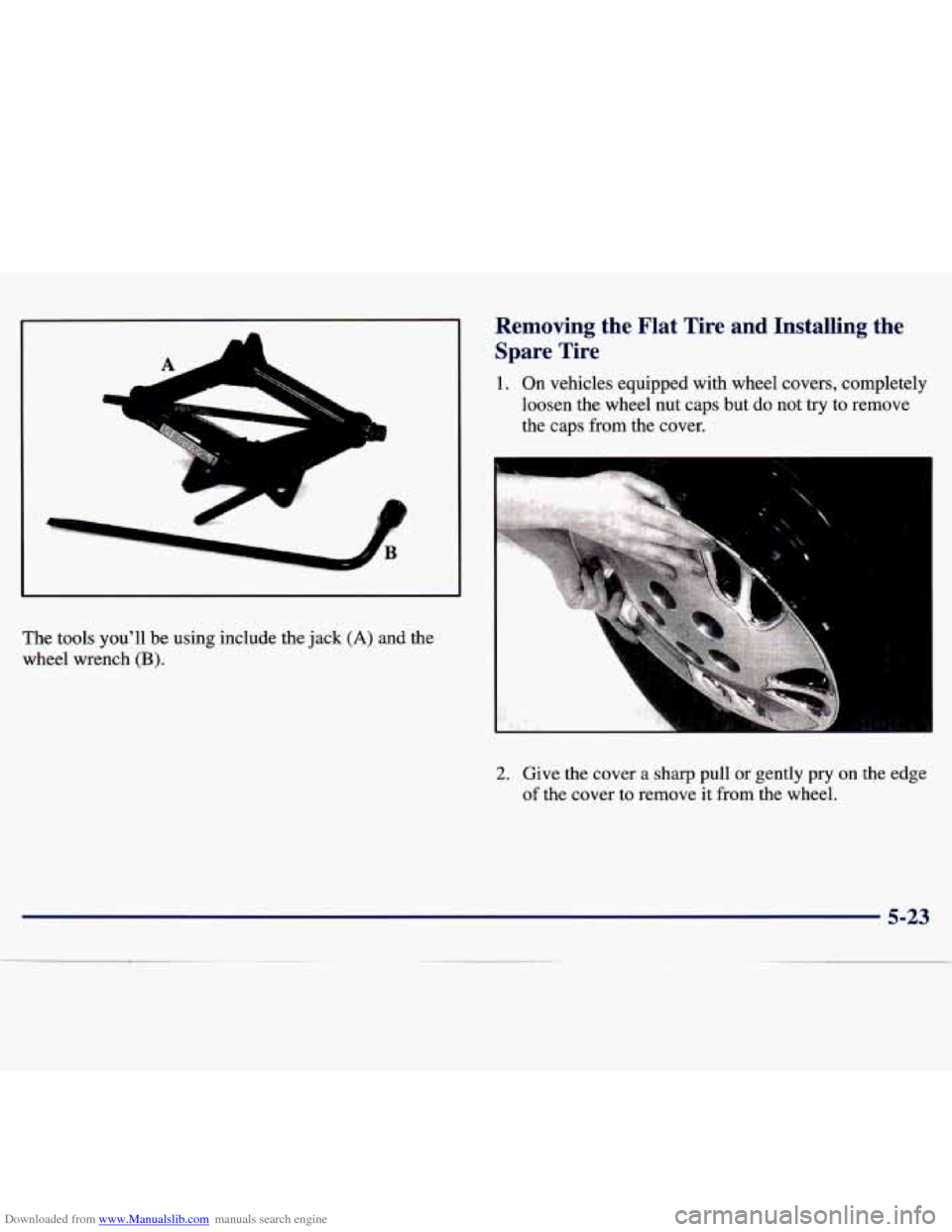
1. On vehicles equipped with wheel covers, completely
loosen the wheel nut caps but
do not try to remove
the caps from the cover.
The tools you'll be using include the jack
(A) and the
wheel wrench
(B).
2. Give the cover a sharp pull or gently pry on the edge
of the cover to remove it from the wheel.
5-23
Page 212 of 354
Downloaded from www.Manualslib.com manuals search engine -
18 (46cm)
w
18 146cm)
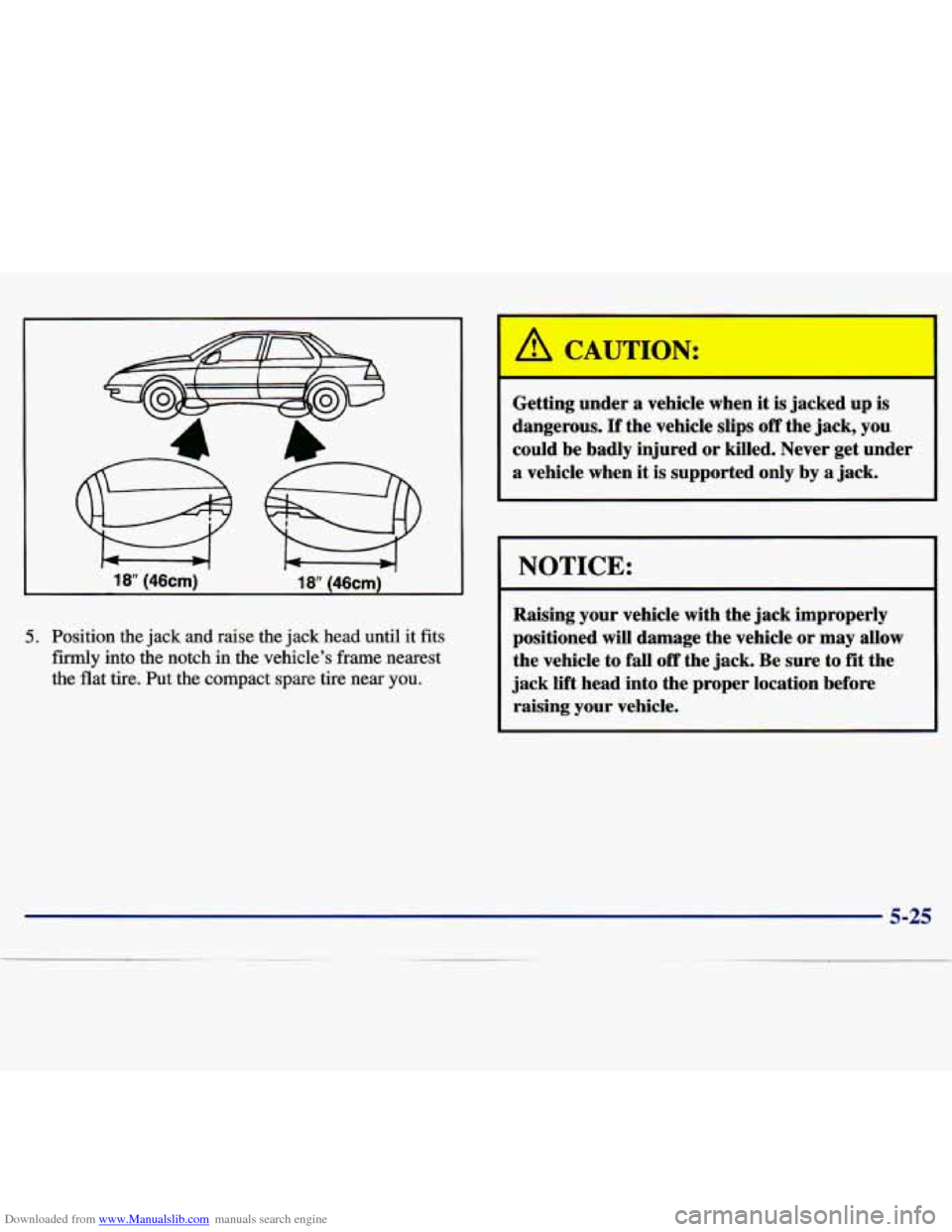
5. Position the jack and raise the jack head until it fits
firmly into the notch in the vehicle’s frame nearest
the flat tire.
Put the compact spare tire near you.
A CAUTION:
Getting under a vehicle when it is jacked up is
dangerous.
If the vehicle slips off the jack, you
could be badly injured or killed. Never get under
a vehicle when it is supported only by a jack.
NOTICE:
Raising your vehicle with the jack improperly
positioned will damage the vehicle or may allow
the vehicle to fall
off the jack. Be sure to fit the
jack lift head into the proper location before
raising your vehicle.
Page 213 of 354
Downloaded from www.Manualslib.com manuals search engine NOTICE:
Do not jack or lift the vehicle using the oil pan.
Pans could crack and begin to leak fluid. When
jacking
or lifting your vehicle, always place the
jack in the proper position.
NOTICE:
Do not jack or lift the vehicle using the
suspension components. Suspension components
can be damaged
by doing this. When jacking or
lifting your vehicle, always place the jack in the
proper position.
L
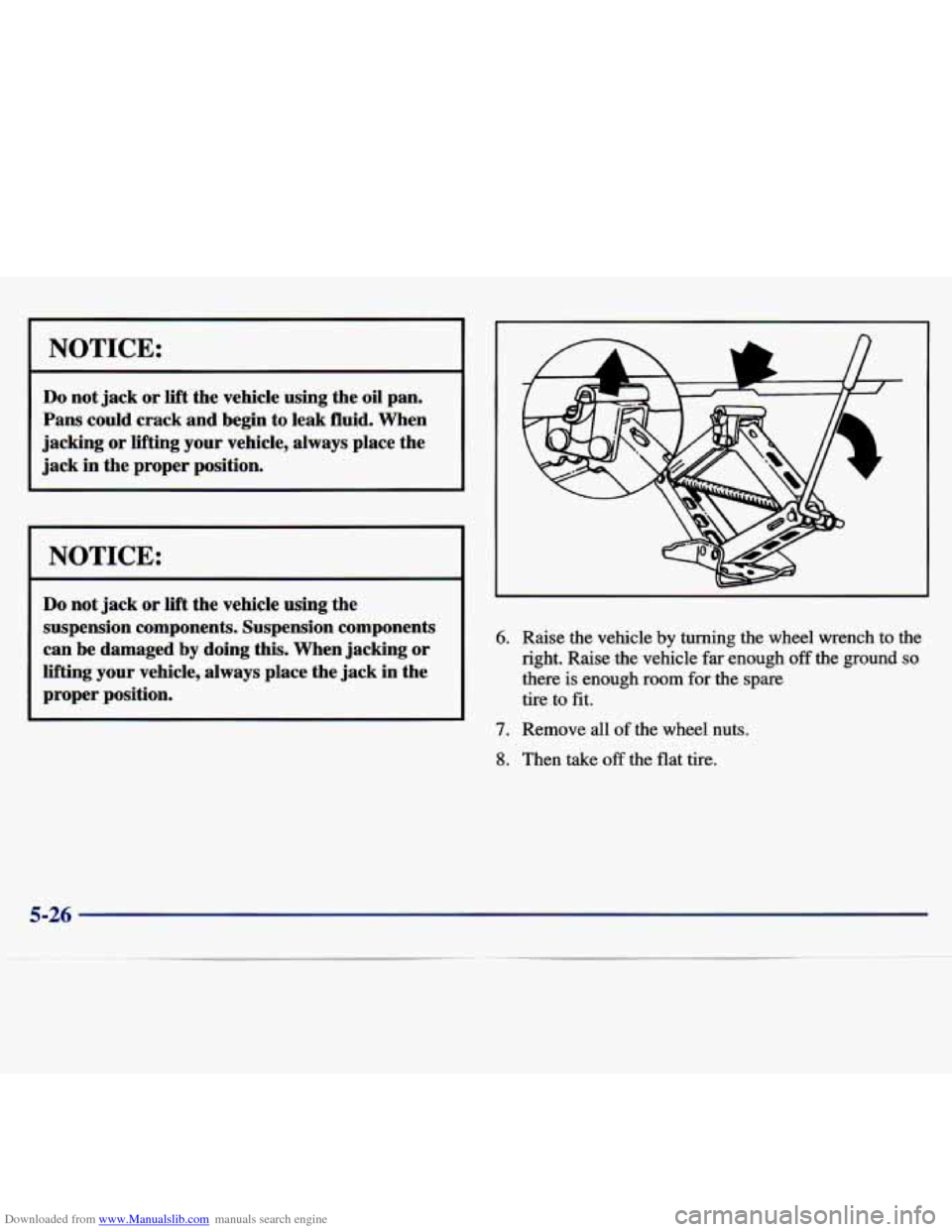
6. Raise the vehicle by turning the wheel wrench to the
right. Raise the vehicle
far enough off the ground so
there is enough room for the spare
tire to fit.
7. Remove all of the wheel nuts.
8. Then take off the flat tire.
5-26
Page 216 of 354
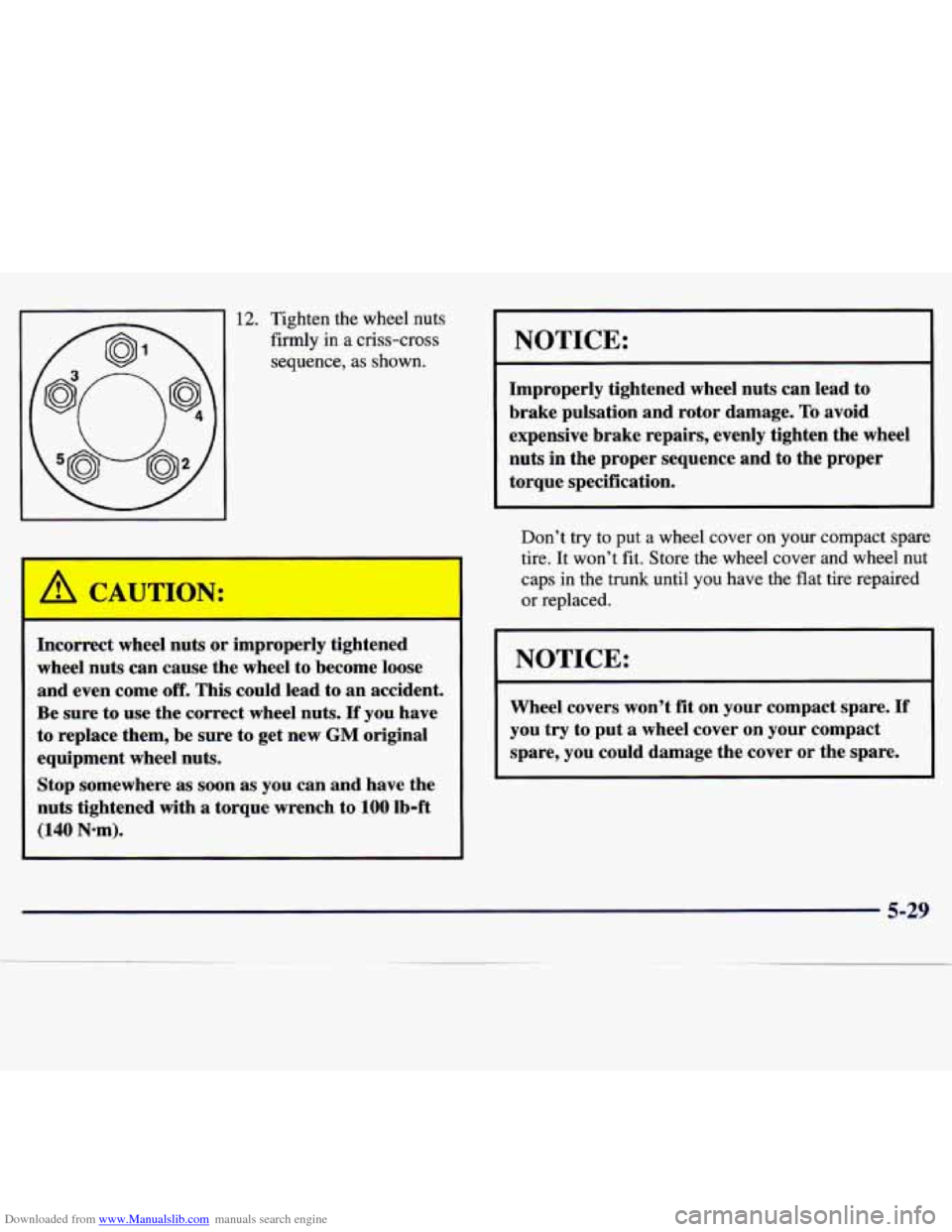
Downloaded from www.Manualslib.com manuals search engine 12. Tighten the wheel nuts
firmly in a criss-cross
sequence, as shown.
A C’ uTION:
Incorrect wheel nuts or improperly tightened
wheel nuts can cause the wheel to become loose
and even come
off. This could lead to an accident.
Be sure
to use the correct wheel nuts, If you have
to replace them, be sure to get new
GM original
equipment wheel nuts.
Stop somewhere as soon as you can and have the
nuts tightened with
a torque wrench to 100 lb-ft
(140 Nom).
NOTICE:
Improperly tightened wheel nuts can lead to
brake pulsation and rotor damage.
To avoid
expensive brake repairs, evenly tighten the wheel
nuts in the proper sequence and to the proper
torque specification,
Don’t try to put a wheel cover on your compact spare
tire. It won’t fit. Store the wheel cover and wheel nut
caps in the trunk until you have the flat tire repaired
or replaced.
NOTICE:
Wheel covers won’t fit on your compact spare. If
you try to put a wheel cover on your compact
spare, you could damage the cover or the spare.
5-29
Page 217 of 354
Downloaded from www.Manualslib.com manuals search engine Storing t' : F ' -ire and
I A -AUTION: I
Storing a jack, a tire or other equipment in the
passenger compartment
of the vehicle could
cause injury. In a sudden stop or collision, loose
equipment could strike someone. Store all these
in the proper place.
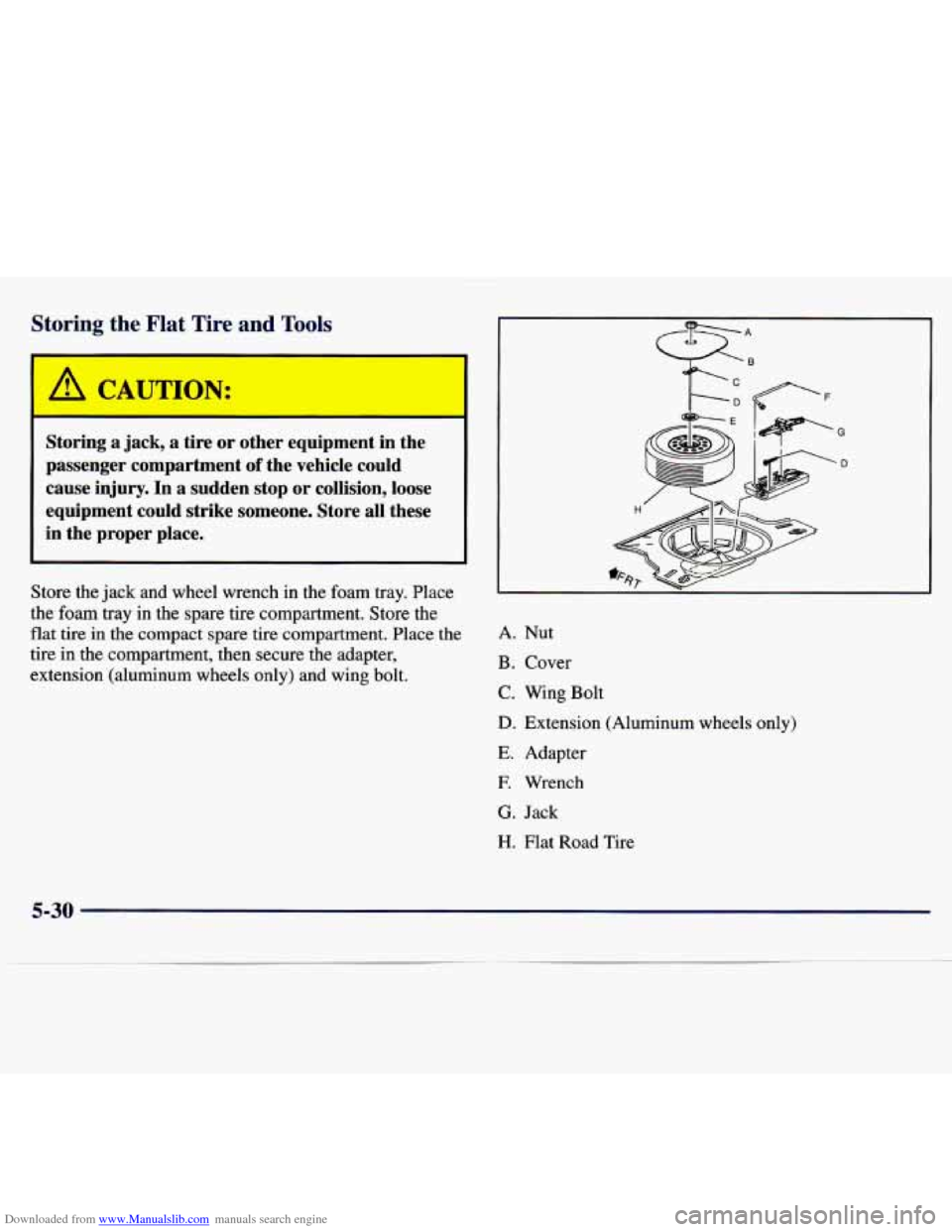
Store the jack and wheel wrench in the foam tray. Place
the
foam tray in the spare tire compartment. Store the
flat tire
in the compact spare tire compartment. Place the
tire in the compartment, then secure the adapter,
extension (aluminum wheels only) and wing bolt.
A. Nut
B. Cover
C. Wing Bolt
D. Extension (Aluminum wheels only)
E. Adapter
E Wrench
G. Jack
H. Flat Road Tire
5-30
Page 219 of 354
Downloaded from www.Manualslib.com manuals search engine Compact Spare Tire
Although the compact spare tire was fully inflated when
your vehicle was new, it can lose air after a time. Check
the inflation pressure regularly. It should be
60 psi
(420 Wa).
After installing the compact spare on your vehicle, you
should stop as soon as possible and make sure your
spare tire
is correctly inflated. The compact spare is
made to perform well at speeds up to
65 mph
(105 km/h) for distances up to 3,000 miles (5 000 km),
so you can finish your trip and have your full-size tire
repaired or replaced where you want. Of course, it’s best
to replace your spare with a full-size tire as soon as you
can. Your spare will last longer and be in good shape in
case you need it again.
NOTICE:
When the compact spare is installed, don’t take
your vehicle through an automatic car wash with
guide rails. The compact spare can get caught on
the rails. That can damage the tire and wheel,
and maybe other parts
of your vehicle. Don’t use your compact spare on other vehicles.
And don’t
mix your compact spare tire or wheel with
other wheels or tires. They won’t fit. Keep your spare
tire and its wheel together.
I NOTICE:
Tire chains won’t fit your compact spare. Using
them can damage your vehicle
and can damage
the chains too. Don’t use tire chains on your
compact spare.
5-32
Page 222 of 354
Downloaded from www.Manualslib.com manuals search engine 0 Section 6 Service a-- - Aopearance Care
Here you will fiid information about the care of your Chevrolet. This section begins with service and fuel
information, and then it shows how to check important fluid and lubricant levels. There is also technical information
about your vehicle, and
a part devoted to its appearance care.
6-2
6-3 6-5
6-5
6-7
6-
12
6-18
6-18
6-23
6-24
6-28
6-29
6-29
6-35
6-36 Doing
Your Own Service Work
What Kind of Fuel to Use
Using Fuel in Foreign Countries
Where to Put the Fuel and Filling the Tank
Checking Things Under the Hood
Checking Your Engine Oil
Automatic Transaxle Fluid
Engine Coolant
Where to
Fill the Windshield Washer Fluid
Important Brake Information
Information on Your Vehicle's Battery
Tips on Vehicle Storage
Bulb Replacement Procedures
Windshield Wiper Blade Replacement
How and When to Check Tire Inflation 6-39
6-42
6-44
6-47
6-48
6-50
6-5 1
6-52
6-53
6-54 6-55
6-6 1
6-6
1
' 6-62
i 6-62 When
it is
Time to Buy New Tires
Wheel Alignment
Cleaning the Inside of Your Vehicle
Care of the Safety Belts
Cleaning the Outside
of Your Vehicle
How to Clean Aluminum Wheels
Underbody Maintenance
Recommended Appearance Care Materials
Your Vehicle Identification Number (VIN)
The Electrical System
Fuses and Circuit Breakers
Replacement Bulb Types for Your Vehicle
Capacities and Specifications
Air Conditioning Specifications
Normal Replacement
Parts
Page 257 of 354
Downloaded from www.Manualslib.com manuals search engine 0
0
0
Underinflated tires pose the same danger as
overloaded tires. The resulting accident
could cause serious injury. Check all tires
frequently to maintain the recommended
pressure. Tire pressure should be checked when your tires
are cold.
Overinflated tires are more likely to be cut,
punctured or broken by
a sudden impact --
such as when you hit a pothole. Keep tires
at the recommended pressure.
Worn, old tires can cause accidents.
If your
tread is badly worn,
or if your tires have
been damaged, replace them.
Inflation -- Tire Pressure
The Tire-Loading Information label, which is on the
rear edge of the driver’s side rear passenger door, shows
the correct inflation pressures for your tires when
they’re cold. “Cold” means your vehicle has been sittin\
g for at least three hours
or driven no more than 1 mile
(1.6 km).
NOTICE:
Don’t let anyone tell you that underinflation or
overinflation is all right.
It’s not. If your tires
don’t have enough air (underinflation), you can
get the following:
0 Too much flexing
Too much heat
0 Tire overloading
0 Bad wear
Bad handling
Bad fuel economy.
If your tires have too much air (overinflation),
you can get the following:
Unusual wear
0 Bad handling
Rough ride
Needless damage from road hazards.
6-36