1997 CHEVROLET MALIBU brake light
[x] Cancel search: brake lightPage 154 of 354
Downloaded from www.Manualslib.com manuals search engine Avoid needless heavy braking. Some people drive
in spurts -- heavy acceleration followed by heavy
braking
-- rather than keeping pace with traffic. This is a
mistake. Your brakes may not have time to cool between
hard stops. Your brakes will wear out much faster if you
do a lot of heavy braking. If you keep pace with the
traffic and allow realistic following distances, you will
eliminate a lot
of unnecessary braking. That means
better braking and longer brake life.
If your engine ever stops while you’re driving, brake
normally but don’t pump your brakes. If you do, the
pedal may get harder
to push down. If your engine
stops, you will still have some power brake assist. But
you will use
it when you brake. Once the power assist is
used up, it may take longer to stop and the brake pedal
will be harder to push.
Anti-Lock Brakes (ABS)
Your vehicle has anti-lock brakes (ABS). ABS is an
advanced electronic braking system that will help
prevent a braking
skid.
If there’s a problem with the
anti-lock brake system, this
warning light will stay on.
See “Anti-Lock Brake
System Warning Light” in
the Index.
4-7
Page 164 of 354
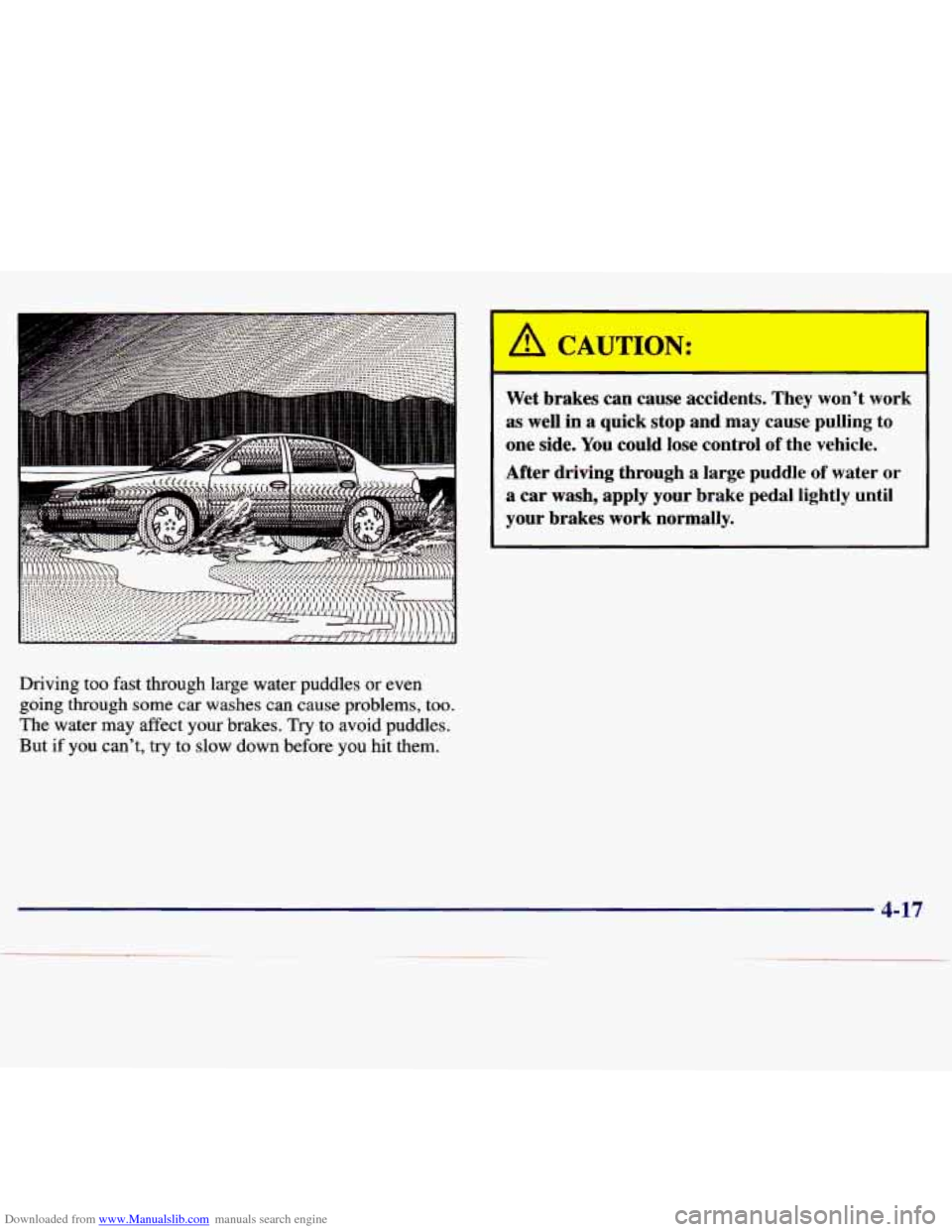
Downloaded from www.Manualslib.com manuals search engine Driving too fast through large water puddles or even
going through some car
washes can cause problems, too.
The water may affect your brakes. Try to avoid puddles.
But if you can’t, try to slow down before you hit them.
Wet brakes can cause accidents. They won’t work
as well in a quick stop and may cause pulling to
one side. You could lose control
of the vehicle.
After driving through a large puddle
of water or
a car wash, apply your brake pedal lightly until
your brakes work normally.
4-17
Page 175 of 354
Downloaded from www.Manualslib.com manuals search engine Run your engine only as long as you must. This saves
fuel. When you run
the engine, make it go a little faster
than just idle. That is, push the accelerator slightly. This
uses less fuel
for the heat that you get and it keeps the
battery charged. You will need a well-charged battery to
restart the vehicle, and possibly for signaling later on
with your headlamps. Let the heater run for a while.
Then, shut the engine off and close the window almost
all the way to preserve the heat. Start the engine again
and repeat
this only when you feel really uncomfortable
from the cold.
But do it as little as possible. Preserve the
fuel as long as you can. To help keep warm, you can get
out
of the vehicle and do some fairly vigorous exercises
every half hour
or so until help comes.
Recreational Vehicle Towing
You can tow your vehicle behind another vehicle for use
at your destination. Be sure to use the proper towing
equipment designed for recreational towing. Follow the
instructions
for the towing equipment.
Towing Your Vehicle from the Front
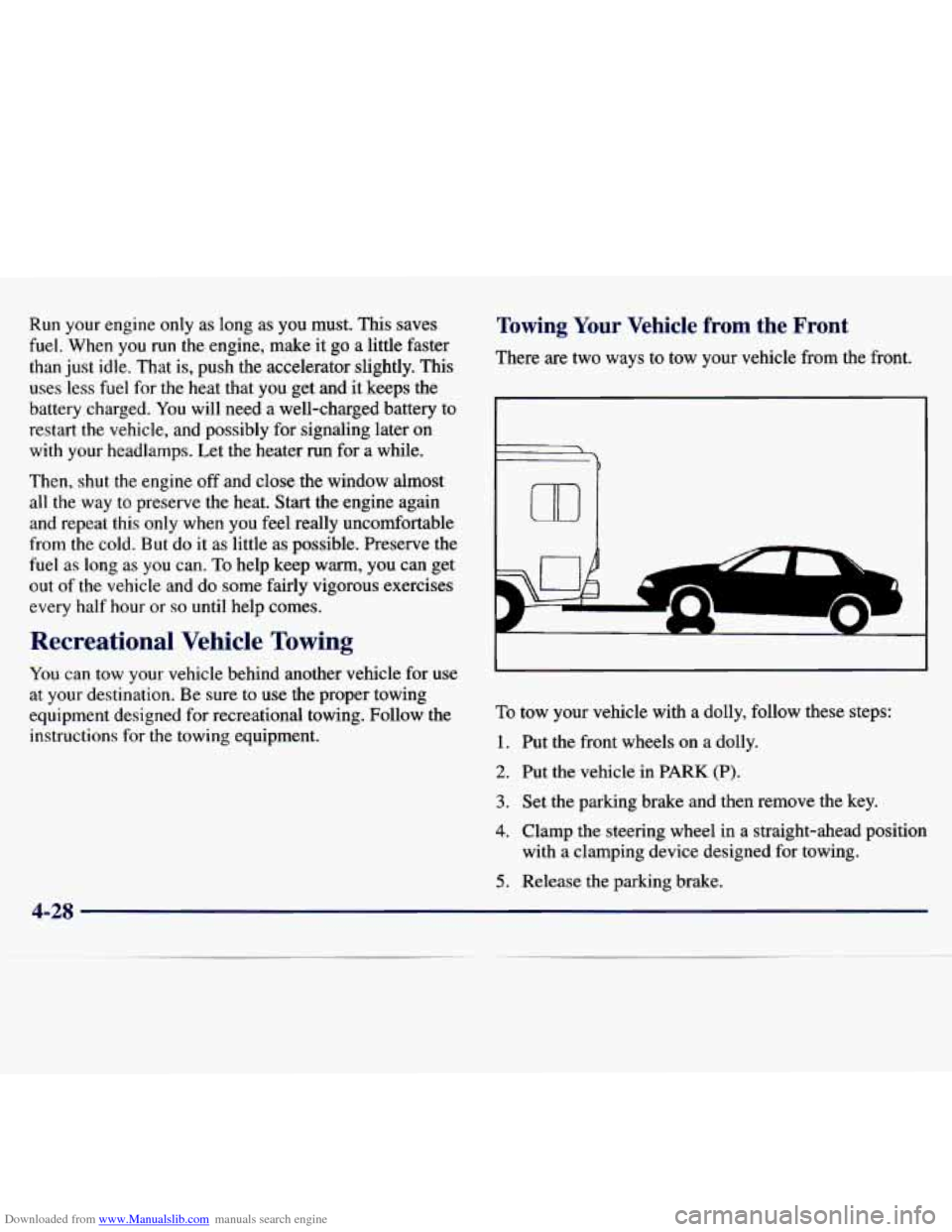
There are two ways to tow your vehicle from the front.
To tow your vehicle with a dolly, follow these steps:
1. Put the front wheels on a dolly.
2. Put the vehicle in PARK (P).
3. Set the parking brake and then remove the key.
4. Clamp the steering wheel in a straight-ahead position
5. Release the parking brake. with a clamping device designed for towing.
4-28
Page 191 of 354
Downloaded from www.Manualslib.com manuals search engine 2. Get the vehicles close enough so the jumper cables
can reach, but be sure the vehicles aren’t touching
each other.
If they are, it could cause a ground
connection you don’t want.
You wouldn’t be able to
start your Chevrolet, and the bad grounding could
damage the electrical systems.
You could be injured if the vehicles roll. Set the
parking brake firmly on each vehicle. Put the
transaxle
in PARK (P).
unnecessary accessories plugged into the cigarette
lighter
or the accessory power outlet. Turn off all
lamps that aren’t needed,
as well as radios. This will
avoid sparks
and help save both batteries. In
addition, it could save your radio.
3. Turn off the ignition on both vehicles. Unplug
I NOTICE:
If you leave your radio on, it could be badly
damaged. The repairs wouldn’t be covered by
your warranty.
4. Open the hoods and locate the batteries.
CAUTION:
An electric fan can start up even when the engine
is not running and can injure you. Keep hands,
clothing and tools away from any underhood
electric
fan.
5-4
Page 246 of 354
Downloaded from www.Manualslib.com manuals search engine system fixed, since a leak means that sooner or later your
brakes won’t work well, or won’t work at all.
So, it isn’t a good idea to ‘‘top off’ your brake fluid.
Adding brake fluid won’t correct a leak.
If you add fluid
when your linings are worn, then you’ll have too much
fluid when you get new brake linings. You should add
(or remove) brake fluid, as necessary, only when work is
done
on the brake hydraulic system.
I
A CAUTION:
If you have too much brake fluid, it can spill on
the engine. The fluid will burn if the engine is
hot enough. You or others could be burned,
and your vehicle could be damaged. Add brake
fluid only when work
is done on the brake
hydraulic system.
BRAKE
United States Canada
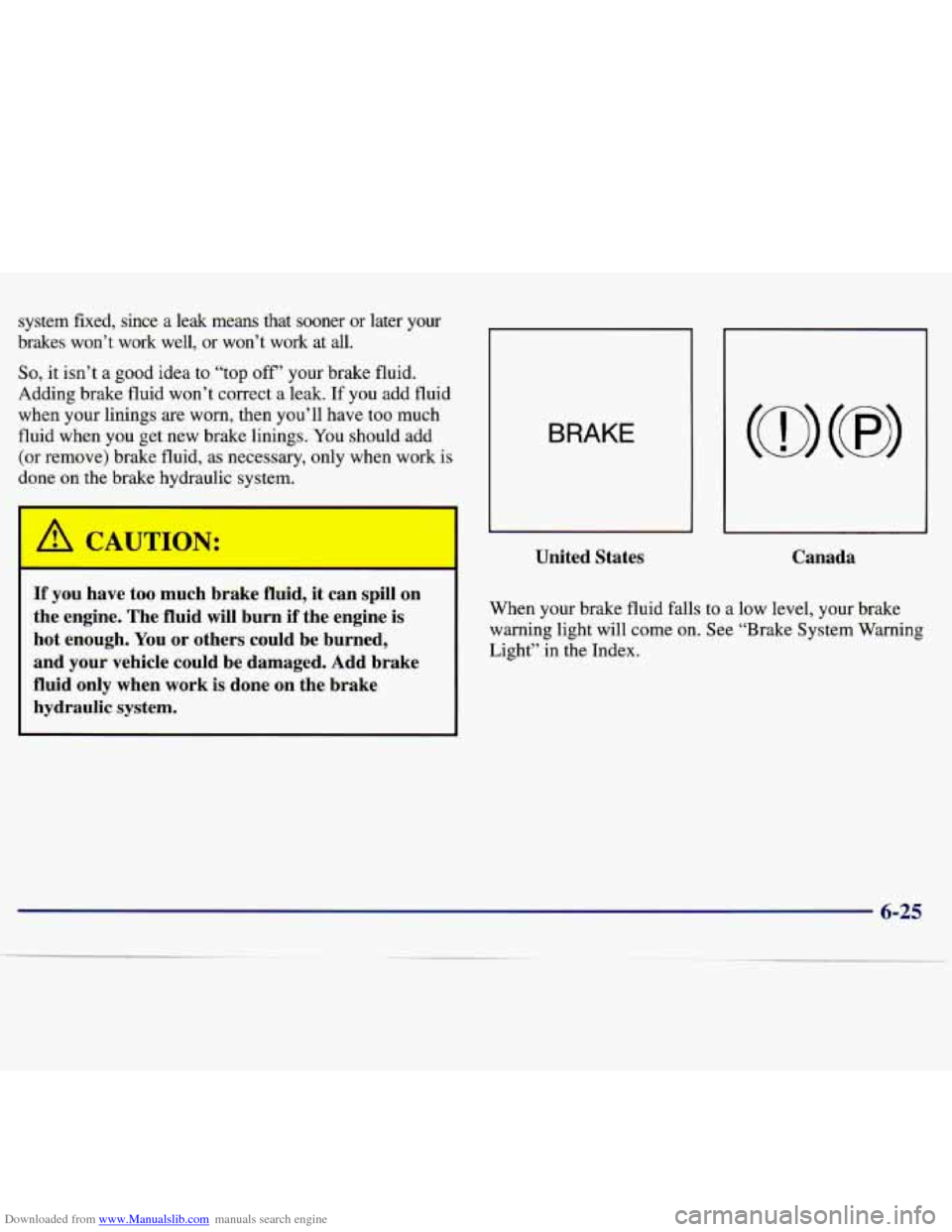
When your brake fluid falls to a low level, your brake
warning light will come
on. See “Brake System Warning
Light” in the Index.
6-25
Page 248 of 354
Downloaded from www.Manualslib.com manuals search engine Brake Wear
Your Chevrolet has front disc brakes and rear drum brakes.
Disc brake pads have built-in wear indicators that make a
high-pitched warning sound when the brake pads are worn and new pads
are needed. The sound may come and go or
be heard
all the time your vehicle is moving (except when
you
are pushing on the brake pedal firmly).
A CAUTION:
The brake wear warning sound means that soon
your brakes won’t work well. That could lead to
an accident. When you hear the brake wear
warning sound, have your vehicle serviced.
NOTICE:
Continuing to drive with worn-out brake pads
could result
in costly brake repair.
Some driving conditions or climates may cause a brake
squeal when the brakes are first applied or lightly
applied.
This does not mean something is wrong with
your brakes.
Properly torqued wheel nuts are necessary to help
prevent brake pulsation. When tires are rotated, inspect
brake pads for wear and evenly torque wheel nuts in the
proper sequence to GM specifications.
Your rear drum brakes don’t have wear indicators, but
if
you ever hear a rear brake rubbing noise, have the rear
brake linings inspected.
Also, the rear brake drums
should be removed and inspected each time the tires are
removed for rotation or changing. When you have the
front brake pads replaced, have the rear brakes
inspected, too.
Brake linings should always be replaced as complete
axle sets.
See “Brake System Inspection” in Section 7 of this manual
under
Part C “Periodic Maintenance Inspections.”
6-27
Page 280 of 354
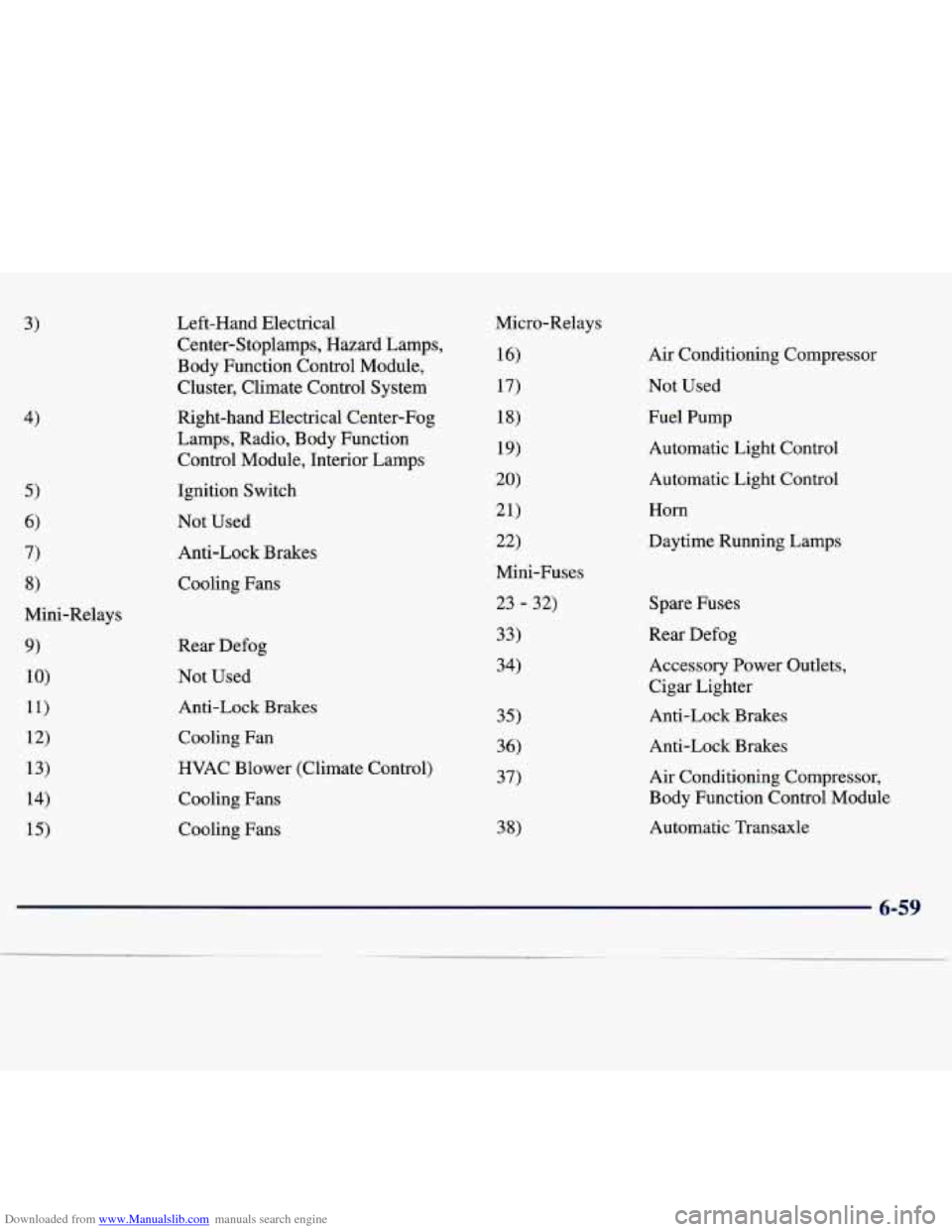
Downloaded from www.Manualslib.com manuals search engine 3)
4)
Left-Hand Electrical
Center-Stoplamps, Hazard Lamps,
Body Function Control Module, Cluster, Climate Control System
Right-hand Electrical Center-Fog
Lamps, Radio, Body Function Control Module, Interior Lamps
Ignition Switch
Not Used
Anti-Lock Brakes
Cooling Fans
Rear Defog
Not Used Anti-Lock
Brakes
Cooling Fan
HVAC Blower (Climate Control)
Cooling Fans
Cooling Fans
35)
36)
37)
3
8)
Air Conditioning Compressor
Not Used
Fuel Pump
Automatic Light Control Automatic Light Control
Horn
Daytime Running Lamps
Spare Fuses
Rear Defog Accessory Power Outlets,
Cigar Lighter
Anti-Lock Brakes
Anti-Lock Brakes
Air Conditioning Compressor,
Body Function Control Module
Automatic Transaxle
6-59
Page 342 of 354
Downloaded from www.Manualslib.com manuals search engine Section 9 Index
Accessory Power Outlet ......................... 2-46
Adding Equipment to Your Vehicle
.................. 6-3
Adjuster. Seat
.............................. 1.2. 1-47
AirBag
....................................... 1-21
How Does it Restrain
.......................... 1-25
How it Works
................................ 1-23
Location
.................................... 1-23
Readiness Light
......................... 1.22. 2.54
Servicing
................................... 1-27
What Makes it Inflate
.......................... 1-25
What Will You See After it Inflates
............... 1-25
When Should it Inflate
......................... 1-24
Air Bag Readiness Light
.................... 1.22. 2.54
Air Cleaner
.................................... 6- 17
Air Conditioning ................................ 3-2
Air Conditioning Refrigerants
..................... 6-62
Alignment and Balance. Tire
...................... 6-42
Aluminum Wheels. Cleaning
...................... 6-50
Antenna. Fixed
................................. 3-24
Antifreeze
..................................... 6- 18
Anti-Lock Brake System Warning Light
................ 2.56. 4.7
Brakes
................................. 2.56. 4.7
Anti.Theft. Radio
.............................. 3- 19 Appearancecare
............................... 6-44
Appearance Care Materials
....................... 6-52
Arbitration Program
.............................. 8-9
Audio Equipment. Adding
......... 2-1 5.2.16.3.22. 6.54
Audio Systems
.................................. 3-7
Auto-Down Window
............................ 2-28
Automatic Light Control
......................... 2-37
Automatic Transaxle
Fluid
....................................... 6-18
Operation
................................... 2-18
Park Mechanism Check
........................ 7-40
Shifting
..................................... 2-19
Ashtray
....................................... 2-44
Backing Up with a Trailer
....................... 4-37
Battery
....................................... 6-28
Jump Starting
................................. 5-3
Replacement. Keyless Entry System
............... 2-8
Saver
...................................... 2-39
Warnings
.................................... 5-3
BBB Auto Line
................................. 8-9
Before Leaving on a Long Trip
.................... 4-21
Better Business Bureau Mediation
................... 8-9
9-1
..