Page 160 of 386

Downloaded from www.Manualslib.com manuals search engine Avoid needless heavy braking. Some people drive in
spurts -- heavy acceleration followed by heavy
braking
-- rather than keeping pace with traffic. This is a
mistake. Your brakes may not have time to cool between
hard stops. Your brakes will wear
out much faster if you
do a lot of heavy braking. If you keep pace with the
traffic and allow realistic following distances, you
will
eliminate a lot of unnecessary braking. That means
better braking and longer brake life.
If your engine ever stops while you’re driving, brake
normally but don’t pump your brakes. If you do, the
pedal may get harder
to push down. If your engine
stops, you will still have some power brake assist. But
you will use it when you brake. Once the power assist is
used up, it may take longer to stop and the brake pedal
will be harder to push.
Anti-Lock Brakes (ABS)
Your vehicle has anti-lock brakes (ABS). ABS is an
advanced electronic braking system that will help
prevent a braking skid.
When
you start your engine and begin to drive away,
your anti-lock brake system will check itself. You may
hear a momentary motor or clicking noise while this test
is going on. This is normal.
ANTI -
LOCK
If there’s a problem with the
anti-lock brake system, this
warning light will stay
on.
See “Anti-Lock Brake
System Warning Light” in
the Index.
Page 161 of 386
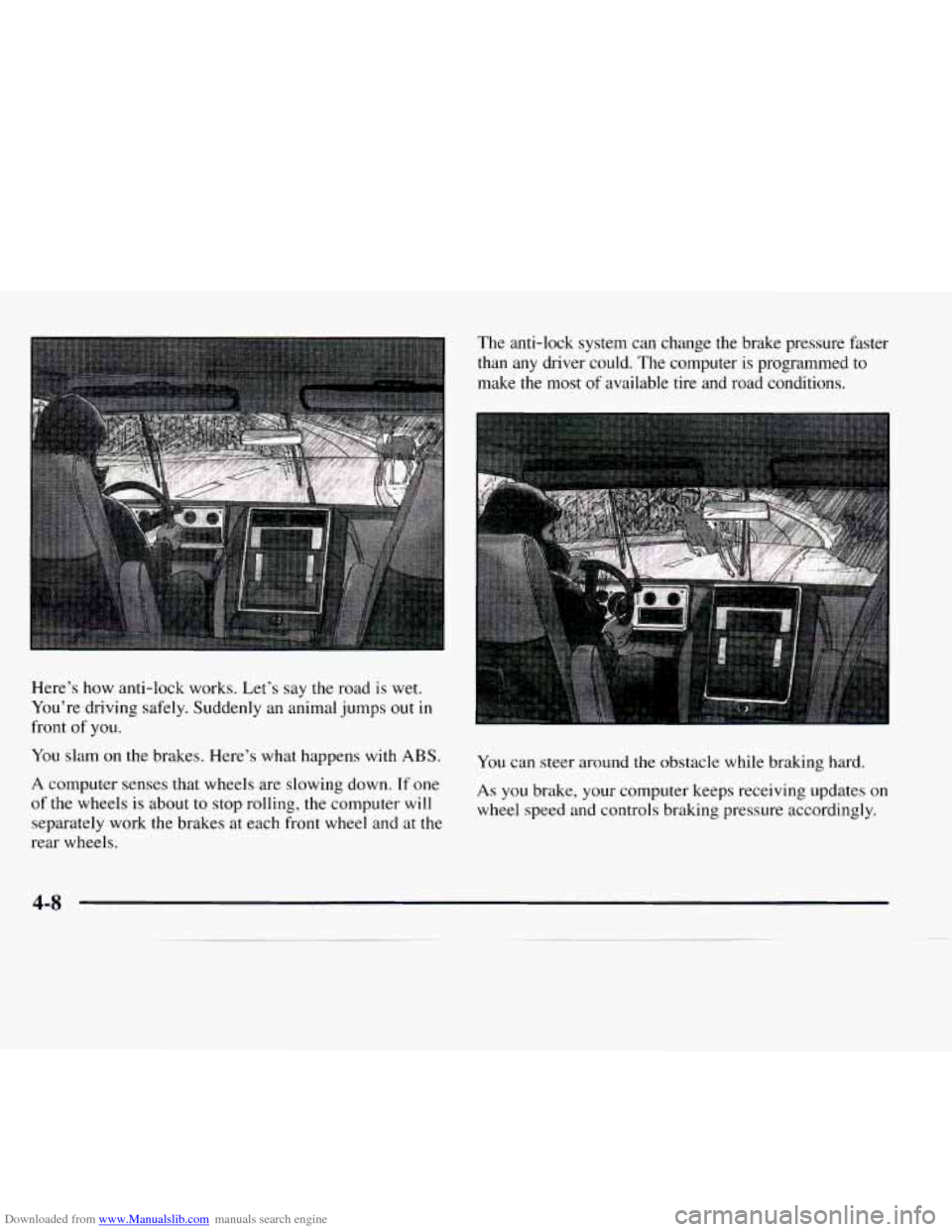
Downloaded from www.Manualslib.com manuals search engine Here’s how anti-lock works. Let’s say the road is wet.
You’re driving safely. Suddenly an animal jumps out
in
front of you.
You slam
on the brakes. Here’s what happens with ABS.
A computer senses that wheels are slowing down. If one
of the wheels is about to stop rolling, the computer will
separately work the brakes at each front wheel and at the
rear wheels. The anti-lock system
can change the brake pressure faster
than any driver
could. The computer is programmed to
make the most of available tire and road conditions.
You can steer around the obstacle while braking hard.
As you brake, your c6mputer keeps receiving updates on
wheel speed and controls braking pressure accordingly.
4-8
Page 167 of 386
Downloaded from www.Manualslib.com manuals search engine If your vehicle starts to slide, ease your foot off the
accelerator pedal and quickly steer the way you want the
vehicle
to go. If you start steering quickly enough, your
vehicle may straighten out. Always be ready for
a
second skid if it occurs.
Of course, traction is reduced when water, snow, ice,
gravel or other material is on
the road. For safety, you’ll
want to slow down and adjust your driving to these
conditions. It is important
to slow down on slippery
surfaces because stopping distance will be longer and
vehicle control more limited.
While driving
on a surface with reduced traction, try
your best to avoid sudden steering, acceleration or
braking (including engine braking by shifting to a lower
gear). Any sudden changes could cause the tires
to slide.
You may not realize the surface is slippery until your
vehicle is skidding. Learn to recognize warning
clues
-- such as enough water, ice or packed snow on
the road to make a “mirrored surface” -- and slow
down when you have any doubt.
Remember: Any anti-lock brake system (ABS) helps
avoid only the braking skid.
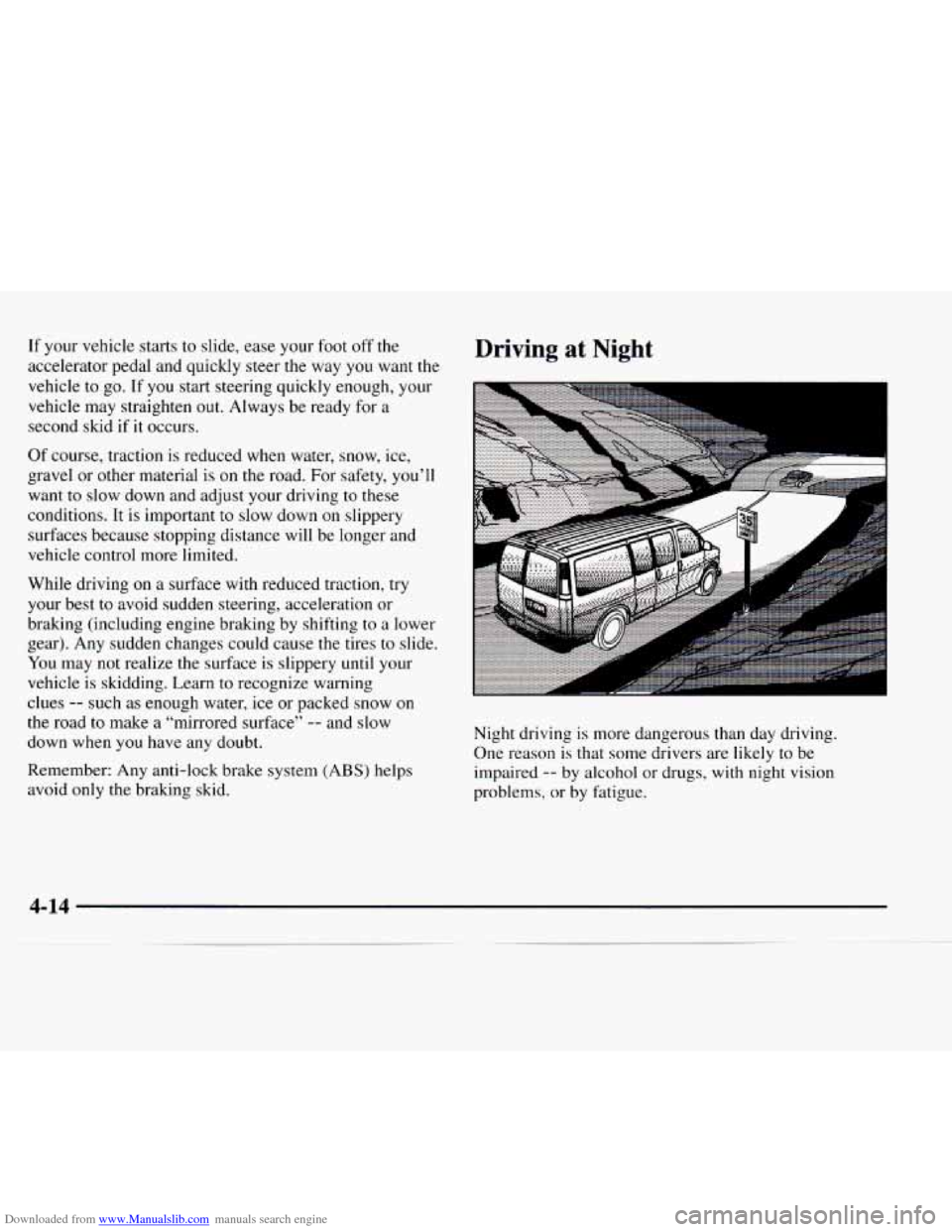
Driving at Night
Night driving is more dangerous than day driving.
One reason
is that some drivers are likely to be
impaired
-- by alcohol or drugs, with night vision
problems, or by fatigue.
4-14
Page 190 of 386

Downloaded from www.Manualslib.com manuals search engine Parking on Hills
You really should not park your vehicle, with a trailer
attached, on a hill. If something goes wrong, your rig
could start
to move. People can be injured, and both
your vehicle and the trailer can be damaged.
But if
you ever have to park your rig on a hill, here’s
how
to do it:
1.
2.
3.
4.
5.
Apply your regular brakes, but don’t shift into
PARK
(P) yet. Then turn your wheels into the curb
if facing downhill or into traffic if facing uphill.
Have someone place chocks under the trailer wheels.
When the wheel chocks are in place, release the
regular brakes until
the chocks absorb the load.
Re-apply the regular brakes. Then apply your
parking brake and then shift to PARK
(P).
Release the reguIar brakes.
When You Are Ready to Leave After
Parking on a Hill
I. Apply your regular brakes and hold the pedal down
while
you:
Start your engine;
0 Shift into a gear; and
0 Release the parking brake.
2. Let up on the brake pedal.
3. Drive slowly until the trailer is clear of the chocks.
4. Stop and have someone pick up and store the chocks.
Maintenance When Trailer Towing
Your vehicle will need service more often when you’re
pulling a trailer. See
the Maintenance Schedule for more
on this. Things that are especially important in trailer
operation are automatic transmission fluid (don’t
overfill), engine oil, axle lubricant, belt, cooling system
and brake adjustment. Each
of these is covered in this
manual, and the Index will help you find them quickly.
If you’re trailering, it’s a good idea to review these
sections before you start your trip.
Check periodically
to see that all hitch nuts and bolts
are tight.
Page 290 of 386
Downloaded from www.Manualslib.com manuals search engine Appearance Care Materials Chart
PART NUMBER DESCRIPTION USAGE
1052929
Cleans vinyl, leather and rubber
Armor All
TM Cleaner
16 oz. (0.473 L) 12345002”” Attracts and
absorbs soils Capture
Dry Spot Remover
8 oz. (0.237 L)
1052930 Spray on wheel
cleaner
Wheel Cleaner 16
oz. (0.473 L)
12345725 Spot cleans paint and gives high luster Finish
Enhancer 16
oz. (0.473 L) 12377966 Protects finish
and removes fine scratches
Cleaning Wax
16
oz. (0.473 L)
12377964 Shines tires Silicone
Tire Shine
12
oz. (0.354 L)
See your General Motors Parts Department for these products.
** Not recommended for use on instrument panel vinyl.
See “Fluids and Lubricants” in the Index.
6-57
Page 295 of 386
Downloaded from www.Manualslib.com manuals search engine POSITION
17.
18.
19.
20.
21.
22.
23.
24. A.
B.
NAME
RADIO- 1
BRAKE
RADIO-B
TRANS STRGEECURITY
RR DEFOG
Not Used
RR HVAC
PWR ACCY
PWR WDO
CIRCUITS PROTECTED
Radio (Ign, Accy)
4WAL PCM, ABS, Cruise Control
Radio (Battery), Power Antenna
PRNDL, Automatic Transmission
EVO Steering, European Security System
Rear Window Defog
RR HVAC Controls, HIGH, MED,
LOW Relays
Power Door Lock, Six-Way Power Seat, Keyless Entry Illumination
Module
Power Windows
Do not
use fuses of higher amperage than those recommended above. Fuse amperage levels are also imprinted on the
fuse panel under the dash.
Page 296 of 386
Downloaded from www.Manualslib.com manuals search engine Engine Compartment Fuse Relay Center
The fuse block is on the driver’s side of the engine
compartment at the rear.
,
[T)
Name
BLOWR
ABS
Circuits Protected
Blower Motor
Electronic Brake Control Module
Name
IGN-B
IGN-A
BATT
LIGHTING
RR BLOWER
ENG-
1
AIC
SPARE
AUX A
AUX-B
RH-HDLP
Circuits Protected
Ignition Switch
Starter Relay, Ignition Switch
Instrument Panel Fuse Block
Instrument Panel Fuse Block,
Headlamp Switch
Rear Auxiliary Blower
Motor Relays
Heated
02 Sensors, Mass Air
Flow Sensor, EGR Valve
Solenoid, Evap Canister Purge
Valve, Crankshaft Position Sensor,
Secondary Air Injection Relay
(Diesel), Water in Fuel Sensor
(Diesel), Fuel Heater (Diesel),
Glowplug
Relay (Diesel),
Wastegate Solenoid (Diesel)
Air Conditioning Clutch Relay
Spare Fuses
Upfitter Provisions
Upfitter Provisions
Right-hand Headlamp (Export Only)
6-63