Page 189 of 386

Downloaded from www.Manualslib.com manuals search engine Making ’hrns
NOTICE:
Making very sharp turns while trailering could
cause the trailer to come in contact with the
vehicle. Your vehicle could be damaged. Avoid
making very sharp turns while trailering.
When you’re turning with a trailer, make wider turns
than normal.
Do this so your trailer won’t strike soft
shoulders, curbs, road signs, trees or other objects.
Avoid jerky or sudden maneuvers. Signal well
in advance.
’hrn Signals When Towing a Trailer
When you tow a trailer, your vehicle has to have extra
wiring and a heavy-duty turn signal flasher (included in
the optional trailering package).
The arrows on your instrument panel will flash
whenever you signal a turn or lane change. Properly
hooked up, the trailer lamps will also flash, telling other
drivers you’re about to
turn, change lanes or stop. When
towing a trailer, the arrows
on your instrument
panel will flash for turns even if the bulbs
on the trailer
are burned out. Thus, you may think drivers behind
you
are seeing your signal when they are not. It’s important
to check occasionally to be sure the trailer bulbs are
still working.
Driving On Grades
Reduce speed and shift to a lower gear before you
start down a long or steep downgrade. If you don’t shift
down, you might have to use your brakes
so much that
they would get
hot and no longer work well.
On a long uphill grade, shift down and reduce your
speed
to around 45 mph (70 kmh) to reduce the
possibility of engine and transmission overheating.
When towing at high altitude on steep uphill grades,
consider
the following: Engine coolant will boil at a
lower temperature than at normal altitudes. If you turn
your engine off immediately after towing at high altitude
on steep uphill grades, your vehicle may show signs
similar
to engine overheating. To avoid this, let the
engine run while parked (preferably on level ground)
with the automatic transmission in
PARK (P) for a
few minutes before turning the engine off. If you do
get the overheat warning, see “Engine Overheating”
in
the Index.
4-36
Page 194 of 386
Downloaded from www.Manualslib.com manuals search engine Section 5 Problems on the Road
Here you’ll find what to do about some problems that can
5-2
5-3
5-3
5-8
5- 12 Hazard
Warning Flashers
Other Warning Devices
Jump Starting
Towing Your Vehicle
Engine Overheating (Gasoline Engine) occur
on the road.
5- 14 Cooling System
5-22 Engine Fan Noise
5-22
If a Tire Goes Flat
5-23 Changing a Flat Tire
5-37 If You’re Stuck: In Sand, Mud, Ice or Snow
Page 195 of 386
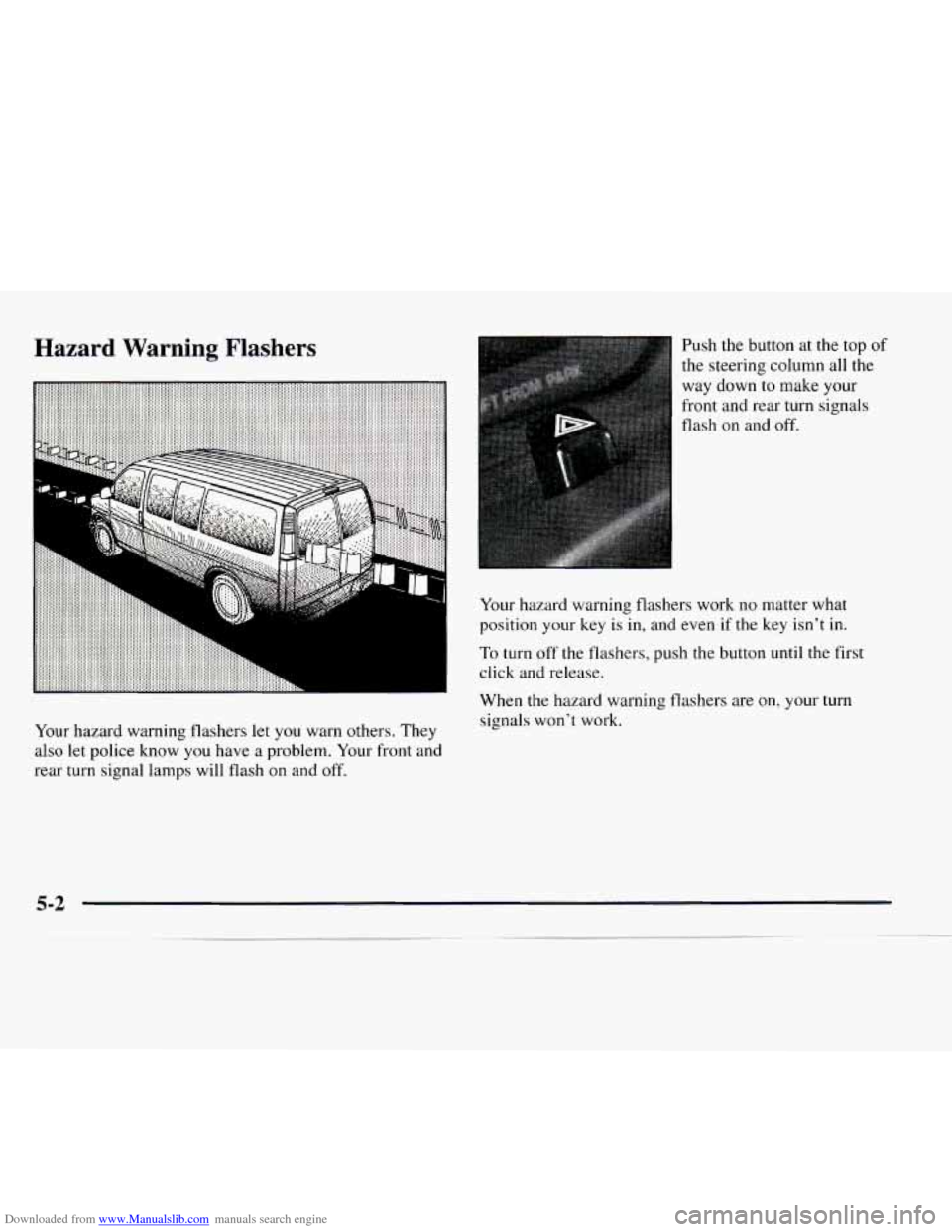
Downloaded from www.Manualslib.com manuals search engine Hazard Warning Flashers Push the button at the top of
the steering column all the
way down to make your
front and rear turn signals
flasb
cm and off.
Your hazard warning flashers
work no matter what
position your key is in, and even if
the key isn’t in.
To turn off the flashers, push the button until the first
click and release.
When the hazard warning flashers are on, your turn
signals won’t work.
Your hazard warning flashers let
you warn others. They
also
let police know you have a problem. Your front and
rear turn signal lamps will flash
on and off.
5-2
Page 196 of 386
Downloaded from www.Manualslib.com manuals search engine Other Warning Devices
If you carry reflective triangles, you can use them to
warn others. Set one up at the side of the road about
300 feet (100 m) behind your vehicle.
Jump Starting
If your battery has run down, you may want to use
another vehicle and
some jumper cables to start your
vehicle. But please follow the steps below
to do it safely.
I I
/1 CAJTION:
Batteries can hurt you. They can be
dangerous because:
They contain acid that can burn you.
They contain gas that can explode or ignite.
They contain enough electricity to burn you.
If you don’t follow these steps exactly, some or all
of these things can hurt
you.
NOTICE:
Ignoring these steps could result in costly damage
to your vehicle that wouldn’t be covered by
your warranty.
Trying to start your vehicle by pushing or pulling
it won’t work, and it could damage your vehicle.
1. Check the other vehicle. It must have a 12-volt
battery with a negative ground system.
NOTICE:
If the other system isn’t a 12-volt system with a
negative ground, both vehicles can be damaged.
If you have a diesel engine vehicle with two batteries
(or more)
you should know before you begin that,
especially in cold weather, you may not be able to
get enough power from a single battery in another
vehicle
to start your diesel engine.
Page 201 of 386
Downloaded from www.Manualslib.com manuals search engine A. Engine Block, Frame, Unpainted Metal Engine Part
B. Good Battery or
Body Surface
C. Dead Battery
Towing Your Vehicle
Try to have your GM dealer or a professional towing
service tow your vehicle. They can provide the right
equipment and know-how to tow it without damage.
See “Roadside Assistance’’ in your Index.
If your vehicle has been changed since it was
factory-new, by adding things like fog lamps, aero
skirting, or special tires and wheels, these things could
be damaged during towing.
Before you do anything, turn on the hazard
warning flashers.
When you call, tell the towing service:
That your vehicle has rear wheel drive.
0 The make, model and year of your vehicle.
Whether you can move the shift lever for
the transmission.
If there was an accident, what was damaged.
Page 206 of 386

Downloaded from www.Manualslib.com manuals search engine If No Steam Is Coming From Your Engine
If you get the overheat warning but see or hear no
steam, the problem may not be too serious. Sometimes
the engine can get a little too hot when you:
Climb a long hill on a hot day.
0 Stop after high-speed driving.
0 Idle for long periods in traffic.
Tow a trailer. See “Driving on Grades’’ in the Index.
If
you get the overheat warning with no sign of steam,
try this for a minute
or so:
1. If you have an air conditioner, turn it off.
2. Turn on your heater to full hot at the highest fan
speed and open the window as necessary.
3. If you’re in a traffic jam, shift to NEUTRAL (N);
otherwise,
shift to the highest gear while
driving
-- AUTOMATIC OVERDRIVE (@)
or DRIVE (D). If
you no
longer have the overheat warning, you can
drive. Just to be safe, drive slower for about
10 minutes.
If the warning doesn’t come back on, you can
drive normally.
If the warning continues, pull over, stop, and park your
vehicle right away.
If there’s still no sign of steam, you can idle the engine
for two or three minutes while you’re parked, to push
the accelerator until the engine speed is about twice as
fast as normal idle speed. Bring the engine speed back
to normal idle speed after two or three minutes. Now
see if the warning stops. But then, if you still have the
warning,
turn ofsthe engine and get everyone out of
the vehicle until it cools down.
You may decide not to lift the hood but to get service
help right away.
Page 209 of 386

Downloaded from www.Manualslib.com manuals search engine How to Add Coolant to the Coolant
Recovery Tank
If you haven’t found a problem yet, but the coolant level
isn’t at the
FULL COLD mark, add a 50/50 mixture of
dean water (preferably distilled) and DEX-COOL@
(silicate-free) antifreeze at the coolant recovery tank. (See
“Engine Coolant” in the Index for more information.)
Adding only plain water to your cooling system
can be dangerous. Plain water, or some other
liquid like alcohol, can boil before the proper
coolant mix will. Your vehicle’s coolant warning
system is set for the proper coolant mix.
CAUTION: (Continued) With plain water
or the wrong mix, your engine
could get too hot but you wouldn’t get the
overheat warning. Your engine could catch fire
and you or others could be burned. Use
a 50/50
mix of clean water and DEX-COOL@ coolant.
I NOTICE:
In cold weather, water can freeze and crack the
engine, radiator, heater core and other parts.
Use the recommended coolant and the proper
coolant mix.
5-16
Page 210 of 386
Downloaded from www.Manualslib.com manuals search engine . . . :
CAUTION:
You can be burned if you spill coolant on hot
engine parts. Coolant contains ethylene glycol
and it
will burn if the engine parts are hot
enough. Don't spill coolant on
a hot engine.
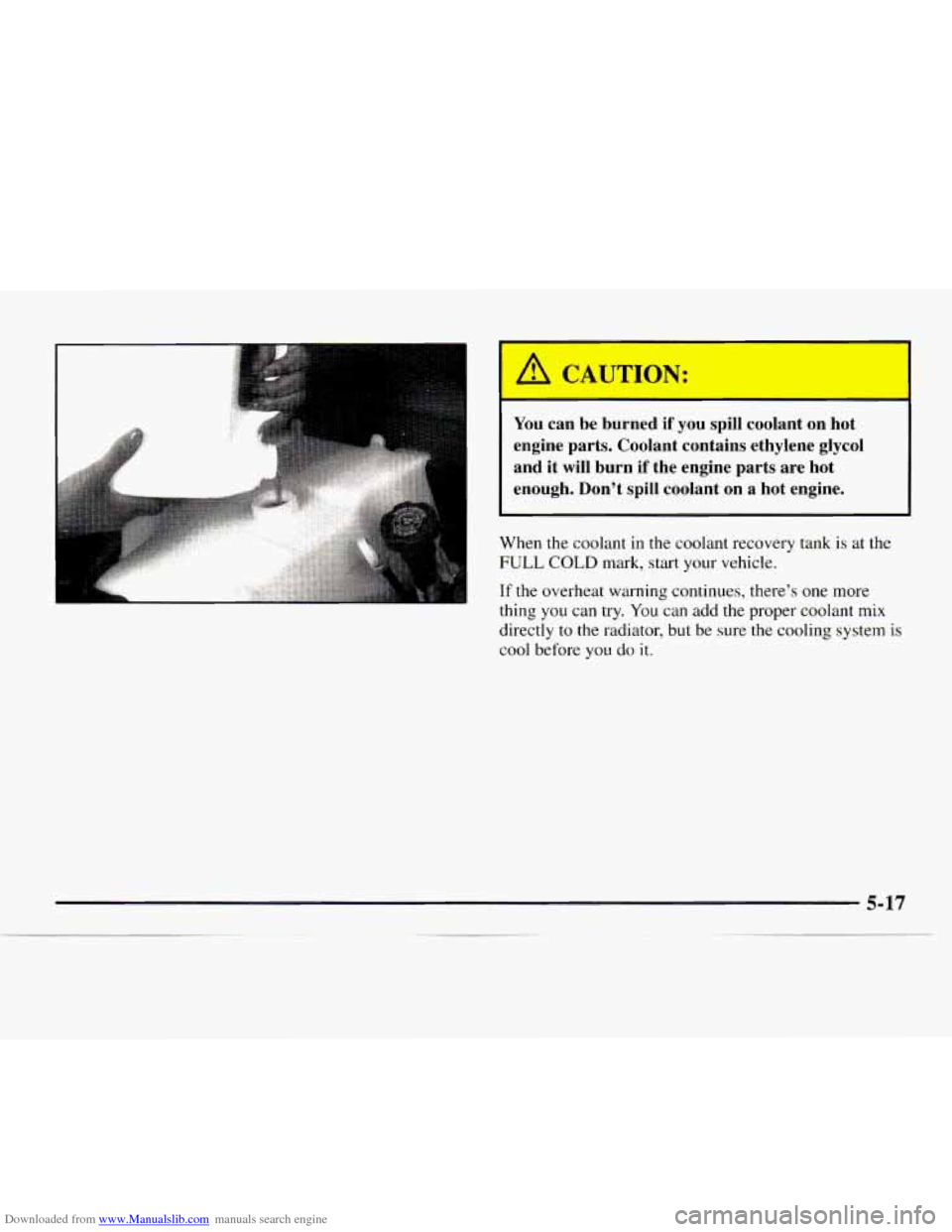
When the coolant in the coolant recovery tank is at the
FULL COLD mark, start your vehicle.
If the overheat warning continues, there's one more
thing
you can try. You can add the proper coolant mix
directly to the radiator, but be sure the cooling system is
cool before you do it.