1997 CHEVROLET EXPRESS steering wheel
[x] Cancel search: steering wheelPage 202 of 386
Downloaded from www.Manualslib.com manuals search engine I I
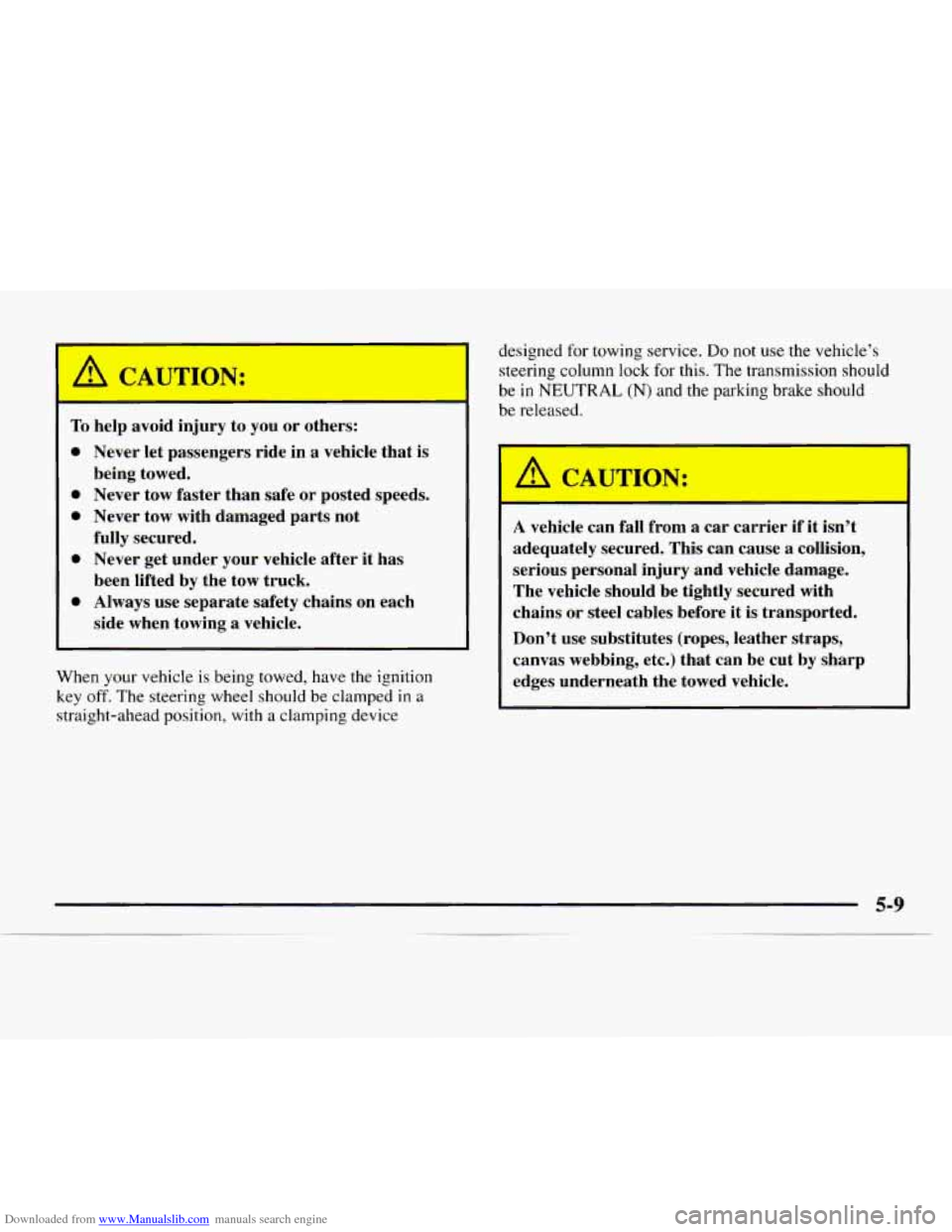
’ A CAUTIO--:
- - -
To help avoid injury to you or others:
0
0
0
0
0
Never let passengers ride in a vehicle that is
being towed.
Never tow faster than safe or posted speeds.
Never tow with damaged parts not
fully secured. Never get under your vehicle after it has
been lifted by the tow truck.
Always use separate safety chains on each
side when towing a vehicle.
When your vehicle is being towed, have the ignition
key
off. The steering wheel should be clamped in a
straight-ahead position, with a clamping device
I designed for towing service. Do not use the vehicle’s
steering column lock for this. The transmission should
be
in NEUTRAL (N) and the parking brake should
be released.
A
,!1 CAUTION:
A vehicle can fall from a car carrier if it isn’t
adequately secured. This can cause a collision,
serious personal injury and vehicle damage.
The vehicle should be tightly secured with
chains or steel cables before it is transported.
Don’t use substitutes (ropes, leather straps,
canvas webbing, etc.) that can be cut by sharp
edges underneath the towed vehicle.
Page 215 of 386
Downloaded from www.Manualslib.com manuals search engine Engine Fan Noise
Your vehicle has a clutched engine cooling fan. When the
clutch is engaged, the fan spins faster to provide more air
to cool the engine. In most everyday driving conditions,
the fan is spinning slower and the clutch is not fully
engaged. This improves fuel economy and reduces fan
noise. Under heavy vehicle loading, trailer towing and/or
high outside temperatures, the fan speed increases as the
clutch more fully engages.
So you may hear an increase
in fan noise. This is normal and should
not be mistaken
as the transmission slipping or making extra shifts. It
is
merely the cooling system functioning properly. The fan
will slow down when additional cooling is not required
and
the clutch partially disengages.
You may also hear this fan noise when you start the engine.
It will go away as the fan clutch partially disengages.
If a Tire Goes Flat
It’s unusual for a tire to “blow out” while you’re driving,
especially
if you maintain your tires properly. If air goes
out of a tire, it’s much more likely to leak
out slowly.
But
if you should ever have a “blowout,” here are a
few tips about what to expect and what to do:
If a front tire fails, the flat tire will create a drag that
pulls the vehicle toward that side. Take your foot
off the
accelerator pedal and grip the steering wheel firmly.
Steer to maintain lane position, and then gently brake to
a stop well
out of the traffic lane.
A rear blowout, particularly on a curve, acts much like
a skid and may require
the same correction you’d use
in
a skid. In any rear blowout, remove your foot from
the accelerator pedal. Get the vehicle under control by
steering the way you want the vehicle
to go. It may be
very bumpy and noisy, but
you can still steer. Gently
brake
to a stop -- well off the road if possible.
If
a tire goes flat, the next part shows how to use your
jacking equipment to change
a flat tire safely.
5-22
Page 231 of 386

Downloaded from www.Manualslib.com manuals search engine NOTICE:
Spinning your wheels can destroy parts of your
vehicle as
well as the tires. If you spin the wheels
too fast while shifting
your transmission back
and forth, you can destroy your transmission.
For information about using tire chains on your vehicle,
see “Tire Chains” in the Index.
Rocking Your Vehicle To Get It Out
First, turn your steering wheel left and right. That will
clear the area around your front wheels. Then shift back
and forth between REVERSE (R) and a forward gear,
spinning
the wheels as little as possible. Release the
accelerator pedal while you shift, and press lightly
on
the accelerator pedal when the transmission is in gear.
If that doesn’t get you out after a few tries,
you may
need to be towed out. If you do need
to be towed out,
see “Towing Your Vehicle” in the Index.
Page 234 of 386

Downloaded from www.Manualslib.com manuals search engine Section 6 Service and Appearance Care
Here you will find information about the care of your vehicle. This section begins with service and fuel information,
and then it shows how to check important fluid and lubricant levels. There
is also technical information about your
vehicle, and
a part devoted to its appearance care.
6-2
6-3
6-5
6-5
6-7
6-1 1
6-12 6-17
6-18
6-22
6-22
6-25
6-26 6-26
6-27
6-28 6-32 Service
Fuel (Gasoline Engine)
Fuels in Foreign Countries
Filling Your Tank
Checking Things Under the Hood
Noise Control System
Engine Oil (Gasoline Engine)
Air Cleaner (Gasoline Engines)
Automatic Transmission Fluid
Rear Axle
Engine Coolant Radiator Pressure Cap
Thermostat Power Steering Fluid
Windshield Washer Fluid
Brakes
Battery 6-32
6-32
6-40
6-4
1
6-49
6-50
6-54
6-55
6-55
6-55
6-56
6-57
6-5 8
6-59
6-63
6-66
6-67 Bulb Replacement
Halogen Bulbs
Windshield Wiper Blade Replacement
Tires Appearance Care
Cleaning the Inside
of Your Vehicle
Cleaning the Outside of Your Vehicle
Cleaning Aluminum Wheels
(If Equipped)
Cleaning Tires Sheet Metal Damage
Finish Damage
Appearance Care Materials Chart
Vehicle Identification Number (VIN)
Electrical System
Capacities and Specifications
Air Conditioning Refrigerants
Lamp and Bulb Data
Page 380 of 386
Downloaded from www.Manualslib.com manuals search engine Paint Spotting. Chemical ........................ 6-56
Park Automatic Transmission
....................... 2-24
Shifting Out of
............................... 2-27
AtNight
.................................... 2-15
Brake
...................................... 2-23
Brake Mechanism Check
....................... 7-48
Lots
....................................... 2-15
OverThingsThatBurn
........................ 2-27
With a Trailer
................................ 4-37
Passenger Position
.............................. 1-25
Passenger Temperature Control
..................... 3-5
Passing
....................................... 4-12
Periodic Maintenance Inspections
.................. 7-49
Power
Antenna Mast Care
............................ 3-28
DoorLocks
................................... 2-5
Option Fuses
................................ 6-60
Remote Control Mirror
........................ 2-43
Seat
......................................... 1-3
Steering ..................................... 4-9
Steering Fluid
................................ 6-26
Windows
................................... 2-29
Power Seat
Pregnancy. Use of Safety Belts
.................... 1-24
Problems on the Road
............................ 5-1
Publications. Service and Owner ................... 8-1 1
Shifting Into ................................. 2-24
Parking Radiator
..................................... 5-19
Radiator Pressure Cap
............................ 6-25
Radio Reception
................................ 3-26
Radios
......................... 3.9.3.11.3.13. 3.18
Rain. Driving In
................................ 4-16
Reading Lamps
................................ 2-41
Rear Axle
....................................... 6-22
Door Security Locks
........................... 2-5
Outside Seat Position
.......................... 1-32
Seatpassengers
.............................. 1-32
Towing
..................................... 5-11
Rearview Mirror
................................ 2-43
Reclining Front Seatbacks
......................... 1-3
Recommended Fluids and Lubricants
............... 7-51
Recovery Tank. Coolant
.......................... 5-16
Refrigerants. Air Conditioning
.................... 6-67
Remote Compact Disc Player
..................... 3-22
Replacement Bulbs
...................................... 6-68
Parts
....................................... 6-67
Wheel
...................................... 6-47
Replacing Safety Belts
........................... 1-52
Reporting Safety Defects
......................... 8-10
Restraints
Checking
................................... 1-52
Child
....................................... 1-40
Head
........................................ 1-5
System Check
................................ 7-46
Reverse. Automatic Transmission
.................. 2-21
Replacing Parts After
a Crash
................... 1-52
9-7
Page 382 of 386
Downloaded from www.Manualslib.com manuals search engine Shifting Automatic Transmission
....................... 2-20
Into Park (P)
................................. 2-24
OutofPark
.................................. 2-27
Shoulder Belt Height Adjuster
..................... 1 . 18
Sidemarker Lamp Bulb Replacement
............... 6-36
Signaling Turns
................................ 2-33
SIR
.......................................... 1-25
Skidding ...................................... 4-13
Specifications and Capacities
...................... 6-64
Speech Impaired. Customer Assistance
............... 8-4
Speedometer
................................... 2-49
Stains. Cleaning
................................ 6-50
Starter Switch Check
............................ 7-46
Starting Your Engine
............................ 2-17
Steam
........................................ 5-12
Steering
....................................... 4-9
In Emergencies
............................... 4- 10
Power ....................................... 4-9
Tips
......................................... 4-9
Wheel. Tilt
.................................. 2-32
StorageAreas
.................................. 2-44
Storage. Vehicle
................................ 6-32
Stuck: In Sand. Mud. Ice or Snow
.................. 5-37
Sunvisors
.................................... 2-46
Supplemental Inflatable Restraint
.................. 1-25
Symbols. Vehicle
.................................. v
Taillamp Bulb Replacement ...................... 6-37
Tape Player Care
............................... 3-27 Temperature Control.
Climate Control System
......... 3-2
Temperature Control. Passenger
.................... 3-5
Theft
......................................... 2-15
Theft-Deterrent Feature
.......................... 3-23
Thermostat
.................................... 6-26
Third Gear. Automatic Transmission
................ 2-22
Tilt Steering Wheel
............................. 2-32
Time. Setting the
................................ 3-8
Tirechains
.................................... 6-49
Tire-Loading Information Label
................... 4-27
Tires
......................................... 6-41
BuyingNew
................................. 6-45
Chains
..................................... 6-49
ChangingaFlat
.............................. 5-23
Cleaning
.................................... 6-55
Dual Operation
............................... 6-45
Inflation
.................................... 6-42
Inflation Check
............................... 7-45
Inspection and Rotation
........................ 6-43
Loading
.................................... 4-27
Pressure
.................................... 6-42
Temperature
................................. 6-47
Traction
.................................... 6-46
Treadwear
................................... 6-46
Uniform Quality Grading
....................... 6-46
Wear Indicators
.............................. 6-44
Wheel Replacement
........................... 6-47
When It’s Time for New
....................... 6-44
TireLoading
................................... 4-27
Alignment and Balance
........................ 6-47
9-9