Page 256 of 386
Downloaded from www.Manualslib.com manuals search engine NOTICE:
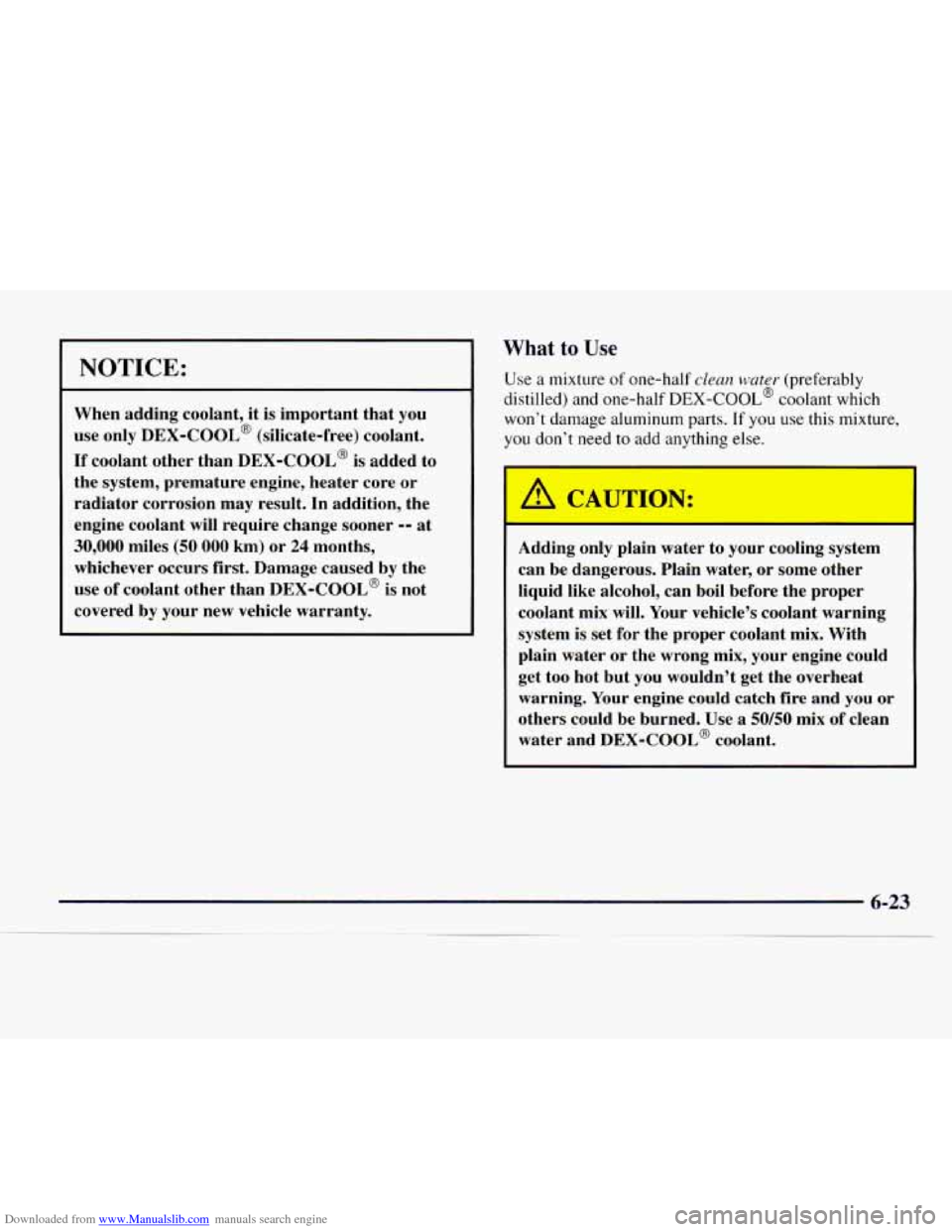
When adding coolant, it is important that you
use only
DEX-COOL@ (silicate-free) coolant.
If coolant other than DEX-COOL@ is added to
the system, premature engine, heater core or
radiator corrosion may result.
In addition, the
engine coolant will require change sooner
-- at
30,000 miles (50 000 km) or 24 months,
whichever occurs first. Damage caused by the
use of coolant other than DEX-COOL@ is not
covered by your new vehicle warranty.
What to Use
Use a mixture of one-half clean water (preferably
distilled) and one-half
DEX-COOL@ coolant which
won’t damage aluminum parts.
If you use this mixture,
you don’t need to add anything else.
I
I
Adding only plain water to your cooling system
can be dangerous. Plain water,
or some other
liquid like alcohol, can boil before the proper
coolant mix will. Your vehicle’s coolant warning
system is set for the proper coolant mix. With
plain water or the wrong mix, your engine could
get too hot but you wouldn’t get the overheat
warning. Your engine could catch fire and you or
others could be burned. Use a
50/50 mix of clean
water and DEX-COOL@ coolant.
Page 257 of 386
Downloaded from www.Manualslib.com manuals search engine NOTICE:
If you use an improper coolant mix, your engine
could overheat and be badly damaged. The
repair cost wouldn’t be covered by your
warranty.
Too much water in the mix can freeze
and crack the engine, radiator, heater core and
other parts.
If you have to add coolant more than four times a year,
have your dealer check your cooling
system.
1 NOTICE:
If you use the proper coolant, you don’t have to
add extra inhibitors or additives which claim to
improve the system. These can be harmful.
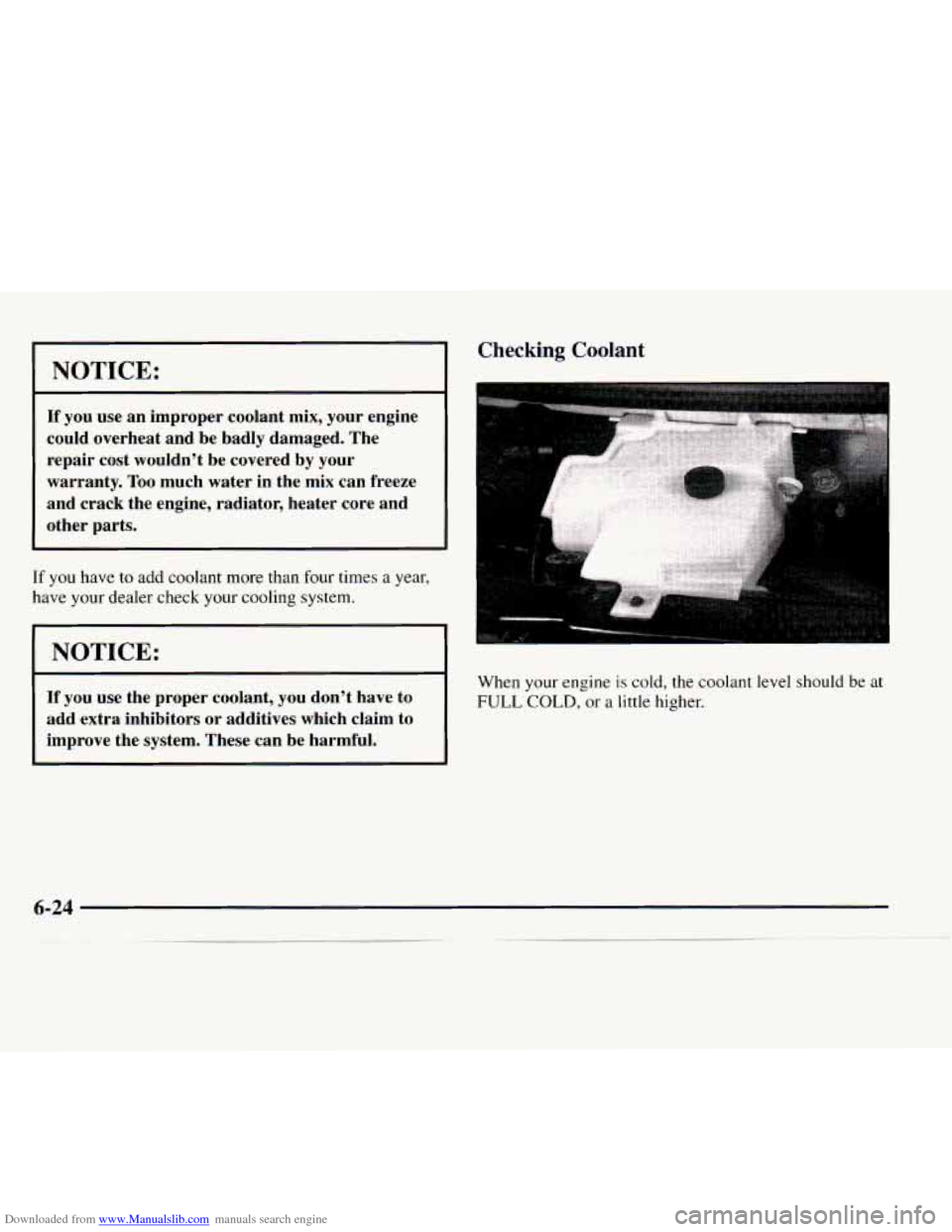
Checking Coolant
When your engine is cold, the coolant level should be at
FULL COLD, or a little higher.
Page 259 of 386

Downloaded from www.Manualslib.com manuals search engine Thermostat
Engine coolant temperature is controlled by a thermostat
in the engine cooling system. The thermostat stops the
flow of coolant through the radiator until the coolant
reaches a preset temperature.
When you replace your thermostat, an
AC@ thermostat
is recommended.
Power Steering Fluid
When to Check Power Steering Fluid
It is not necessary to regularly check power steering
fluid unless you suspect there is a leak in the system or
you hear an unusual noise.
A fluid loss in this system
could indicate a problem. Have the system inspected
and repaired.
How To Check Power Steering Fluid
When the engine compartment is cool, wipe the cap and
top
of the reservoir clean, then unscrew the cap and
wipe the dipstick with
a clean rag. Replace the cap and
completely tighten it. Then remove the cap again and
look at the fluid level on the dipstick.
The level should be at the
FULL COLD mark. If
necessary, add only enough fluid to bring the level up
to the mark.
To prevent brake fluid contamination never check or fill
the power steering reservoir with the master cylinder
cover
off.
What to Use
To determine what kind of fluid to use, see
“Recommended Fluids and Lubricants”
in the Index.
Always use the proper fluid. Failure
to use the proper
fluid can cause leaks and damage hoses and seals.
6-26
Page 281 of 386

Downloaded from www.Manualslib.com manuals search engine Using the wrong replacement wheels, wheel
bolts or wheel nuts on your vehicle can be
dangerous.
It could affect the braking and
handling
of your vehicle, make your tires lose
air and make you lose control. You could have a
collision in which you
or others could be injured.
Always use the correct wheel, wheel bolts and
wheel nuts
for replacement.
I NOTICE:
The wrong wheel can also cause problems with
bearing life, brake cooling, speedometer or
odometer calibration, headlamp aim, bumper
height, vehicle ground clearance and tire or tire
chain clearance to the body and chassis.
Whenever a wheel, wheel bolt or wheel nut is replaced
on a dual wheel setup, check the wheel nut torque after
100, 1,000 and 6,000 miles (I 60, 1 600 and 10 000 km)
of driving. For proper torque, see “Wheel Nut Torque”
in the Index.
See “Changing a Flat Tire” in the Index for
more information.
Used Replacement Wheels
Putting a used wheel on your vehicle is
dangerous. You can’t know how it’s been used or
how far it’s been driven. It could fail suddenly
and cause an accident.
If you have to replace a
wheel, use a new GM original equipment wheel.
6-48
Page 298 of 386
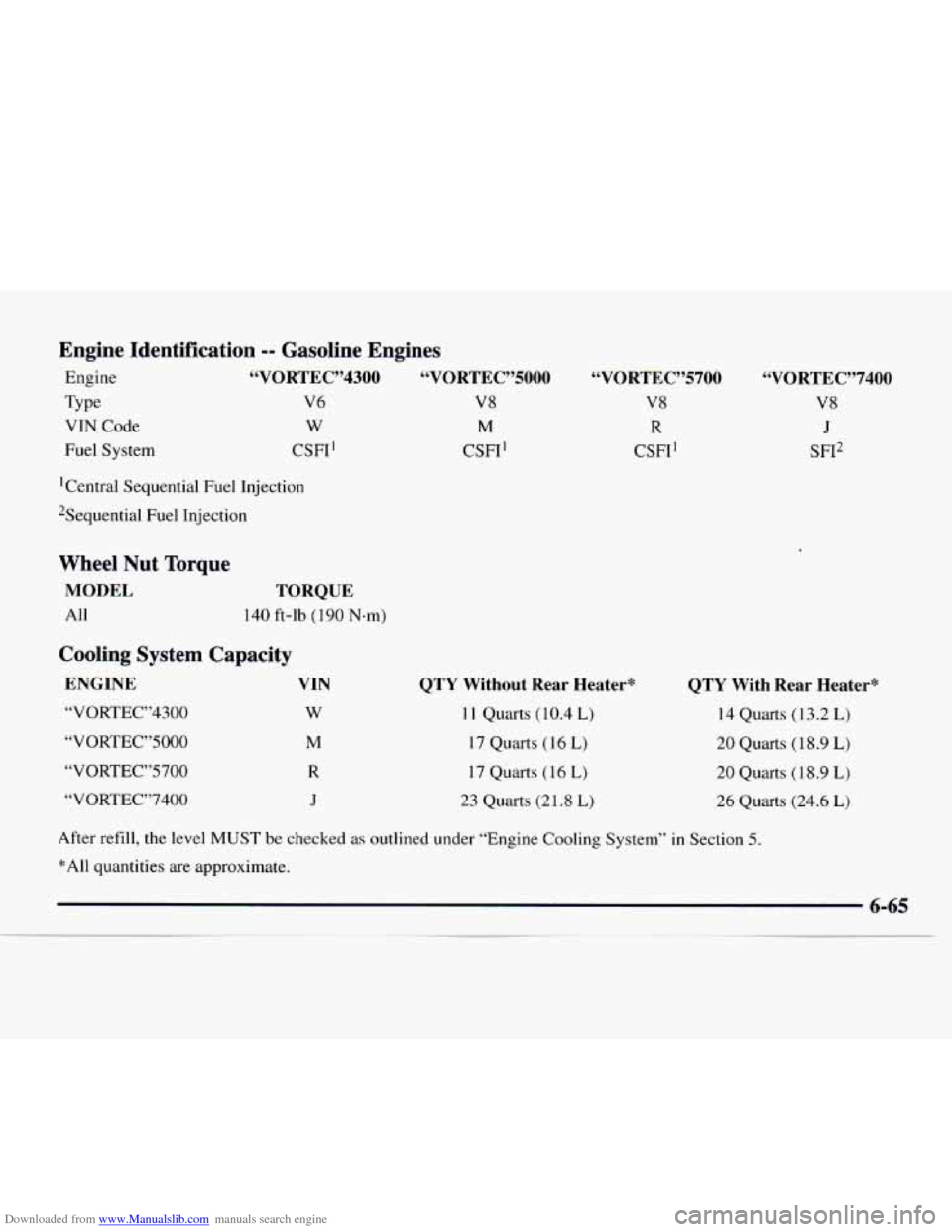
Downloaded from www.Manualslib.com manuals search engine Engine Identification -- Gasoline Engines
Type V6 V8 Engine
“VORTEC”4300 “VORTEC”5000
VIN Code W M
Fuel System CSFI~ CSFI 1
Central Sequential Fuel
Injection
2Sequential Fuel Injection
Wheel Nut Torque
MODEL
All
TORQUE
140 ft-lb (1 90 N-m)
Cooling System Capacity
ENGINE VIN
“VORTEC”4300 W
“VORTEC”5000 M
“VORTEC”5700 R
“VORTEC”7400 J
“VORTEC”5700
V8
R
CSFI 1
“VORTEC”7400
V8
J
SFI*
QTY Without Rear Heater*
1 1 Quarts (10.4 L)
17 Quarts ( 16 L)
17 Quarts ( 16 L)
23 Quarts (21.8 L)
QTY With Rear Heater*
14 Quarts (13.2 L)
20 Quarts (18.9 L)
20 Quarts (18.9 L)
26 Quarts (24.6 L)
After refill, the level MUST be checked as outlined under “Engine Cooling System” in Section 5.
*All quantities are approximate.
Page 309 of 386
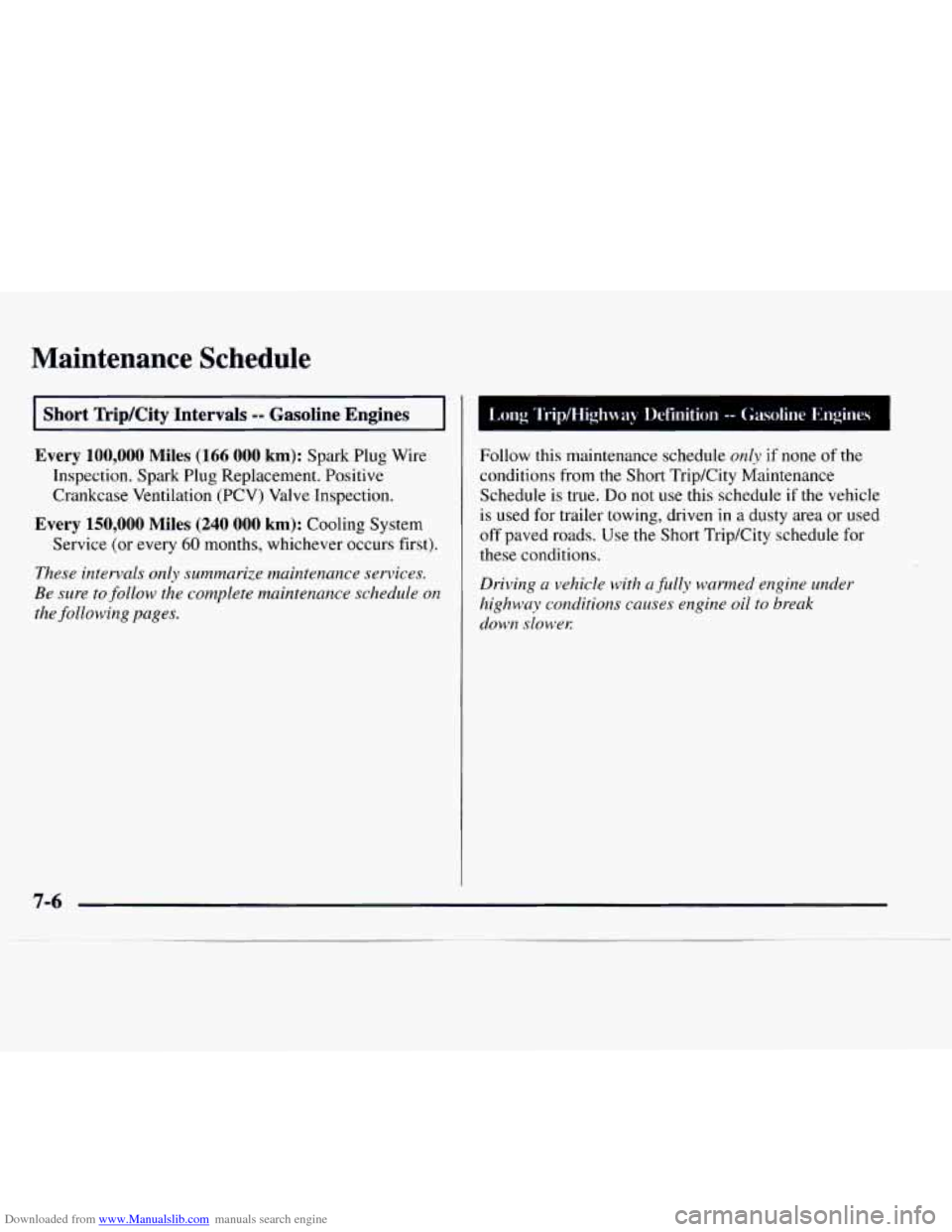
Downloaded from www.Manualslib.com manuals search engine Maintenance Schedule
I Short TripKity Intervals -- Gasom
Every 100,000 Miles (166 000 km): Spark Plug Wire
Inspection. Spark Plug Replacement. Positive
Crankcase Ventilation (PCV) Valve Inspection.
Every 150,000 Miles (240 000 km): Cooling System
These intervals only summarize maintenance services.
Be sure to-follow the complete maintenance schedule on
the following pages.
Service (or every 60 months, whichever occurs first).
I
Follow this maintenance schedule only if none of the
conditions from
the Short Trip/City Maintenance
Schedule is true.
Do not use this schedule if the vehicle
is used
for trailer towing, driven in a dusty area or used
off paved roads. Use the Short Trip/City schedule for
these conditions.
Driving a vehicle with ~l$dly warmed engine under
highway conditions causes engine
oil to break
down slower:
Page 310 of 386
Downloaded from www.Manualslib.com manuals search engine Maintenance Schedule
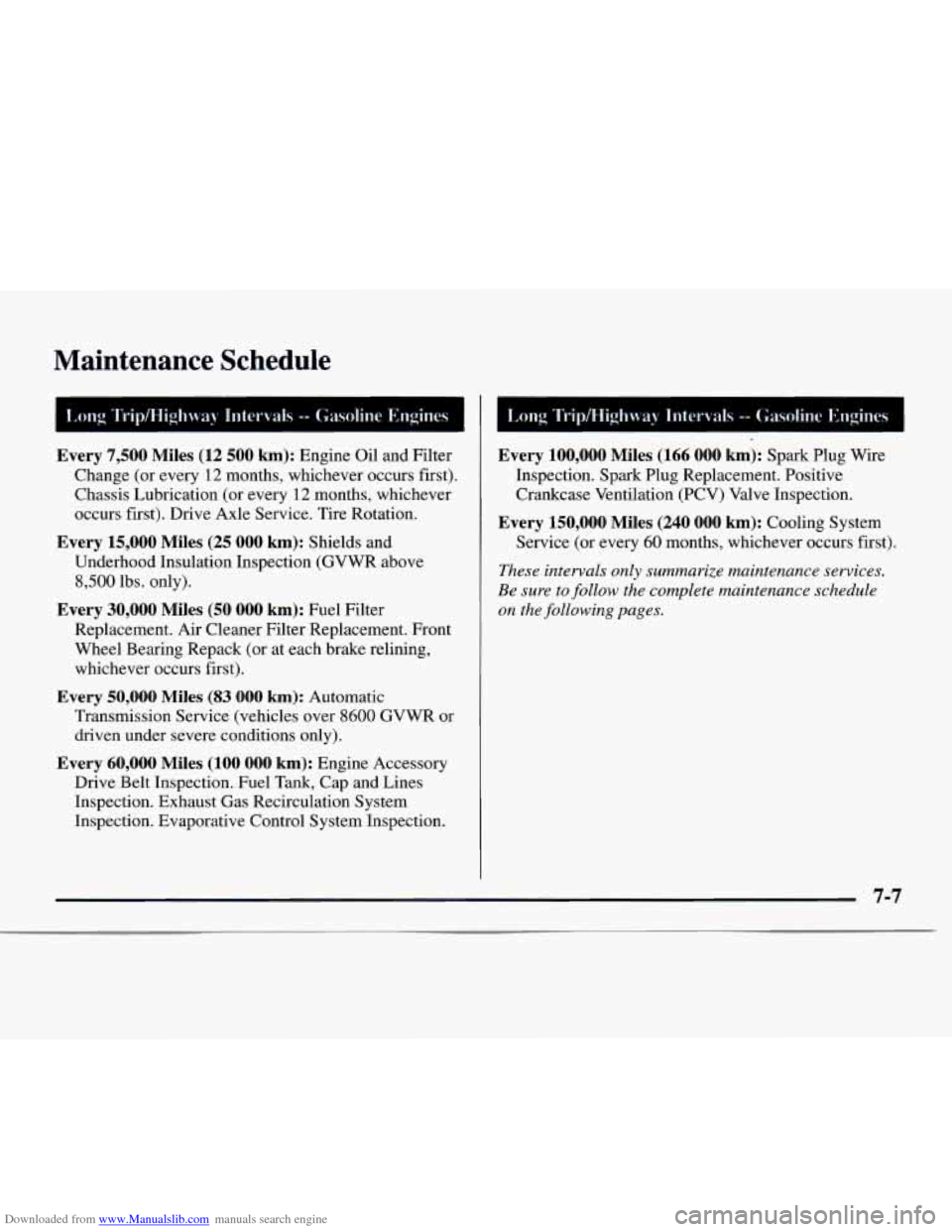
Every 7,500 Miles (12 500 km): Engine Oil and Filter
Change (or every
12 months, whichever occurs first).
Chassis Lubrication (or every
12 months, whichever
occurs first). Drive Axle Service. Tire Rotation.
Every 15,000 Miles (25 000 km): Shields and
Underhood Insulation Inspection (GVWR above
8,500 lbs. only).
Every 30,000 Miles (50 000 km): Fuel Filter
Replacement. Air Cleaner Filter Replacement. Front
Wheel Bearing Repack (or at each brake relining,
whichever occurs first).
Every 50,000 Miles (83 000 km): Automatic
Transmission Service (vehicles over
8600 GVWR or
driven under severe conditions only).
Every 60,000 Miles (100 000 km): Engine Accessory
Drive Belt Inspection. Fuel Tank, Cap and Lines
Inspection. Exhaust Gas Recirculation System
Inspection. Evaporative Control System Inspection.
I Long Tripmighway Intervals -- Gasoline Engines 1
Every 100,000 Miles (166 000 km): Spark Plug Wire
Inspection. Spark Plug Replacement. Positive
Crankcase Ventilation (PCV) Valve Inspection.
Every 150,000 Miles (240 000 km): Cooling System
Service (or every
60 months, whichever occurs first).
These intervals only summarize maintenance services.
Be sure to follow the complete maintenance schedule
on the following pages.
7-7
Page 334 of 386
Downloaded from www.Manualslib.com manuals search engine I Short ’IYipKity Maintenance Schedule =- Gasoline Engines I
- In hilly or mountainous terrain.
- When doing frequent trailer towing.
- Uses such as found in taxi, police or
delivery service.
IJ’yo~1 do not use your vehicle under any of these
conditions, the.fluid
and.filter do not require changing.
0 Inspect Positive Crankcase Ventilation
(Pcv) valve.
An Emission Control Service.
I I I 1
DATE
SERVICED BY ACTUAL MILEAGE
150,000 Miles (240 000 km)
0 Drain, flush and refill cooling system
(or every
60 months since last service,
whichever occurs first). See “Engine
Coolant” in the Index for
what to use.
Inspect hoses. Clean radiator, condenser,
pressure cap and neck. Pressure test cooling
system and pressure cap.
An Emission Control Service.
DATE SERVICED BY ACTUAL MILEAGE