1997 CHEVROLET EXPRESS change time
[x] Cancel search: change timePage 182 of 386
Downloaded from www.Manualslib.com manuals search engine Towing a Trailer
A CAUTION:
If you don’t use the correct equipment and drive
properly, you can lose control when you pull
a
trailer. For example, if the trailer is too heavy, the
brakes
may not work well -- or even at all. You
and your passengers could be seriously injured.
Pull
a trailer only if you have followed all the
steps in this section.
Ask your GM dealer for
advice and information about towing a trailer
with your vehicle.
NOTICE:
Pulling a trailer improperly can damage your
vehicle and result in costly repairs not covered by
your warranty.
To pull a trailer correctly, follow
the advice in this part, and see your
GM dealer
for important information about towing
a trailer
with your vehicle.
Your vehicle can tow a trailer. To identify what the
vehicle trailering capacity is for your vehicle, you
should read the information in “Weight of the Trailer’’
that appears later
in this section. But trailering is
different than just driving your vehicle by itself.
Trailering means changes in handling, durability and
fuel economy. Successful, safe trailering takes correct
equipment, and it has
to be used properly.
That’s the reason for this section.
In it are many
time-tested, important trailering tips and safety rules.
Many
of these are important for your safety and that of
your passengers. So please read this section carefully
before you pull a trailer.
Page 226 of 386
Downloaded from www.Manualslib.com manuals search engine A CAUTION:
Rust or dirt on the wheel, or on the parts to
which it is fastened, can make the wheel nuts
become loose after
a time. The wheel could come
off and cause an accident. When you change
a
wheel, remove any rust or dirt from the places
where the wheel attaches to the vehicle. In an
emergency, you can use a cloth or
a paper towel
to do this; but be sure to use
a scraper or wire
brush later, if you need to, to get all the rust or
dirt off.
A CAUTION:
Never use oil or grease on studs or nuts. If you
do, the nuts might come loose. Your wheel could
fall off, causing a serious accident.
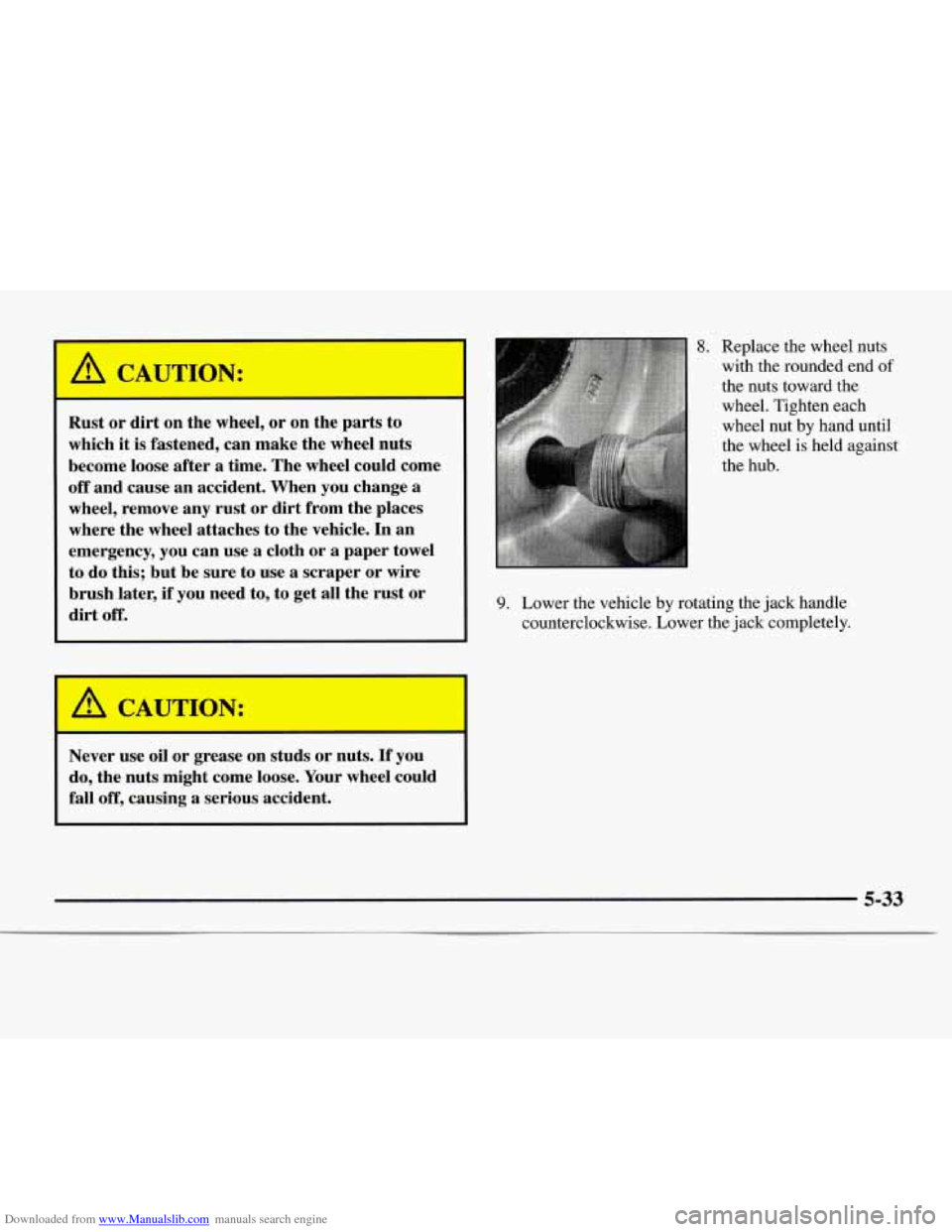
8. Replace the wheel nuts
with the rounded end
of
the nuts toward the
wheel. Tighten each
wheel nut by hand until
the wheel is held against
the hub.
9. Lower the vehicle by rotating the jack handle
counterclockwise. Lower the jack completely.
5-33
Page 251 of 386

Downloaded from www.Manualslib.com manuals search engine Operating the engine with the air cleaner off
can cause you or others to be burned. The air
cleaner not only cleans the air,
it stops flame if
the engine backfires. If it isn’t there, and the
engine backfires, you could be burned. Don’t
drive with it
off, and be careful working on the
engine with the air cleaner off.
NOTICE:
If the air cleaner is off, a backfire can cause a
damaging engine fire. And, dirt can easily get
into your engine, which will damage it. Always
have the
air cleaner in place when you’re driving.
Automatic Transmission Fluid
When to Check and Change
A good time to check your automatic transmission fluid
level is when the engine oil is changed.
Change both the fluid and filter every
50,000 miles
(83 000 km) if the vehicle’s GVWR is over 8,600 or
if the vehicle is mainly driven under one or more of
these conditions:
0 In heavy city traffic where the outside temperature
regularly reaches
90°F (32°C) or higher.
0 In hilly or mountainous terrain.
0 When doing frequent trailer towing.
0 Uses such as found in taxi, police or delivery service.
If your vehicle’s
GVWR is not over 8,600 and you do
not use your vehicle under any of these conditions, the
fluid and filter do not require changing.
See “Scheduled Maintenance Services”
in the Index.
Page 264 of 386
Downloaded from www.Manualslib.com manuals search engine Some driving conditions or climates may cause a brake
squeal when the brakes are first applied or lightly
applied. This does
not mean something is wrong with
your brakes.
Properly torqued wheel
nuts are necessary to help
prevent brake pulsation. When tires are rotated, inspect
brake pads for wear and evenly torque wheel nuts in the
proper sequence to
GM specifications.
Your rear drum brakes don’t have wear indicators, but
if you ever hear a rear brake rubbing noise, have the
rear brake linings inspected. Also, the rear brake drums
should be removed and inspected each time the tires
are removed for rotation or changing. When you have
the front brake pads replaced, have the rear brakes
inspected,
too.
Brake linings should always be replaced as complete
axle sets.
See “Brake System Inspection” in Section
7 of this
manual under Part
C “Periodic Maintenance
Inspections”.
Brake Pedal Travel
See your dealer if the brake pedal does not return to
normal height, or if there is a rapid increase in pedal
travel. This could be
a sign of brake trouble.
Brake Adjustment
Every time you make a brake stop, your disc brakes
adjust for wear.
If your brake pedal goes down farther than normal, your
rear drum brakes may need adjustment. Adjust them by
backing up and firmly applying the brakes a few times.
Replacing Brake System Parts
The braking system on a modern vehicle is complex.
Its many parts have to be
of top quality and work well
together if the vehicle is to have really good braking.
Your vehicle was designed and tested with top-quality
GM brake parts. When you replace parts of your braking
system
-- for example, when your brake linings wear
down and you have
to have new ones put in -- be sure
you get new approved
GM replacement parts. If you
don’t, your brakes may no longer work properly. For
example,
if someone puts in brake linings that are wrong
for your vehicle, the balance between your front and
rear brakes can change
-- for the worse. The braking
performance you’ve come to expect can change in many
other ways
if someone puts in the wrong replacement
brake parts.
Page 277 of 386

Downloaded from www.Manualslib.com manuals search engine After the tires have been rotated, adjust the front and rear
inflation pressures as shown on the Certificatioflire label.
Make certain that
all wheel nuts are properly tightened.
See “Wheel Nut Torque” in the Index.
1
Rust or dirt on a wheel, or on the parts to which
it is fastened, can make wheel nuts become loose
after
a time. The wheel could come off and cause
an accident. When you change
a wheel, remove
any rust or dirt from places where the wheel
attaches to the vehicle. In
an emergency, you can
use a cloth or a paper towel to do this; but be
sure to use
a scraper or wire brush later, if you
need to, to get all the rust or dirt
off. (See
“Changing a Flat Tire” in the Index.) When
It’s Time
for New Tires
One way to tell when it’s
time for new tires is to
check the treadwear
indicators, which will
appear when your tires have
only
1/16 inch (1.6 mm) or
less
of tread remaining.
Some commercial truck
tires may not have
treadwear indicators.
You need
a new tire if any of the following statements
are true:
0 You can see the indicators at three or more places
0 You can see cord or fabric showing through the
around the tire.
tire’s rubber.
0 The tread or sidewall is cracked, cut or snagged deep
enough
to show cord or fabric.
0 The tire has a bump, bulge or split.
0 The tire has a puncture, cut or other damage that
can’t be repaired well because
of the size or location
of the damage.
6-44
, , , .
Page 297 of 386

Downloaded from www.Manualslib.com manuals search engine Name
RH-HIBM
ECM-I
HORN LH-HDLP
LH-HIBM
FUEL SOL
IGN-E
ECM-B
Circuits Protected
Right-hand High-beam Headlamp (Export Only)
Ignition Coil, Crankshaft Position
Sensor, VCM, Fuel Injectors,
Coil Driver
Horn Relay, Underhood Lamp(
s)
Left-hand Headlamp
(Export Only)
Left-hand High-beam Headlamp (Export Only)
PCM,
Fuel Solenoid Driver,
Engine Shutoff Solenoid
Air Conditioning Clutch Relay
Fuel Pump Relay, VCM, PCM,
Fuel Pump and Engine Oil
Pressure Switch
Capacities and Specifications
Replacement Parts
Replacement part numbers listed in this section are
based on the latest information available at the time
of
printing, and are subject to change. If a part listed in this
manual
is not the same as the part used in your vehicle
when
it was built, or if you have any questions, please
contact your
GM truck dealer.
These specifications are for information only. If you
have any questions, see the service manual for the
chassis
or refer to the body manufacturer’s publications.
Page 311 of 386

Downloaded from www.Manualslib.com manuals search engine I Short TripKity Maintenance Schedule =- Gasoline Engines I
The services shown in this schedule up to 100,000 miles
(1 66 000 km) should be performed after 100,000 miles
(166
000 km) at the same intervals. The services shown
at 150,000 miles
(240 000 km) should be performed at
the same interval after 150,000 miles (240 000 km).
See “Owner Checks and Services” and “Periodic
Maintenance Inspections” following.
Footnotes
3- The U.S. Environmental Protection Agency or the
California Air Resources Board has determined that the
failure to perform this maintenance item will
not nullify
the emission warranty or limit recall liability prior
to the
completion of the vehicle’s useful life. We, however,
urge that all recommended maintenance services be
performed at the indicated intervals and the maintenance
be recorded.
# Lubricate the front suspension, kingpin bushings,
steering linkage and rear driveline center splines.
+ A good time to check your brakes is during tire
rotation. See “Brake System Inspection’’ under “Periodic
Maintenance Inspection’’ in Part
C of this schedule.
** Drive axle service (see “Recommended Fluids and
Lubricants’’
in the Index for proper lubricant to use):
0
0
0
Locking Differential -- Drain fluid and refill at first
engine
oil change. At subsequent oil changes, check
fluid level and add fluid as needed.
If driving in
dusty areas or towing a trailer, drain fluid and refill
every 15,000 miles (25
000 km).
Standard Differential
-- Check fluid level and add
fluid as needed at every oil change. If driving in
dusty areas or towing a trailer, drain fluid and refill
every
15,000 miles (25 000 km).
More frequent lubrication may be required for
heavy-duty use.
Page 335 of 386

Downloaded from www.Manualslib.com manuals search engine Long Trip/Highway Maintenance Schedule -- Gasoline Engines I
The services shown in this schedule up to 100,000 miles
(166 000 km) should be performed after 100,000 miles
(166 000 km) at the same intervals. The services shown
at 150,000 miles
(240 000 km) should be performed at
the same interval after
150,000 miles (240 000 km).
See “Owner Checks and Services” and “Periodic
Maintenance Inspections” following.
Footnotes
ri‘ The U.S. Environmental Protection Agency or the
California Air Resources Board has determined that the
failure to perform this maintenance item will not
nullify
the emission warranty or limit recall liability prior to the
completion of the vehicle’s useful
life. We, however,
urge that all recommended maintenance services be
performed at the indicated intervals and the maintenance
be recorded.
## Lubricate the front suspension, kingpin bushings,
steering linkage and rear driveline center splines.
+ A good time to check your brakes is during tire
rotation. See “Brake System Inspection” under “Periodic
Maintenance Inspections”
in Part C of this schedule.
** Drive axle service (see “Recommended Fluids and
Lubricants”
in the Index for proper lubricant to use):
Locking Differential -- Drain fluid and refill at first
engine oil change. At subsequent
oil changes, check
fluid level and add fluid
as needed.
Standard Differential -- Check fluid level and add
fluid
as needed at every engine oil change.
7-32