Page 51 of 404

Downloaded from www.Manualslib.com manuals search engine a Section 2 Features and Controls
Here you can learn about the many standard and optional features on your Chevrolet, and information on starting,
shifting and braking. Also explained are the instrument panel and the warning systems that tell you
if everything is
working properly
-- and what to do if you have a problem.
2-2
2-4 2-7
2-1
1
2-13 2- 14
2-17
2-18
2-23
2- 24
2-26
2-27
2-29
2-32 Keys
Door Locks
Remote Keyless Entry
Hatch
Theft Vehicle and Content Theft-DeterrentIAlarm
System
PASS-Key@
I1
Feature Customization
New Vehicle “Break-In”
Ignition Positions
Starting Your Engine
Engine Coolant Heater
Automatic Transmission Operation
Manual Transmission
2-3 8
2-42
2-42
2-44
2-44
2-45
2-5 2
2-56
2-5
8
2-60
2-6
1
2-6 1
2-68
2-74
2-77 Parking Brake
Parking Over Things That Burn
Engine Exhaust
Windows
Tilt Steering Wheel
Turn Signalhlultifunction Lever
Lamps
Mirrors Storage Compartments
Ashtray and Lighter
Sun Visors
Accessory Plug
Convertible Top
Instrument Panel
Warning Lights, Gages and Indicators
2-1
Page 58 of 404

Downloaded from www.Manualslib.com manuals search engine Operation Alarmanic Mode
The driver’s door will unlock automatically when
UNLOCK is pressed. If UNLOCK is pressed again
within five seconds, the passenger door will also unlock.
All doors will lock when LOCK is pressed.
The hatch will unlock when the button with the trunk
symbol is pressed twice within five seconds, as long as
the ignition is turned to the
OFF position. If the ignition
is on, the trunk button will only work if the transmission
is in PARK (P) for an automatic transmission, or if the
parking brake
is set on a manual transmission.
The system will turn on the interior lamps for about
40 seconds (or until the ignition switch is turned to the
RUN position), when you unlock
the doors or hatch.
The interior lamps will
go off when you lock the doors.
Operating the Remote Keyless Entry transmitter may
interact with the Vehicle and Content
Theft-DeterrenUAlarm System (if you have this option).
See “Vehicle and Content Theft-DeterrenVAlarm
System” in the Index. If
your vehicle is equipped with the Vehicle and Content
Theft-DeterrenVAlarm System, you will have a fourth
button
on your transmitter. This button is the panic
button. If you are involved in a panic situation, press
this button and your vehicle’s horn will sound and the
headlamps will flash. This will draw needed attention to
you and your vehicle. To turn this feature off, either
push the panic button again or turn the ignition
to the
RUN position. Note:
This feature will not work if your
ignition is on or if the transmitter is
30 feet (9 m) or
more away from your vehicle.
Wansmitter Range
The range of your Remote Keyless Entry system should
be about
3 feet (1 m) up to 30 feet (9 m). At times you
may notice a decrease in the range. This is normal for
the Remote Keyless Entry system. If the transmitter
does not work, or you have
to stand closer to your
vehicle for the transmitter to work:
You may have to replace the battery in your transmitter.
See the instructions for battery replacement.
0 You may be too far from your vehicle. Check your
distance. You may have
to stand closer to your
vehicle in rain or snow.
2-8
Page 62 of 404
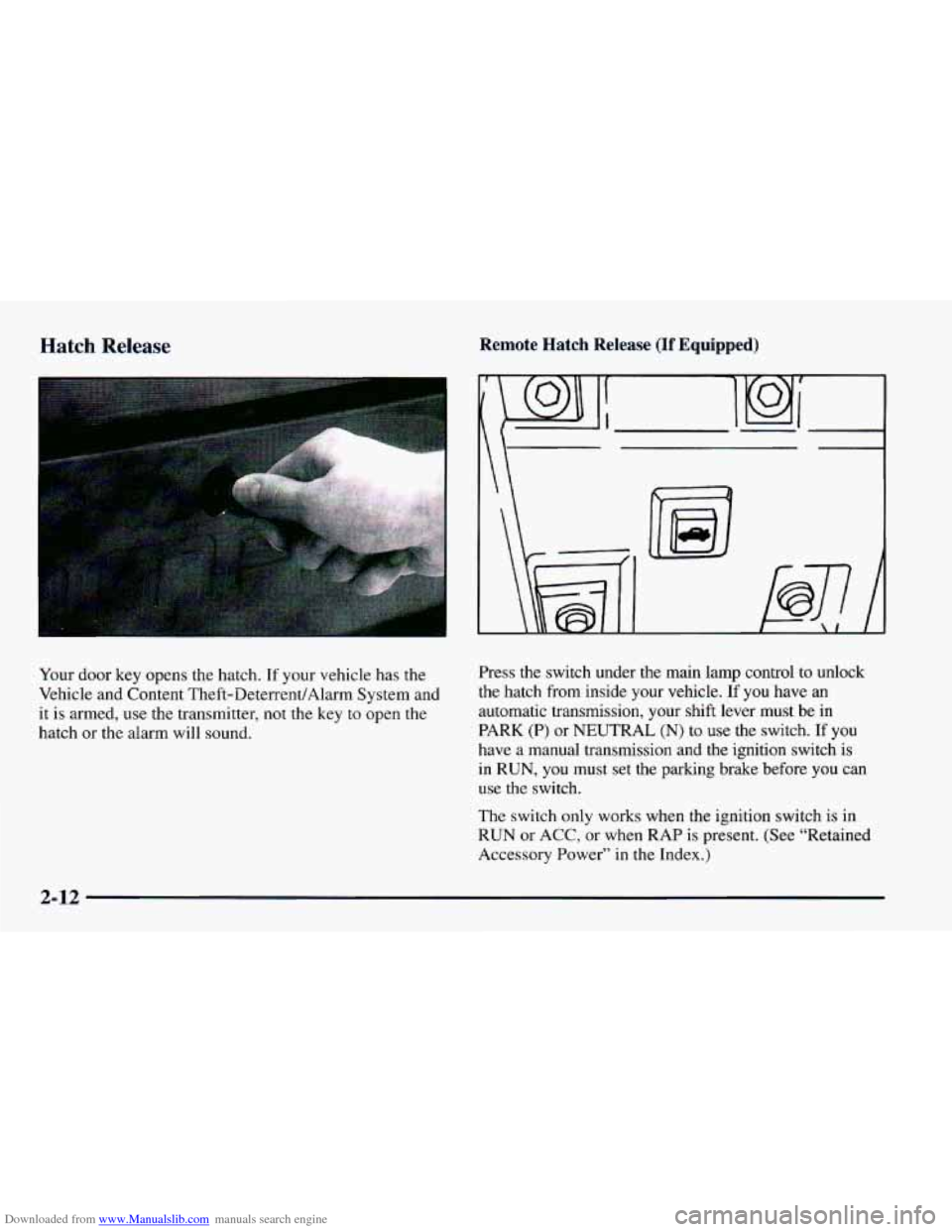
Downloaded from www.Manualslib.com manuals search engine Hatch Release
Your door key opens the hatch. If your vehicle has the
Vehicle and Content Theft-DeterrentlAlarm System and
it is armed, use the transmitter, not the key to open the
hatch or the alarm will sound.
Remote Hatch Release (If Equipped)
\ I
B
Press the switch under the main lamp control to unlock
the hatch from inside your vehicle.
If you have an
automatic transmission, your shift lever must be in
PARK (P) or NEUTRAL
(N) to use the switch. If you
have a manual transmission and the ignition switch is
in RUN, you must set the parking brake before you can
use
the switch.
The switch
only works when the ignition switch is in
RUN or
ACC, or when RAP is present. (See “Retained
Accessory Power”
in the Index.)
2-12
Page 79 of 404
Downloaded from www.Manualslib.com manuals search engine Automatic Transmission Operation
There are several different positions for your shift lever.
PARK (P): This locks your rear wheels. It’s the best
position to use when you start your engine because your
vehicle can’t move easily.
I
It is dangerous to get out of your vehicle if the
shift lever is not fully in PARK
(P) with the
parking brake firmly set. Your vehicle can roll.
Don’t leave your vehicle when the engine
is
running unless you have to. If you have left the
engine running, the vehicle can move suddenly.
You or others could be injured.
To be sure your
vehicle won’t move, even when you’re on
fairly
level ground, always set your parking brake and
move the shift lever to
PARK (P).
See “Shifting Into PARK (P)” in the Index. If
you’re pulling a trailer, see “Towing a Trailer’’ in
the Index.
2-29
Page 83 of 404

Downloaded from www.Manualslib.com manuals search engine SECOND (2): Press the clutch pedal to the floor as you
let
up on the accelerator pedal and shift into SECOND (2).
Then, slowly let up on the clutch pedal as you press the
accelerator pedal.
THIRD (3), FOURTH (4) AND FIFTH (5): Shift into
THIRD
(3), FOURTH (4) and FIFTH (5) the same way
you do for SECOND
(2). Slowly let up on the clutch as
you press the accelerator pedal.
To Stop, let up on the accelerator pedal and press the
brake pedal.
Just before the vehicle stops, press the clutch
pedal and brake pedal, and
shift to NEUTRAL (N).
NEUTRAL (N): Use this position when you start or
idle your engine.
REVERSE (R): To back up, press down the clutch
pedal and shift into REVERSE
(R). Let up on the clutch
pedal slowly while pressing the accelerator pedal.
NOTICE:
Shift to REVERSE (R) only after your vehicle is
stopped. Shifting to REVERSE
(R) while your
vehicle
is moving could damage your
transmission.
Also use REVERSE (R), along with the parking brake,
for parking your vehicle.
2-33
Page 88 of 404
Downloaded from www.Manualslib.com manuals search engine Parking Brake
To set the parking brake, hold the brake pedal down and
pull up on the parking brake lever.
If the ignition is on,
the brake system warning light will come
on.
To release the parking brake, hold the brake pedal down.
Pull
the parking brake lever up until you can push in the
release button. Hold the release button in as
you move
the brake lever all the way down.
2-38
Page 89 of 404
Downloaded from www.Manualslib.com manuals search engine Shifting Into PARK (P) (Automatic
NOTICE: Transmission Models Only)
Driving with the parking brake on can cause
your rear brakes
to overheat. You may have to
replace them, and you could also damage other
parts of your vehicle.
If you are towing a trailer and are parking on any hill,
see “Towing a Trailer” in the
Index. That section shows
what to
do first to keep the trailer from moving.
It can be dangerous to get out of your vehicle if
the shift lever
is not fully in PARK (P) with the
parking brake firmly set. Your vehicle can roll.
If you have left the engine running, the vehicle
can move suddenly. You or others could be
injured.
To be sure your vehicle won’t move, even
when you’re on fairly level ground, use the steps
that follow.
If you’re pulling a trailer, see
“Towing
a Trailer” in the Index.
2-39
Page 90 of 404

Downloaded from www.Manualslib.com manuals search engine 1.
2.
3.
4.
Hold the brake pedal down with your right foot and
set the parking brake.
Move the shift lever into PARK (P) position by
holding in the button on the lever and push the lever
all the way toward the front
of your vehicle.
Move the ignition key to the
LOCK position.
Remove the key and take it with
you. If you can
leave your vehicle with the key in your hand, your
vehicle is in PARK (P).
Leaving Your Vehicle With the Engine
Running
(Automatic Transmission
Models
Only)
It can be dangerous to leave your vehicle with
the engine running. Your vehicle could move
suddenly if the shift lever is not fully in PARK
(P)
with the parking brake firmly set. And, if you
leave the vehicle with the engine running, it could
overheat and even catch fire. You or others could
be injured. Don’t leave your vehicle with the
engine running unless you have to.
If
you have to leave your vehicle with the engine
running, be sure your vehicle is in PARK
(P) and your
parking brake is firmly set before you leave it. After
you’ve moved the shift lever into the PARK (P)
position, hold
the regular brake pedal down. Then, see if
you can move the shift lever away from PARK (P)
without first pushing the button. If
you can, it means
that the shift lever wasn’t fully locked into PARK
(P).
2-40