Page 202 of 404
Downloaded from www.Manualslib.com manuals search engine Making firns
I NOTICE:
Making very sharp turns while trailering could cause the trailer to come in contact with the
vehicle. Your vehicle could be damaged. Avoid
making very sharp turns while trailering.
When you’re turning with a trailer, make wider
turns than normal.
Do this so your trailer won’t
strike soft shoulders, curbs, road signs, trees or other
objects. Avoid jerky or sudden maneuvers. Signal well
in advance.
%rn Signals When Towing a Trailer
When you tow a trailer, your vehicle may need a
different turn signal flasher and/or extra wiring. Check
with your Chevrolet dealer. The green arrows
on your
instrument panel will flash whenever
you signal a turn
or lane change. Properly hooked up, the trailer lamps
will also flash, telling other drivers you’re about to turn,
change lanes or stop. When
towing
a trailer, the green arrows on your
instrument panel will flash for turns even if the bulbs on
the trailer are burned out. Thus, you may think drivers
behind
you are seeing your signal when they are not. It’s
important
to check occasionally to be sure the trailer
bulbs are still working.
Driving On Grades
Reduce speed and shift to a lower gear before you
start down a long or steep downgrade. If you don’t shift
down, you might have to
use your brakes so much that
they would get hot and no longer work well.
On a long uphill grade, shift down and reduce your
speed
to around 45 mph (70 km/h) to reduce the
possibility of engine and transmission overheating.
If
you are towing a trailer and you have an automatic
transmission with overdrive,
you may prefer to drive in
DRIVE
(D) instead of AUTOMATIC OVERDRIVE (@)
(or, as you need to, a lower gear). Or, if you have a
manual transmission with FIFTH (5) or SIXTH (6) gear
and
you are towing a trailer it is better not to use
FIFTH
(5) or SIXTH (6) gear. Just drive in FOURTH
(4) gear (FIFTH (5) gear if you have a six-speed manual
transmission) (or, as
you need to, a lower gear).
4-38
Page 203 of 404
Downloaded from www.Manualslib.com manuals search engine Parking on Hills
You really should not park your vehicle, with a trailer
attached, on
a hill. If something goes wrong, your rig
could start
to move. People can be injured, and both
your vehicle and the trailer can be damaged.
But if you ever have to park your rig on a hill, here’s
how to do it:
1.
2.
3.
4.
5.
Apply your regular brakes, but don’t shift
into PARK (P)
yet, or into gear for a
manual transmission.
Have someone place chocks under the trailer wheels.
When the wheel chocks are
in place, release the
regular brakes. Then apply your parking brakes
until the chocks absorb the load.
Reapply the regular brakes. Then apply your parking
brake and then shift to PARK(P) or REVERSE (R)
for a manual transmission.
Release the regular brakes.
When You Are Ready to Leave After
Parking on
a Hill
1. Apply your regular brakes and hold the pedal down
while you:
Start your engine;
0 Shift into a gear; and
0 Release the parking brake.
2. Let up on the brake pedal.
3. Drive slowly until the trailer is clear of the chocks.
4. Stop and have someone pick up and store the chocks.
Maintenance When Trailer Towing
Your vehicle will need service more often when you’re
pulling
a trailer. See the Maintenance Schedule for
more on this. Things that are especially important
in
trailer operation are automatic transmission fluid (don’t
overfill), engine oil, axle lubricant, belt, cooling system
and brake adjustment. Each
of these is covered in this
manual, and the Index will help
you find them quickly.
If you’re trailering, it’s a good idea to review these
sections before you start your trip.
Check periodically
to see that all hitch nuts and bolts
are tight.
4-39
Page 208 of 404
Downloaded from www.Manualslib.com manuals search engine NOTICE:
Ignoring these steps could result in costly damage
to your vehicle that wouldn’t be covered by
your warranty.
Trying to start your Chevrolet by pushing
or
pulling it could damage your vehicle, even if you
have a manual transmission. And if you have an
automatic transmission,
it won’t start that way.
1. Check the other vehicle. It must have a 12-volt
battery with a negative ground system.
NOTICE:
If the other system isn’t a 12-volt system with a
negative ground, both vehicles can be damaged.
2.
3.
Get the vehicles close enough so the jumper cables
can reach, but be sure the vehicles aren’t touching
each
other. If they are, it could cause a ground
connection you don’t want.
You wouldn’t be able to
start
your Chevrolet, and the bad grounding could
damage the electrical systems.
Turn off the ignition
on both vehicles. Turn off all
lights that aren’t needed, and radios. This will avoid
sparks and help save both batteries. And it could
save your radio!
I NOTICE:
If you leave your radio on, it could be badly
damaged. The repairs wouldn’t be covered by
your warranty.
4. Open the hoods and locate the batteries.
Find
the positive (+) and negative (-) terminals on
each battery.
5-4
Page 219 of 404
Downloaded from www.Manualslib.com manuals search engine If No Steam Is Coming From Your Engine
If you get the overheat warning but see or hear no
steam, the problem may not be too serious. Sometimes
the engine can get
a little too hot when you:
0 Climb a long hill on a hot day.
0 Stop after high-speed driving.
0 Idle for long periods in traffic.
Tow a trailer.
If
you get the overheat warning with no sign of steam,
try this for a minute or
so:
1. If you have an air conditioner, turn it off.
2. Turn on your heater to full hot at the highest fan
speed and open
the window as necessary.
3. If you’re in a traffic jam, shift to NEUTRAL (N);
otherwise, shift to the highest gear while
driving
-- AUTOMATIC OVERDRIVE (a) or
DRIVE (D) for automatic transmissions.
If you no longer have the overheat warning, you can
drive. Just to be safe, drive slower for about
10 minutes.
If the warning doesn’t come back on, you can
drive normally.
If the warning continues, pull over, stop, and park your
vehicle right away.
If there’s still no sign of steam, you can idle the engine
for two or three minutes while you’re parked,
to see if
the warning stops. But then, if you still have the
warning,
turn ofthe engine and get everyone out
of the vehicle until it cools down.
You may decide not
to lift the hood but to get service
help right away.
5-15
Page 233 of 404
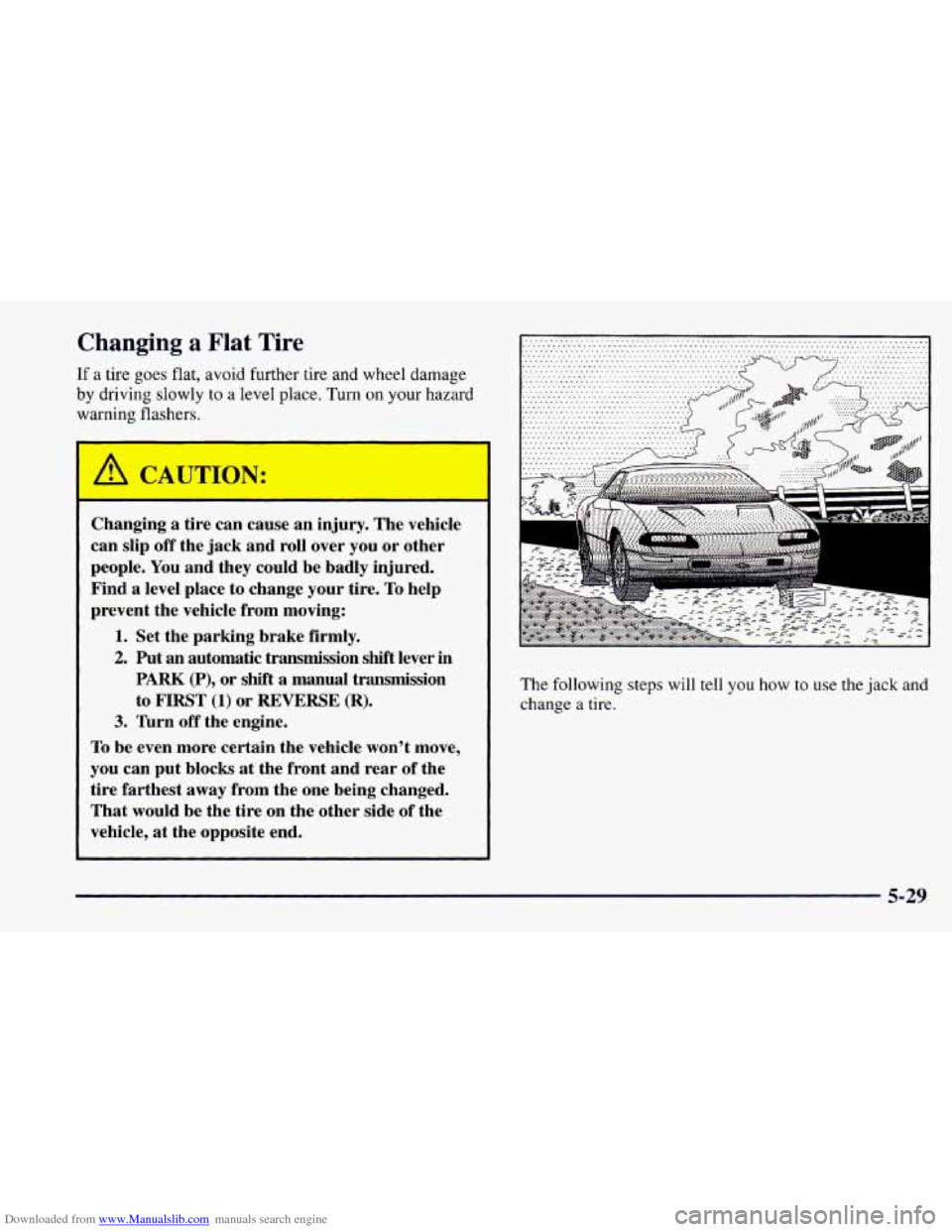
Downloaded from www.Manualslib.com manuals search engine Changing a Flat Tire
If a tire goes flat, avoid further tire and wheel damage
by driving slowly to a level place. Turn on your hazard
warning flashers.
-
/ CA, TION:
Changing a tire can cause an injury. The vehicle
can slip off the jack and roll over you or other
people. You and they could be badly injured.
Find
a level place to change your tire. To help
prevent the vehicle from moving:
1. Set the parking brake firmly.
2. Put an automatic transmission shift lever in
PARK (P), or shift
a manual transmission
to FIRST
(1) or REVERSE (R).
3. nrn off the engine.
To be even more certain the vehicle won’t move,
you can put blocks at the front and rear
of the
tire farthest away from the one being changed.
That would be the tire on the other side of the
vehicle, at the opposite end.
The following steps will tell you how to use the jack and
change
a tire.
5-29
Page 247 of 404
Downloaded from www.Manualslib.com manuals search engine 0 Section 6 Service and Appearance Care
Here you will find information about the care of your Chevrolet. This section begins with service and fuel
information, and then it shows how to check important fluid and lubricant levels. There is also technical information
about
your vehicle, and a part devoted to its appearance care.
6- 2
6-3'
6-5
6-6
6-8
6- 12
6-18
6-2
1
6-25 6-28
6-32
6-33
6-35
6-39
6-40 Service
Fuel
Fuels
in Foreign Countries
Filling Your Tank
Checking Things Under
the Hood
Engine Oil
Air Cleaner Automatic Transmission Fluid
Manual Transmission Fluid
Engine Coolant
Power Steering Fluid
Windshield Washer Fluid
Brakes
Battery
Bulb Replacement
6-50
6-58
6-59
6-62
6-62
6-63
6-65
6-66
6-67
6-68
6-68 6-68
6-74
6-74
6-76 Tires
Appearance Care
Cleaning the Inside of Your Chevrolet
Care of Safety Belts
Glass
Cleaning the Outside of Your Chevrolet
Aluminum or Chrome Wheels
Underbody Maintenance
Appearance Care Materials Chart
Vehicle Identification Number (VIN)
Service
Parts Identification Label
Electrical System
Replacement Bulbs
Capacities and Specifications
Air Conditioning Refrigerants
Page 256 of 404
Downloaded from www.Manualslib.com manuals search engine When you open the hood of the 3800 Engine you'll see:
.. > .. - k
A. Engine Coolant Reservoir
B. Battery
C. Oil Fill Cap
D. Automatic Transmission Dipstick
(If Equipped))
E. Engine Fan I. Brake Fluid Reservoir
F. Windshield Washer Reservoir J. Clutch Fluid Reservoir
G. Power Stee.ring Reservoir (If Equipped))
H. Engine Oil Dipstick K. Air Cleaner
6-10
Page 257 of 404
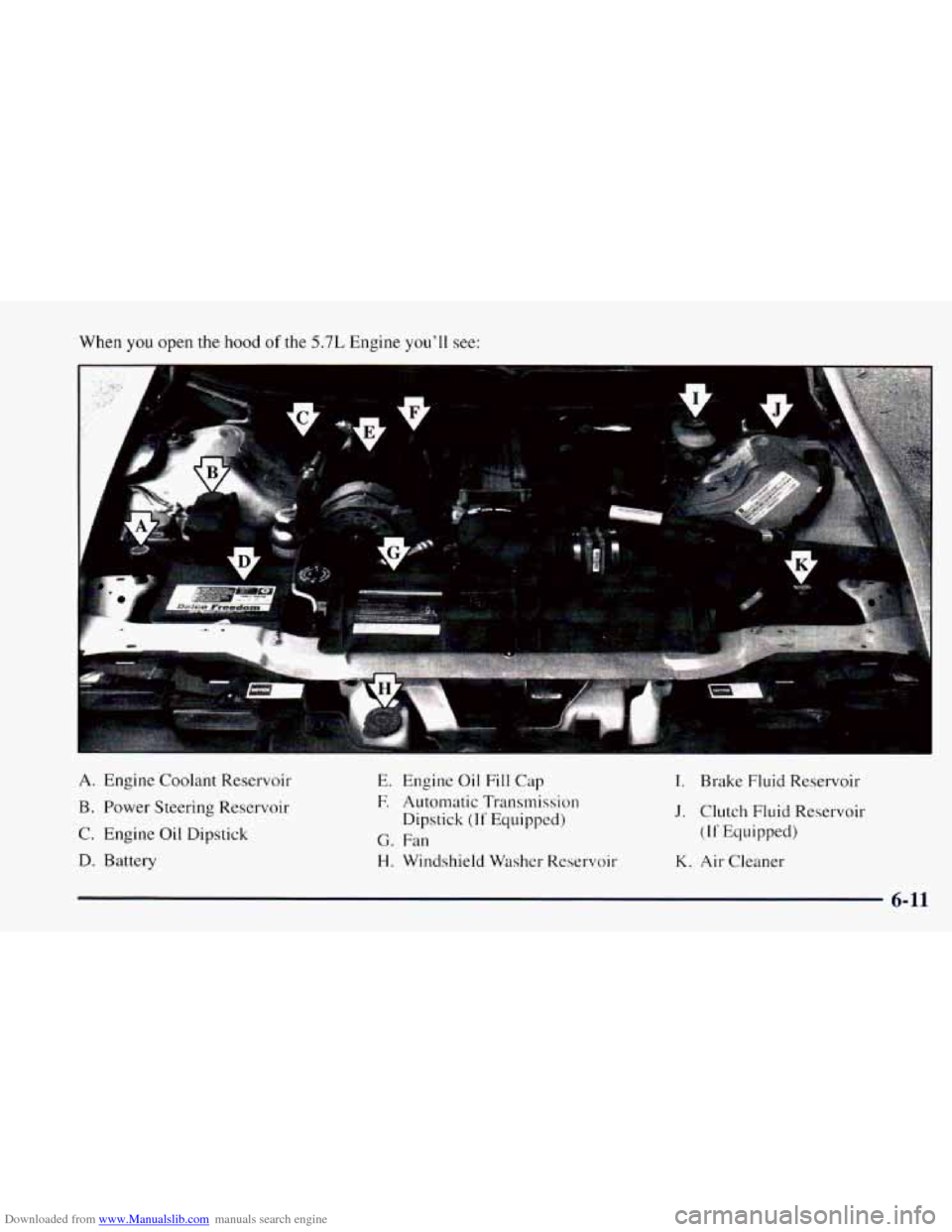
Downloaded from www.Manualslib.com manuals search engine When you open the hood of the 5.7L Engine you’ll see:
A. Engine Cool ant Res ervoir
B. Power Steering Reservoir
C. Engine
Oil Dipstick
D. Battery
E. Engine Oil Fill Cap
E Automatic Transmission
Dipstick
(If Equipped)
G. Fan
H. Windshield Washer Reservoir
I. Brake Fluid Reservoir
J. Clutch Fluid Reservoir
(If Equipped)
K. Air Cleaner
6-11