1997 CHEVROLET CAMARO CD player
[x] Cancel search: CD playerPage 154 of 404

Downloaded from www.Manualslib.com manuals search engine 'I
You must first load the magazine with discs before you
can play a compact disc. Each of the 12 trays holds one
disc. Press the button on the back of the magazine and
pull gently on one of the trays. Load the trays from
bottom to top, placing a disc on the tray label side down.
If you load a disc label side up, the disc will not play
and an error will occur. Gently push the tray back into
the magazine
slot. Repeat this procedure for loading up
to
12 discs in the magazine.
Once you have loaded the discs in the magazine, slide
open the door of the compact disc (CD) changer. Push
the magazine into the changer in the direction
of the
arrow marked
on top of the magazine. Close the door
by sliding it all the way
to the left. If the
door is
left partially open, the changer will not operate
and
an error will occur. When the door is closed, the
changer will begin checking for discs in the magazine.
This will continue for up
to two minutes depending on
the number of discs loaded.
To eject the magazine from the player, slide the CD
changer door all the way open. The magazine will
automatically eject. Remember to keep the door closed
whenever possible to keep dirt and dust from getting
inside
the changer.
Whenever a CD magazine with discs is loaded in the
changer, the CD symbol will appear
on the radio display.
If the CD changer
is checking the magazine for CDs, the
CD symbol will flash
on the display until the changer is
ready
to play. When a CD begins playing, a disc and
track number will be displayed.
The disc numbers are
listed on the front of the magazine.
All
of the CD functions are controlled by the radio
buttons, except for ejecting
the CD magazine.
PREV
(1): Press this button or the SEEK left arrow to
go to the start of the current track. If you hold or press
this button more than once, the player will continue
moving back through the disc. The sound will mute
while seeking.
3-14
Page 155 of 404

Downloaded from www.Manualslib.com manuals search engine PROG (2): Press this button to select a disc. The disc
number and track number will be displayed.
NEXT (3): Press this button or the SEEK right arrow to
to go to the next track. If
you hold the button or press it
more than once, the player will continue moving forward
through the tape. The sound will mute while seeking.
REV (4): Press and hold this button to reverse quickly
through a track selection. Release it to resume playing.
FWD (6): Press and hold this button to advance quickly
through a track selection. Release it
to resume playing.
SEEK: Press the right arrow to seek to the next
selection on the CD. Press the left arrow to search for
the previous selection on the CD. The sound will mute
while seeking.
SCAN: When you press SCAN while playing a CD, you
will hear the first few seconds of each disc. Press SCAN
again
to stop on a CD. The CD will mute while scanning
and SCAN will appear on the display.
P.SCAN: Press this button to hear the tracks in random,
rather than sequential, order. RANDOM will appear on
the display. Press P.SCAN again to. turn off random play.
TAPE AUX: Press this button if you have a disc loaded
in the changer and the radio is playing to play a compact
disc. Press AM-FM to return
to the radio when a compact
disc is playing. Press TAPE AUX to switch
between the tape and compact disc if both are loaded.
EJECT: Slide the CD changer door all the way open
and the disc holder will automatically eject.
Compact Disc Changer Errors
If an error occurs while trying to play a CD in the
compact disc changer, the following conditions may
have caused the error:
a
0
0
0
0
The road is too rough. The disc should play when the
road is smoother.
The disc is dirty, scratched, wet or loaded label
side up.
The air is very humid.
If so, wait about an hour and
try again.
The CD changer door is open. Completely close the
changer door to restore normal operation.
An empty magazine is inserted in the CD changer.
Try the magazine again with a disc loaded on one
of
the trays.
If any error occurs repeatedly or if an error cannot be
corrected, please contact your dealer.
3-15
Page 156 of 404
Downloaded from www.Manualslib.com manuals search engine AM-FM Stereo with Compact Disc Player
and Automatic Tone Control
(If Equipped)
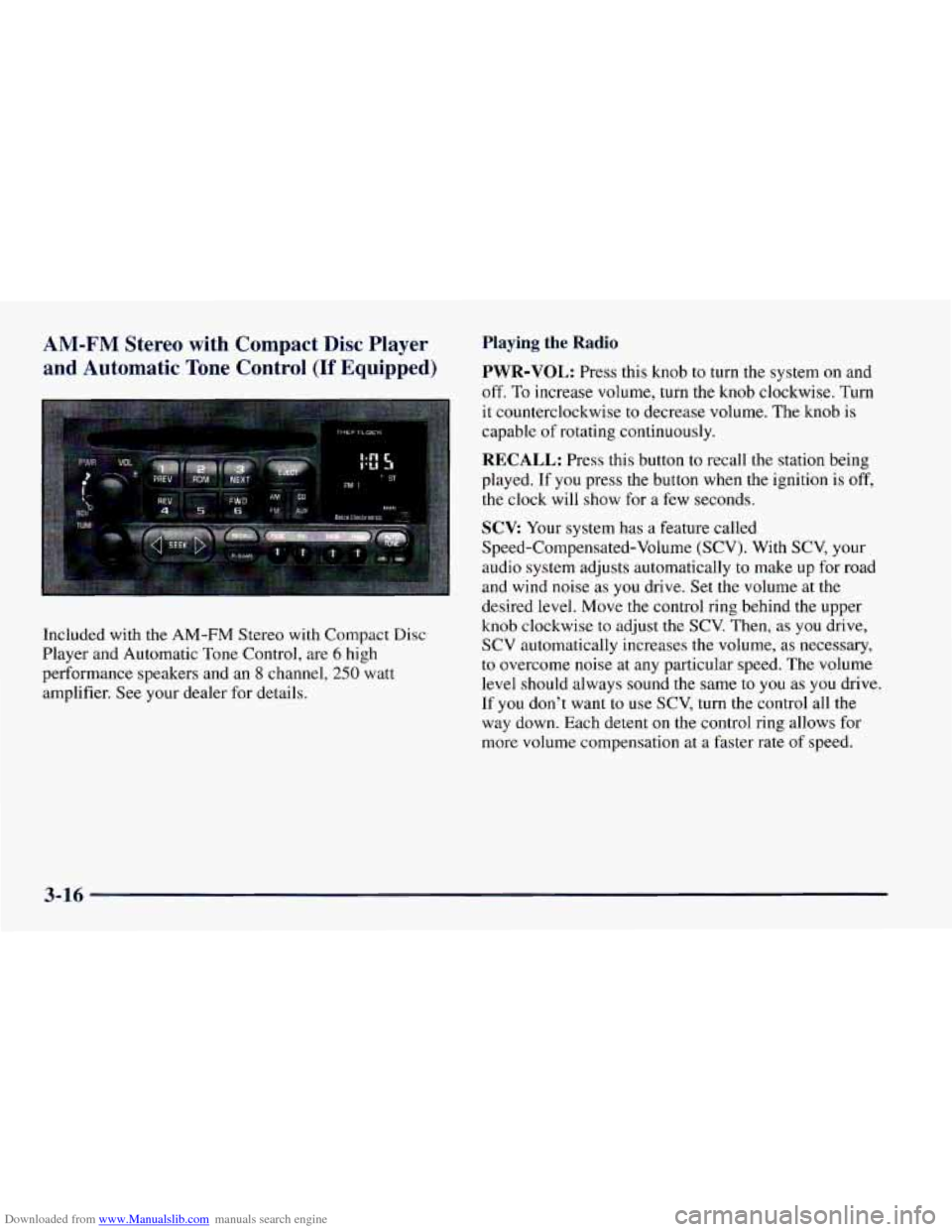
Included with the AM-FM Stereo with Compact Disc
Player and Automatic Tone Control, are
6 high
performance speakers and an
8 channel, 250 watt
amplifier. See your dealer for details.
Playing the Radio
PWR-VOL: Press this knob to turn the system on and
off. To increase volume, turn the knob clockwise. Turn
it counterclockwise to decrease volume. The knob is
capable of rotating continuously.
RECALL: Press this button to recall the station being
played.
If you press the button when the ignition is off,
the clock will
show for a few seconds.
SCV: Your system has a feature called
Speed-Compensated-Volume (SCV). With SCV, your
audio
system adjusts automatically to make up for road
and wind noise as
you drive. Set the volume at the
desired level. Move the control ring behind the upper
knob clockwise
to adjust the SCV. Then, as you drive,
SCV automatically increases the volume, as necessary,
to overcome noise at any particular speed. The volume
level should always sound the same to you as you drive.
If
you don’t want to use SCV, turn the control all the
way down. Each detent on the control ring allows for
more volume compensation at
a faster rate of speed.
3-16
Page 158 of 404

Downloaded from www.Manualslib.com manuals search engine TREB: Press this knob lightly so it extends. Turn the
knob clockwise
to increase treble and counterclockwise
to decrease treble. When
you use this control, the radio’s
AUTO TONE setting will switch to manual. If
a station
is weak or noisy, you may want to decrease the treble.
Push these knobs back into their stored positions when
you’re not using them.
AUTO TONE: This feature allows you to choose
preset bass and treble equalization settings designed for
classical, news, rock, pop, country/western and jazz
stations.
C/W will appear on the display when you first
press AUTO TONE. Each time you press it, another
setting will appear
on the display. Press it again after
JAZZ appears and the AUTO TONE display will go
blank. Tone control will return to the BASS and TREB
knobs. Also, if you use the BASS and TREB knobs,
control will return to them and the AUTO TONE
display will go blank.
Adjusting the Speakers
BAL:
Press this knob lightly so it extends. Turn the
knob clockwise for right speakers and counterclockwise
for left speakers. The middle position balances the
sound between the speakers.
FADE: Press this knob lightly so it extends. Turn the
knob clockwise to adjust the sound to the front speakers
and counterclockwise
for the rear speakers. The middle
position balances the sound between the speakers.
Push these knobs back into their stored positions when
you’re not using them.
Playing a Compact Disc
Insert a disc partway into the slot, label side up. The
player will pull it in.
The disc should begin playing. The
display will show CD and the CD symbol.
If you’re driving
on a very rough road or if it’s very hot,
the disc may not play and ERR (error) may appear on
the display. Press RECALL to take ERR off the display.
When things get back to normal, the disc should play.
If the disc comes out, it could be that:
The disc is upside down.
It is dirty, scratched or wet.
It is very humid. (If so, wait about an hour and
try again.)
3-18
Page 159 of 404

Downloaded from www.Manualslib.com manuals search engine PREV (1): Press this button or the left SEEK arrow to
go back to the start of a current track.
If you hold the
button or press it more than once, the player will
continue moving back through the disc. The sound will
mute while seeking.
RDM (2): Press this button to hear the tracks in random,
rather than sequential, order.
RANDOM will show on
the display. Press RDM again
to turn off random play.
RDM is reset to off when the disc is ejected.
NEXT (3): Press this button or the right SEEK arrow to
go
to the next track. If you hold the button or press it
more than once, the player will continue moving
forward through the disc. The sound will mute
while seeking.
REV (4): Press and hold this button to quickly reverse
within
a track. Release it to play the passage. You can
use the counter reading on the display to locate a
passage more easily.
FWD (6): Press and hold this button to advance quickly
within a track. Release it to resume playing. You can
use the counter reading on the display to locate a
passage easily.
RECALL: Press this button to see which track is
playing. Press it again within five seconds to see how
long it has been playing (elapsed time). The track
number also appears when you change the volume or
when a new track starts to play.
AM-FM: Press this button to play the radio when a disc
is in the player. The letters
CD will go off the display.
CD AUX: Press this button to change to the disc
function when the radio
is on. A CD icon will appear on
the display when the disc is in the player, whether it
is
active or not.
E JECR Press this button to remove the disc. The radio
will play. The disc will start at the first track when
you
reinsert it.
If you turn
off the ignition or radio with a disc in the
player, it will stay in the player. When you turn on the
ignition
or system, the disc will start playing where it
was stopped.
If you press EJECT but don’t remove the
disc, the player will pull the disc back in to protect it
after about one minute.
3-19
Page 162 of 404

Downloaded from www.Manualslib.com manuals search engine Understanding Radio Reception
FM Stereo
FM stereo will give you the best sound. But FM signals
will reach only about
10 to 40 miles (16 to 65 km). Tall
buildings or hills can interfere with
FM signals, causing
the sound to come and go.
AM
The range for most AM stations is greater than for FM,
especially at night. The longer range, however, can
cause stations to interfere with each other.
AM can pick
up noise from things like storms and power lines. Try
reducing the treble
to reduce this noise if you ever get it.
Tips About Your Audio System
Hearing damage from loud noise is almost undetectable
until
it is too late. Your hearing can adapt to higher
volumes of sound. Sound that seems normal can be loud
and harmful to your hearing. Take precautions by
adjusting the volume control on your radio to a safe
sound level before your hearing adapts to it.
To help avoid hearing loss or damage:
Adjust the volume control to the lowest setting.
Increase volume slowly until you hear comfortably
and clearly.
NOTICE:
Before you add any sound equipment to your
vehicle
-- like a tape player, CB radio, mobile
telephone or two-way radio
-- be sure you can
add what you want.
If you can, it’s very
important to do it properly. Added sound
equipment may interfere with the operation
of
your vehicle’s engine, Delco radio or other
systems, and even damage them. Your vehicle’s
systems may interfere with the operation of
sound equipment that has been added
improperly.
So, before adding sound equipment, check with
your dealer and be sure to check Federal rules
covering mobile radio and telephone units.
3-22
Page 163 of 404

Downloaded from www.Manualslib.com manuals search engine Care of Your Cassette Tape Player
A tape player that is not cleaned regularly can cause
reduced sound quality, ruined cassettes or a damaged
mechanism. Cassette tapes should be stored in their
cases away from contaminants, direct sunlight and
extreme heat. If they aren’t, they may not operate
properly or may cause failure of the tape player.
Your tape player should be cleaned regularly after every
50 hours of use. Your radio may display CLN to indicate
that you have used your tape player for
50 hours without
resetting the tape clean timer.
If this message appears on
the display, your cassette tape player needs to be
cleaned. It will still play tapes, but you should clean it as
soon as possible
to prevent damage to your tapes and
player. If you notice a reduction
in sound quality, try a
known good cassette to see if
it is the tape or the tape
player at fault. If this other cassette has
no improvement
in sound quality, clean the tape player. Cleaning
may be done with a scrubbing action,
non-abrasive cleaning cassette with pads which scrub
the tape head as the hubs
of the cleaner cassette turn. It
is normal for the cassette to eject while cleaning. Insert
the cassette at least three times to ensure thorough
cleaning.
A scrubbing action cleaning cassette is
available through your Chevrolet dealership.
You may also choose a non-scrubbing action, wet-type
cleaner which
uses a cassette with a fabric belt to clean
the tape head. This type
of cleaning cassette will not
eject and, it may
not clean as thoroughly as the
scrubbing type cleaner.
After you clean the player, press and hold
EJECT for
five seconds to reset the
CLN indicator. The radio will
display
--- to show the indicator was reset.
Cassettes are subject to wear and the sound quality may
degrade over time. Always make sure the cassette tape
is in good condition before you have your tape
player serviced.
3-23
Page 316 of 404

Downloaded from www.Manualslib.com manuals search engine Main Fuse Block ~
FUSE USAGE CHART
10 20 30 40 STOPlHAZARD TURN 6-U PCM BATT RADIO ACCY 1
TAIL LTS HVAC 70 80 1 PWR ACCY COURTESY
9n lin 121]
LFI 130 140 ~-l 150
GAGES AIR BAG CIGAR/ACCY DEFOGEEATS
IGN PCM IGN WlPERlWASH BATT WINDOWS
IP DIMMER ACCY RADIO
SEE OWNER'S MANUAL FOR MORE INFORMATION PRINTED IN U.S.A 10281550 I
Fuse
STOPMAZARD
TURN
B-U
PCM BATT
RADIO ACCY
Usage
Hazard Flasher, Brake Switch
Assembly
Traction ControV2nd Gear Start
Switch, Back-up
Lamp Switch,
Turn Flasher, Daytime Running
Lamps (DRL) Module
Powertrain Control Module
(PCM), Fuel Pump Relay
Delco Audyssey Radio Amplifier
Remote CD player (trunk)
6-70