Page 212 of 402
Downloaded from www.Manualslib.com manuals search engine Following Distance
Stay at least twice as far behind the vehicle ahead as you
would when driving your vehicle without a trailer. This
can help
you avoid situations that require heavy braking
and sudden turns.
Passing
You’ll need more passing distance up ahead when
you‘re towing
a trailer. And, because you’re a good deal
longer,
you’ll need to go much farther beyond the
passed vehicle before you can return
to your lane.
Backing Up
Hold the bottom of the steering wheel with one hand.
Then, to move the trailer to the left, just move that hand
to the left. To move the trailer to the right, move your
hand
to the right. Always back up slowly and, if
possible, have someone guide you.
Making Turns
I NOTICE:
Making very sharp turns while trailering could
cause the trailer to come in contact with the
vehicle. Your vehicle could be damaged. Avoid
making very sharp turns while trailering.
When you’re turning with a trailer, make wider turns
than normal.
Do this so your trailer won’t strike soft
shoulders, curbs, road signs, trees or other objects.
Avoid jerky or sudden maneuvers. Signal well
in advance.
I’urn Signals When Towing a Trailer
When you tow a trailer, your vehicle has to have extra
wiring and
a heavy-duty turn signal flasher (included in
the optional trailering package).
The arrows
on your instrument panel will flash
whenever you signal
a turn or lane change. Properly
hooked up, the trailer lamps will
also flash, telling other
drivers you‘re about
to turn, change lanes or stop.
4-51
Page 219 of 402
Downloaded from www.Manualslib.com manuals search engine Hazard Warning Flashers
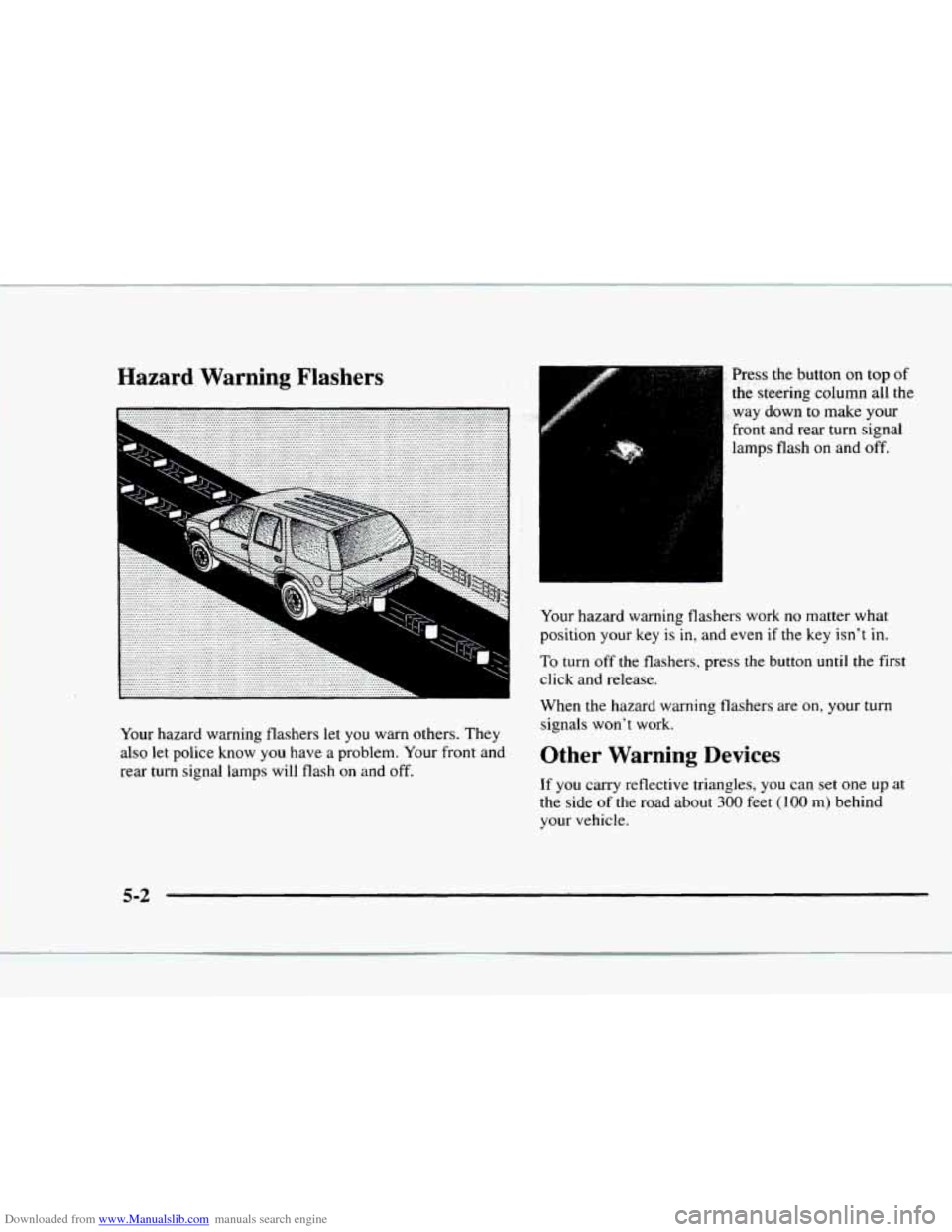
Your hazard warning flashers let you warn others. They
also let police know you have a problem. Your front and
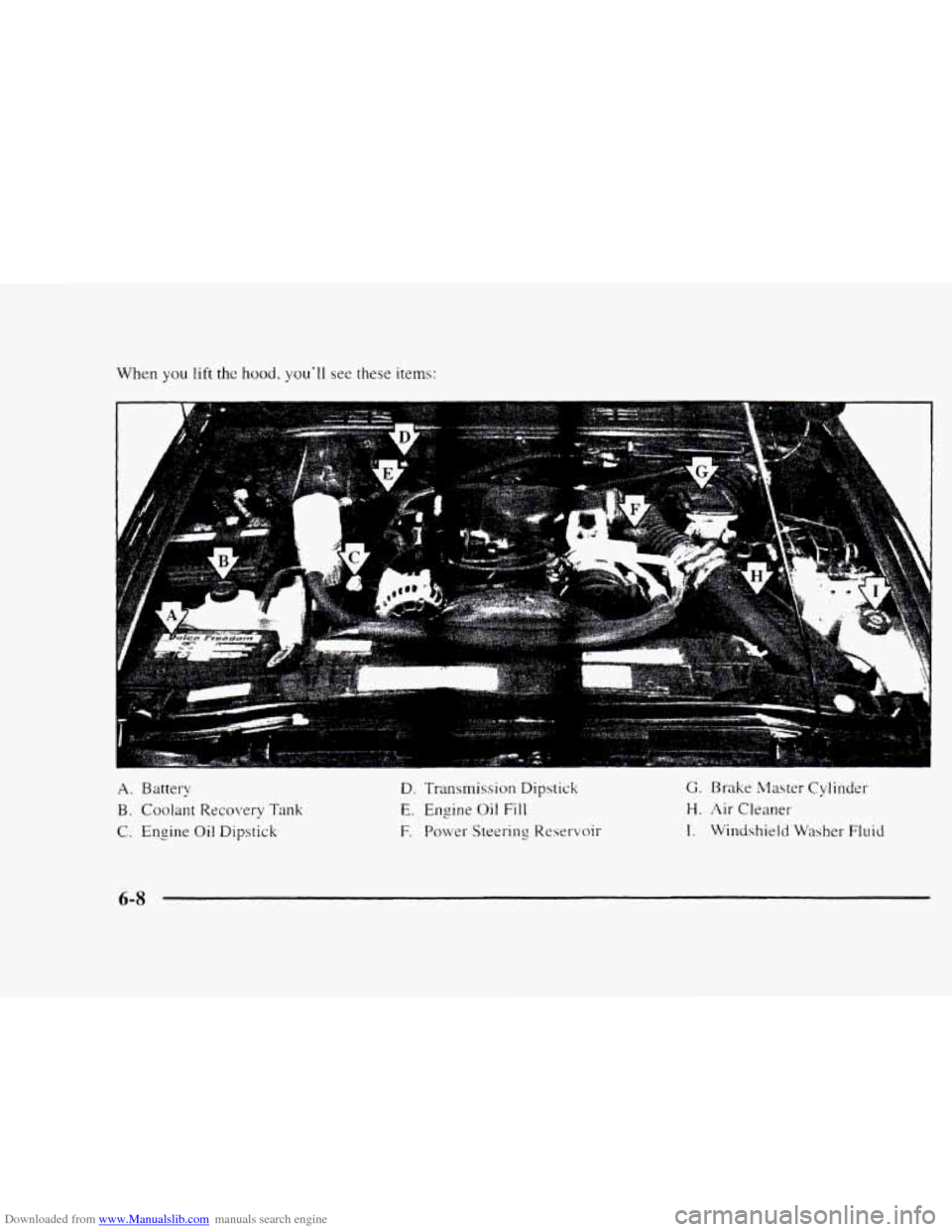
rear turn signal lamps will flash on and off. Press
the button
on top of
the steering column all the
way down
to make your
front and rear turn signal
lamps flash
on and off.
Your hazard warning flashers work no matter what
position your key is
in, and even if the key isn’t in.
To turn off the flashers, press the button until the first
click and release.
When the hazard warning flashers are on, your turn
signals won’t work.
Other Warning Devices
If you carry reflective triangles, you can set one up at
the side of the road about
300 feet (100 m) behind
your vehicle.
5-2
Page 226 of 402
Downloaded from www.Manualslib.com manuals search engine When your vehicle is being towed, have the ignition key
turned to the OFF position. The steering wheel should
be clamped in
a straight-ahead position with a clamping
device designed for towing service.
Do not use the
vehicle's steering column lock for this. The transmission
should be in NEUTRAL
(N) and the transfer case, if you
have one, should be in 2HI. The parking brake should
be released.
If your vehicie has a floor mounted shifter and no
electrical power, the electrical solenoid lock must be
overridden
to shift from PARK (P) to NEUTRAL (N).
Follow these steps:
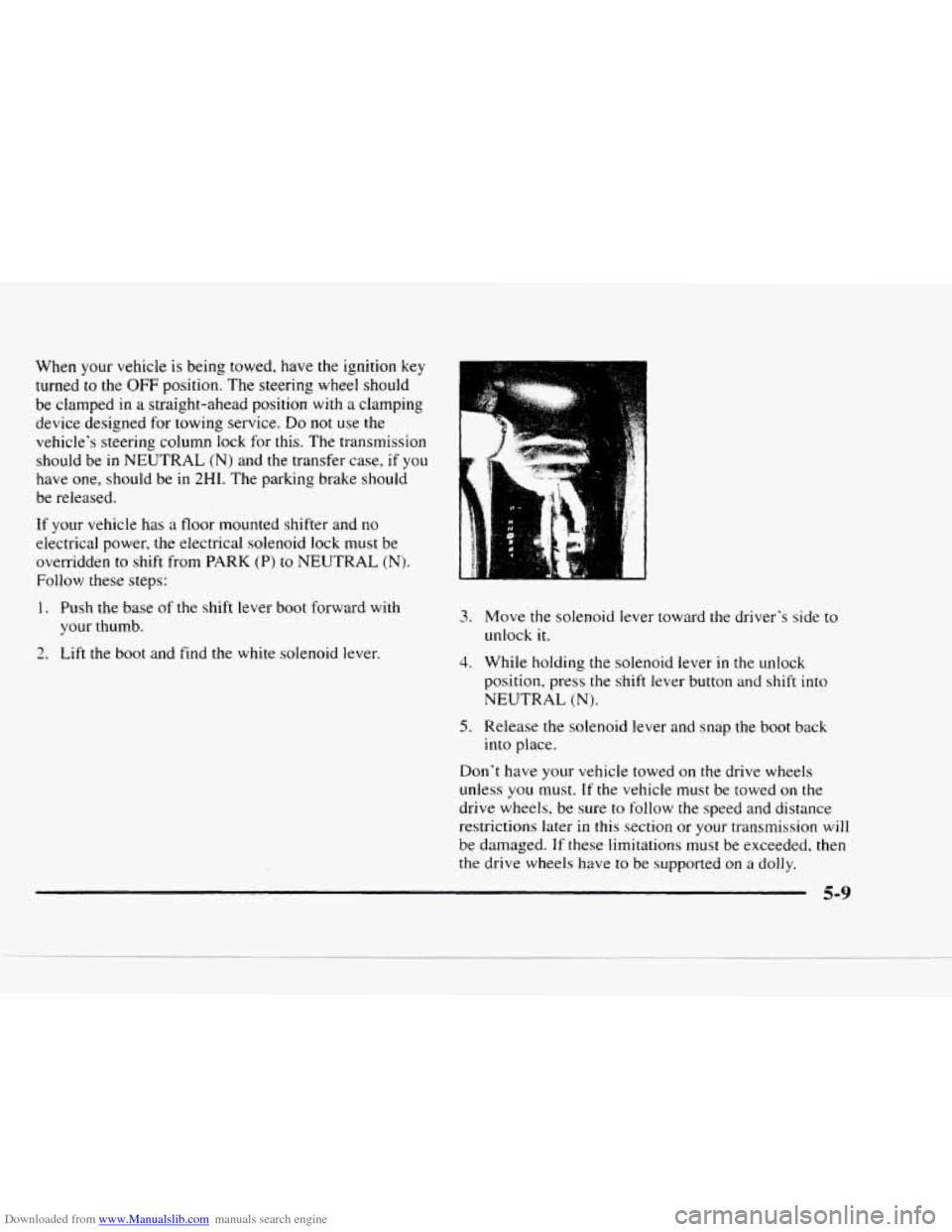
1. Push the base of the shift lever boot forward with
your thumb.
2. Lift the boot and find the white solenoid lever.
1-
3.
4.
5.
Move the solenoid lever toward the driver's side to
unlock it.
While holding the solenoid lever in the unlock
position, press the shift lever button and shift into
NEUTRAL
(N).
Release the solenoid lever and snap the boot back
into place.
Don't have your vehicle towed on the drive wheels
unless you must.
If the vehicle must be towed on the
drive wheels, be sure to follow the speed and distance
restrictions later in this section or your transmission will
be damaged.
If these limitations must be exceeded, then
the drive wheels have to
be supported on a dolly.
5-9
Page 239 of 402

Downloaded from www.Manualslib.com manuals search engine Engine Fan Noise
This vehicle has a clutched engine cooling fan. When
the clutch
is engaged, the fan spins faster to provide
more air
to cool the engine. In most everyday driving
conditions, the clutch
is not engaged. This improves
fuel economy and reduces fan noise. Under heavy
vehicle loading, trailer towing and/or high outside
temperatures. the fan speed increases when the clutch
engages.
So you may hear an increase in fan noise. This
is normal and should
not be mistaken as the
transmission slipping or making extra shifts.
It is merely
the cooling system functioning properly. The
fa11 will
slow down when additional cooling is not required and
the clutch disengages.
You may also hear this fan noise when you start the
engine.
It will go away as the fan clutch disengages.
If a Tire Goes Flat
It's unusual for a tire to "blow out" while you're driving.
especially
if you maintain your tires properly. If air goes
out of a tire, it's much Inore likely to leak out slowly.
But if you should ever have ;I "blowout." here are a few
tips about what to expect and what to do:
If a front tire fails. the flat tire will create a drag that
pulls the vehicle toward that side. Take your foot off the
accelerator pedal and grip the steering wheel firmly.
Steer
to maintain lane position. and then gently brake to
a stop well out of the traffic lane.
A rear blowout. particularly on a curve. acts much like a
skid and may require the same correction you'd use in a
skid. In any rear blowout. remove your foot from the
xcelerator pedal. Get the \,chicle under control by
steering the way you want the vehicle to go. It may be
\.cry bunlpy and noisy. but you can still steer. Gently
brake
to a stop -- well off the road if possible.
5-22
Page 254 of 402
Downloaded from www.Manualslib.com manuals search engine I NOTICE: I
Spinning your wheels can destroy parts of your
vehicle as well as the tires. If you spin the wheels
too fast while shifting your transmission back
and forth,
you can destroy your transmission.
For information about using tire chains on your vehicle,
see “Tire Chains”
in the Index.
Rocking Your Vehicle To Get It Out
First, turn your steering wheel left and right. That will
clear
the area around your front wheels. Then shift back
and forth between
REVERSE (R) and a forward gear
(or with a manual transmission, between FIRST ( 1) or
SECOND (2) and REVERSE(R)), spinning the wheels
as little as possible. Release the accelerator pedal while
you shift, and press lightly on the accelerator pedal
when the transmission is
in gear. If that doesn’t get you
out after a few tries, you may need to be towed out.
Or, you can use your recovery hooks if your vehicle has
them. If you do need to be towed out, see ”Towing
Your Vehicle”
in the Index.
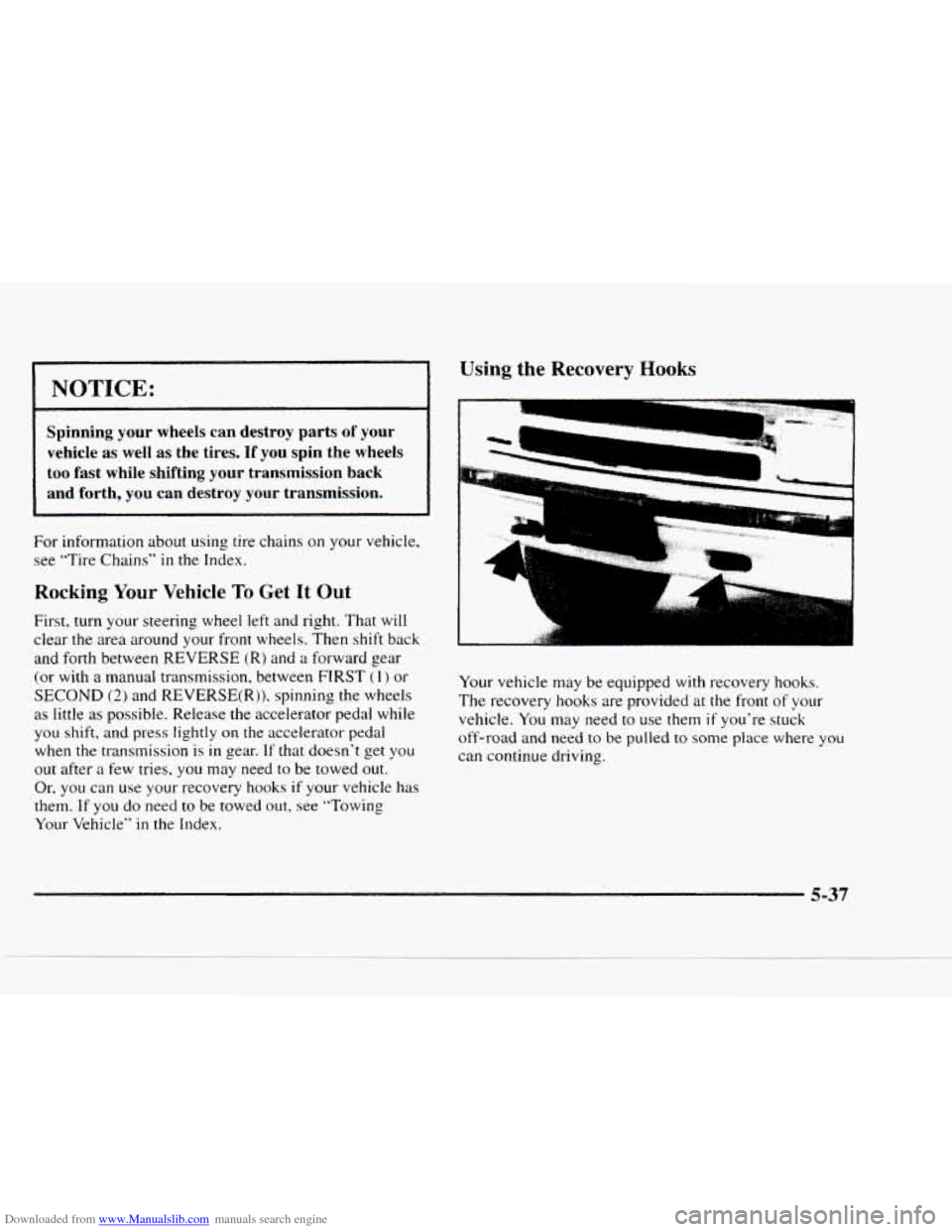
Using the Recovery Hooks
P
Your vehicle may be equipped with recovery hooks.
The recovery
hooks are provided at the front of your
vehicle. You may need to use them
if you’re stuck
off-road and need
to be pulled to some place where you
can continue driving.
5-37
Page 256 of 402
Downloaded from www.Manualslib.com manuals search engine Section 6 Service and Appearance Care
Here you will find information about the care of your vehicle. This section begins with service and fuel information,
and then
it shows how to check important fluid and lubricant levels. There is also technical information about your
vehicle, and a part devoted
to its appearance care.
6-3
6-4
6-5
6-6
6-9 6-
13
6- 14
6-18
6- 19
6-
20
6-2 1
6-23
6-26
6-26
6-26 6-27
Fuel
Fuels in Foreign Countries
Filling Your Tank
Checking Things Under the Hood
Engine Oil
Air Cleaner
Automatic Transmission Fluid
Manual Transmission Fluid
Hydraulic Clutch
Rear Axle
Four-wheel Drive and All-Wheel Drive
Engine Coolant Radiator Pressure Cap
Thermostat Power Steering Fluid
Windshield Washer Fluid 6-28
6-32
6-3 3 6-3 8
6-40 6-49
6-49
6-52
6-54
6-5
7
6-5 8
6-58
6-58
6-62
6-63
6-64
Brakes
Battery
Bulb Replacement
Windshield Wiper Blade Replacement
Tires
Appearance Care
Cleaning the Inside
of Your Vehicle
Care
of Safety Belts
Cleaning the Outside of Your Vehicle
Appearance Care Materials Chart
Vehicle Identification Number
(VIN)
Service Parts Identification Label
Electrical System
Replacement Bulbs
Capacities and Specifications
Air Conditioning Refrigerants
Page 263 of 402
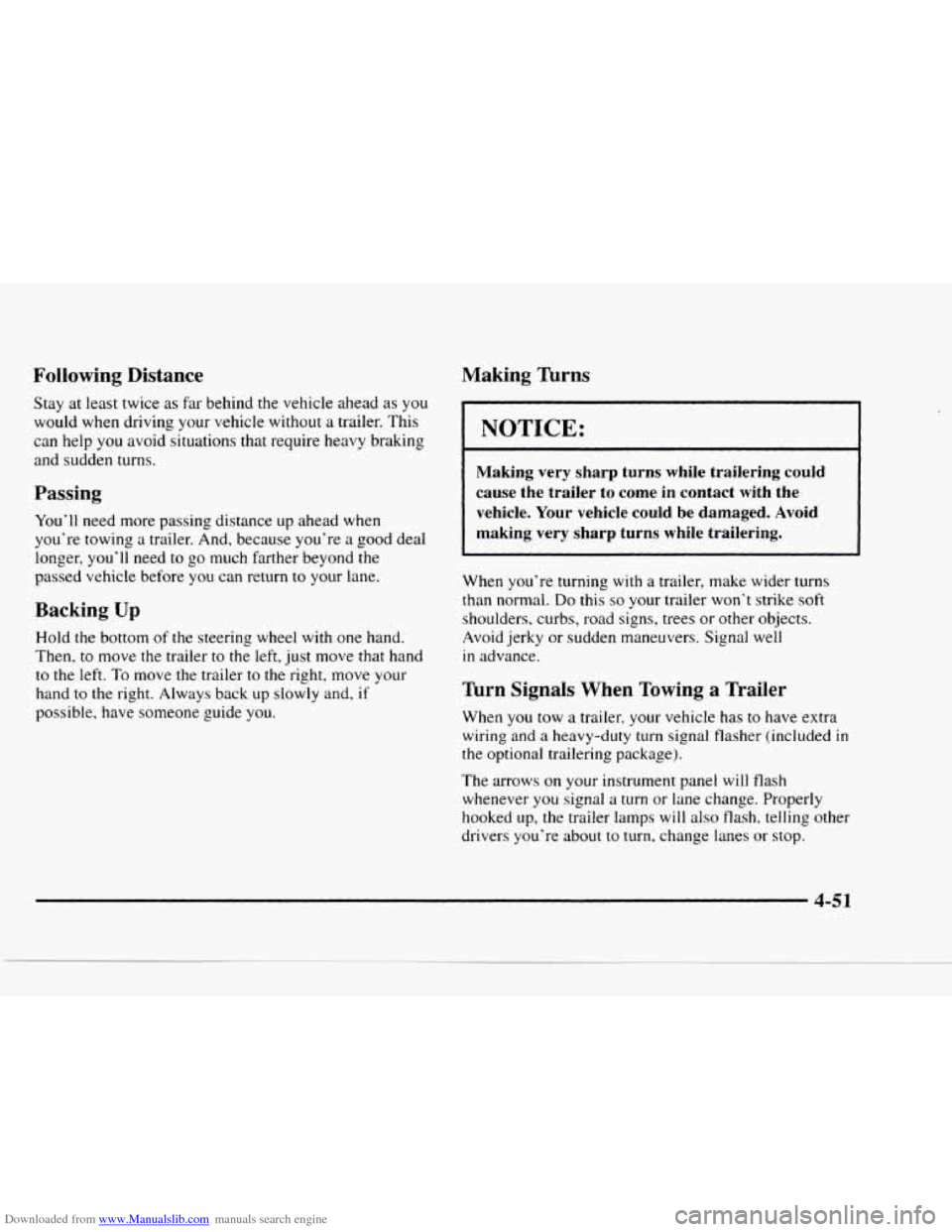
Downloaded from www.Manualslib.com manuals search engine When you lift the hood. you'll see these items:
B -- ."*f . ..
A. Battery
B. Coolant Recovery Tank
C. Engine Oil Dipstick
*
C
D. Transmission Dipstick
E. Engine Oil Fill
F. Power Steering Reservoir
G. Brake Master Cylinder
H. Air Cleaner
I. Windshield Washer Fluid
6-8
Page 267 of 402
Downloaded from www.Manualslib.com manuals search engine Engine Oil Additives
Don't add anything to your oil. Your GM dealer is ready
to advise if you think something should be added.
When to Change Engine Oil
If any one of these is true for you. use the short tripkity
. maintenance schedule:
a
a
a
0
a
Most trips are less than 5 to 10 miles (8 to 16 km).
This is particularly important when outside
temperatures are below freezing.
Most trips include extensive idling (such
as frequent
driving in stop-and-go traffic).
You operate
your vehicle in dusty areas or
off-road frequently.
You frequently tow
a trailer or use a currier on top of
your vehicle.
The vehicle is used for delivery service. police, taxi
or other commercial application. Driving under
these conditions causes engine oil
to
break down sooner. If any one of these is true for your
vehicle, then you need
to change your oil and filter
every
3.000 miles (5 000 km) or 3 months -- whichever
occllrs first.
If none of them is true, use the long trip/highway
maintenance schedule. Change the oil and filter every
7,500 miles ( 12 500 km) or 12 months -- whichever
occurs first. Driving
a vehicle with a fully warmed
engine under highway conditions causes engine oil
to
break down slower.
Remote Oil Filter (Four-wheel Drive)
The access door for the remote oil filter is in the steering
linkage shield assembly located under the radiator
support.
Twist the screw to unlock or lock the door.
Make sure
if you open the door. it is securely closed
when
~OLI are finished.
6-12