Page 68 of 404
Downloaded from www.Manualslib.com manuals search engine You’ll be using the lap-shoulder belt. See the earlier part
about the top strap if the child restraint has
one.
1. Because your vehicle has a front passenger air bag,
always move the seat
as far back as it will go before
securing a forward-facing child restraint, (See
“Seats’’
in the Index.)
2. Put the restraint on the seat. Follow the instructions
for the child restraint.
3. Secure the child in the child restraint as the
instructions say.
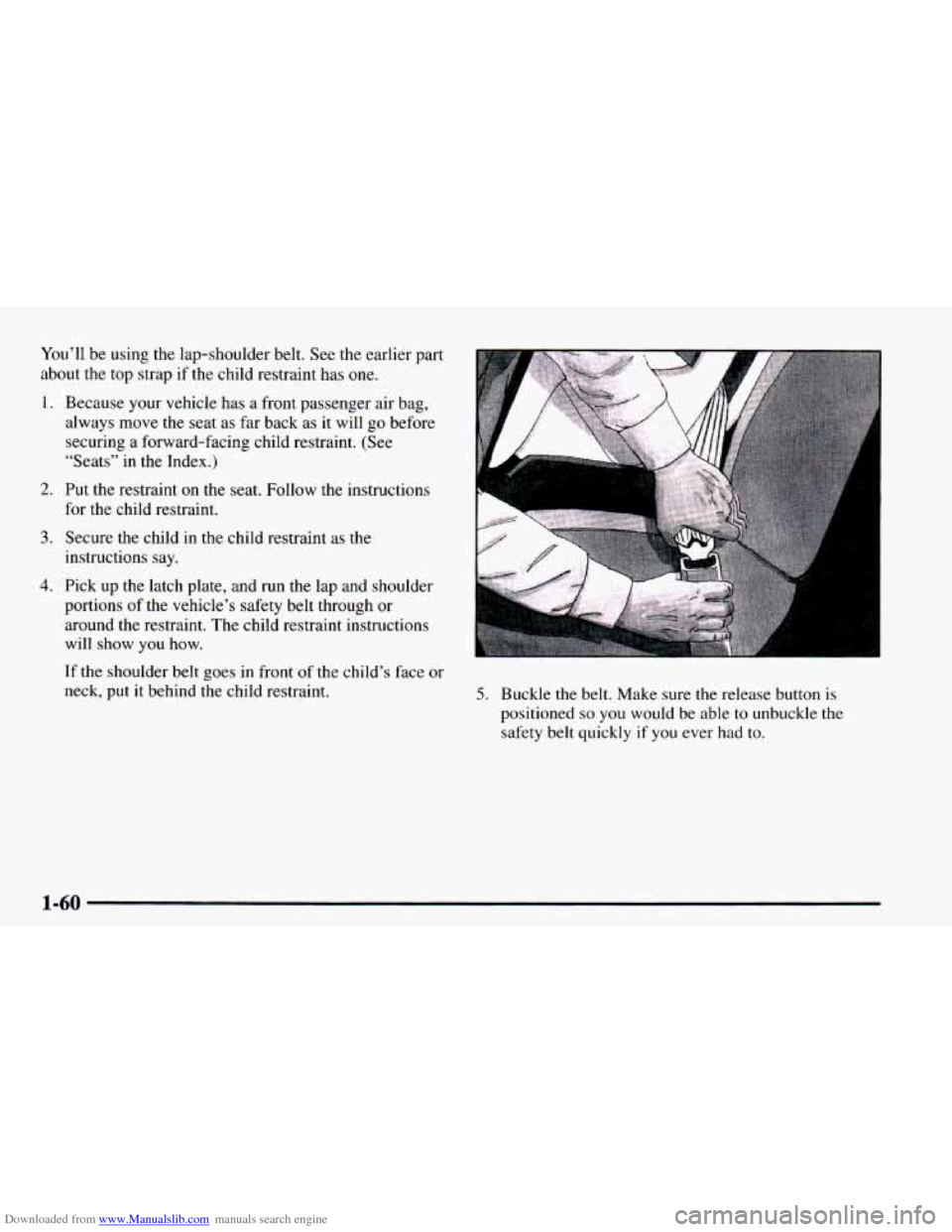
4. Pick up the latch plate, and run the lap and shoulder
portions of the vehicle’s safety belt through or
around the restraint. The child restraint instructions
will show
you how.
If the shoulder belt goes in front of the child’s face or
neck, put
it behind the child restraint.
a
5. Buckle the belt. Make sure the release button is
positioned
so you would be able to unbuckle the
safety belt quickly if you ever had to.
1-60
Page 69 of 404
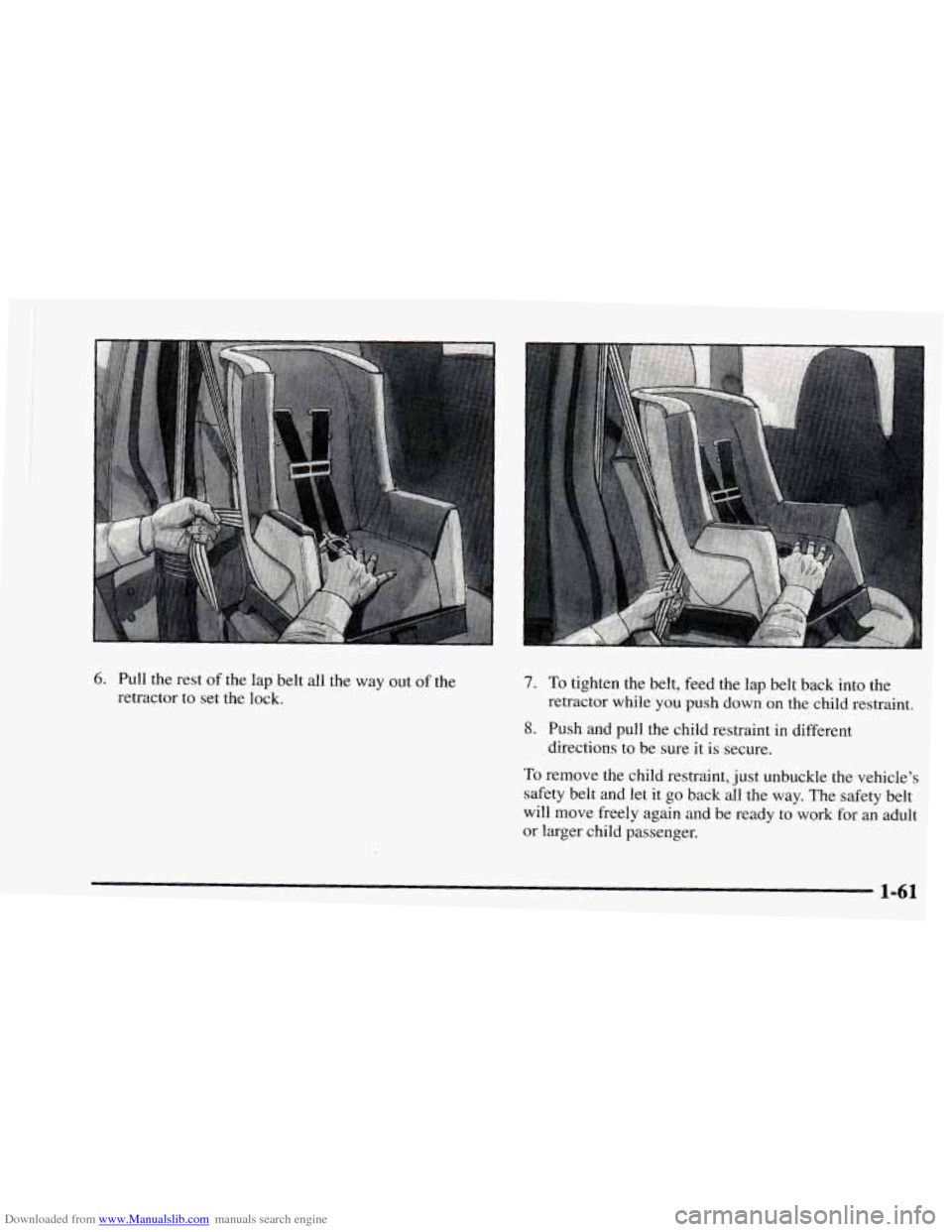
Downloaded from www.Manualslib.com manuals search engine 6. Pull the rest of the lap belt all the way out of the
retractor to set the lock. 7. To tighten the belt, feed the lap belt back into the
8. Push and pull the child restraint in different
To remove the child restraint, just unbuckle the vehicle’s
safety belt and let it go back all the way. The safety belt
will move freely again and be ready to work for an adult
or larger child passenger. retractor
while you push down
on the child restraint.
directions to be sure it is secure.
1-61
Page 84 of 404
Downloaded from www.Manualslib.com manuals search engine Synchronization
Synchronization may be necessary due to the security
method used by this system. The transmitter does not
send the same signal twice
to the receiver. The receiver
will not respond to a signal it has been sent previously.
This will prevent anyone from recording and playing
back the signal from the transmitter.
To resynchronize your transmitter, stand
close to your
vehicle and simultaneously press and hold
the LOCK
and UNLOCK buttons on the transmitter for eight
seconds. The door locks should cycle to confirm
' synchronization. If the locks do not cycle, see your
dealer
for service.
Sliding Door
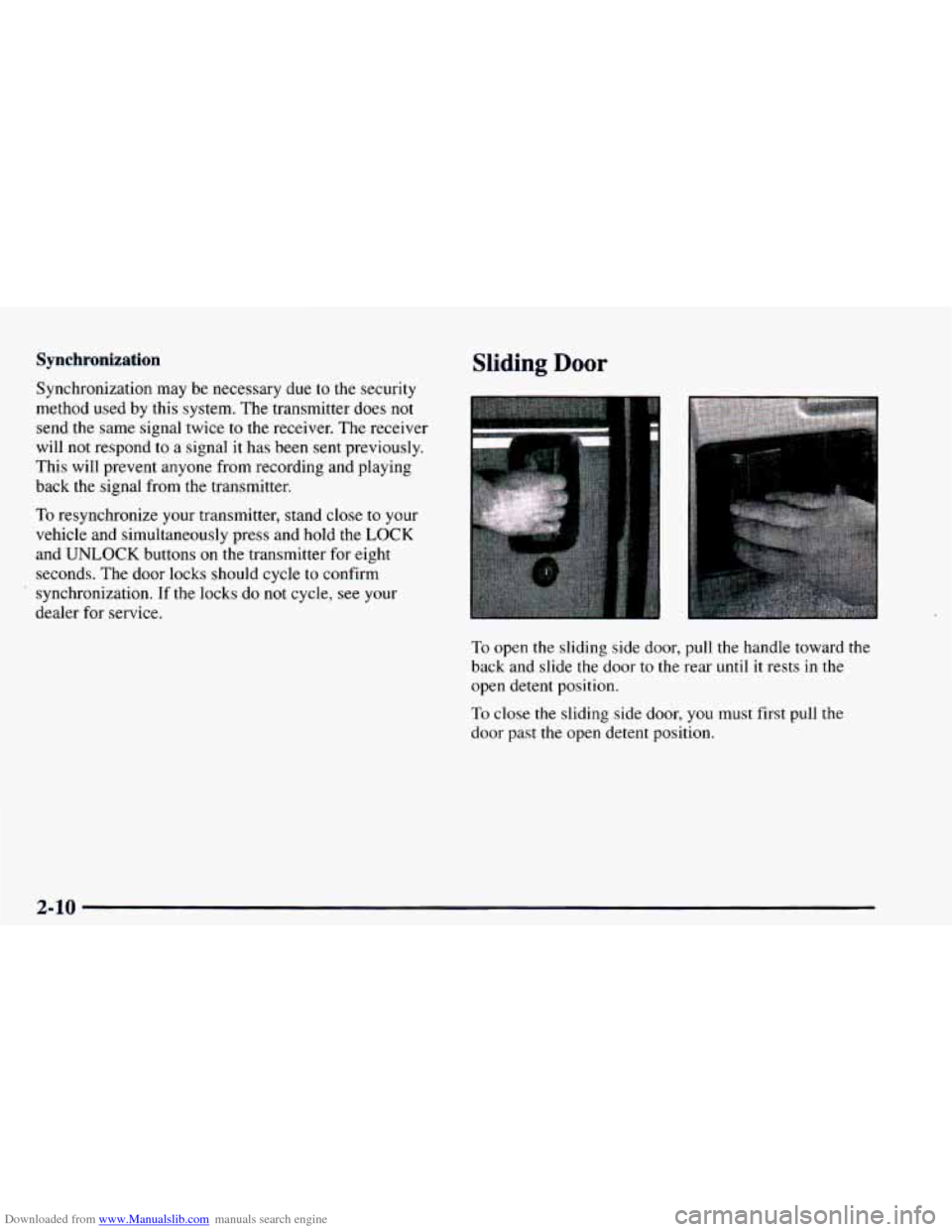
To open the sliding side door, pull the handle toward the
back and slide the door to the rear
until it rests in the
open detent position.
To close the sliding side door,
you must first pull the
door past the open detent position.
2-10
Page 85 of 404
Downloaded from www.Manualslib.com manuals search engine A UTION:
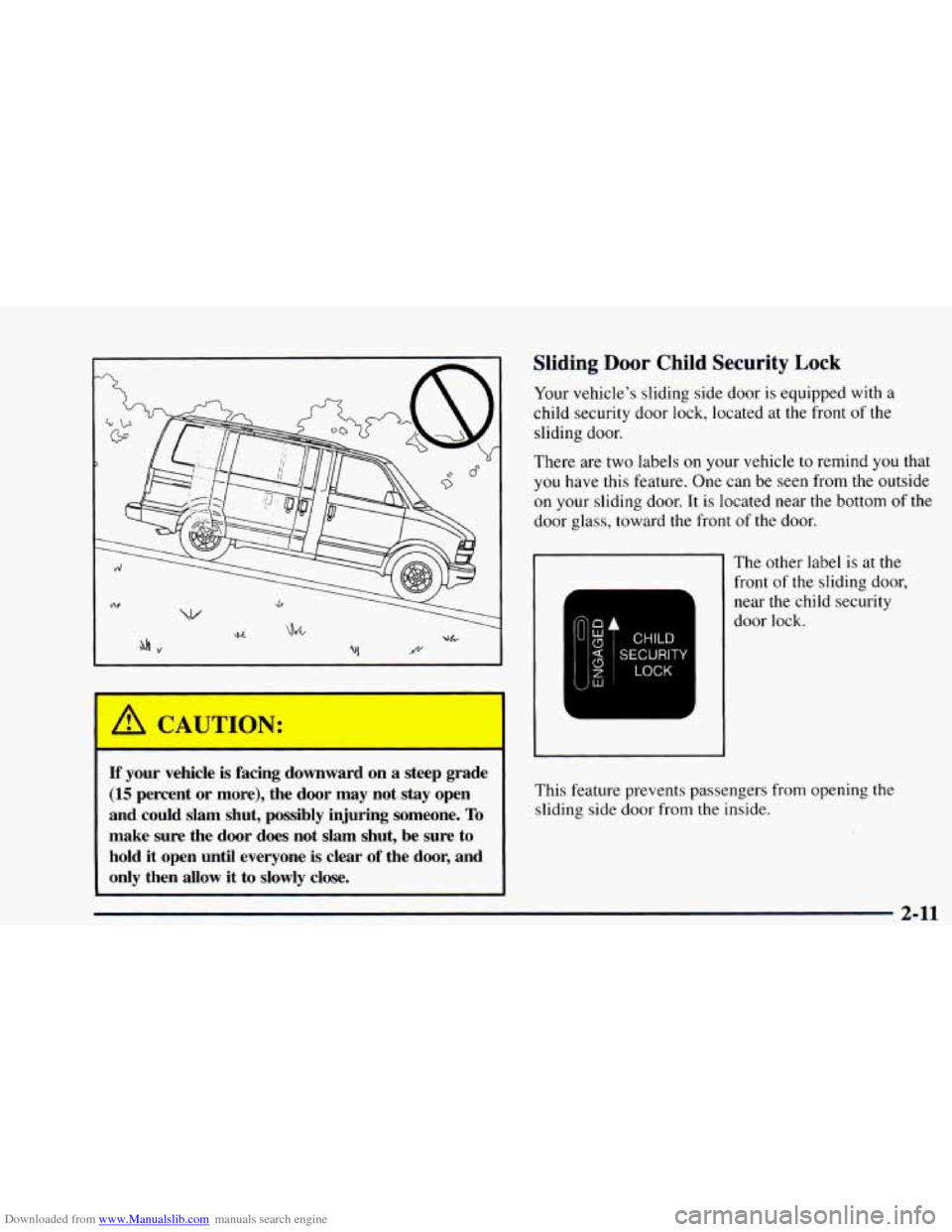
If your vehicle is facing downward on a steep grade
(15 percent or more), the door may not stay open
and could slam shut, possibly injuring someone.
To
make sure the door does not slam shut, be sure to
hold
it open until everyone is clear of the door, and
~ only then allow it to slowly close.
Sliding Door Child Security Lock
Your vehicle’s sliding side door is equipped with a
child security door lock, located at the front
of the
sliding door.
There are two labels
on your vehicle to remind you that
you have this feature. One can be seen from the outside
on your sliding door. It is located near the bottom of the
door glass, toward the front
of the door.
r
The other label is at the
front
of the sliding door,
near the child security
door lock.
This feature prevents passengers from opening the
sliding side door from the inside.
2-11
Page 86 of 404
Downloaded from www.Manualslib.com manuals search engine To use this feature, do the following:
1. Move the lever all the way up.
2. Close the door.
To open the sliding side door while the child security
lock is engaged, unlock the door and open it from
the outside.
If you don’t cancel the security lock feature, adults or
older children who ride
in the rear won’t be able to open
the sliding door from the inside. You should let adults
and older children know how the security door lock
works, and how to cancel the lock.
Canceling the Sliding Door Child
Security Lock
To cancel the child security lock:
1. Unlock the door and open it from the outside.
2. Move the lever all the way down.
Hatch
It can be danL ‘ous to drive with the rear
swing-out windows, rear hatch or rear doors
open because carbon monoxide (CO) gas can
come into your vehicle. You can’t see or smell
CO. It can cause unconsciousness and even death
If you must drive with the rear swing-out
windows, rear hatch or rear doors open or if
electrical wiring or other cable connections must
pass through the seal between the body and the
rear swing-out windows,
rear hatch or rear doors:
Make sure all windows are shut.
Turn the fan on your heating or cooling
system to its highest speed with the setting
on anything but MAX A/C. That will force
outside air into your vehicle. See “Comfort
Controls” in the Index.
instrument panel, open them
all the way.
If you have air outlets on or under the
See “Engine Exhaust” in the Index.
2-12
Page 123 of 404

Downloaded from www.Manualslib.com manuals search engine Convenience Net (Option)
You may have a convenience net in the rear of your
vehicle to help keep small loads, like grocery bags,
in
place during sharp turns or quick stops and starts.
The net is
not designed for larger, heavier items.
You can unhook
the net so that it will lie flat when
you’re not using
it.
Luggage Carrier (Option)
If you have a luggage carrier, you can load things on top
of your vehicle.
The luggage carrier has slats, side rails and crossrails
attached to the roof to secure cargo. The moveable tie
downs, attached
to the side rails, should be used to
secure loads to the luggage carrier.
Be sure the cargo is properly loaded. Follow these
guidelines:
0
0
0
Carrying small, heavy loads on the roof is not
recommended.
Tie the load to
the moveable tie down, (two per each
side
of the side rails). Use the crossrails only to keep
the load from sliding.
If you need to carry long items, tie the load to the
moveable tie downs provided
in the side rails. Also
tie the load
to the bumpers. Do not tie the load so
tightly that the crossrails or side rails are damaged.
2-49
Page 124 of 404

Downloaded from www.Manualslib.com manuals search engine ~~ NOTICE:
Loading cargo that
weighs more than 200 lbs.
(91 kg) on the luggage carrier may damage your
vehicle. When you carry large things, never let
them hang over the rear or the sides of your
vehicle. Load your cargo
so that it rests on the
slats and does not scratch or damage the vehicle.
Put the cargo against the side rails and fasten it
securely to the luggage carrier. Put the main
weight as far forward
as you can.
Don’t exceed
the maximum vehicle capacity when
loading your vehicle. For more information on vehicle
capacity and loading, see “Loading Your Vehicle”
in
the Index.
To prevent damage or loss of cargo as you’re driving,
check now and
then to make sure the luggage carrier and
cargo are still securely fastened.
Ashtrays and Cigarette Lighter
The cigarette lighter is on the left of the engine
cover console.
To use the lighter, press it in all the way and let go.
When it’s done heating, it will pop back by itself.
NOTICE:
Don’t hold a cigarette lighter in with your hand
while it is heating.
If you do, it won’t be able to
back
away from the heating element when it’s
ready. That can make it overheat, damaging the
lighter and the heating element.
2-50
Page 127 of 404
Downloaded from www.Manualslib.com manuals search engine Universal Transmitter (Option)
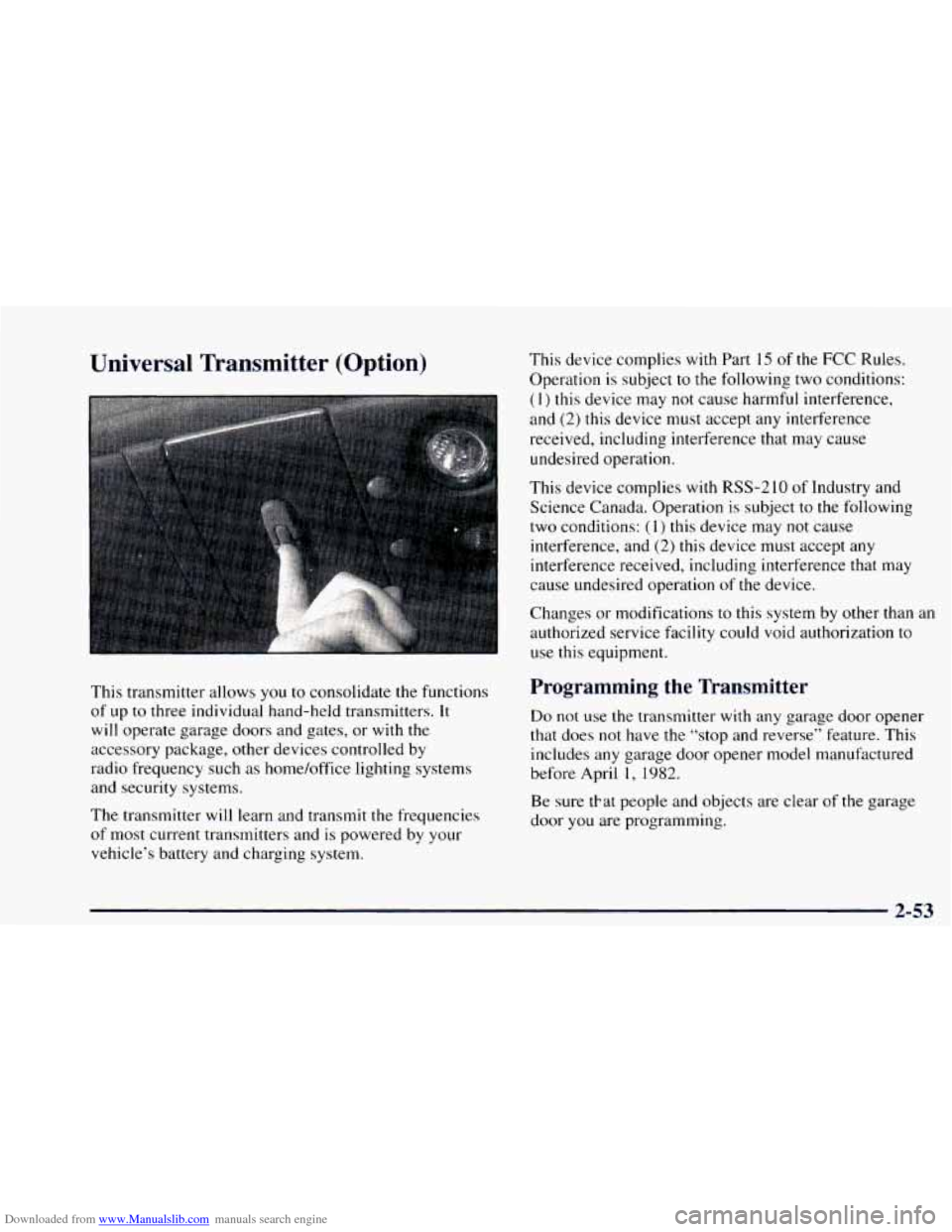
This transmitter allows you to consolidate the functions
of up to three individual hand-held transmitters.
It
will operate garage doors and gates, or with the
accessory package, other devices controlled by
radio frequency such as home/office lighting systems
and security systems.
The transmitter will learn and transmit the frequencies
of most current transmitters and is powered by your
vehicle’s battery and charging system. This device
complies with Part
15 of the FCC Rules.
Operation is subject to the following two conditions:
( 1) this device may not cause harmful interference,
and (2) this device must accept any interference
received, including interference that may cause
undesired operation.
This device complies with RSS-2
10 of Industry and
Science Canada. Operation is subject
to the following
two conditions:
(1) this device may not cause
interference, and
(2) this device must accept any
interference received, including interference that may
cause undesired operation
of the device.
Changes or modifications to this system by other than an
authorized service facility could void authorization
to
use this equipment.
Programming the Transmitter
Do not use the transmitter with any garage door opener
that does not have the “stop and reverse” feature. This
includes any garage door opener model manufactured
before April
1, 1982.
Be sure tkat people and objects are clear of the garage
door
you are programming.
2-53