1997 CADILLAC ELDORADO belt
[x] Cancel search: beltPage 60 of 361
Downloaded from www.Manualslib.com manuals search engine Accident statistics show that children are safer if they
are restrained in the rear seat. But they need to use the
safety belts properly.
e Children who aren’t buckled up can be thrown out in
0 Children who aren’t buckled up can strike other
a crash.
people
who are.
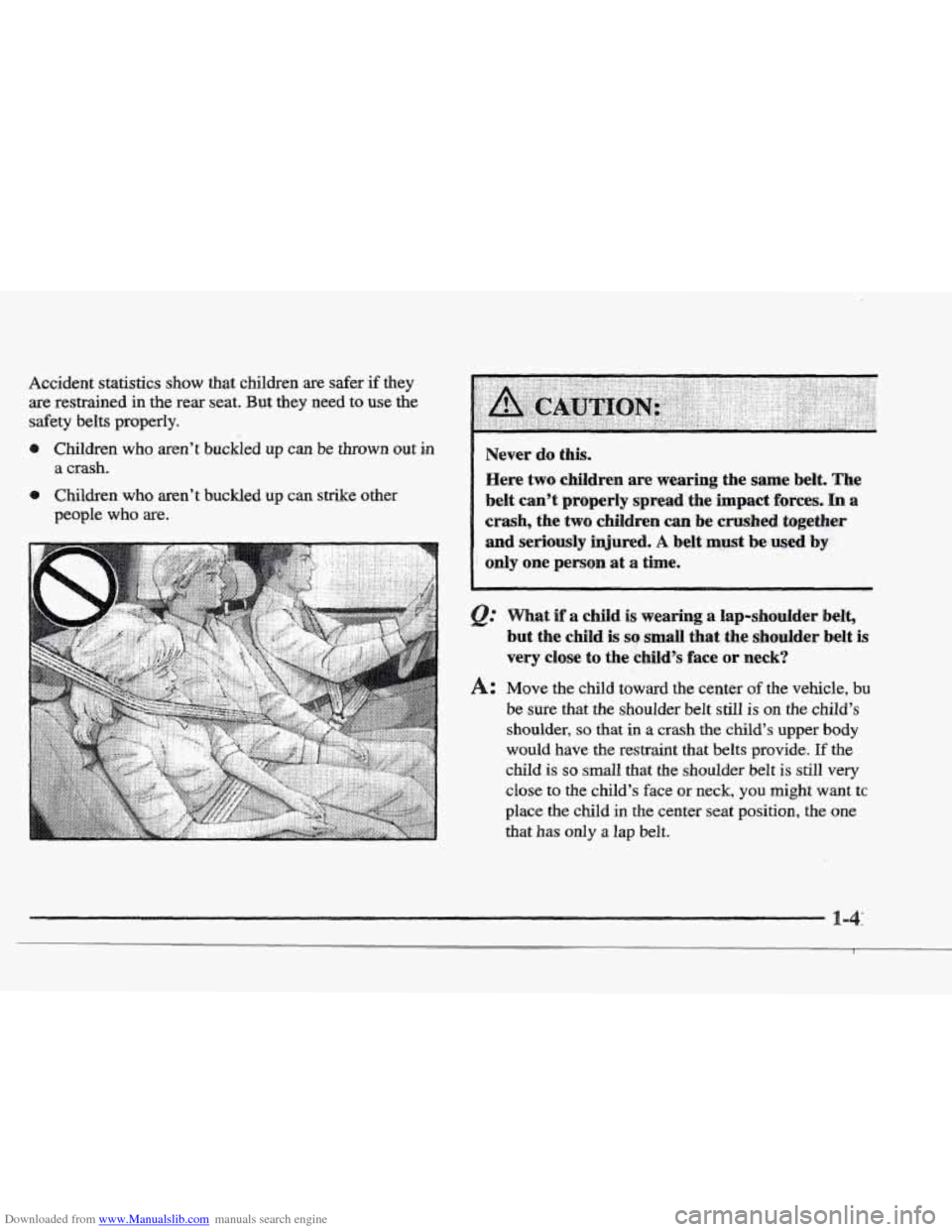
Never do this.
Here two children are wearing the same belt. The
belt can’t properly
spread the impact forces. In a
crash, the
two children can be crushed together
and seriously injured. A belt must be used by
only one person at a time.
~~~~~ ~. ~
@ What if a child is wearing a lap-shoulder belt,
but the child
is so .small that the shoulder belt is
very close to the child’s face or neck?
A: Move the child toward the center of the vehicle, bu
be sure that the shoulder belt still is on the child’s
shoulder, so that in a crash the child’s upper body
would have the restraint that belts provide.
If the
child is so small that the shoulder belt is still very
close to the child’s face or neck, you might want tc
place the child
in the center seat position, the one
that has
only a lap belt.
I
Page 61 of 361
Downloaded from www.Manualslib.com manuals search engine _. .. , . ,
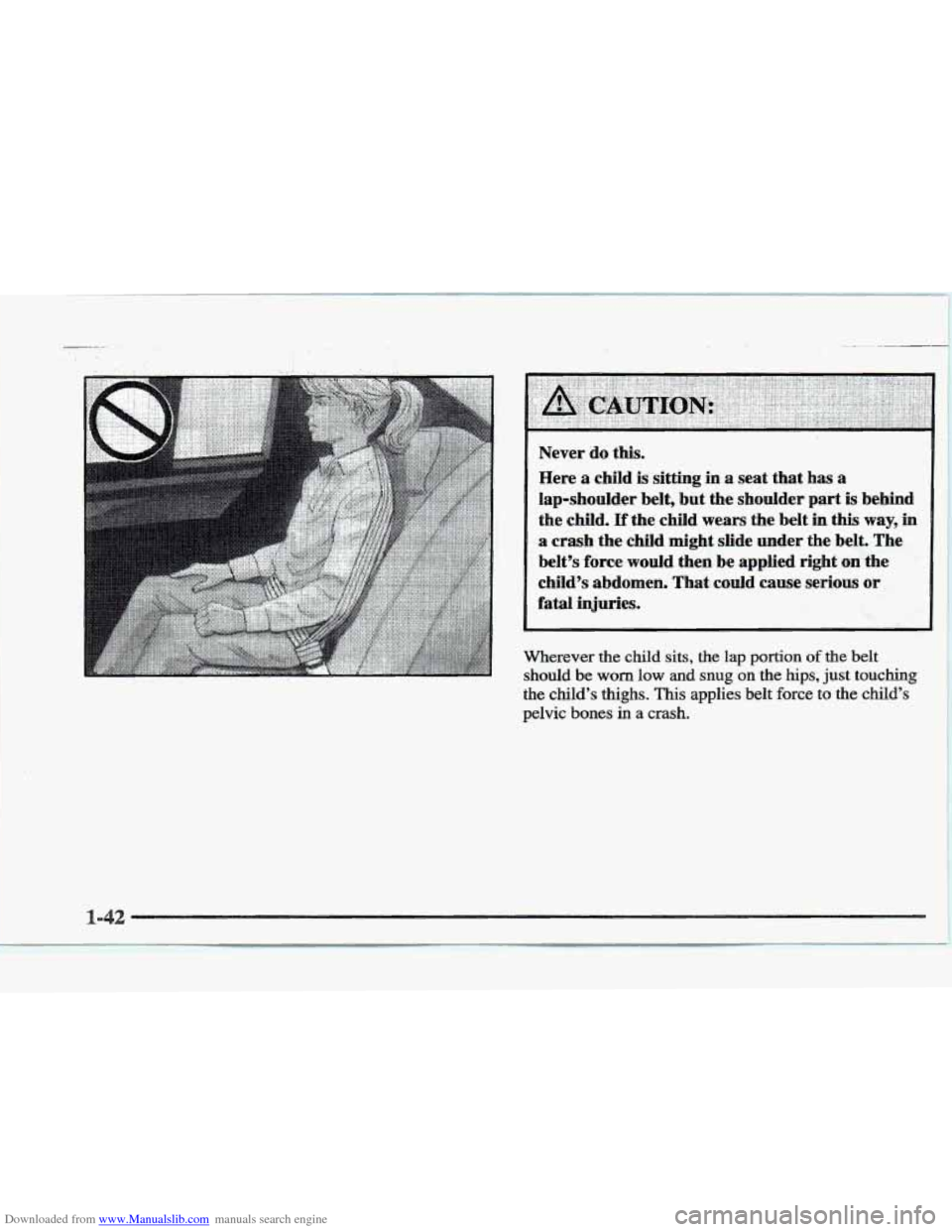
Never do this.
Here a child
is sitting in a seat that has a
lap-shoulder belt, but the shoulder part
is behind
the
child. If the child wears the belt in this way, in
a crash the child might slide under the belt. The
belt’s force would then be applied right on.the
child’s abdomen. That could cause serious or
fatal injuries.
Wherever the child sits, the lap portion of the belt
should be
worn low and snug on the hips, just touching
the child’s thighs. This applies belt force to the child’s
pelvic bones in a crash.
Page 62 of 361
Downloaded from www.Manualslib.com manuals search engine If the vehicle’s safety belt will fasten around you, you
should use it.
But
if a safety belt isn’t Bong enough to fasten, your
dealer will order you an extender. It’s free. When you go
in to order
it, take the heaviest coat you will wear, SO the
extender will be long enough for you. The extender will
be just for you, and just for the seat
in your vehicle that
you choose.
Don’t let someone else use it, and use it
only for the seat it is made to fit. To wear it, just attach it
to the regular safety belt.
s
Now and then, make sure the safety belt reminder light
and all your belts, buckles, latch plates, retractors and
anchorages are working properly.
Look for any other
loose or damaged safety belt system parts. If you see
anything that
might keep a safety belt system from
doing its job, have it repaired.
TQ~ or frayed safety belts may not protect you in a
crash. They can rip apart under impact forces. Hf a belt is
torn or frayed, get a new one right away.
Also
look for any opened or broken air bag covers, and
have them repaired or replaced. (The air bag system
does not
need regular maintenance.) If
you’ve had a crash, do you need new belts?
After
a very minor collision, nothing may be necessary.
But if the belts were stretched, as they would
be if worn
during
a more severe crash, then you need new belts.
If belts are cut or damaged, replace them. Collision
damage also may mean you will need to have safety belt
or seat
parts repaired or replaced. New parts and repairs
may be necessary even if
the belt wasn’t being used at
the time of the collision.
If an
air bag inflates, you’ll need to replace air bag
system parts. See
the part on the air bag system earlier in
this section.
Page 67 of 361

Downloaded from www.Manualslib.com manuals search engine I. ..
N’:
Unlocked doors can e dangerous.
Passengers
-- especially sc ildren -- can easily
open the doors asld fall out. When a door is
locked, the inside le won’t open it.
Outsiders can easily enter through an unlocked
door when
you sllow down or stop your vehicle.
This may not be so obvious: You increase the
crash if the doors aren’t locked. Wear safety belts
properly, lock your doors and you will be far
better off whenever you drive your vehicle.
chance of being thrown out of the vehicle in a
There are several ways to lock and unlock your vehicle.
From the outside, use either the door key or the Remote
Keyless
Entry (RKE) transmitter.
If your vehicle has the optional theft-deterrent system,
YOU must unlock the doors with the key or RME
transmitter t~ avoid setting off the aIa1-m.
Slide the manual lock lever down to lock the door from
the inside. To unlock the door, slide the lock lever up.
Your vehicle will have this feature if it is equipped with
the optional theft-deterrent system. When unlocking
either
door, you can also unlock the other door by
holding the key in the turned position for a few seconds
or by quickly turning the door key twice in the
lock cylinder.
Page 133 of 361
Downloaded from www.Manualslib.com manuals search engine F s
This part describes the warning lights and gages that
may be
on your vehicle. The pictures will help YOU
locate them.
Warning lights and gages can signal that something is
wrong before it becomes serious enough to cause an
expensive repair or replacement. Paying attention to
your warning lights and gages could also save
you or
others from injury.
Warning lights come
on when there may be or is a
problem with one of your vehicle’s functions.
As you
will see
in the details on the next few pages, some
warning lights come on briefly when
YOU start the
engine just to let you know they’re working.
If you are
familiar with this section, you should not be alarmed
when this happens.
Gages can indicate when there
may be or is a problem
with one of your vehicle’s functions. Often gages and
warning Bights work together to let
YOU know when
there’s
a problem with your vehicle.
When one
of the warning lights comes on and stays on
when YOU are driving, or when one of the gages shows
there may be a problem, check
the section that tells YOU
what to do about it. Please follow this manual’s advice.
Waiting to do repairs can be costly
-- and even
dangerous.
So please get to know your warning lights
and gages. They’re
a big help.
Your vehicle also
has a Driver Information Center that
works along with
the warning lights and gages. See
“Driver Information Center” later in this section.
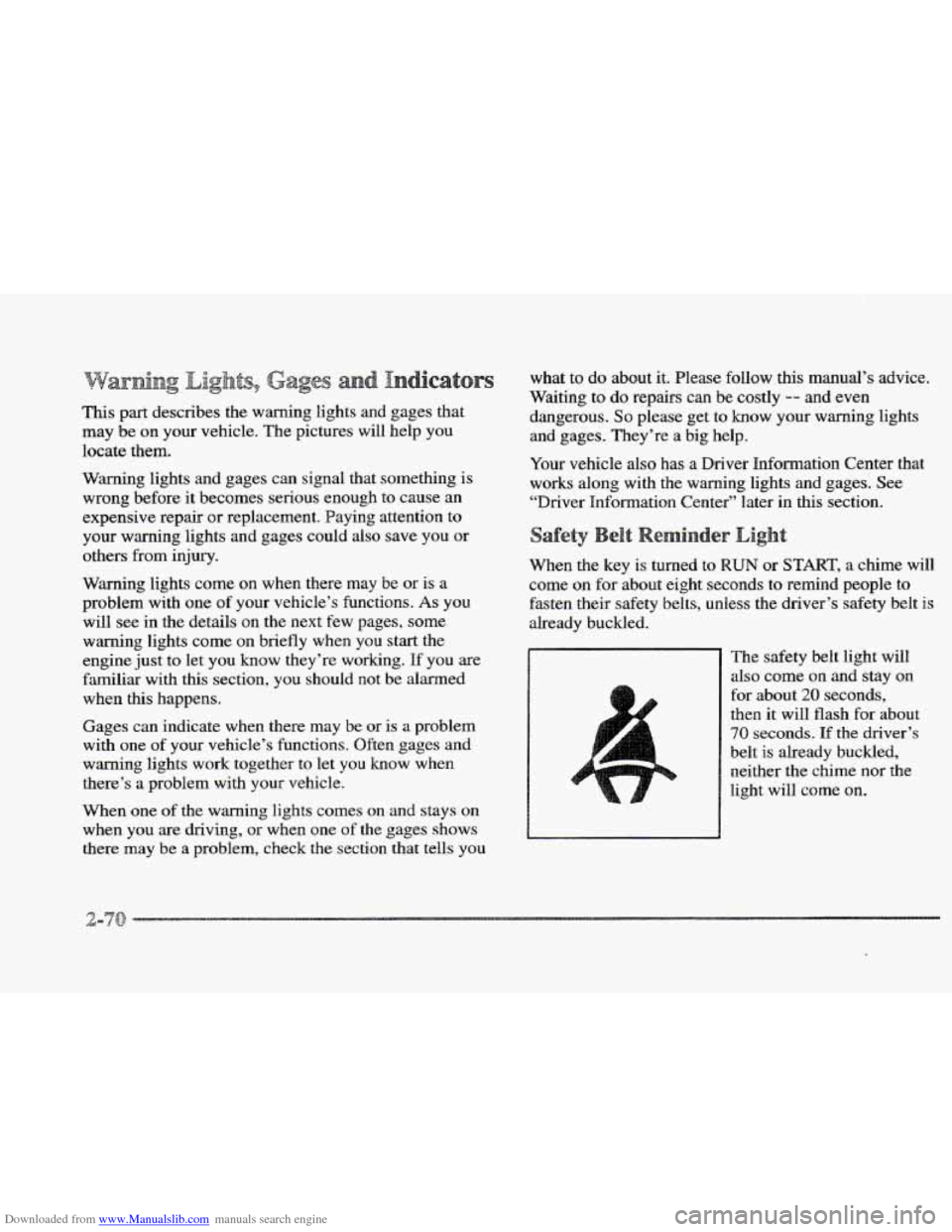
When the key is turned
to RUN or START, a chime will
come on for
about eight seconds to remind people to
fasten their safety belts, unless
the driver’s safety belt is
already buckled.
The safety belt light
will
also come on and stay
for about
20 seconds,
then it will flash
for about
70 seconds. If the driver’s
belt
is already buckled,
neither the chime nor the
light will come on.
Page 182 of 361
Downloaded from www.Manualslib.com manuals search engine Some cleaning cassettes or CD adapter kits may appear
as
a broken tape. If the cleaning cassette is ejected
immediately from the tape player, follow these steps
for
the TAPE CLEAN OVE
E. Turn the ignition to RUN or ACC.
2. Turn the radio off.
3. Press and hold the SOURCE button for three
seconds. After thee seconds, the tape icon will flash
indicating the cut tape feature
is now turned off.
4. Turn the radio on and insert the cleaning cassette (CX
the CD adapter kit).
5. Eject the tape after the tape player has been cleaned.
When
the cleaning cassette has been ejected, the broken
tape detection feature
is active again.
YOU may also choose a non-scrubbing action, wet-type
cleaner which uses a cassette with
a fabric belt to clean
the
tape head. This type of cleaning cassette will not
eject and, it may
not clean as thoroughly as the
scrubbing
type cleaner.
Cassettes are subject to
wear and the sound quality
may degrade over time. Always make sure the cassette
tape
is in good condition. before YOU have your tape
player serviced. Handle discs carefully. Store
them in their original case:
or other protective cases
and away from direct sunlight
and dust. If the surface
of a disc is soiled, dampen a
clean, soft cloth in a mild, neutral detergent solution anc
clean it, wiping from the center to the edge.
Be sure never to touch the signal surface when handling
discs. Pick up discs by grasping the outer edges or the
edge
of the hole and the outer edge.
Your power antenna will look its best and work
well if it’s cleaned
from time to time. To clean the
antenna mast:
1. Turn on the ignition and radio to raise the antenna.
2. Dampen a clean cloth with mineral spirits or
equivalent solvent.
3. Wipe the cloth over the mast sections, removing
any dirt.
3-27
Page 187 of 361
Downloaded from www.Manualslib.com manuals search engine . . . .. ,. ..
efensive
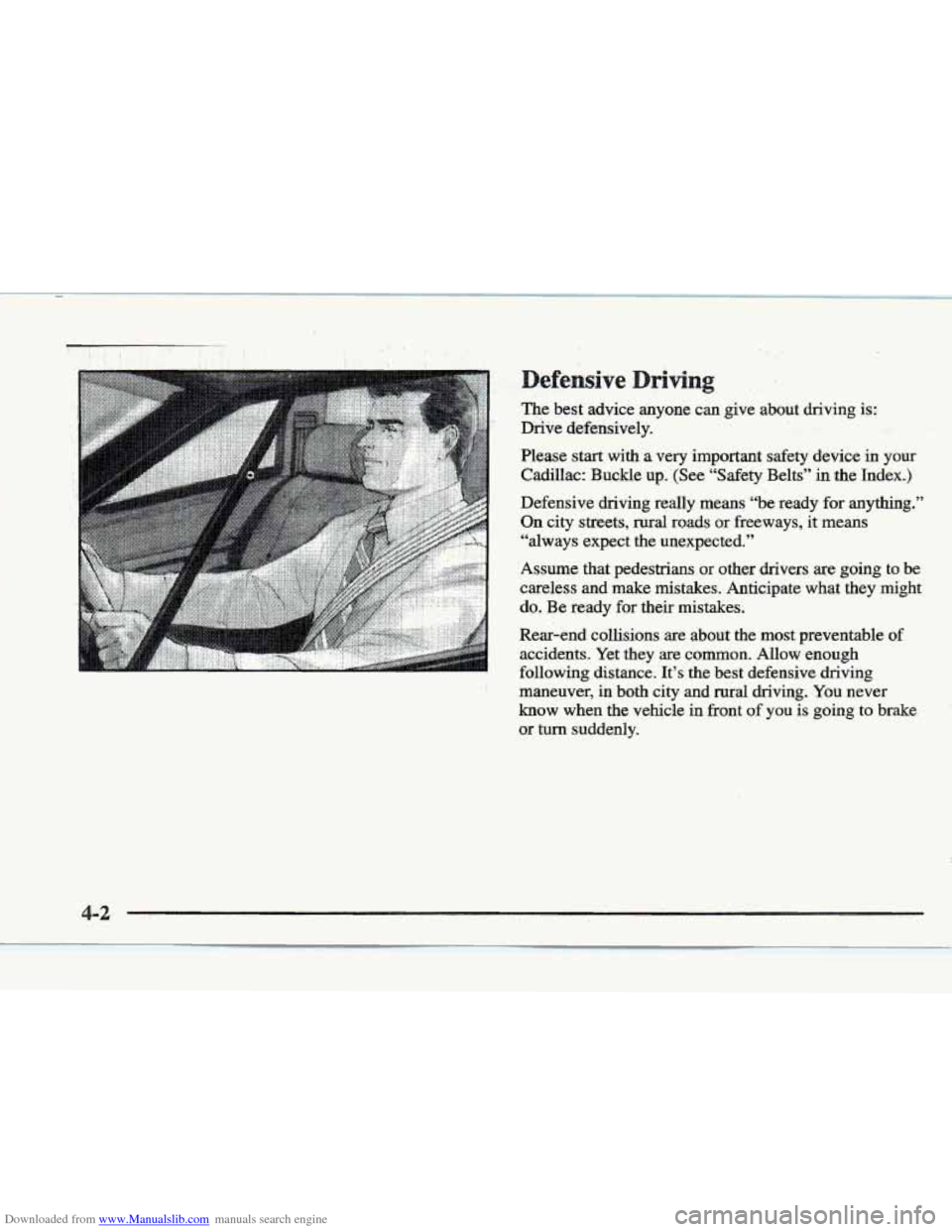
The best advice anyone can give about driving is:
Drive defensively.
Please start
with a very important safety device in your
Cadillac: Buckle up. (See “Safety Belts” in the Index.)
Defensive driving really means “be ready
for anything.”
On city streets, rural roads or freeways, it means
“always expect the unexpected.”
Assume that pedestrians or other drivers
are going to be
careless and make mistakes. Anticipate what they might
do. Be ready
for their mistakes.
Rear-end collisions are about the most preventable
of
accidents. Yet they are common. Allow enough
following distance. It’s the best defensive driving
maneuver, in both city and rural driving. You never
know when the vehicle in front
of you is going to brake
or
turn suddenly.
Page 197 of 361
Downloaded from www.Manualslib.com manuals search engine teering in
There are times when steering can be more effective
than braking. For example, you come over a hill and
find a truck stopped in your lane, or a car suddenly pulls
out
from nowhere, or a child darts out from between
parked cars and stops right
in front of you. You can
avoid these problems by bralung
-- if you can stop in
the. But sometimes you can’t; there
isn’t room.
That’s the time
for evasive action -- steering around
the problem.
Your Cadillac can perfonn very well
in emergencies like
these. First apply your brakes.
(See “Braking in
Emergencies” earlier
in this section.) It is better to
remove as
much speed as you can from a possible
collision. Then steer around
the problem, to the left or
right depending
on the space available.
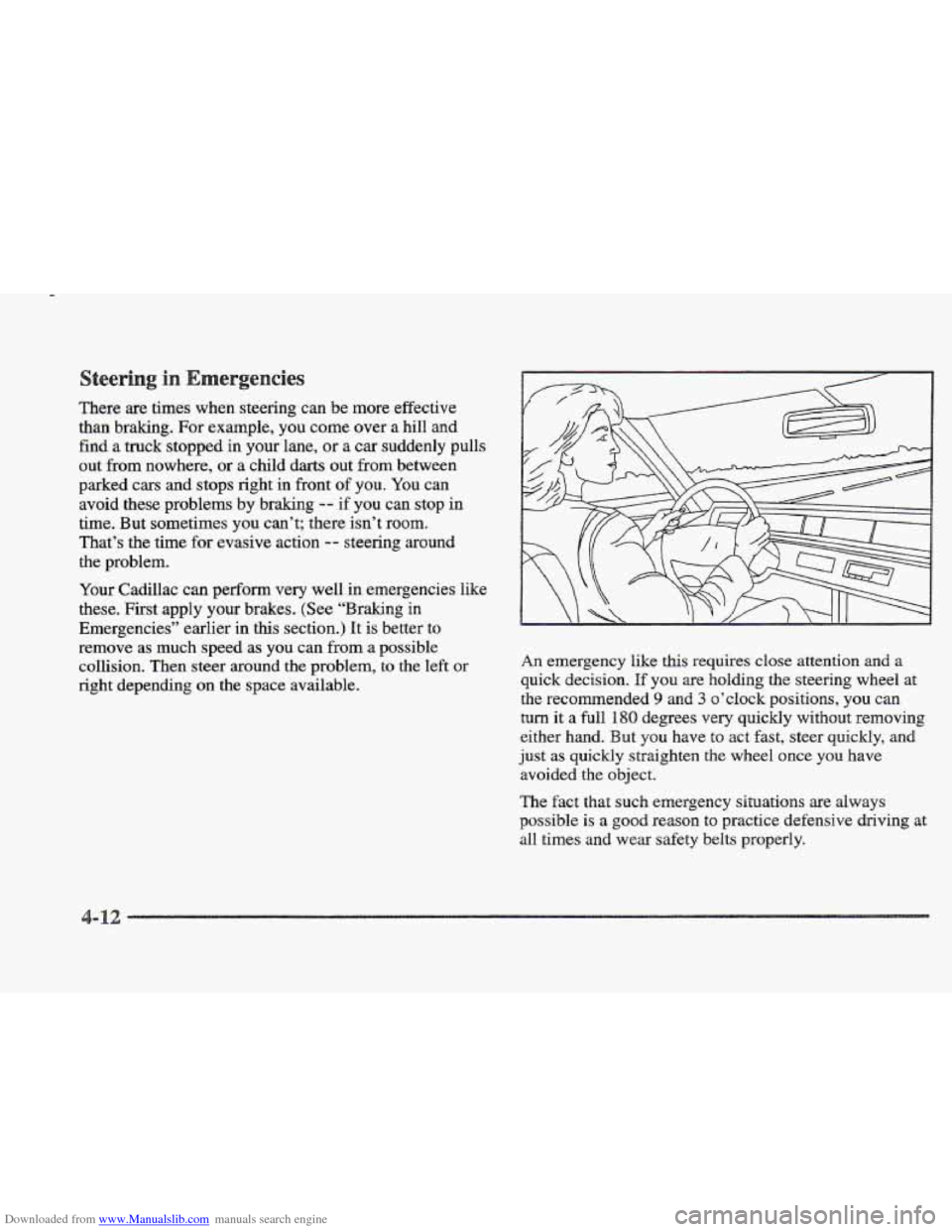
An emergency like this requires close attention and a
quick decision.
If you are holding the steering wheel at
the recommended
9 and 3 o’clock positions, you can
turn it a full 180 degrees very quickly without removing
either hand. But
you have to act fast, steer quickly, and
just
as quickly straighten the wheel once you have
avoided
the object.
The fact
that such emergency situations are always
possible is
a good reason to practice defensive driving at
all times and wear safety belts properly.