1997 CADILLAC ELDORADO fuel
[x] Cancel search: fuelPage 128 of 361
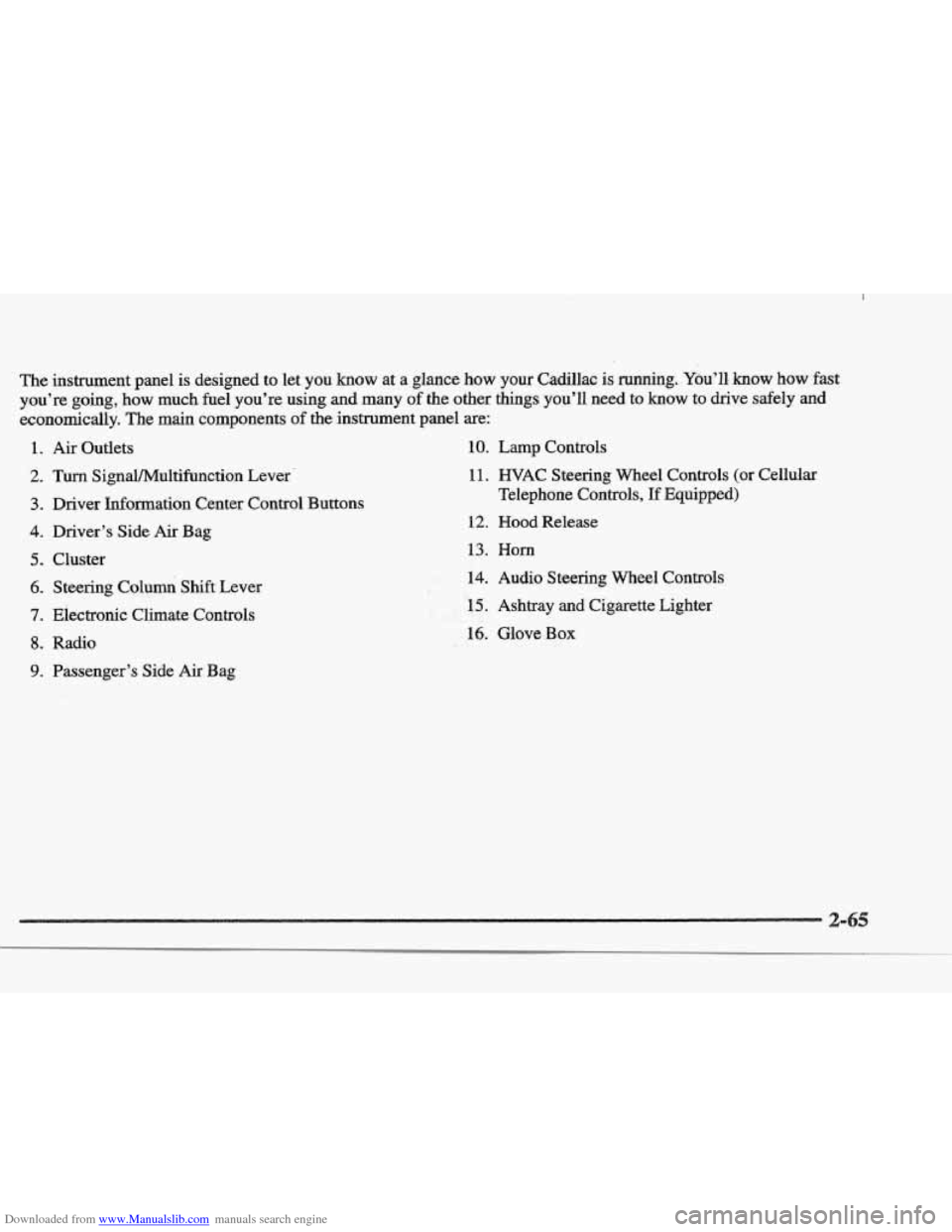
Downloaded from www.Manualslib.com manuals search engine The insbrument.pane1 is designed to let you know at a glance how your Cadillac is running. You’ll, know how fast
you’re going, how
much fuel you’re using and many of the other things you’ll need to know to drive safely and
economically. The main components of the instrument panel are:
1.
2.
3.
4.
5.
6.
7.
8.
9.
Air Outlets
Turn SignaVMultifbnction Lever.
Driver Information Center Control Buttons
Driver’s Side
Air Bag
Cluster Steering Columi Shift Lever
Electronic Climate Controls
Radio
Passenger’s Side
Air Bag
10. Lamp Controls
11. WAC Steering Wheel Controls (or Cellular
Telephone Controls,
If Equipped)
12. Hood Release
13. Horn
.#k. 14. Audio Steering Wheel Controls
F. , LI
- , .r 15. Ashtray and Cigarette Lighter I !i&&
16. Glove Box
Page 132 of 361
Downloaded from www.Manualslib.com manuals search engine I -I
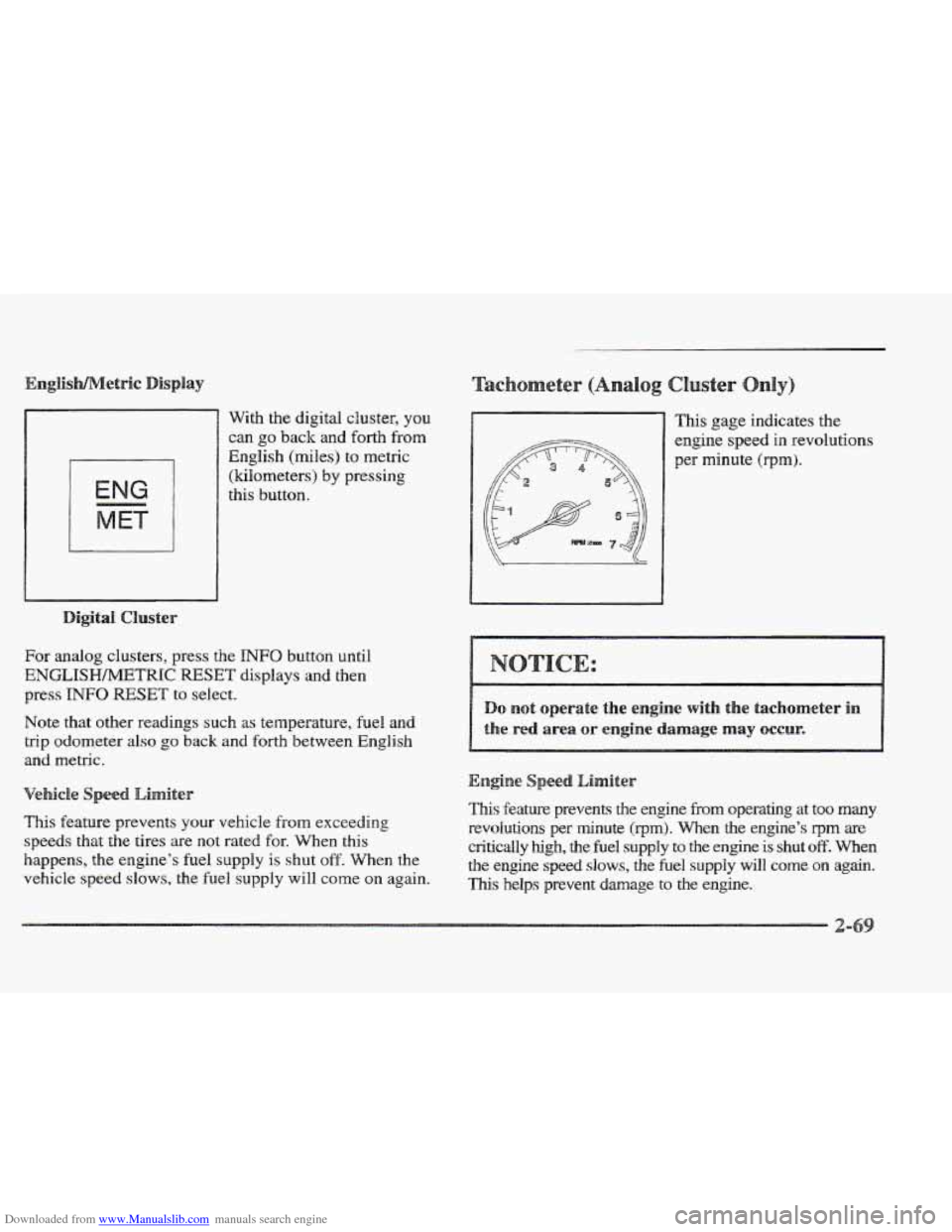
With the digital cluster, you
can go back and forth from
English (miles) to metric
(kilometers)
by pressing
this button.
For analog clusters, press the INFO button until
ENGLISHh4ETRIC RESET displays and then
press
INFO RESET to select.
Note that other readings
such as temperature, fuel and
trip odometer
also go back and forth between English
and metric.
This feature prevents your vehicle from exceeding
speeds that the tires are not rated for. When this
happens, the engine’s
fuel supply is shut off. When the
vehicle speed
slows, the fuel supply will come on again. This gage
indicates the
engine speed
in revolutions
per minute (rprn).
eed Limiter
This feature prevents the engine from operating at too many
revolutions per minute (rprn). When the engine’s qrn are
critically high, the fuel supply to the engine is shut off. When
the engine speed slows, the fuel supply will come on again.
This helps prevent damage to the engine.
Page 139 of 361
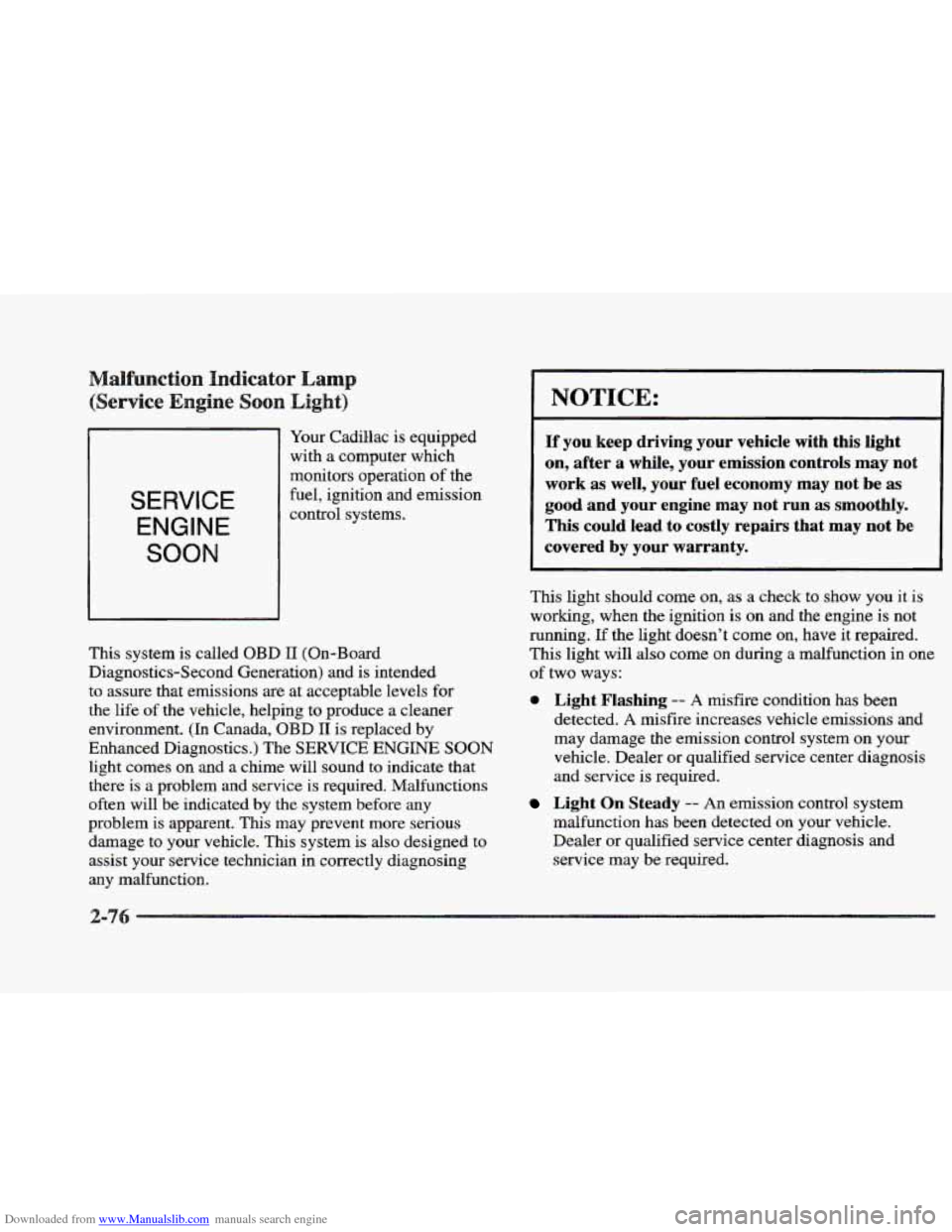
Downloaded from www.Manualslib.com manuals search engine Your Cadillac is equipped
with
a computer which
monitors operation
of the
fuel, ignition and emission
SERVICE
ENGINE
SOON
This system is called OBD 11 (On-Board
Diagnostics-Second Generation) and is intended
to assure that emissions
are at acceptable levels for
the life of the vehicle, helping to produce a cleaner
environment. (In Canada,
OBD I1 is replaced by
Enhanced Diagnostics.) The
SERVICE ENGINE SOON
light comes on and a chime will sound to indicate that
there is a problem and service is required. Malfunctions
often will be indicated
by the system before any
problem is apparent. This may prevent more serious
damage to your vehicle. This system is also designed to
assist your service technician in correctly diagnosing
any malfunction.
I NOTICE:
I I
If you keep driving your vehicle with this light
on, after a while, your emission controls may not
work as well, your fuel economy may not be as
good and your engine may not run as smoothly.
This could lead to costly repairs that may not be
covered by your warranty.
1
This light should come on, as a check to show you it is
working, when the ignition is
on and the engine is not
running.
If the light doesn’t come on, have it repaired.
This light will also come on during a malfunction in one
of two ways:
* Light Flashing -- A misfire condition has been
detected.
A misfire increases vehicle emissions and
may damage the emission control system on your
vehicle. Dealer
or qualified service center diagnosis
and service
is required.
Light On Steady -- An emission control system
malfunction has been detected on your vehicle.
Dealer
or qualified service center diagnosis and
service may be required.
Page 140 of 361
Downloaded from www.Manualslib.com manuals search engine the Light Is Flashing
The following may prevent more serious damage to
your vehicle:
Reducing
vehicle speed.
9 Avoiding hard accelerations.
e Avoiding steep uphill grades.
@ If you are towing a trailer, reduce the amount of
cargo being hauled as soon as it is possible.
If the light stops flashing and remains on steady, see “If
the Light
Is On Steady” following.
If the light continues to flash, when it is safe to do so,
stop the vehicle. Find a safe place to park your vehicle.
Turn the key off, wait at least 10 seconds and restart the
engine.
If the light remains on steady, see “If the Light
Is Qn Steady” following. If the light is still flashing,
follow
the previous steps, and drive the vehicle to your
dealer or qualified service center for service.
You may
be able to correct the emission system
malfunction
by considering the following:
Did you just drive through a deep puddle
of water?
If so, your electrical system may be wet. The condition
will usually be corrected when the electrical system
dries out. A few driving trips should turn the light off.
Are you low on fuel?
As your engine starts to run out of fuel, your engine may
not run as efficiently as designed since small amounts of
air are sucked into the fuel line causing
a misfire. The
system can detect this. Adding fuel should correct this
condition. Make sure
to install the fuel cap properly. It
will take a few driving trips to turn the light off.
Have you recently changed brands of fuel?
If
so, be sure to fuel your vehicle with quality fuel (see
“Fuel” in
the Index). Poor fuel quality will cause your
engine not to run as efficiently as designed. You may
notice
this as stalling after start-up, stalling when you put
the vehicle into gear,
misfiring, hesitation on acceleration
or stumbling
on acceleration. (These conditions may go
away once the engine is warmed
up.) This will be
detected
by the system and cause the light to turn on.
If you experience one or more of these conditions,
change the fuel brand you use.
It will require at least one
full
tank of the proper fuel to turn the light off.
If none of the above steps have made the light turn off,
have your dealer or qualified service center check the
vehicle. Your dealer has the proper test equipment and
diagnostic tools
to fix any mechanical or electrical
problems that may have developed.
Page 142 of 361
Downloaded from www.Manualslib.com manuals search engine 13
GAL 11-
PREMIUM UNLEADED
FUEL ONLY
Digital Cluster
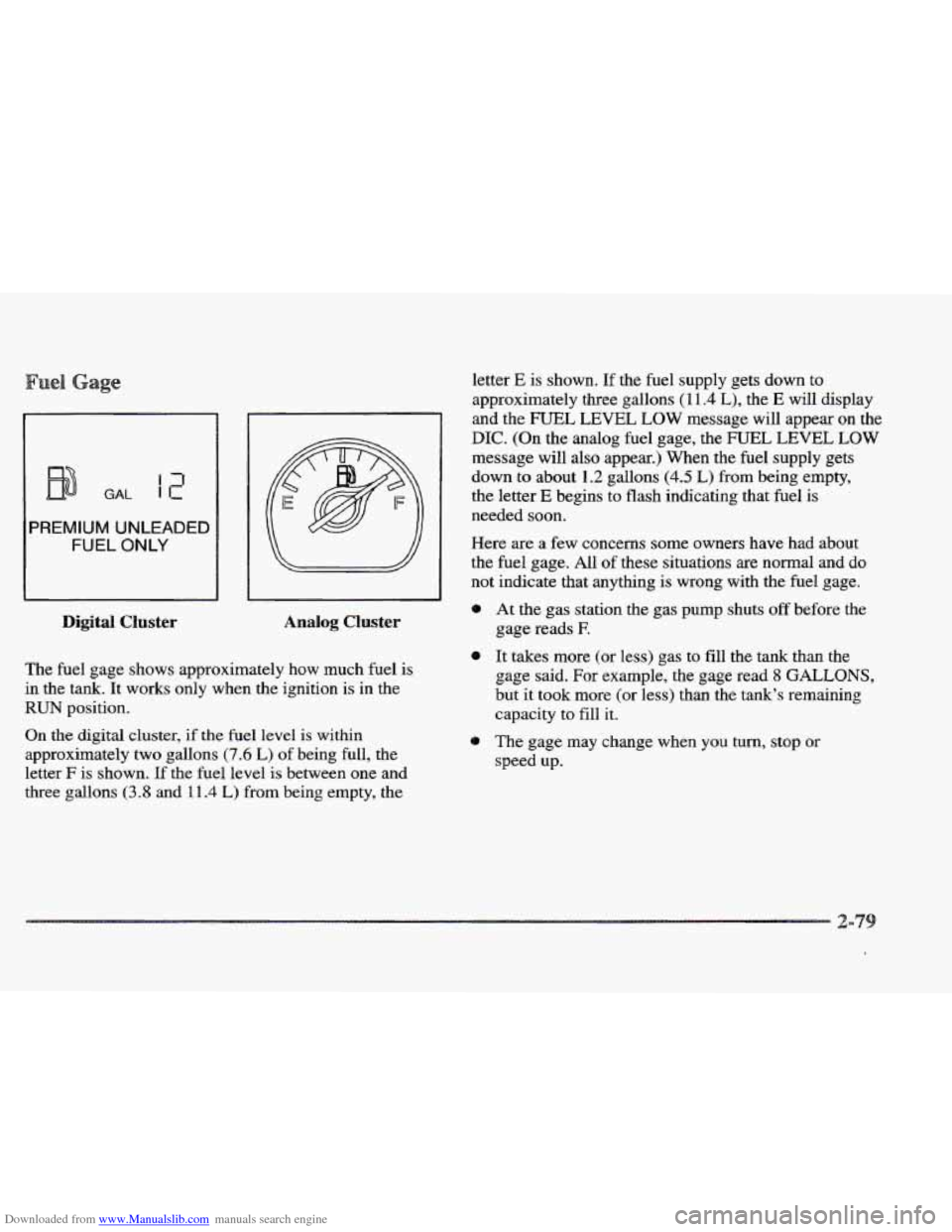
letter E is shown. If the fuel supply gets down to
approximately three gallons
( 1 1.4 L), the E will display
and the FUEL LEVEL LOW message will appear on the
DIC. (On the analog fuel gage, the FUEL LEVEL LOW
message will also appear.) When the fuel supply gets
down to about
1.2 gallons (4.5 L) from being empty,
the letter
E begins to flash indicating that fuel is
needed soon.
Here are a few concerns
some owners have had about
the fuel gage. All of these situations are normal
and do
not indicate that anythmg is wrong with the fuel gage.
I
0 At the gas station the gas pump shuts off before the
Analog Cluster gage reads E
The fuel gage shows approximately how much fuel is
in the tank. It works only when the ignition is in the
RUN position.
On the digital cluster, if the fuel level is within
approximately two gallons
(7.6 L) of being full, the
letter
F is shown. If the fuel level is between one and
three gallons
(3.8 and 111.4 L) from being empty, the
0 It takes more (or less) gas to fill the tank than the
gage said. For example, the gage read
8 GALLONS,
but it took more (or less) than the tank’s remaining
capacity to fill it.
0 The gage may change when you turn, stop or
speed up.
Page 143 of 361
Downloaded from www.Manualslib.com manuals search engine Digital Cluster
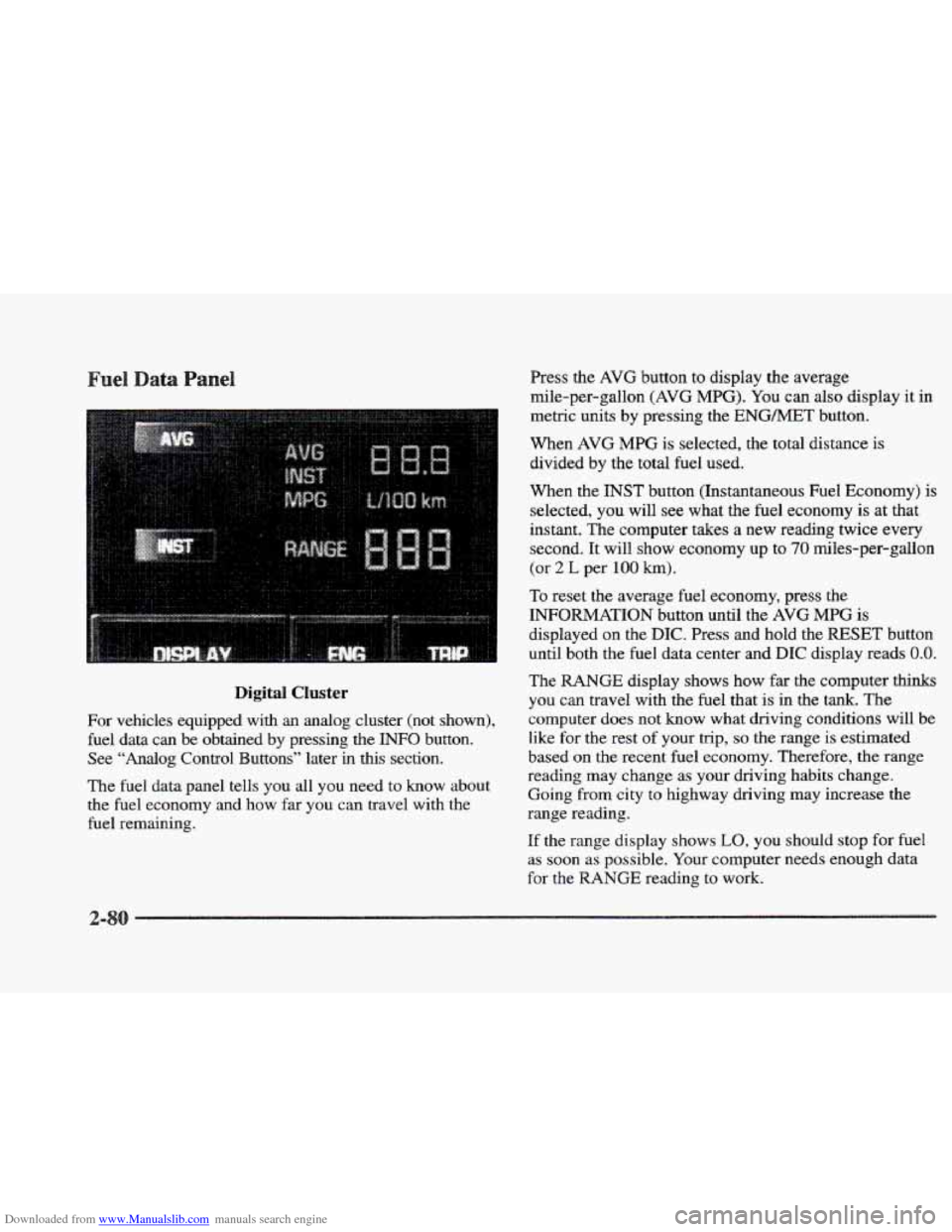
For vehicles equipped with an analog cluster (not shown),
fuel data can be obtained by pressing the INFO button.
See
“Analog Control Buttons” later in this section.
The
fuel data panel tells you all you need to know about
the fuel economy and how far you can travel with the
fuel remaining. Press
the
AVG button to display the average
mile-per-gallon
(AVG MPG). You can also display it in
metric units by pressing the
ENGMET button.
When AVG
MPG is selected, the total distance is
divided by the total fuel used.
When the
INST button (Instantaneous Fuel Economy) is
selected, you will see what the
fuel economy is at that
instant. The computer takes a new reading twice every
second.
It will show economy up to 70 miles-per-gallon
(or
2 L per 100 km).
To reset the average fuel economy, press the
INFORMATION button until the AVG MPG is
displayed on the DIC. Press and hold the RESET button
until both the fuel data center and
DIC display reads 0.0.
The RANGE display shows how far the computer thinks
you can travel with the fuel that is in the
tank. The
computer does not
know what driving conditions will be
like for
the rest of your trip, so the range is estimated
based
on the recent fuel economy. Therefore, the range
reading may change as your driving habits change.
Going from city to highway driving may increase the
range reading.
If the range display shows
LO, you should stop for fuel
as soon as possible. Your computer needs enough data
for the MNGE reading to work.
2-
Page 144 of 361
Downloaded from www.Manualslib.com manuals search engine river
The DIC display gives you the status of many of your
vehicle’s systems. The DIC is
also used to display driver
personalization features and warning/status messages.
Your vehicle may be equipped with the following
features that can be individually customized for up to
two drivers.
e Programmable Automatic Door Locks
e Remote Confirmation (for RKE)
e Exterior Lighting (at Unlock)
e Remote Recall Memory (for RKE or Key in
the Ignition)
e Battery Guard Storage
8 Climate Control Personalization
Memory Seat and Mirrors
Radio Personalization
For detailed information, see each feature in the Index.
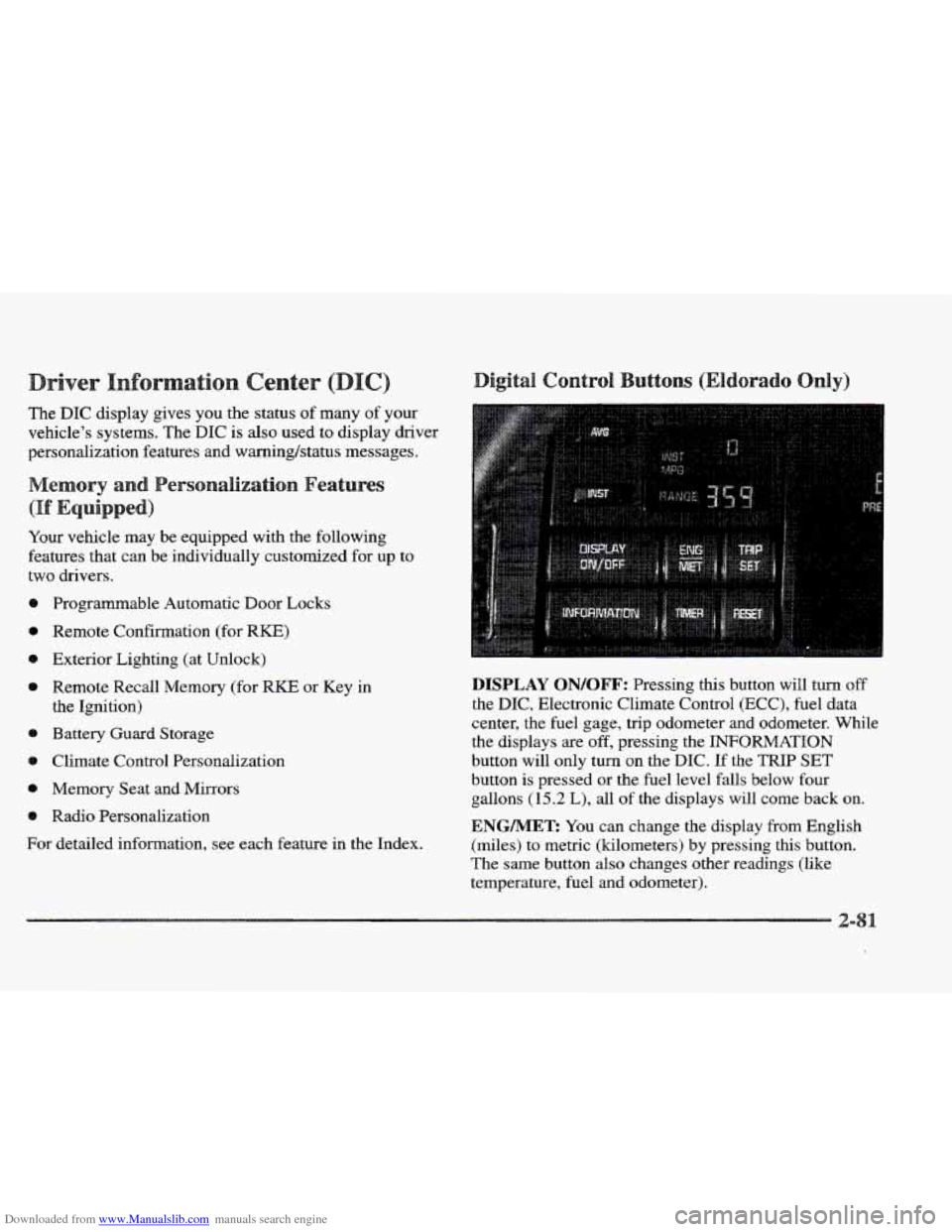
DISPLAY QN/QFF: Pressing this button will turn off
the DIC, Electronic Climate Control (ECC), fuel data
center, the fuel gage, trip odometer and odometer. While
the displays
are off, pressing the INFORMATION
button will only turn
on the DIC. If the TRIP SET
button is pressed or the fuel level falls below four
gallons
(15.2 L), all of the displays will come back on.
ENGMET: You can change the display from English
(miles) to metric (kilometers) by pressing this button.
The same button also changes other readings (like
temperature, fuel and odometer).
Page 145 of 361

Downloaded from www.Manualslib.com manuals search engine TRIP SET By using this button, you can tell how far
you’ve gone since you last set the
TRIP SET back to
zero. To reset, press and hold the button
until zeros
appear. If your vehicle is domestic, the trip odometer
will return to zero after 999.9 miles
( 1 609 km). If your
vehicle is Canadian, the
trip odometer will return to zero
after
1 999.9 km (1,242 miles).
INFORMATION: Pressing this button repeatedly will
display the MPG
AVG, MPG INST, GAL FUEL USED,
AVG MPH, ENGINE
RPM, BATTERY VOLTS,
COOLANT TEMP and
OIL LIFE LEFT.
TIMER: This feature is like a stopwatch, in that
you can clock the time it takes to get from one point
to another.
To operate, press the TIMER button until
TIMER OFF
0O:OO:OO is displayed on the DIC. Each of the fields for
the hours, minutes and seconds are two numeric digits.
Once TIMER
OFF 0O:OO:OO is displayed, press the
TIMER button to start the timing feature. Press the
TIMER button again to stop
it. If you will be starting
and stopping your Cadillac, during
a trip for instance,
the
TIMER feature will automatically start timing where
it left
off when you last stopped. To reset it, press and
hold the
RESET button until the display reads TIMER
0O:OO:OO. Press the INFORMATION button to exit from
the TIMER function.
RESET Pressing this button will reset the MPG AVG,
MPG INST, GAL FUEL USED, AVG MPH and OIL
LIFE LEFT. Pressing RESET when a non-resettable
display appears
will cause a “recall” mode to occur.
When this happens, all DIC warning messages that have
been displayed since the ignition key was turned to
RUN will redisplay. If no messages were displayed, a
MONITORED SYSTEMS
OK message will appear.
MPG AVG (Reset): Press the INFORMATION button
to display the MPG
AVG (Average Fuel Economy), then
press and hold the
IRESET button until 0.0 MPG AVG
is displayed.
FUEL USED (Reset): Press the INFORMATION
button to display the
GAL FUEL USED on the DIC,
then press and hold the
RESET button until 0.0 GAL
FUEL USED is displayed.
AVG MPH (Reset): Press the INFORMATION button
to display the AVG
MPH (Average Speed), then press
and hold the RESET button until
0.0 AVG MPH
is displayed.
OIL LIFE LEFT (Reset): Press the INFORMATION
button to display the OIL LIFE LEFT, then press and
hold the
RESET button until 100% OIL LIFE LEFT is
displayed. (This only needs to be reset after you have
had the oil changed.)