1997 CADILLAC ELDORADO brake light
[x] Cancel search: brake lightPage 151 of 361
Downloaded from www.Manualslib.com manuals search engine 2 MINUTES, WAIT 1 MINUTE and then STAKT CAR.
When the REMOVE KEY message is displayed, remove
the ignition key. Check the ignition key for damage. If it
is damaged, it may need to be replaced. If you see no
damage, clean
the pellet contacts with a soft cloth or
napkin before inserting the key back into
the ignition.
Have your vehicle serviced if the message still appears.
SERVICE A/C SYSTEM A/C COMPRESSOR
OFF - 14: This message appears when the electronic
sensors that control the air conditioning and heating
systems
are no longer working. Have the climate control
system serviced if you notice a drop in heating and air
conditioning efficiency.
SERVICE AIR BAG - 83: There is a problem with the
Supplemental Inflatable Restraint (air bag) system when
this message appears. Let only
a qualified technician
work on your vehicle.
See your Cadillac dealership for
service at once.
SERVICE BRAKE FLUID SWITCH - 37: A defect
in the brake fluid detection circuit causes this message
to display
if the ignition is in the RUN position. Have
the brake system serviced by a Cadillac technician as
soon as possible. If the brake warning light is on, refer
to the directions listed in that part.
SERVICE CHARGING SYSTEM - 102: This
message will display when a problem
with the charging system
has been detected. Have your vehicle serviced at
your Cadillac dealership.
SERVICE ELECTRICAL SYSTEM - 106: This
message will display if
an electrical problem has
occurred within the PCM. Have your vehicle serviced
by your Cadillac dealership.
SERVICE EMISSIONS SYSTEM - 104: A problem in
the emission5 system has occurred when this message
appears. Have your Cadillac dealershp service your vehicle.
SERVICE ENGINE COOLING SYSTEM - 103: A
problem within the engine cooling system has been
detected when this message displays. See your Cadillac
dealership for service.
SERVICE FUEL SYSTEM - 101: The PCM has
detected
a problem withm the fuel system when this
message appears. See your Cadillac dealership for service.
SERVICE IDLE CONTROL SYSTEM - 187: A
problem with the idle control has occurred when this
message displays.
Bring your vehicle to your Cadillac
dealership for service.
SERVICE IGNITION SYSTEM - 105: This message
displays when
a failure in the ignition system has
been detected. Have your vehicle serviced by your
Cadillac dealership.
Page 192 of 361
Downloaded from www.Manualslib.com manuals search engine Avoid needless heavy braking. Some people drive in
spurts -- heavy acceleration followed by heavy
braking
-- rather than keeping pace with traffic. This is a
mistake. Your brakes
may not have time to cool between
hard stops. Your brakes will wear out much faster if you
do a lot of heavy braking.
If you keep pace with the
traffic and allow realistic following distances, you will
eliminate
a lot of unnecessary braking. That means
better braking and longer brake
life.
If your engine ever stops while you’re driving, brake
normally but don’t pump your brakes.
If you do, the
pedal may get harder to push down.
If your engine
stops, you will still have some power brake assist. But
you will use
it when you brake. Once the power assist is
used up, it may take longer to stop and the brake pedal
will be harder to push. Your
vehicle
has anti-lock brakes (ABS). ABS is an
advanced electronic braking system that will help
prevent a braking skid.
When
you start your engine and begin to drive away,
your anti-lock brake system will check itself. You may
hear a momentary motor or clicking noise while this test
is going on, and you may even notice that your brake
pedal moves a little. This
is normal.
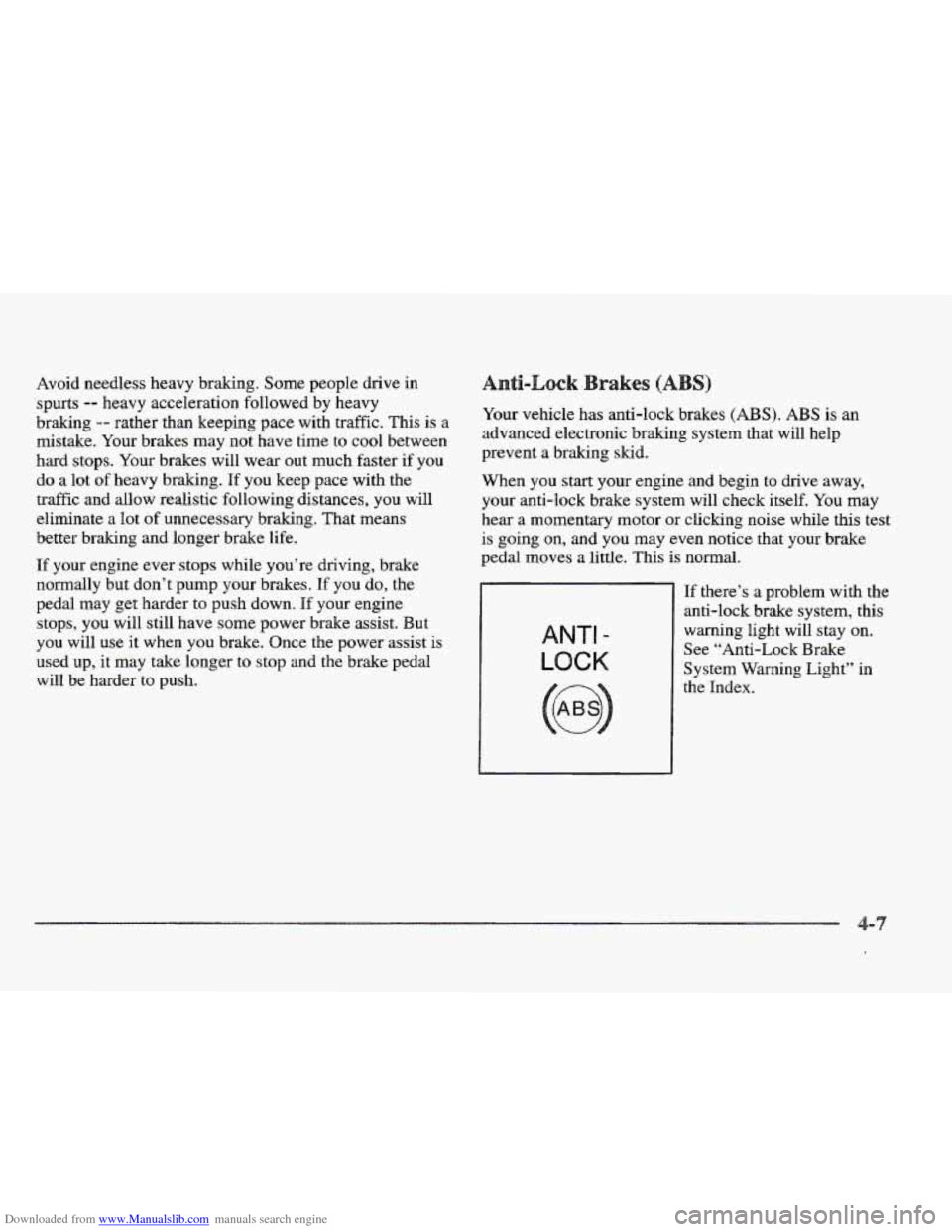
ANTI -
LOCK
If there’s a problem with the
anti-lock brake system, this
warning light will stay on.
See “Anti-Lock Brake
System Warning Light” in
Page 194 of 361
Downloaded from www.Manualslib.com manuals search engine Remember: Anti-lock doesn’t change the time you need
to get your foot up to the brake pedal
or always decrease
stopping distance. If you get too close to the vehicle
in
front of you, you won’t have time to apply your brakes
if that vehicle suddenly slows or stops. Always leave
enough room up ahead
to stop, even though YOU have
anti-lock brakes.
using Anti-Lock
Don’t pump the brakes. Just hold the brake pedal down
and
let anti-lock work for YOU. You may hear the
anti-lock pump or motor operate, and feel
the brake
pedal pulsate, but this is normal.
Your vehicle has a traction control system that limits wheel
spin.
This is especially useful in slippery road conditions.
The system operates only
if it senses that one or both of
the front wheels are spinning or beginning to lose traction.
When
this happens, the system works the front brakes and
reduces engine power to limit wheel spin.
The TRACTION
ENGAGED message will display on
the Driver Information Center when the traction control
system is limiting wheel spin. See “Driver Information
Center Messages”
in the Index. You may feel or hear the
system working, but this is normal.
If your vehicle is in cruise control when the traction
control system begins to limit wheel spin, the cruise
control will automatically disengage. When road
Conditions allow you
to safely use it again, you may
re-engage the cruise control. (See “Cruise Control” in
the Index.)
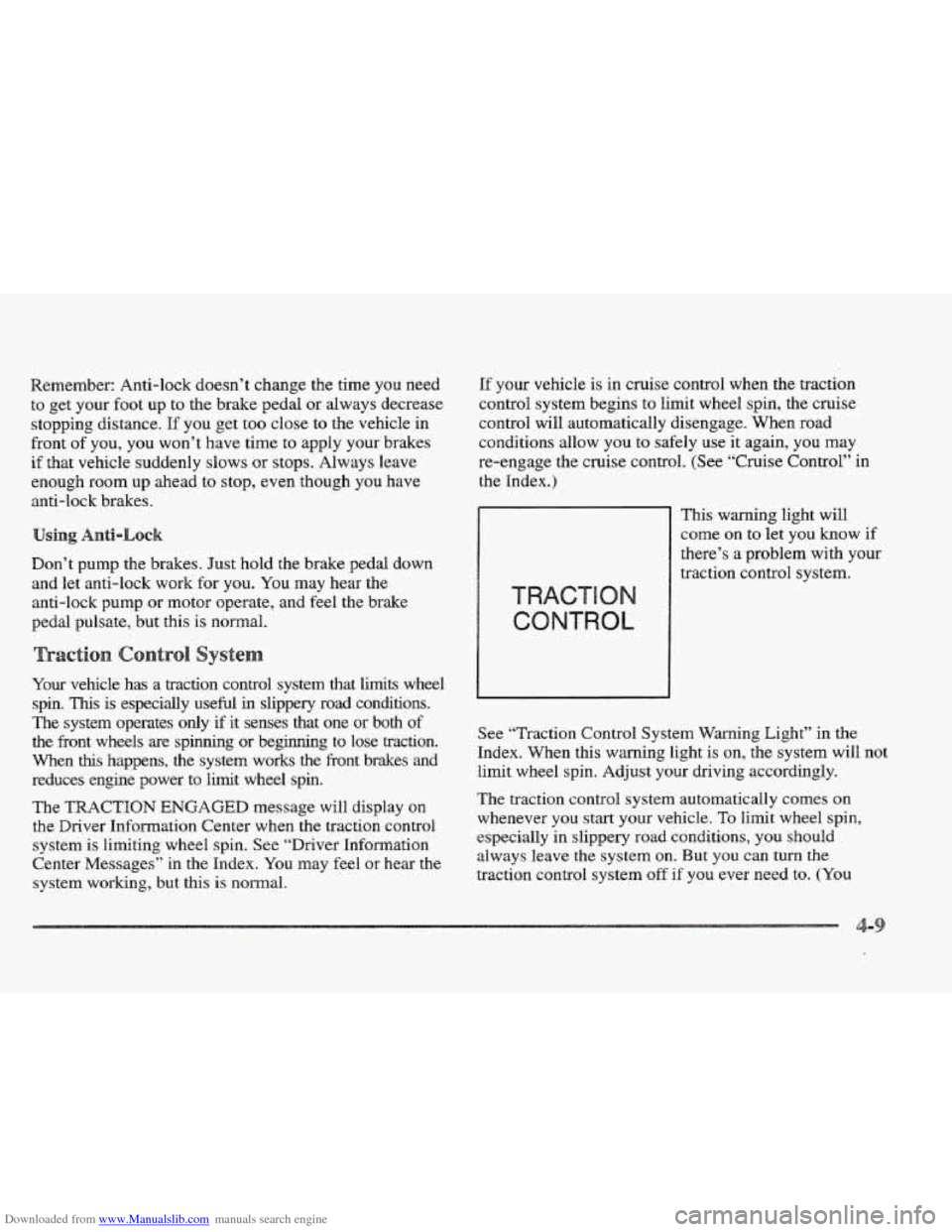
This warning light will
come
on to let you know if
there’s a problem with your
traction control system.
See “Traction Control System Warning Light” in the
Index. When this
warning light is on, the system will not
limit wheel
spin. Adjust your driving accordingly.
The traction control system automatically comes on
whenever you start your vehicle.
To liHnit wheel spin,
especially in slippery
road conditions, you should
always leave
the system on. But you can turn the
traction control system
off if you ever need to. (You
Page 204 of 361
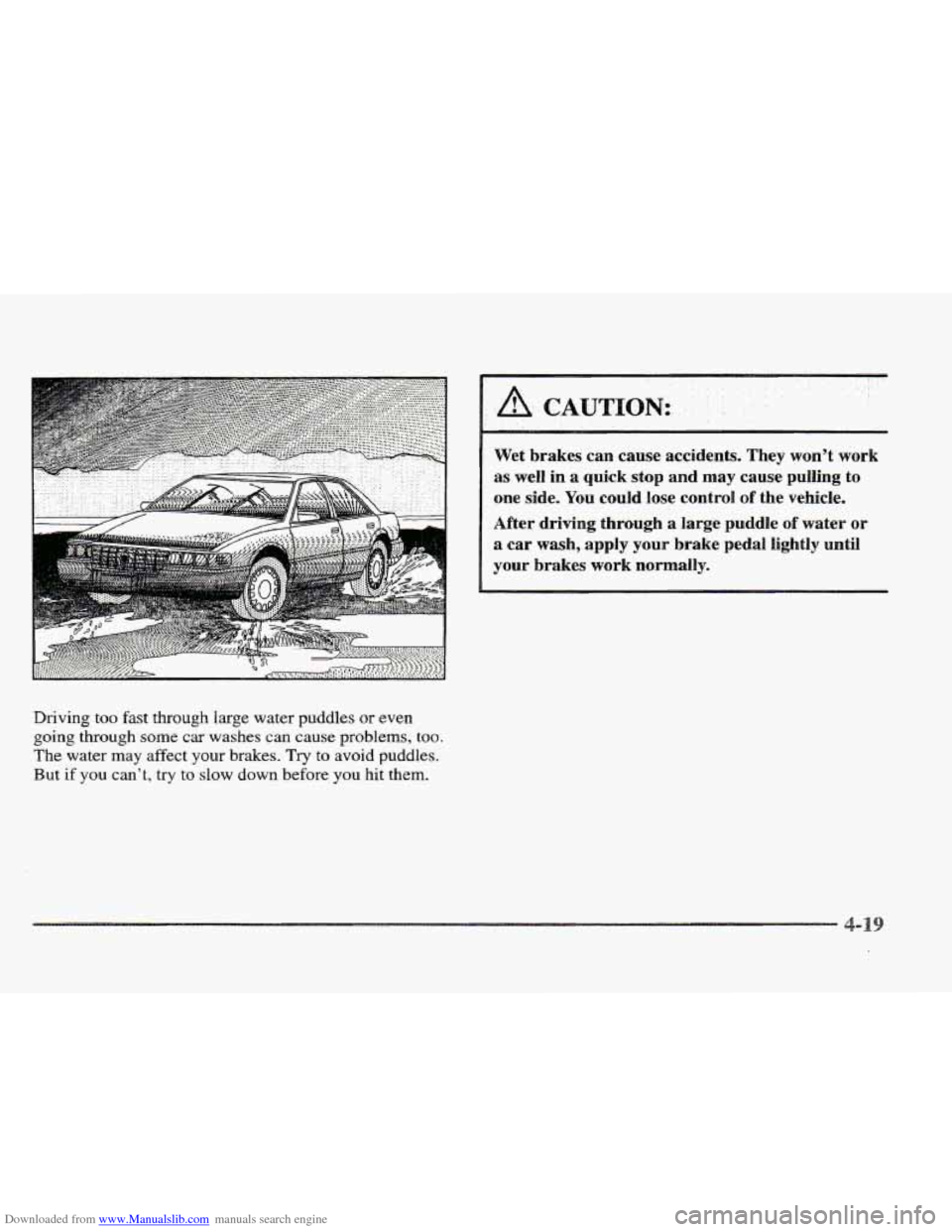
Downloaded from www.Manualslib.com manuals search engine Driving too fast through large water puddles or even
going through some car washes can cause problems, too.
The water may affect your brakes. Try to avoid puddles.
But if you can't, try to slow down before you hit them.
,A CAUTION: .' '
..
..
.. ..
Wet brakes can cause accidents. They won't work
as well in a quick stop and may cause pulling to
one side. You could lose control of the vehicle.
After driving through a large puddle of water or
a car wash, apply your brake pedal lightly until
your brakes
work normally.
Page 290 of 361

Downloaded from www.Manualslib.com manuals search engine Your brake master cylinder reservoir is here. It is filled
with
DOT-3 brake fluid.
There are only two reasons why the brake fluid level
in
the reservoir might go down. The first is that the brake
fluid goes down to an acceptable level during normal
brake lining wear. When new linings are put in, the fluid
level goes back up. The other reason
is that fluid is
leakng out of the brake system. If it is, you should have
your brake system fixed, since a leak means that sooner
or later your brakes won’t work well, 01- w~n’t work
at all.
so, it isn’t a good idea to “top off’ your brake fluid.
Adding brake fluid won’t correct a leak.
If you add fluid
when your linings are
worn, then you’ll have too much
fluid when you
get new brake linings. YOU should add
(or remove) brake fluid, as necessary, only when work is
done
on the brake hydraulic system.
When your brake fluid
falls to a low level, your brake
warning light will come on. See “Brake System Warning
Light” in the Index.
Page 292 of 361
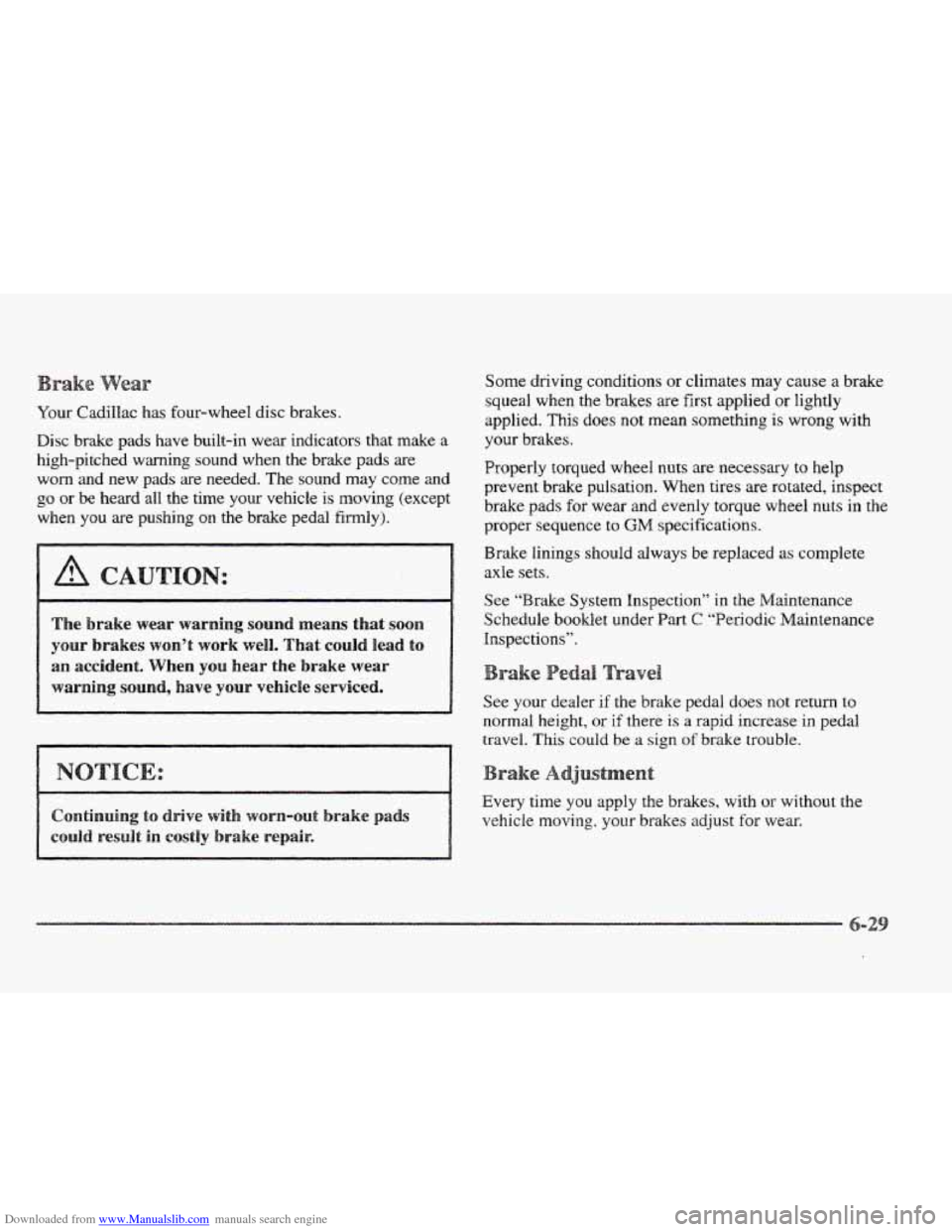
Downloaded from www.Manualslib.com manuals search engine Your Cadillac has four-wheel disc brakes.
Disc brake pads have built-in wear indicators that make a
high-pitched warning sound when the brake pads
are
worn and new pads are needed. The sound may come and
go or be heard all the time your vehicle is moving (except
when you are pushing on the brake pedal firmly).
The brake wear warning sound means that soon
your brakes won9$ work well. That could lead to
an accident. When you hear the brake wear
warning sound, have your vehicle serviced.
Some driving conditions or climates may cause a brake
squeal when the brakes are first applied or lightly
applied. This does
not mean something is wrong with
your brakes.
Properly torqued
wheel nuts are necessary to help
prevent brake pulsation. When tires are rotated, inspect
brake pads for wear and evenly torque wheel
nuts in the
proper sequence to GM specifications.
Brake linings should always be replaced
as complete
axle
sets.
See “Brake System Inspection” in the Maintenance
Schedule booklet under Part
C “Periodic Maintenance
Inspections”.
See your dealer
if the brake pedal does not return to
normal height, or if there is a rapid increase in pedal
travel. This could be a sign of brake trouble.
Every time you apply the brakes, with or without the
vehicle
moving, your brakes adjust for wear.
Page 320 of 361
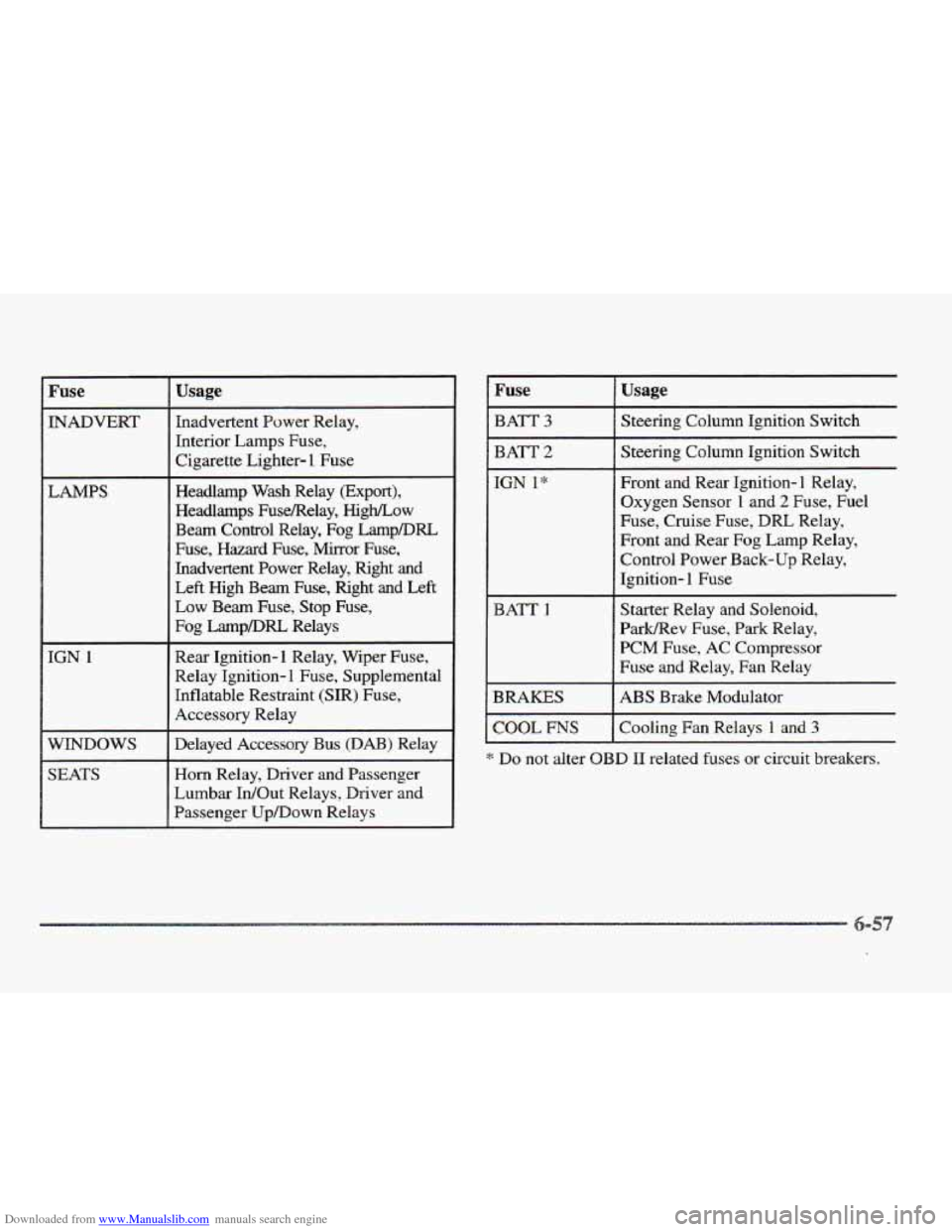
Downloaded from www.Manualslib.com manuals search engine Fuse
INADVERT
LAMPS
____~
IGN 1
WINDOWS
SEATS
Usage
Inadvertent Power Relay,
Interior Lamps
Fuse,
Cigarette Lighter- 1 Fuse
Headlamp Wash Relay (Export),
Headlamps FuseRelay,
High/Low
Beam Control Relay, Fog LampDRL
Fuse, Hazard Fuse, Mirror Fuse,
Inadvertent Power Relay, Right
and
Left High Beam Fuse, Right and Left
Low Beam Fuse, Stop Fuse,
Fog LampDRL Relays
Rear Ignition-1 Relay, Wiper Fuse,
Relay Ignition-
1 Fuse, Supplemental
Inflatable Restraint (SIR) Fuse,
Accessory Relay
Delayed Accessory Bus
(DAB) Relay
Horn Relay, Driver and Passenger
Lumbar IdOut Relays, Driver and
Passenger Up/Down Relays
I Fuse
I BATT 3
I BATT 2
I COOL ms
Usage
Steering Column Ignition Switch
Steering Column Ignition Switch
Front and Rear Ignition- 1 Relay,
Oxygen Sensor
1 and 2 Fuse, Fuel
Fuse, Cruise
Fuse, DRL Relay,
Front and
Rear Fog Lamp Relay,
Control Power Back-up Relay,
Ignition-
1 Fuse
Starter Relay and Solenoid,
Park/Rev Fuse,
Park Relay,
PCM Fuse,
AC Compressor
Fuse and Relay, Fan Relay
ABS Brake Modulator
Cooling Fan Relays
1 and 3
* Do not alter OBD I1 related fuses or circuit breakers.
Page 346 of 361
Downloaded from www.Manualslib.com manuals search engine ..........
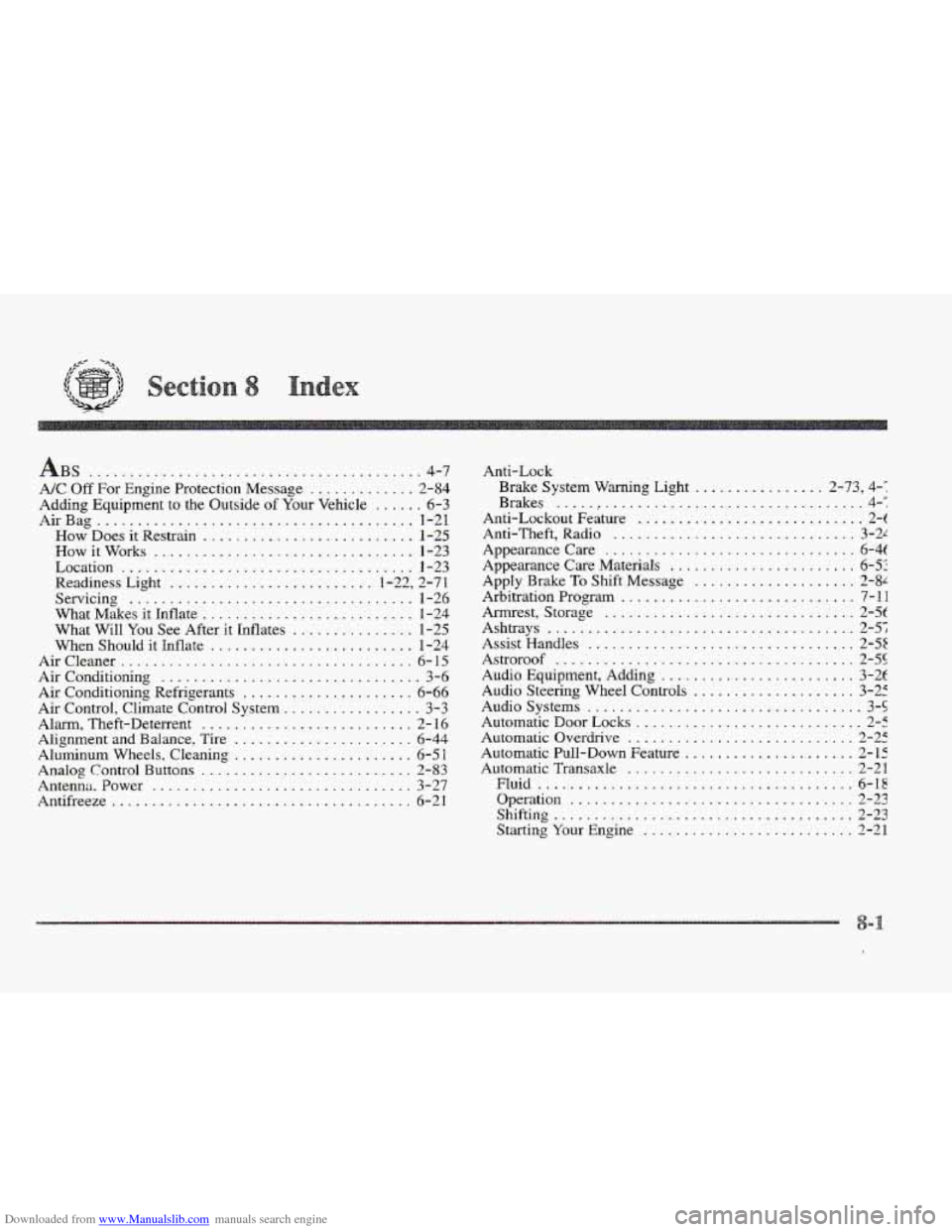
BS ......................................... 4-7
AK Off For Engine Protection Message ............. 2-84
Adding Equipment to the Outside
of Your Vehicle ...... 6-3
AirBag ....................................... 1-21
How Does it Restrain .......................... 1-25
How it Works ................................ 1-23
Location .................................... 1-23
Readiness Light
......................... 1.22. 2.71
Servicing
................................... 1-26
What Makes it Inflate
.......................... 1-24
What Will
You See After it Inflates ............... 1-25
When Should it Inflate
......................... 1-24
AirCIeaner
.................................... 6-15
Air Conditioning ................................ 3-6
Air Conditioning Refrigerants
..................... 6-66
Air Control, Climate Control System ................. 3-3
Alarm. Theft-Deterrent
.......................... 2- 16
Aluminum Wheels. Cleaning ...................... 6-51
Analog Control Buttons .......................... 2-83
Antenna . Power ................................ 3-27
Antifreeze
..................................... 6-21
Alignment and Balance.
Tire ...................... 6-44
Anti-Lock
Brake System Warning Light
................ 2.73. 4..
Brakes .....,................................ 4-:
Anti-Lockout Feature ............................ 2-t
Anti-Theft, Radio .............................. 3-21
Appearance Care ............................... 6-4t
Appearance Care Materials
....................... 6-5:
Apply Brake
To Shift Message .................... 2-8'
Arbitration Program ............................. 7-11
Arrnrest, Storage
............................... 2-5t
Ashtrays ...................................... 2-5;
Assist Handles ................................. 2-55
Astroroof ..................................... 2-55
Audio Equipment, Adding ........................ 3-2f
Audio Steering Wheel Controls
.................... 3-25
Audio Systems
.................................. 3-5
Automatic Door Locks
............................ 2-5
Automatic Overdrive ............................ 2-25
Automatic Pull-Down Feature
..................... 2-15
Automatic Transaxle ............................ 2-21
Fluid
....................................... 6-18
Shiftin ,o ..................................... 2-23
Starting Your Engine
.......................... 2-21
Operation
................................... 2-23