1997 BUICK REGAL fuse
[x] Cancel search: fusePage 14 of 422
Vehicle Symbols
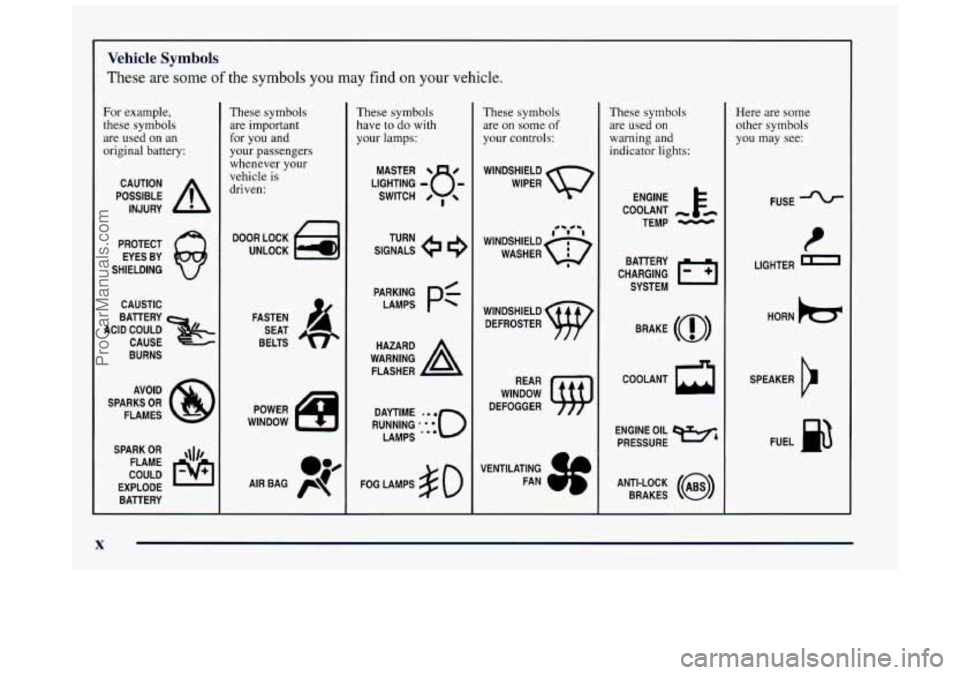
These are some of the symbols you may find on your vehicle.
For example,
these symbols
are used on an
original battery:
POSSIBLE A
CAUTION
INJURY
PROTECT EYES BY
SHIELDING
CAUSTIC
ACID COULD BAllERY
CAUSE
BURNS
SPARK
OR ,111,
COULD FLAME
EXPLODE BAllERY
These symbols are important
for you and
your passengers
whenever your
vehicle is
driven:
DOOR LOCK
UNLOCK
FASTEN SEAT
BELTS
These symbols
have to do with
your lamps:
SIGNALS @ e
TURN
These symbols
are
on some of
your controls:
WINDSHIELD
WIPER
WINDSHIELD DEFROSTER
WINDOW
DEFOGGER
These symbols
are used on
warning and
indicator lights:
COOLANT -
TEMP -
CHARGING I-1
BAllERY
SYSTEM
BRAKE
(0)
COOLANT a
ENGINE OIL w,
PRESSURE
ANTI-LOCK
(@)
BRAKES
Here are some
other symbols
you may see:
FUSE
I
LIGHTER n
HORN )tr
SPEAKER
b
FUEL p3
ProCarManuals.com
Page 16 of 422
Seats and Seat Controls
This section tells you how to adjust the seats and
explains
the reclining seatbacks and head restraints.
Manual Front Seat
You can lose control of the vehicle if you try to
adjust a manual driver’s seat while the vehicle is
moving. The sudden movement could startle and
confuse you,
or make you push a pedal when you
don’t want to. Adjust the driver’s seat only when
the vehicle is not moving. 2-Way
Manual Seat
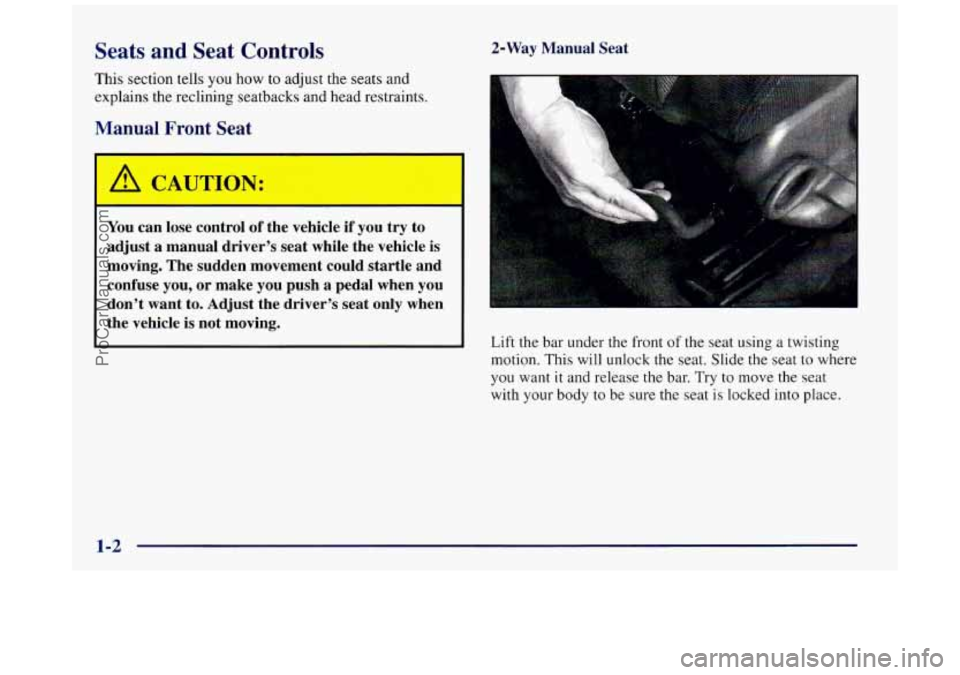
Lift the bar under the front of the seat using a twisting
motion. This will unlock the seat. Slide the seat to where
you want
it and release the bar. Try to move the seat
with your body to be sure the seat is locked into place.
1-2
ProCarManuals.com
Page 93 of 422
PASS-Key@ I1
Your vehicle is equipped
with the PASS-Key
I1
(Personalized Automotive
Security System)
theft-deterrent system.
PASS-Key
TI is a passive
theft-deterrent system.
It works when you insert
or remove the key from
the ignition.
PASS-Key
I1 uses a resistor pellet in the ignition key
that matches a decoder in your vehicle.
When
the PASS-Key I1 system senses that someone is
using the wrong key, it shuts down the vehicle’s starter an\
d
fuel systems. For about three minutes, the starter won’t
work and fuel won’t go to the engine.
If someone tries to
start your vehicle again or uses another key during this
time, the vehicle will
not start. This discourages someone
from randomly trying different keys with different resistor
pellets in an attempt to make a match.
The ignition key must be clean and
dry before it’s inserted
in the ignition or the engine may not start. If the engine does
not start and the
SECURITY light is flashing, the key
may be dirty or wet. Turn
the ignition off.
Clean and dry the key. Wait about three minutes and try
again.
If the starter still won’t work, and the key appears
to be clean and dry, wait about three minutes and try
another ignition key. At this time, you may also want to
check the fuse (see “Fuses and Circuit Breakers” in the
Index). If
the starter won’t work with the other key, your
vehicle needs service.
If your vehicle does start, the first
ignition key may be faulty. See your Buick dealer or a
locksmith who can service the PASS-Key
11.
If you accidentally use a key that has a damaged or
missing resistor pellet, the starter won’t work and the
SECURITY light will come on. But you don’t have to
wait three minutes before trying another ignition key.
See your Buick dealer or a locksmith who can service
the PASS-Key I1 to have a new key made.
If you’re ever driving and the SECURITY light comes on,
you will be able to restart your engine if you turn it off.
Your PASS-Key
I1 system, however, is not working
properly and must be serviced by your Buick dealer. Your
vehicle is not protected by the PASS-Key
I1 system.
If you lose or damage a PASS-Key IT ignition key, see
your Buick dealer or
a locksmith who can service the
PASS-Key
I1 to have a new key made.
2-17
-
ProCarManuals.com
Page 112 of 422
As you signal a turn or a lane change, if the arrow
flashes faster than normal, a signal bulb may be
burned out and other drivers won’t see your turn signal.
If a bulb is burned out, replace it to
help avoid an
accident. If the arrows don’t go on at all when you
signal a turn, check for burned-out bulbs and then check
the fuse (see “Fuses and Circuit Breakers” in the Index).
A chime will sound if you leave your turn signal on for
more than
3/4 mile (1.2 km).
Headlamp HigWLow Beam
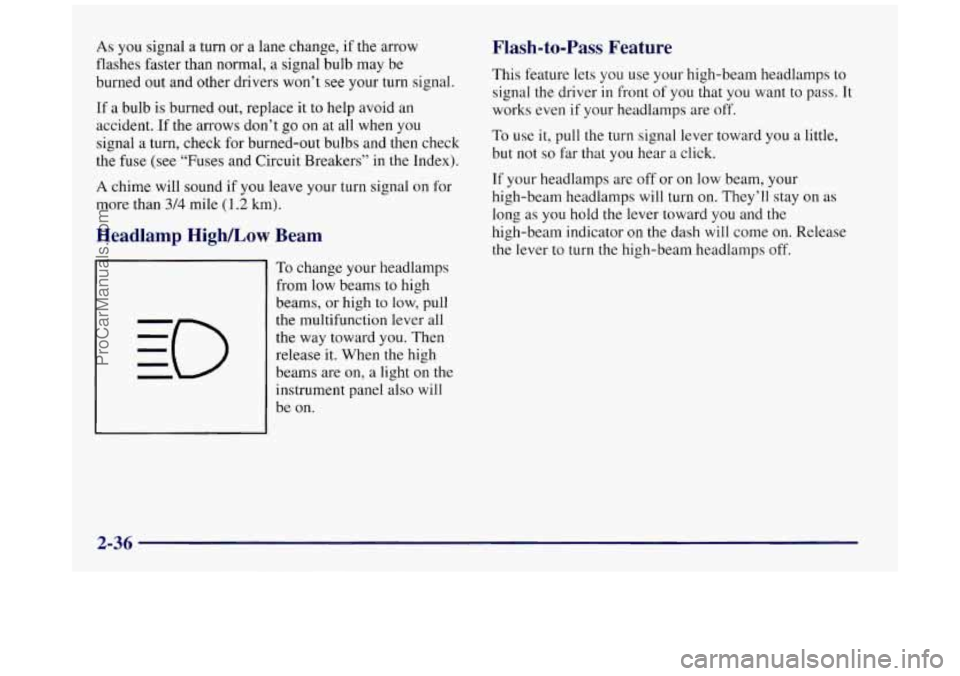
To change your headlamps
from low beams to high
beams, or high to low, pull
the multifunction lever all
the way toward you. Then
release it. When the high
beams are on, a light on the
instrument panel also will
be on.
Flash-to-Pass Feature
This feature lets you use your high-beam headlamps to
signal
the driver in front of you that you want to pass. It
works even if your headlamps are off.
To use it, pull the turn signal lever toward you a little,
but not
so far that you hear a click.
If your headlamps are off or on low beam, your
high-beam headlamps will turn
on. They’ll stay on as
long as
you hold the lever toward you and the
high-beam indicator on the dash will come on. Release
the lever to turn
the high-beam headlamps off.
2-36
ProCarManuals.com
Page 129 of 422
NOTICE:
Adding some electrical equipment to your vehicle
can damage it
or keep other things from working
as they should. This wouldn’t be covered by your
warranty. Check with your dealer before adding
electrical equipment and never use anything that
exceeds the fuse rating.
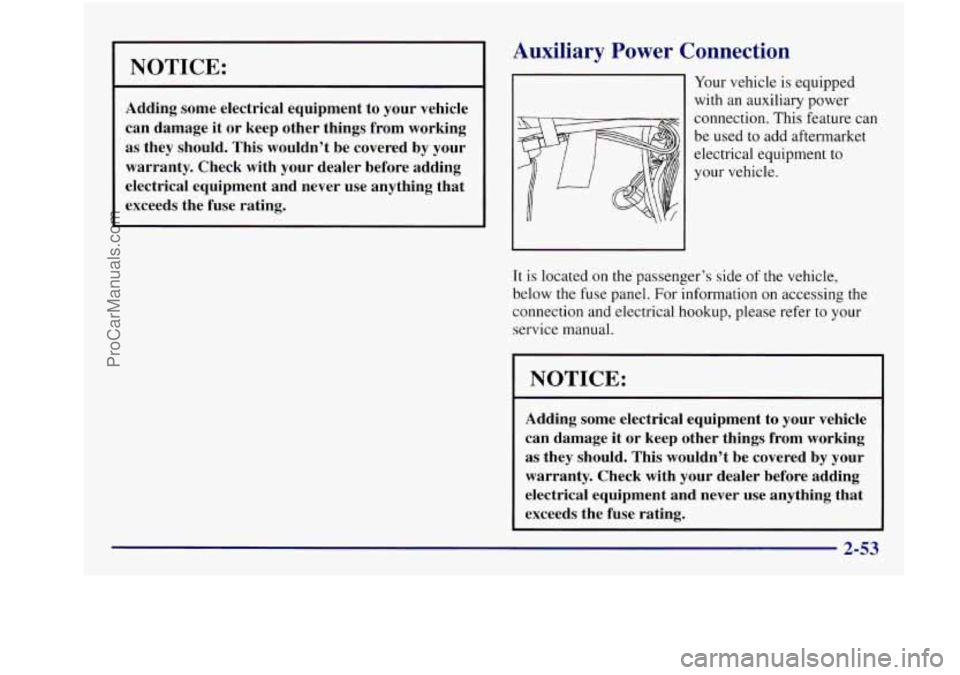
Auxiliary Power Connection
Your vehicle is equipped
with an auxiliary power
connection. This feature can
be used
to add aftermarket
electrical equipment to your vehicle.
It is located on the passenger’s side
of the vehicle,
below the fuse panel.
For information on accessing the
connection and electrical hookup, please refer to your
service manual.
I NOTICE:
Adding some electrical equipment to your vehicle
can damage it or keep other things from working
as they should. This wouldn’t be covered by your
warranty. Check with your dealer before adding
electrical equipment and never use anything that
exceeds the fuse rating.
2-53
ProCarManuals.com
Page 143 of 422

Tire Pressure Monitor Light
LOW
TI RE
The tire pressure monitor
system can alert you to
a
large change in the pressure
in
one tire. The system
won’t alert you before you
drive that a tire is low or
flat. Each time you start
your Buick, you must drive
10 to
20 miles (15 to 30 km)
before the system will
work properly.
After you’ve driven
10 to 20 miles (15 to 30 km), the
LOW TIRE light will come on if the pressure in one tire
becomes at least 10 psi
(69 kPa) higher or lower than the
other three tires. The tire pressure monitor system
detects differences in tire rotation speeds that are caused
by changes in tire pressure. It will not alert you
if the
pressure in more than one tire is low or high or
if the
system is not calibrated properly.
The system can alert
you about a low tire
-- but it doesn’t measure tire
pressure, and it doesn’t replace normal tire maintenance.
See “Tires’’
in the Index.
When the LOW TIRE light comes
on, you should stop
as soon as you can and check all your tires for damage. (If
a tire
is flat, see “If a Tire Goes Flat” in the Index.)
Also, check the tire pressure in all four tires as soon
as
you can. (See “Inflation - Tire Pressure” in the Index.)
The
LOW TIRE light will
stay on until you turn off
the ignition or press the red
RESET button, which is
located inside your
instrument panel fuse block.
(It’s the first button in
the
top row of the fuse block.)
Don’t press the RESET button without first checking
and adjusting the pressure in all four tires.
If you press
the button when the tire pressure is incorrect,
the check
tire pressure system will not work properly
and may
not alert you when a tire is low.
Any time
you adjust the tire pressure, you’ll need to
calibrate the check tire pressure system.
You’ll also neea
to calibrate the system whenever you buy new tires,
have tires repaired or rotate your tires.
ProCarManuals.com
Page 148 of 422
The oil light could also come on in the following situations:
The light will come on briefly when you turn on the
ignition to show you that it is working properly.
(If it
doesn’t come on with the ignition on, you may have
a
problem with the fuse or bulb. Have it fixed right away.)
0 Sometimes when the engine is idling at a stop, the
light may blink on and
off. This is normal.
Don’t keep driving if the oil pressure is low. If
you do, your engine can become so hot that it
catches fire. You
or others could be burned.
Check your oil as soon as possible and have
your vehicle serviced.
NOTICE:
Damage to your engine from neglected oil problems can be costly and is not covered by
your warranty.
Low Oil Level Light
LOW
OIL
Your engine is equipped with
an oil level monitoring
system. When
the ignition
key is turned on, the
LOW
OIL light will come on
briefly.
If the light does not
come on briefly, have it fixed
so it will be ready to warn
you if there’s a problem.
If the light stays on, stop the vehicle on a level surface
and turn the engine
off. Check the oil level using the
engine oil dipstick. (See “Engine Oil” in the Index.)
If
the light does not flash, have the low oil level sensor
system repaired
so it will be ready to warn you if there’s
a problem.
The oil level monitoring system only checks oil level
during the brief period between key
on and engine
crank. It does not monitor engine oil level when the
engine is running. Additionally, an oil level check is
only performed if
the engine has been turned off for a
considerable period of time, allowing the oil normally in
circulation to drain back into the oil pan.
2-72
ProCarManuals.com
Page 278 of 422
Service
Your Buick dealer knows your vehicle best and wants
you to be happy with it.
We hope you’ll go to your
dealer for all your service needs. You’ll get genuine GM
parts and GM-trained and supported service people.
We hope you’ll want
to keep your GM vehicle all GM.
Genuine GM parts have one
of these marks:
Doing Your Own Service Work
If you want to do some of your own service work, you’ll
want to use the proper Buick Service Manual. It tells
you much more about how
to service your Buick than
this manual can.
To order the proper service manual, see
“Service and Owner Publications’’ in the Index.
Your vehicle has an air bag system. Before attempting to
do your own service work, see “Servicing Your
Air
Bag-Equipped Buick” in the Index. You
should keep a record with
all parts receipts and list
the mileage and the date
of any service work you
perform. See “Maintenance Record” in the Index.
r I
I
A CAUl ON:
-
You can be injured and your vehicle could be
damaged
if you try to do service work on a
vehicle without knowing enough about it.
Be sure you have sufficient knowledge,
experience, the proper replacement parts
and tools before you attempt any vehicle
maintenance task.
Be sure to use the proper nuts, bolts and
other fasteners. “English” and “metric”
fasteners can be easily confused.
If you use
the wrong fasteners, parts can later break
or fall
off. You could be hurt.
I
6-2
ProCarManuals.com