1997 BUICK REGAL change wheel
[x] Cancel search: change wheelPage 245 of 422
Towing Your Vehicle
Try to have a Buick dealer or a professional towing
service tow your vehicle.
If your vehicle has been changed or modified since it
was factory-new by adding aftermarket items like fog
lamps, aero skirting, or special tires and wheels, these
instructions and illustrations may not be correct.
Before
you do anything, turn on the hazard
warning flashers.
When you call, tell the towing service:
That your vehicle cannot be towed from the front or
rear with sling-type equipment.
0 That your vehicle has front-wheel drive.
The make, model and year of your vehicle.
Whether you can still move the shift lever.
If there was an accident, what was damaged.
When the towing service arrives, let the tow operator
know that this manual contains detailed towing
instructions and illustrations.
The operator may want to
see them.
To help avoid injury to you or others:
Never let passengers ride in a vehicle that is
Never tow faster than safe or posted speeds.
Never tow with damaged parts not
fully secured.
Never get under your vehicle after it has
been lifted by the tow truck.
Always secure the vehicle on each side with
separate safety chains when towing it.
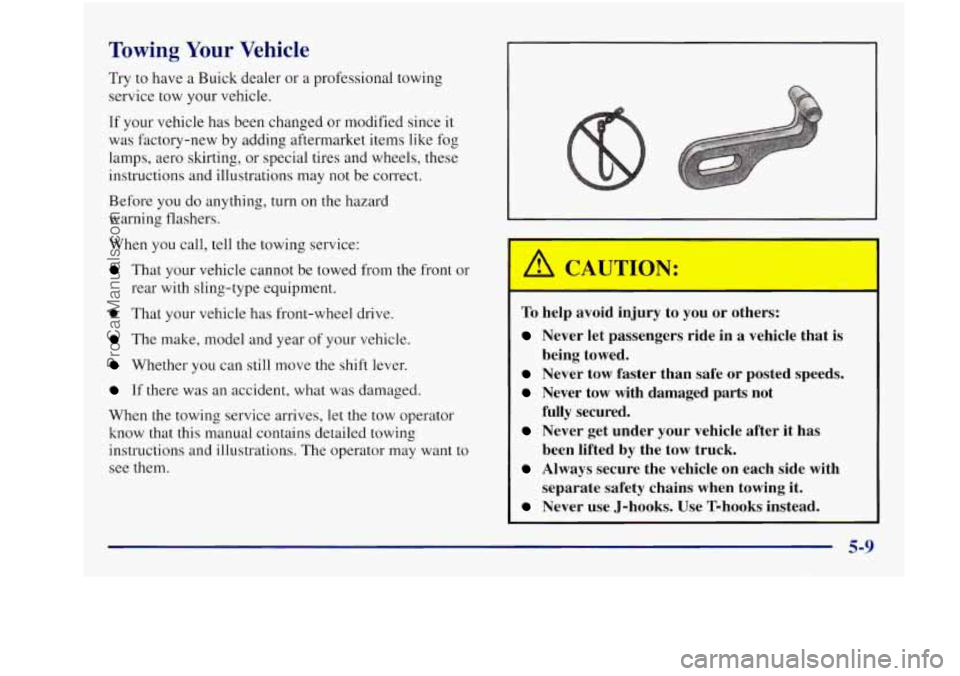
Never use J-hooks. Use T-hooks instead.
being
towed.
ProCarManuals.com
Page 261 of 422
If a Tire Goes Flat
It’s unusual for a tire to “blow out” while you’re driving,
especially
if you maintain your tires properly. If air goes
out of a tire, it’s much more likely to leak out slowly.
But if you should ever have a “blowout,’’ here are
a few
tips about what to expect and what to do:
If a front tire fails, the flat tire will create a drag that
pulls the vehicle toward that side. Take your foot off the
accelerator pedal and grip the steering wheel firmly.
Steer to maintain lane position, and then gently brake to
a stop well out
of the traffic lane.
A rear blowout, particularly on a curve, acts much like a
skid and may require the same correction you’d use
in a
skid. In any rear blowout, remove your foot from the
accelerator pedal. Get the vehicle under control by
steering the way you want the vehicle to go. It may be
very bumpy and noisy, but you can still steer. Gently
brake
to a stop -- well off the road if possible.
If
a tire goes flat, the next part shows how to use your
jacking equipment to change
a flat tire safely.
Changing a Flat Tire
If a tire goes flat, avoid further tire and wheel damage
by driving slowly to a level place. Turn on your hazard
warning flashers.
I
Changing a tire can cause an injury. The vehicle
can slip off the jack and roll over you or other
people. You and they could be badly injured.
Find
a level place to change your tire. To help
prevent the vehicle from moving:
1. Set the parking brake firmly.
2. Put the shift lever in PARK (P).
3. Turn off the engine.
To be even more certain the vehicle won’t move,
you can put blocks at the front and rear
of the
tire farthest
away from the one being changed.
That would be the tire on the other side of the
vehicle,
at the opposite end.
ProCarManuals.com
Page 268 of 422
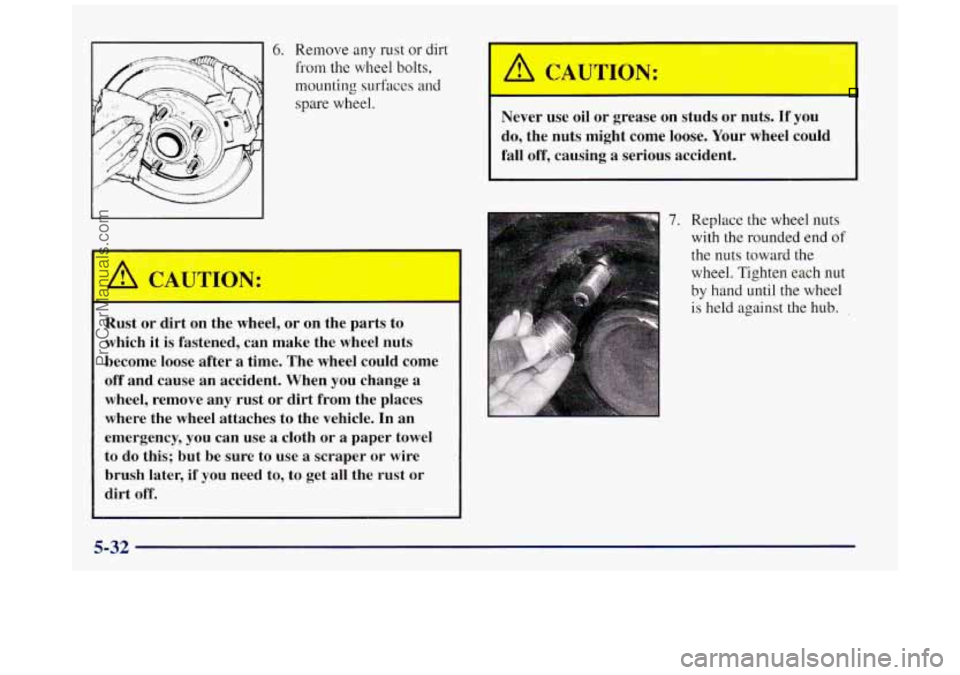
6. Remove any rust or dirt
from the wheel bolts,
mounting surfaces and
spare wheel.
Rust or dirt on the wheel, or on the parts to
which it is fastened, can make the wheel nuts
become loose after
a time. The wheel could come
off and cause an accident. When you change a
wheel, remove any rust or dirt from the places
where the wheel attaches to the vehicle. In an
emergency, you can use
a cloth or a paper towel
to do this; but be sure to use a scraper or wire brush later,
if you need to, to get all the rust or
dirt off.
Never use oil or grease on studs or nuts. If you
do, the nuts might come loose. Your wheel could
fall off, causing a serious accident.
7. Replace the wheel nuts
with the rounded end
of
the nuts toward the
wheel. Tighten each
nut
by hand until the wheel
is held against the hub. ,
5-32
ProCarManuals.com
Page 307 of 422
Some driving conditions or climates may cause a
brake squeal when the brakes are first applied or lightly
applied. This does
not mean something is wrong with
your brakes.
Properly torqued wheel nuts are necessary to help
prevent brake pulsation. When tires are rotated, inspect
brake pads for wear and evenly torque wheel nuts
in
the proper sequence to GM specifications.
Brake linings should always be replaced as complete
axle sets.
See “Brake System Inspection” in Section
7 of this
manual under Part
C “Periodic Maintenance
Inspections.”
Brake Pedal Travel
See your dealer if the brake pedal does not return to
normal height, or if there is a rapid increase
in pedal
travel. This could be a sign of brake trouble.
Brake Adjustment
Every time you apply the brakes, with or without the
vehicle moving, your brakes adjust for wear.
Replacing Brake System Parts
The braking system on a modern vehicle is complex.
Its many parts have to be of top quality and work well
together if the vehicle is to have really good braking.
Your vehicle was designed and tested with top-quality
GM brake parts. When you replace parts
of your braking
system
-- for example, when your brake linings wear
down and you have to have new ones put in
-- be sure
you get new approved GM replacement parts. If you
don’t, your brakes may no longer work properly. For
example,
if someone puts in brake linings that are wrong
for your vehicle, the balance between your front and
rear brakes can change
-- for the worse. The braking
performance you’ve come
to expect can change in many
other ways if someone puts in the wrong replacement
brake parts.
Battery
Every new Buick has a Delco Freedom@ battery. You
never have to add water to one of these. When it’s time
for a new battery, we recommend a Delco Freedom
battery. Get one that has the replacement number shown
on the original battery’s label.
~ 6-31
ProCarManuals.com
Page 318 of 422
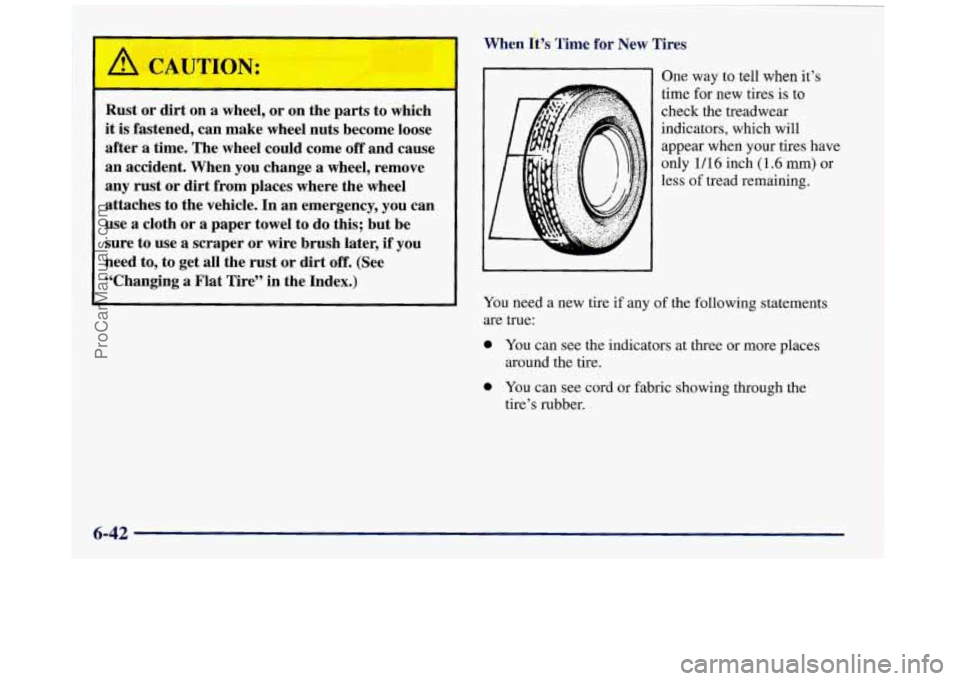
When &)s The for New Tires
Rust or dirt on a wheel, or on the parts to which
it is fastened, can make wheel nuts become loose
after a time. The wheel could come
off and cause
an accident. When you change
a wheel, remove
any rust or dirt from places where the wheel
attaches to the vehicle. In an emergency, you can
use
a cloth or a paper towel to do this; but be
sure to use a scraper or wire brush later,
if you
need to, to get all the rust or
dirt off. (See
“Changing
a Flat Tire” in the Index.)
One way to tell’when it’s
time for new tires is to
check the treadwear
indicators, which will
appear when your tires have
only 1/16 inch (1.6
mm) or
less of tread remaining.
You need a new tire if any of the following statements
are true:
0 You can see the indicators at three or more places
around the tire.
0 You can see cord or fabric showing through the
tire’s rubber.
6-42
ProCarManuals.com
Page 339 of 422
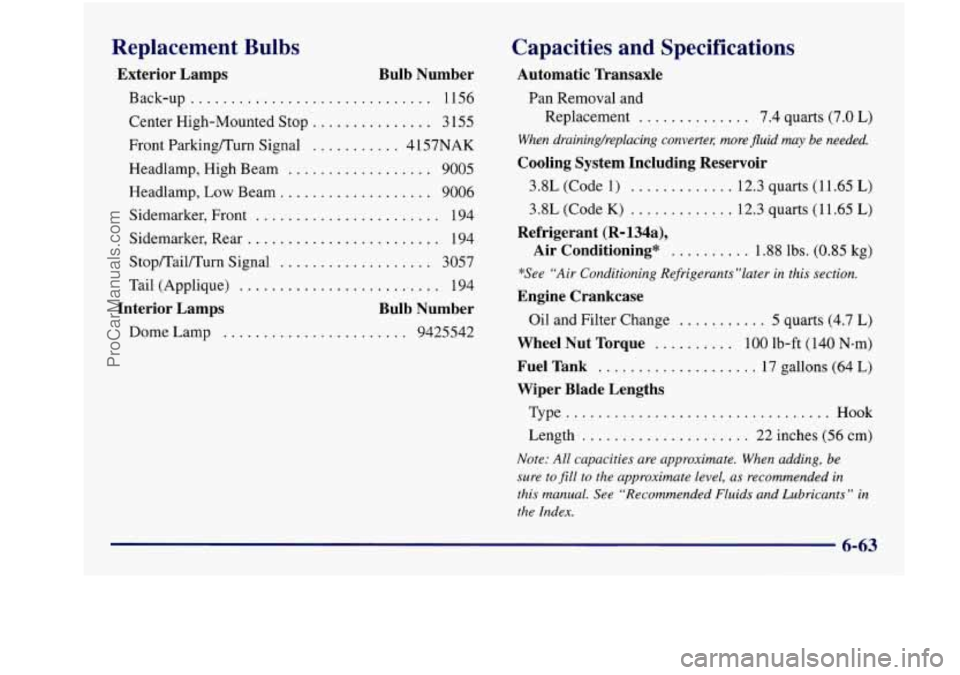
Replacement Bulbs
Exterior Lamps Bulb Number
Back-up .............................. 1156
Center High-Mounted Stop
............... 3 155
Front Parking/Turn Signal
........... 4 157NAK
Headlamp, High Beam
.................. 9005
Headlamp,
Low Beam. .................. 9006
Sidemarker, Front
....................... 194
Sidemarker, Rear
........................ 194
Stop/Tail/Turn Signal
................... 3057
Tail (Applique)
......................... 194
Interior Lamps Bulb Number
Dome Lamp ....................... 9425542
Capacities and Specifications
Automatic nansaxle
Pan Removal and
Replacement
.............. 7.4 quarts (7.0 L)
When drainingheplacing converter; more fluid my be needed.
Cooling System Including Reservoir
3.8L (Code 1) ............. 12.3 quarts (1 1.65 L)
3.8L (Code K) ............. 12.3 quarts (1 1.65 L)
Air Conditioning* .......... 1.88 lbs. (0.85 kg)
Refrigerant (R=134a),
*See “Air Conditioning Refrigerants”1ater in this section.
Engine Crankcase
Oil and Filter Change ........... 5 quarts (4.7 L)
Wheel Nut Torque .......... 100 lb-ft (140 N-m)
Fuel Tank .................... 17 gallons (64 L)
Wiper Blade Lengths
Type ................................. Hook
Length ..................... 22 inches (56 cm)
Note: All capacities are approximate. When adding, be
sure to
fill to the approximate level, as recommended in
this manual. See “Recommended Fluids and Lubricants
” in
the Index.
6-63
ProCarManuals.com
Page 418 of 422
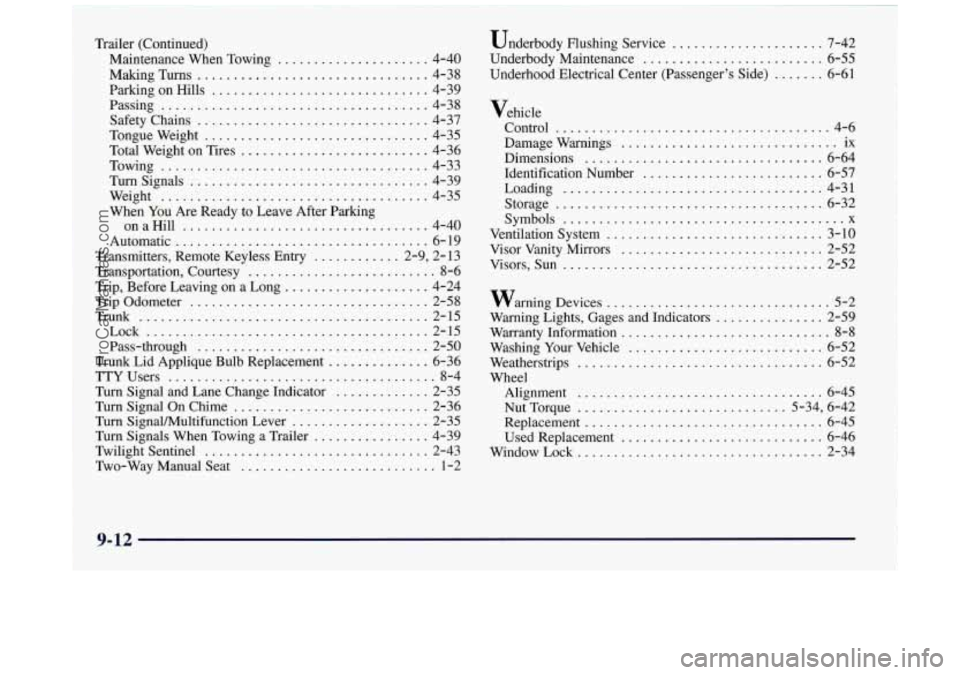
L
Trailer (Continued) Maintenance When Towing
..................... 4-40
MakingTurns
................................ 4-38
ParkingonHills
.............................. 4-39
Passing
..................................... 4-38
Tongueweight
............................... 4-35
Total Weight on Tires
.......................... 4-36
Towing
..................................... 4-33
Turn Signals ................................. 4-39
Weight
..................................... 4-35
When
You Are Ready to Leave After Parking
onaHill
.................................. 4-40
Automatic
................................... 6- 19
Transportation. Courtesy
.......................... 8-6
Trip. Before Leaving on a Long
.................... 4-24
Trip Odometer
................................. 2-58
Trunk
........................................ 2-15
Lock
....................................... 2-15
Trunk Lid Applique Bulb Replacement
.............. 6-36
TTYUsers
...................................... 8-4
Turn Signal and Lane Change Indicator
............. 2-35
Turn Signal
On Chime ........................... 2-36
Turn SignaYMultifunction Lever
................... 2-35
Turn Signals When Towing a Trailer
................ 4-39
Safety Chains
................................ 4-37
Transmitters. Remote Keyless Entry
............ 2.9. 2.13
Pass-through
................................ 2-50
llvilight Sentinel
............................... 2-43
Two-way Manual Seat
........................... 1-2 Underbody
Flushing Service
..................... 7-42
Underbody Maintenance
......................... 6-55
Underhood Electrical Center (Passenger’s Side)
....... 6-61
Vehicle Control
...................................... 4-6
Damage Warnings
.............................. ix
Dimensions
................................. 6-64
Identification Number
......................... 6-57
Storage
..................................... 6-32
Symbols
....................................... x
Ventilationsystem
.............................. 3-10
Visor Vanity Mirrors
............................ 2-52
Visors. Sun
.................................... 2-52
Loading
.................................... 4-31
warning Devices
............................... 5-2
Warning Lights. Gages and Indicators
............... 2-59
Warranty Information
............................. 8-8
Weatherstrips
.................................. 6-52
Nut Torque ............................. 5-34. 6-42
Replacement
................................. 6-45
Used Replacement
............................ 6-46
Washing
Your Vehicle ........................... 6-52
Wheel Alignment
.................................. 6-45
WindowLock
.................................. 2-34
9-12
ProCarManuals.com